
Quick Answer: Where AI Fits In A Game MVP
AI in gaming is useful when it improves one measurable player or production loop: smarter NPC behavior, adaptive difficulty, controlled dialogue, procedural content support, AI-assisted QA, fraud detection, live-ops recommendations, or faster content iteration. For a startup, the best first question is not how advanced the AI can be. The best question is which AI feature makes the first playable version more compelling without turning the MVP into a research project.
A strong AI game MVP usually ships one primary AI loop. That loop might tune bot behavior, personalize tutorials, adjust challenge, generate limited dialogue from approved lore, recommend missions, flag economy abuse, or help designers test balance faster. Tie the loop to a metric such as retention, session length, tutorial completion, match quality, player satisfaction, content throughput, QA coverage, or support workload.
The practical path is to start with a bounded feature, prove that players or developers care, instrument the outcome, then decide whether to expand the model, content system, autonomy, or live-ops automation. Use the MVP Scope Builder when a broad AI idea needs to become a release-ready feature list.
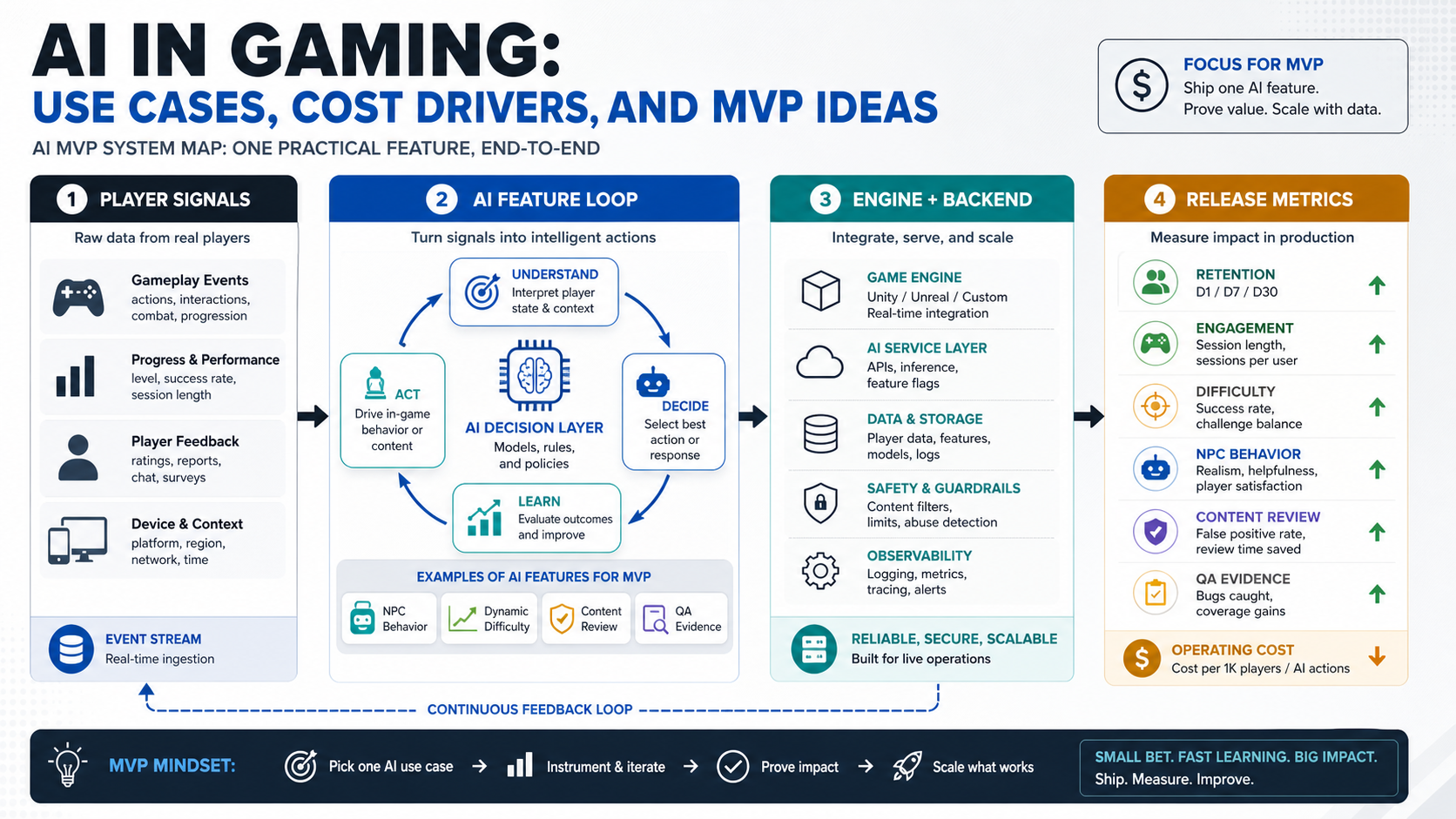
What AI In Gaming Means In Product Terms
AI in gaming is a product layer that uses player signals, game state, content rules, models, and backend services to make gameplay, production, moderation, or operations more adaptive. Some AI features are classic game AI: pathfinding, behavior trees, utility scoring, bot tactics, and procedural systems. Others use machine learning or generative AI: personalization, dynamic dialogue, synthetic QA, anti-cheat signals, player segmentation, content assistance, and game operations copilots.
For a product team, the label matters less than the job. If the feature changes moment-to-moment gameplay, it has to be fast, predictable, and testable inside the engine. If it generates text, voice, quests, or levels, it needs guardrails, moderation, and content review. If it recommends offers or predicts churn, it needs analytics, data pipelines, and experimentation. If it acts like an autonomous character or tool-using assistant, compare the concept with Generative AI vs AI Agents vs Agentic AI before overbuilding autonomy.
Current platform direction matters. Unity documents Sentis as a runtime engine for trained models inside Unity projects, while Google has published game examples using Gemma on-device and Gemini or Vertex AI in the cloud. NVIDIA ACE focuses on conversational and actionable game characters with cloud and on-device model options. Unreal Engine's Neural Network Engine gives teams a common API for model inference, but its documentation still warns teams to use beta features carefully when shipping. Those options are promising, but they do not remove the need for gameplay constraints, QA, fallback behavior, and cost monitoring.
AI In Gaming Use Cases By MVP Fit
The best first AI feature depends on game type, team size, data readiness, platform targets, and the player promise. A competitive multiplayer game has different needs than a narrative RPG, learning game, simulation, casino-style product, casual mobile title, or live-service economy.
| Use Case | What It Improves | MVP Fit | Main Risk |
|---|---|---|---|
| Adaptive difficulty | Keeps challenge aligned with player skill | High when retention depends on challenge balance | Can feel unfair if rules are hidden |
| NPC behavior tuning | Creates believable opponents and companions | High for combat, sports, racing, strategy, and training games | Requires heavy playtesting and designer control |
| Controlled dynamic dialogue | Makes characters respond to player context | Medium when narrative is the hook | Needs lore, tone, safety, latency, and moderation controls |
| Procedural content support | Creates map, mission, item, or level variants | Medium when replayability is core | Quality can become inconsistent without review |
| Player personalization | Recommends missions, tutorials, events, or offers | High for mobile and live-service games | Needs clean analytics and careful experiments |
| AI-assisted QA | Finds balance issues, crashes, and edge cases faster | High for teams with limited QA capacity | Does not replace human fun testing |
| Anti-cheat and fraud signals | Flags suspicious behavior and economy abuse | Medium to high for competitive or marketplace games | False positives can damage trust |
For most game startups, the best AI feature is not the most futuristic one. It is the feature that directly strengthens the core loop players will judge in the first session.
Which AI Features Should A Game Startup Build First?
Start with a feature that has high player value and manageable implementation complexity. Adaptive difficulty, NPC behavior tuning, tutorial personalization, controlled content variation, and AI-assisted QA often make better early bets than fully autonomous worlds or unrestricted user-generated content.
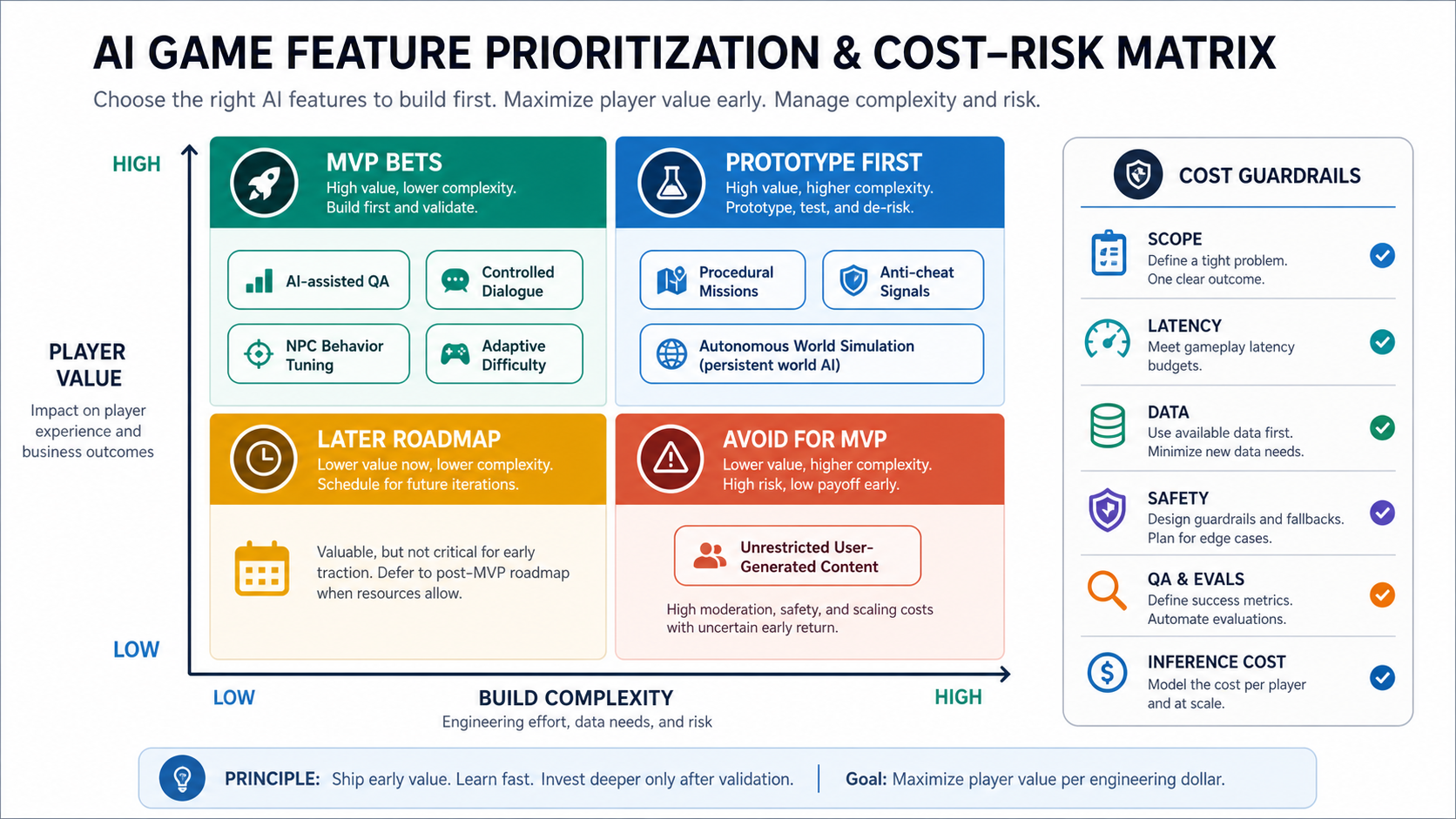
A useful prioritization rule is simple: if the feature cannot be tested with a small player group, instrumented with a measurable outcome, and explained to the design team, it probably belongs after the MVP. If the game promise depends on it, build a narrow prototype first and treat it as the highest-risk discovery work.
AI Game MVP Ideas By Product Type
Different games need different AI entry points. A few practical MVP patterns are worth considering.
- Casual mobile game: adaptive difficulty, personalized level ordering, churn-risk nudges, and AI-assisted level testing. Plan this alongside mobile app development decisions because device performance, analytics, and release cadence affect the AI loop.
- Narrative game: controlled character dialogue, quest hinting, lore retrieval, and writer-assist tools rather than unrestricted free chat.
- Strategy or simulation game: opponent behavior tuning, economy balancing, event generation, and scenario recommendations.
- Sports or racing game: bot behavior, skill matching, anti-cheat signals, and replay analysis.
- Kids or learning game: progress-aware hints, personalized learning paths, safety-first moderation, and parent or teacher analytics.
- Live-service game: matchmaking signals, event recommendations, economy anomaly detection, support triage, and personalization experiments.
Teams exploring dialogue, narration, game assistants, or lore-aware characters may need LLM development patterns such as retrieval, prompt orchestration, context limits, evaluations, safety filters, and versioned content controls.
Architecture Options For AI In Games
Most AI game features fall into four architecture patterns. The first is in-engine logic: behavior trees, utility AI, pathfinding, and deterministic rules that run close to gameplay. The second is game backend intelligence: recommendations, matchmaking signals, analytics, economy tuning, and live-ops decisions. The third is model-assisted content: generated dialogue, item descriptions, level variants, or asset metadata with designer review. The fourth is agentic or tool-using AI: characters, copilots, or operations assistants that can retrieve data, plan steps, and use tools.
The right choice depends on latency, safety, cost, and player impact. Real-time combat behavior should not depend on a slow external call. Dialogue can tolerate more latency if the experience is designed around it. Live-ops recommendations can run asynchronously. Content generation should usually pass through review before it reaches players. Tool-using assistants or autonomous NPCs should be treated as AI agent development work only when permissions, state, tools, and fallback rules are clear.
For production content and workflow systems, Generative AI development should cover orchestration, evaluations, moderation, observability, and integration. For broader feature delivery, AI development services should include gameplay constraints, backend architecture, telemetry, quality gates, and release controls.
What Drives AI Game Development Cost?
AI game development cost is driven less by the word AI and more by feature scope, integration depth, model requirements, content review, and live operations. A rules-based bot or adaptive difficulty loop can be comparatively contained. A real-time LLM-powered character with memory, moderation, voice, localization, telemetry, creator tools, and scalable inference is a very different project.
| Cost Driver | Lower-Scope Version | Higher-Scope Version |
|---|---|---|
| Feature ambition | One scoring, tuning, or recommendation loop | Open-ended generation, autonomous behavior, or persistent memory |
| Engine integration | Offline tools, backend decisions, or limited in-engine hooks | Real-time gameplay integration across Unity, Unreal, custom engine, or multiplayer services |
| Data readiness | Existing events and manual labels are enough | New telemetry, labels, data pipelines, or moderation queues are needed |
| Model approach | Rules, behavior trees, hosted API, or small local model | Fine-tuning, custom models, vector search, voice, or multi-model orchestration |
| Safety and content review | Internal tools or low-risk generated suggestions | Player-facing generation, children-focused content, or public UGC |
| Testing burden | Deterministic rules and stable output ranges | Variable outputs by player state, model version, prompt, locale, and content library |
| Operating cost | Low-frequency inference and simple monitoring | High-volume API calls, GPU inference, vector databases, observability, and cost alerts |
For directional planning, compare the AI feature with the wider build complexity in the Custom Software Cost Estimator. If the feature is meant to reduce production, QA, support, or live-ops workload, use the AI Automation ROI Calculator to test whether the value side justifies production work.
Testing And Release Evidence For AI Game Features
AI features increase testing because output can change by player state, content state, model version, prompt, network conditions, device class, and live data. Treat AI QA as release evidence, not a final checkbox.
- Gameplay tests: verify that the feature improves the core loop instead of making challenge, pacing, or fairness worse.
- Scenario tests: cover new players, expert players, edge behavior, low-connectivity sessions, failed model calls, and content gaps.
- Evaluation sets: keep representative prompts, player states, NPC goals, forbidden responses, expected fallbacks, and regression examples.
- Telemetry checks: log inputs, decisions, outputs, overrides, cost, latency, and player response without collecting unnecessary sensitive data.
- Human review: require designer, narrative, safety, or support approval when generated output can affect trust.
- Rollback controls: use feature flags, model versioning, content versioning, and safe defaults when a model or service degrades.
If the AI loop touches release confidence, balance, or regression coverage, plan it with QA automation testing from the start. The goal is not to prove that the AI works once. The goal is to prove that the game remains playable, fair, and observable when the AI changes.
Common Mistakes When Adding AI To A Game
The most common mistake is treating AI as the game concept instead of a way to strengthen the game concept. Players care about challenge, agency, fairness, surprise, progression, and fun. AI should serve those outcomes.
- Building open-ended AI before the core loop works: if the base game is weak, AI will not save it.
- Ignoring latency: model calls that feel fine in a demo may feel broken during real gameplay.
- Skipping instrumentation: without events and metrics, teams cannot tell whether AI improved retention or engagement.
- Letting generated content bypass review: lore, safety, tone, and player trust need guardrails.
- Underestimating QA: variable outputs create more states to test, not fewer.
- Optimizing only for novelty: a simpler bot, rules system, or recommendation may create more value than an expensive generative feature.
A Practical Roadmap For An AI Game Feature
- Define the player promise. Name the experience the AI feature should improve: challenge, immersion, replayability, personalization, fairness, or production speed.
- Choose one measurable loop. Pick a metric such as retention, completion, match quality, content throughput, QA time, or support load.
- Prototype the smallest version. Use rules, mock services, narrow models, or limited content before building a full platform.
- Instrument and playtest. Track inputs, decisions, outputs, overrides, player response, and failure cases.
- Add controls. Include fallback behavior, human review, moderation, model versioning, and cost monitoring.
- Scale only after evidence. Expand content, models, autonomy, or personalization once the first AI loop proves value.
For teams moving from concept to production, the strongest roadmap is narrow: one AI feature, one player or production outcome, one evaluation set, one release path, and a clear decision about what stays out of the MVP.
How NextPage Helps With AI Game MVPs
NextPage helps founders and product teams turn AI game ideas into scoped software plans. That can mean evaluating whether an AI feature belongs in the MVP, designing the game-data and backend architecture, prototyping a model-assisted feature, building an LLM-powered dialogue or assistant layer, or creating the telemetry needed to measure the result.
The strongest starting point is a focused question: which AI feature would make the game more playable, more repeatable, or faster to produce? From there, NextPage can help compare build options, define the first release, and decide what should remain a later roadmap bet.