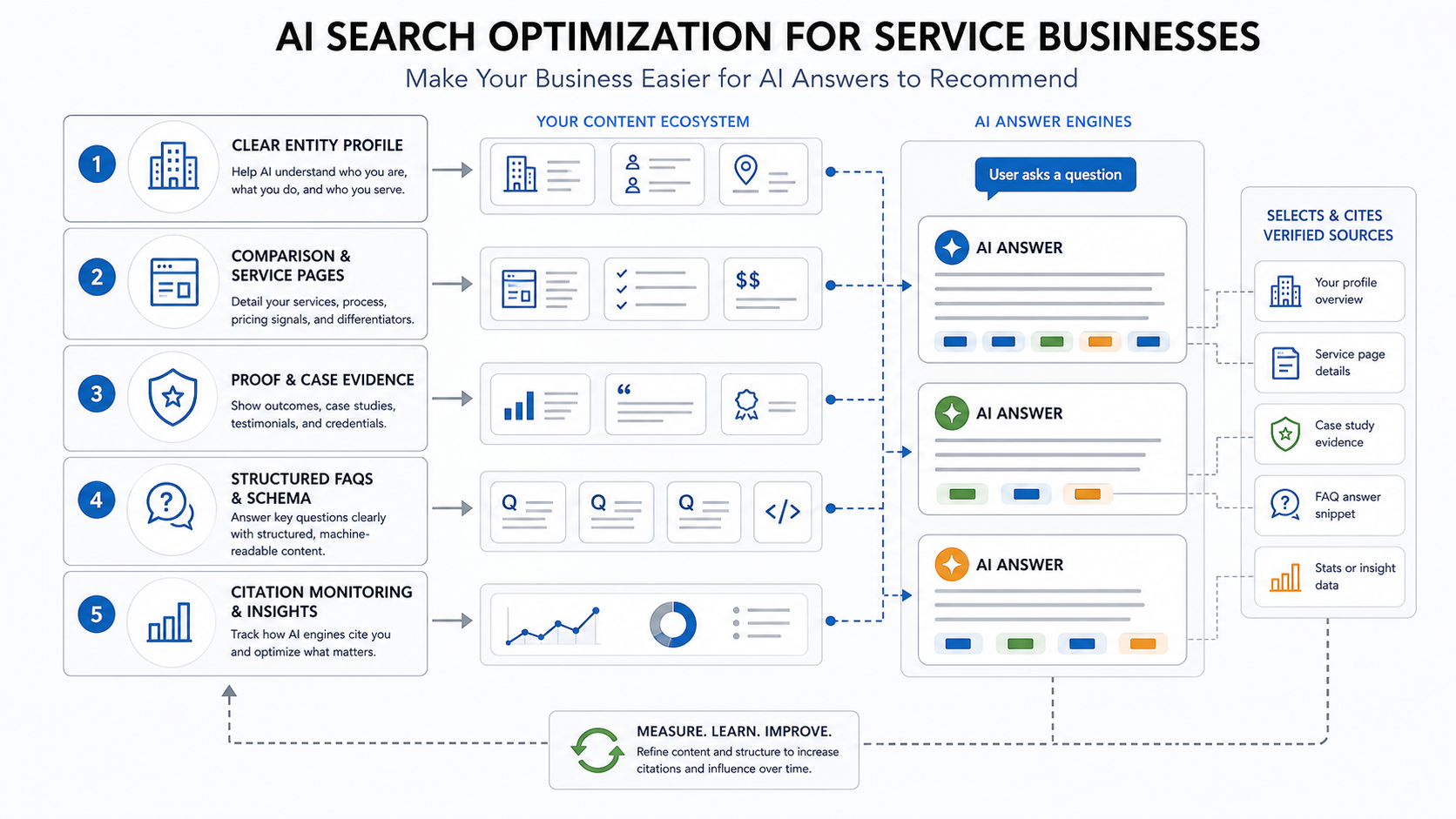

Quick Answer: AI Search Optimization for Service Businesses
AI search optimization for service businesses is the process of making your company easier for AI answer engines to understand, compare, trust, and cite when buyers ask for recommendations. It combines entity clarity, answer-ready service pages, proof assets, structured data, comparison content, technical crawlability, and ongoing citation monitoring.
This is not a replacement for SEO. Google's public guidance for AI features still points site owners back to accessible pages, search policies, helpful people-first content, and structured data that matches visible page content. The practical difference is that AI answers synthesize multiple sources, so vague positioning, thin service pages, unsupported claims, and weak proof become easier to expose.
For a service business, the goal is simple: when someone asks an AI system, "Who can help me with this problem?", your website should provide a clear answer, credible evidence, and enough structured context for the system to understand why you belong in the shortlist. NextPage's AI search optimization work focuses on that exact problem.
Why Service Businesses Need a Different Playbook
Product companies can often rely on named features, specifications, reviews, marketplace listings, and product comparison pages. Service businesses are harder for AI systems to compare because the offer is usually consultative: strategy, implementation, support, process quality, technical depth, domain experience, and trust.
That creates a visibility gap. A service company may be excellent at the work but still hard for AI systems to describe because the site says broad things such as "digital transformation partner" or "end-to-end solutions" without explaining who the company serves, what problems it solves, how delivery works, what proof exists, and which alternatives a buyer is comparing.
AI search optimization fixes that gap by turning expertise into machine-readable and buyer-readable evidence. It does not mean stuffing pages with keywords for every AI platform. It means building a stronger public knowledge layer around the business.
| Buyer Question | Weak Page Signal | AI-Ready Signal |
|---|---|---|
| Who offers this service? | Generic service headline | Specific service page with industries, outcomes, process, and proof |
| Can they solve my kind of problem? | One paragraph of capabilities | Use cases, constraints, project examples, and decision criteria |
| How do they compare? | No alternative or comparison content | Build-vs-buy, agency-vs-in-house, platform, and vendor comparison pages |
| Can I trust them? | Unverified claims | Case studies, author expertise, client-fit notes, methodology, and visible evidence |
| What should I do next? | Generic contact CTA | Relevant audit, assessment, calculator, or scoped consultation CTA |
How AI Answer Engines Evaluate Service Businesses
Different AI search systems use different retrieval, ranking, summarization, and citation methods, but most need the same raw material: crawlable pages, clear entities, topical relevance, trust signals, and source passages that directly answer the user's question. Bing's public search documentation says generative answers based on search results include source references so users can verify and learn more. That makes source clarity and page-level usefulness important.
AI systems also need disambiguation. If your company name, category, location, services, and proof are scattered across inconsistent pages, the system has to guess. If your service page explains the exact problem, who it is for, what the delivery model includes, how risks are handled, and where proof lives, the system has a better source to retrieve.
The most useful mental model is not "ranking in ChatGPT" or "winning Gemini." Think of it as becoming a reliable source for the questions your best buyers already ask.
Build a Clear Business Entity
AI search starts with entity clarity. A service business should make it easy to answer basic questions: what the company is, where it operates, what services it provides, who it serves, what proof exists, who leads the work, and which public profiles confirm the same information.
Start with the home page, About page, key service pages, author bios, case studies, and structured organization information. Use consistent naming, service terminology, locations, founder or leadership profiles, social profiles, and sameAs links where appropriate. Avoid making every page sound like a different company.
For service businesses, the entity profile should also include specialization. "Software company" is weak. "Custom software, AI, and web app development for founders and operations teams replacing manual workflows" is stronger because it gives the AI system a category, audience, problem space, and buying context.
Map Buyer Prompts Before Writing More Content
Service businesses often respond to AI search by publishing more blog posts. That can help, but it is usually the wrong first move. Start by mapping the prompts buyers actually ask at each stage: problem discovery, vendor discovery, comparison, cost planning, risk review, and implementation planning.
| Prompt Type | Example Buyer Prompt | Best Page To Support It |
|---|---|---|
| Problem discovery | How do I improve AI visibility for a service business? | Educational guide with examples and definitions |
| Vendor discovery | Who helps B2B companies with AI search optimization? | Clear service page with proof and fit criteria |
| Comparison | AI search consultant vs SEO agency vs in-house team | Honest comparison page or decision guide |
| Cost planning | How much does AI search optimization cost? | Cost guide, audit offer, or scoped engagement page |
| Risk review | Can schema or AI content hurt search visibility? | Technical guidance with policy-aware caveats |
The prompt map decides which pages need direct answers, where internal links should point, and which proof assets are missing. It also keeps the strategy from becoming a list of disconnected keywords.
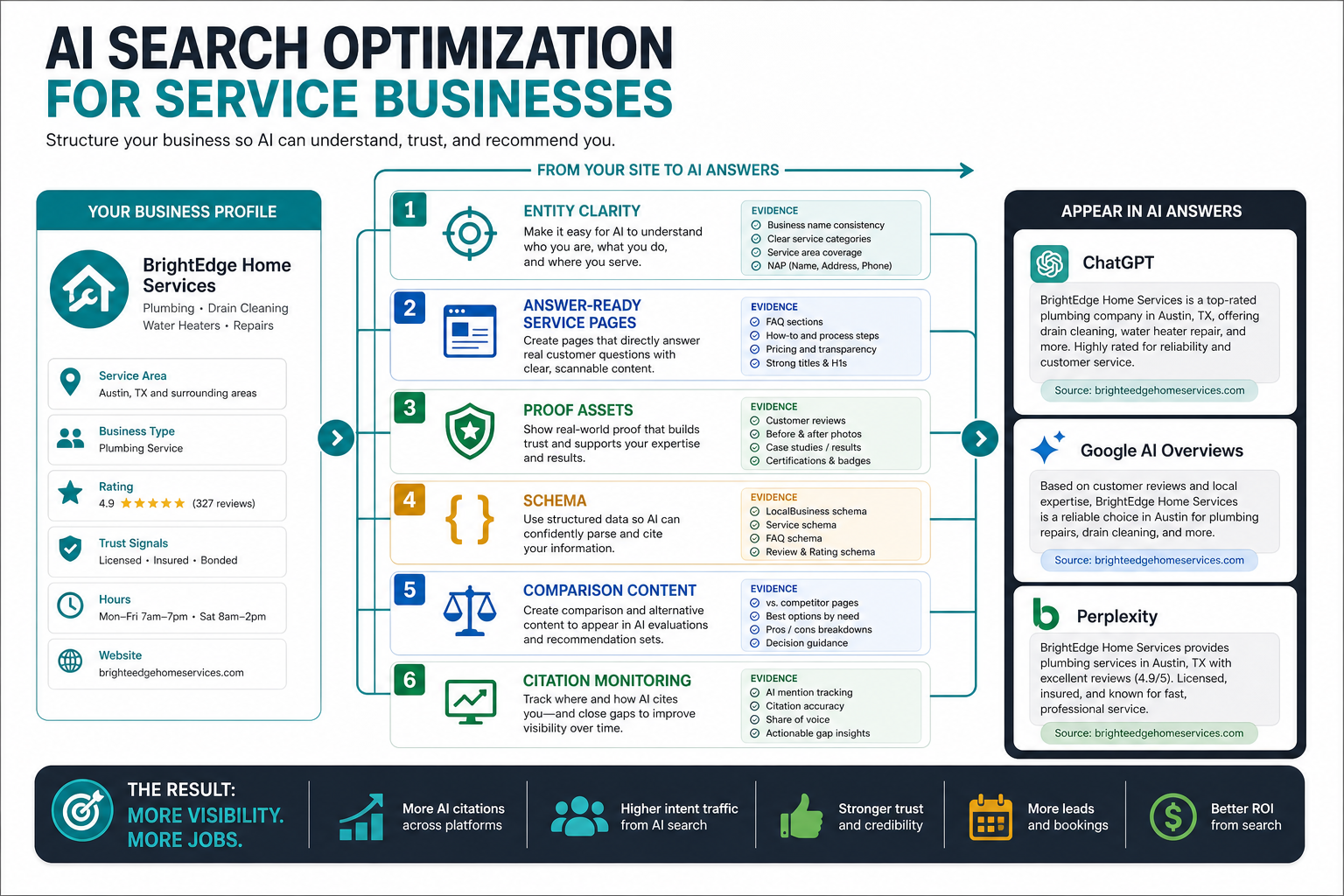
Make Service Pages Answer-Ready
A service page should answer the questions a buyer would ask before a sales call. That includes what the service covers, when it is a good fit, when it is not, the typical process, inputs required, deliverables, timeline drivers, budget drivers, risks, integrations, and examples.
Answer-ready does not mean every paragraph needs to be short. It means the page has clear headings, direct answers, useful comparison tables, concrete examples, and enough context for both a human buyer and an AI system to extract a reliable answer.
For example, a page about AI development services should explain model selection, data access, workflow integration, evaluation, monitoring, permissions, and deployment responsibilities. A page about LLM development should be explicit about RAG, prompts, tools, security, and production operations.
| Service Page Section | Why It Helps AI Search |
|---|---|
| Direct definition | Gives answer engines a concise explanation of the service |
| Fit and non-fit criteria | Helps recommendation systems avoid overbroad matches |
| Process and deliverables | Turns vague expertise into concrete implementation signals |
| Use cases | Maps the service to real buyer prompts and industry language |
| Proof and examples | Supports trust, not just topical relevance |
| FAQs | Creates extractable answers for recurring buyer questions |
Create Comparison and Decision Content
AI answer engines are often used for comparison prompts: "best company for X," "agency vs freelancer," "build vs buy," "which platform should we use," or "what should a startup choose?" Service businesses need content that answers those decision questions honestly.
Strong comparison content does not pretend your service is always the answer. It explains tradeoffs. If a buyer should use SaaS, say so. If a small project fits no-code, say so. If custom development becomes justified when integrations, workflows, security, or ownership matter, explain the trigger clearly.
This is where tools can support content. A buyer comparing options can use an AI Search Visibility Checker to see whether the site has enough entity clarity, answer-ready content, schema, authority signals, and citation-friendly pages. For AI workflow investments, an AI Automation ROI Calculator can turn the decision into a more concrete business case.
Turn Proof Into Citable Evidence
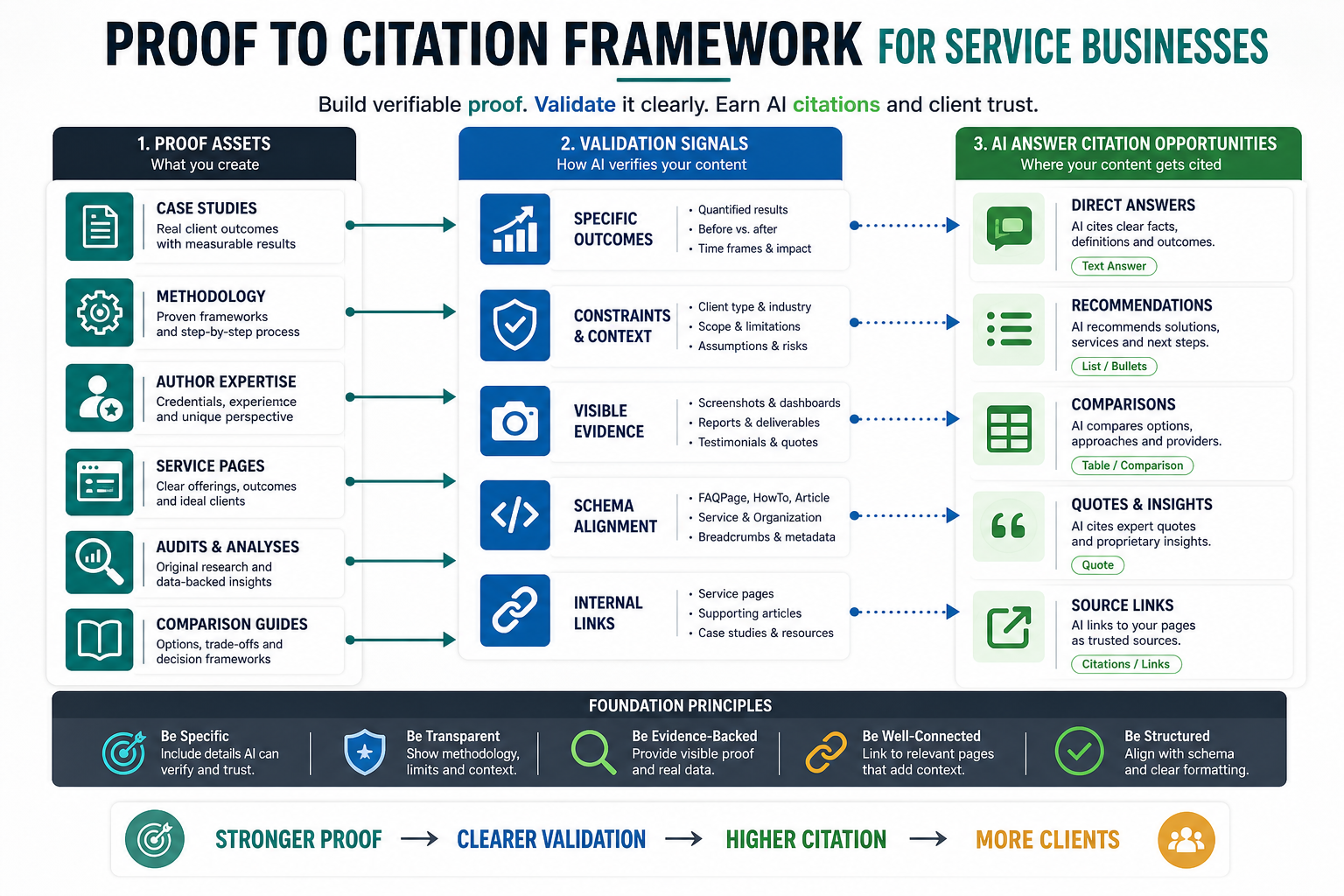
AI search systems need more than claims. They need source material that shows why a business is credible. For service companies, proof can include public case studies, process documentation, client-fit notes, project constraints, before-and-after metrics, screenshots when allowed, certifications, expert authorship, original research, pricing guidance, and independent mentions.
The key is to make proof specific and findable. A testimonial saying "great team" is less useful than a case study explaining the problem, constraints, solution architecture, measurable outcome, and delivery role. A vague portfolio gallery is weaker than a project page with problem context and implementation details.
| Proof Asset | What It Should Show | Where It Should Link |
|---|---|---|
| Case study | Problem, constraints, solution, role, and outcome | Relevant service page and portfolio page |
| Methodology page | How delivery decisions are made | Service page and consultation CTA |
| Audit or tool | How a buyer can assess their current state | Tool page and follow-up offer |
| Author profile | Who is accountable for the advice | Article, About page, and public profiles |
| Cost guide | Budget drivers and tradeoffs | Commercial service page and estimator |
Proof should be close to the service pages it supports. If your AI search optimization page claims you help businesses improve answer-engine visibility, connect it to audits, sample fixes, measurement methodology, and pages that explain how the work is delivered.
Use Schema and Technical Signals Carefully
Structured data helps search systems understand a page, but it is not a shortcut. Google's AI feature guidance explicitly warns that structured data should match the visible text on the page. Service businesses should use schema to clarify the truth of the page, not to add invisible claims.
Useful schema patterns can include Organization, LocalBusiness where relevant, Service, FAQPage, Article, BreadcrumbList, Review or AggregateRating only when policies and visible evidence support it, and sameAs links for public profiles. Technical basics still matter: indexable pages, canonical URLs, clean internal links, fast rendering, accessible HTML, and XML sitemap inclusion.
For AI-heavy service pages, technical clarity also means avoiding thin JavaScript-only content that crawlers cannot reliably extract. The visible page should contain the actual definitions, FAQs, proof, and decision criteria you want answer engines to understand.
Measure AI Search Visibility Without Chasing Noise
AI search measurement is still less mature than traditional search analytics. Rankings are unstable, prompts vary, citations can appear without clicks, and different tools measure different surfaces. That does not mean measurement is useless. It means the dashboard should be interpreted carefully.
Track a practical set of signals: whether AI systems can describe your business correctly, whether they name your brand for important service prompts, which pages are cited, whether competitors are repeatedly included, what missing proof or comparison content appears in answers, and whether AI-assisted visitors convert after landing on the site.
Use monitoring to decide what to improve next, not to claim guaranteed citation wins. Start with a baseline using the AI Search Visibility Checker, then review service pages, FAQs, proof assets, schema, and internal links around the prompts that matter most.
90-Day AI Search Optimization Roadmap
A service business does not need to rebuild the entire website at once. A practical 90-day roadmap can produce stronger public signals without creating content for its own sake.
| Phase | Focus | Output |
|---|---|---|
| Days 1-15 | Baseline and entity audit | Prompt set, entity map, service inventory, citation baseline, schema review |
| Days 16-35 | Service page clarity | Rewritten priority pages with direct answers, fit criteria, proof, FAQs, and CTAs |
| Days 36-55 | Decision content | Comparison pages, cost guides, implementation checklists, and buyer questions |
| Days 56-75 | Proof and authority | Case studies, author bios, public profiles, internal links, and source consolidation |
| Days 76-90 | Measurement and iteration | Prompt monitoring, cited-page review, conversion checks, and next content priorities |
For service companies building AI-enabled products, the roadmap can also connect to generative AI development and production-readiness content. The same clarity that helps buyers understand your services also helps your team scope better AI products.
How NextPage Helps Service Businesses With AI Search
NextPage approaches AI search optimization as a content, technical SEO, and product-positioning system. We identify the prompts your best buyers ask, audit whether your site answers them clearly, improve service and comparison pages, add structured proof, align schema with visible content, and build monitoring around AI answer visibility.
For technology and service businesses, the work often overlaps with AI implementation strategy. If your company sells AI products or builds AI workflows, your content needs to explain the difference between generative AI, AI agents, and agentic systems. NextPage's guide to generative AI vs AI agents vs agentic AI is an example of the kind of explanatory page that can support both buyers and answer engines.
If your website is already getting search traffic but AI answers do not describe the business accurately, start with an AI search visibility audit. The immediate win is usually not more content. It is clearer service architecture, stronger proof, better internal links, and pages that answer buyer questions directly enough to be trusted.