
Quick Answer: Connected Vehicle Platform Architecture
A connected vehicle platform is the software layer that turns vehicle signals into reliable services for drivers, fleet teams, engineering teams, support teams, and business systems. The architecture has to connect embedded devices, mobile apps, gateways, APIs, event streams, cloud storage, OTA update workflows, remote diagnostics, V2X integrations, analytics, and dashboards without letting every new feature become a custom integration project.
The best architecture starts with one operating question: which vehicle events must become trusted business actions? Speed, location, battery state, diagnostic codes, sensor alerts, route status, driver behavior, charging events, firmware versions, and service history all have different latency, storage, privacy, and reliability needs. Treating them as one generic data feed usually creates cost, security, and scaling problems later.
Use the MVP Scope Builder to separate the first release from later vehicle, dashboard, and analytics phases. If you are comparing build options, the custom software development cost guide will help pressure-test the hidden work in integrations, data pipelines, support, and long-term maintenance.
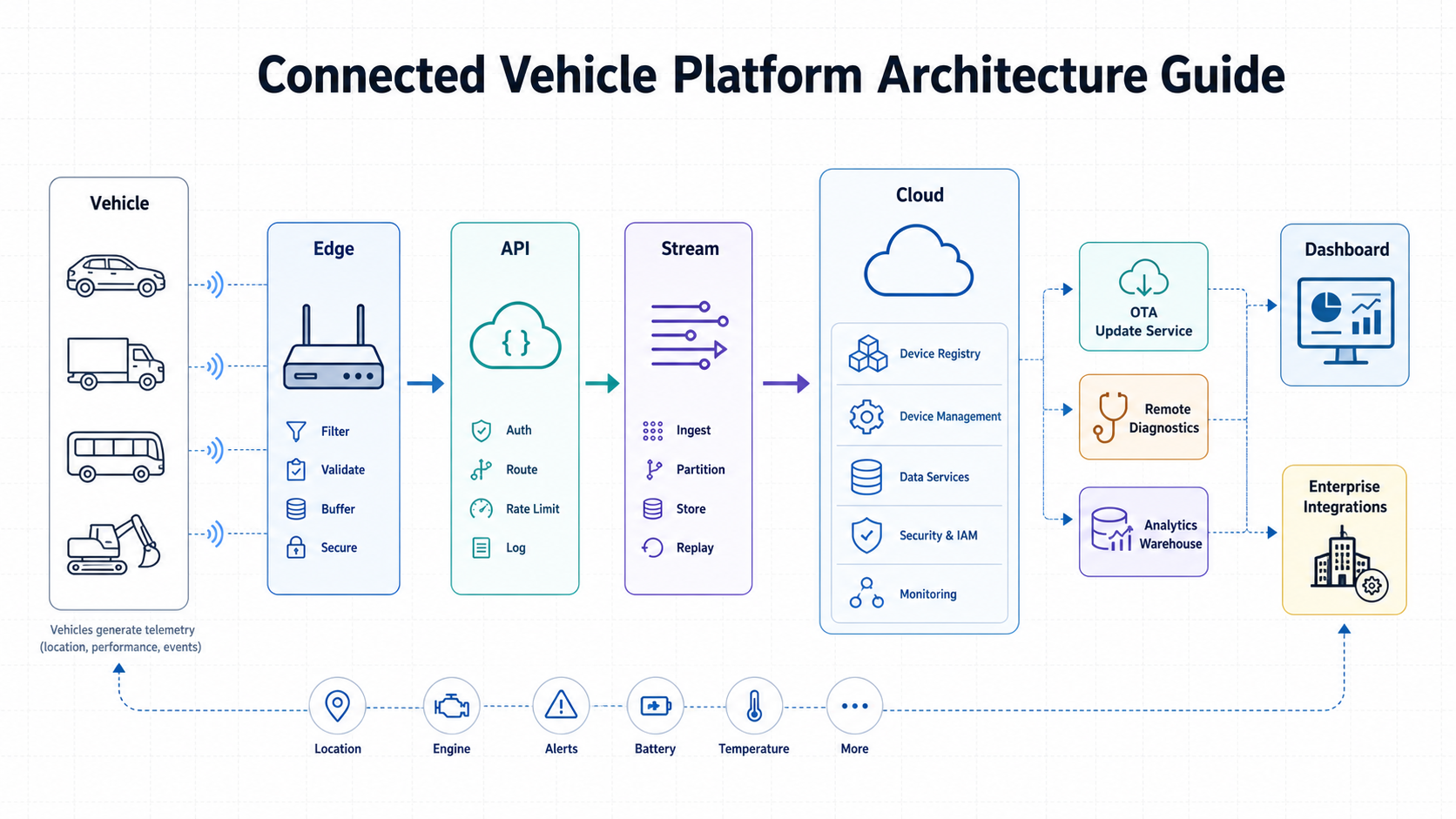
Reference Architecture From Vehicle to Cloud
The OrangeMantra reference page positions automotive software around connected vehicles, fleet SaaS, telematics, OTA updates, remote diagnostics, V2X, data intelligence, and cloud-based automotive platforms. Those capabilities are valid, but they need an architecture that separates vehicle communication, platform reliability, data products, and user workflows. For teams turning this into an accountable product roadmap, NextPage's custom software development practice helps connect backend architecture, APIs, dashboards, and delivery ownership.
A practical reference architecture usually has eight layers:
- Vehicle and embedded layer: ECUs, sensors, telematics control units, battery systems, infotainment modules, and firmware versions that produce signals or receive commands.
- Edge and gateway layer: message filtering, buffering, protocol translation, compression, offline tolerance, and secure handshakes before data reaches the cloud.
- Ingestion layer: APIs, device identity, certificates, rate limits, event validation, and message queues that protect the platform from malformed or excessive traffic.
- Stream and processing layer: real-time event routing for alerts, diagnostics, geofencing, trip events, charging events, maintenance signals, and operational workflows.
- Storage layer: hot stores for recent operational data, analytical stores for history, object storage for logs or files, and retention policies for privacy-sensitive records.
- Service layer: OTA orchestration, remote diagnostics, vehicle command APIs, fleet rules, user management, payments, notifications, and third-party integrations.
- Experience layer: fleet dashboards, admin consoles, mobile apps, driver tools, service portals, support workbenches, and engineering observability views.
- Governance layer: security, audit logs, data lineage, consent, privacy controls, incident response, monitoring, and platform SLOs.
This layered view helps teams avoid a common mistake: building the first dashboard directly on top of raw telemetry. Dashboards should consume trusted platform events, not fragile device payloads that change every time firmware or hardware changes.
Telemetry and Data Pipeline Decisions
Telemetry architecture is not only a throughput problem. It is a product decision because every signal has a different business value. A tire pressure alert may need immediate routing. A firmware inventory update may be batch-safe. A trip summary may need transformation before it becomes useful to a customer portal. A raw sensor stream may be valuable for engineering but unnecessary for most operations users.
| Decision area | Architecture question | Practical guidance |
|---|---|---|
| Device identity | How does each vehicle, module, or gateway prove who it is? | Use certificate-based identity and rotate credentials without manual vehicle service visits. |
| Event model | Which events are raw telemetry, derived facts, alerts, commands, or audit records? | Version schemas early so firmware and cloud teams can evolve safely. |
| Latency | Which workflows need seconds, minutes, hours, or daily processing? | Reserve real-time paths for operational decisions, not every available signal. |
| Storage | What needs short-term operational lookup versus long-term analytics? | Separate hot operational stores from cheaper analytical and archival storage. |
| Reliability | What happens when vehicles lose connectivity or the cloud rejects a message? | Design buffering, retry, idempotency, deduplication, and reconciliation into the first release. |
| Ownership | Who owns schema changes, data quality, and incident response? | Create an operating model before adding more vehicles or partners. |
For connected vehicle teams, API design is as important as data ingestion. Internal services, customer dashboards, support tooling, partner systems, and analytics jobs should not all depend on the same low-level device payload. Put stable platform APIs between the vehicle data model and the experiences that consume it.
OTA, Diagnostics, V2X, and Fleet Workflows
Connected vehicle platforms usually become more complex when they shift from monitoring to action. Reading telemetry is one thing; sending commands, deploying firmware, opening service cases, coordinating roadside support, or integrating V2X signals requires stronger safety, authorization, audit, and rollback controls.
- OTA updates: define firmware inventory, rollout cohorts, staged deployment, eligibility checks, rollback criteria, vehicle state requirements, customer communication, and release audit trails.
- Remote diagnostics: convert diagnostic trouble codes, sensor anomalies, and maintenance thresholds into support workflows with severity, owner, history, and recommended action.
- Fleet operations: route location, trip, utilization, fuel or battery, driver behavior, maintenance, and dispatch data into workflows that operators can act on daily.
- V2X integrations: treat vehicle-to-everything feeds as high-trust interfaces with explicit safety, latency, privacy, standards, and failure-mode design.
- Customer apps: expose only stable, permissioned capabilities such as status, service booking, alerts, navigation support, and account-level controls.
Teams often underestimate the operational product work around these capabilities. An OTA update service needs release managers, support processes, communications, monitoring, and incident runbooks. A diagnostics platform needs service workflows and escalation logic. A fleet dashboard needs role-based views so dispatchers, maintenance teams, finance, and executives are not staring at the same raw metrics.
Dashboards and Data Products
Dashboards should be designed around decisions, not data availability. A platform may capture thousands of signals, but a maintenance manager needs exception queues, status changes, warranty context, and recommended actions. A fleet operator needs vehicle availability, route risk, utilization, and alerts. A product leader needs adoption and reliability trends. An engineering team needs firmware versions, failed commands, latency, and device health.
Start by defining dashboard personas and the decisions each one must make. Then decide which events are trusted enough for that decision. If the data is not reliable enough to support a business action, the dashboard should show quality or freshness status rather than pretending certainty.
| User | Useful view | Signals that matter |
|---|---|---|
| Fleet operator | Vehicle availability, route status, alerts, utilization, and exceptions | Location, trip events, battery/fuel, fault codes, geofence events, downtime |
| Maintenance lead | Diagnostics queue, service priority, parts or warranty context | DTCs, sensor thresholds, service history, recurring faults, severity |
| OTA release manager | Campaign status, eligibility, success/failure rate, rollback triggers | Firmware inventory, cohort, install state, command result, vehicle state |
| Product leader | Feature adoption, reliability, engagement, customer impact | Active vehicles, app usage, command success, support tickets, SLA trends |
| Engineering team | Device health, latency, schema errors, ingestion failures, cost anomalies | Gateway status, API errors, queue lag, payload rejection, storage growth |
If predictive maintenance or AI-assisted triage is part of the roadmap, estimate the value before committing to model-heavy work. The AI Automation ROI Calculator can help compare engineering cost against repeatable operational savings.
Security, Privacy, Safety, and Observability Guardrails
Connected vehicle software touches physical systems, customer data, location data, driver behavior, and operational continuity. Security and observability cannot be added after the first production fleet is live. They have to shape the platform from the first architecture review.
- Identity and access: use strong device identity, service-to-service authentication, least-privilege operator roles, and explicit approval paths for sensitive commands.
- Command safety: protect remote actions with vehicle-state checks, rate limits, command audit logs, replay protection, and rollback or cancellation rules.
- Data privacy: classify location, driver behavior, account, diagnostic, and vehicle data so retention and access match legal and customer expectations.
- Observability: monitor device connection health, ingestion errors, stream lag, processing failures, OTA campaign status, dashboard latency, and storage cost.
- Incident response: define ownership for device, cloud, data, security, customer support, and partner incidents before launch.
- Compliance readiness: map safety, privacy, cybersecurity, audit, and regional data rules to concrete platform controls rather than broad policy statements.
For teams scaling beyond a pilot, delivery ownership matters as much as individual developers. If you need senior engineering capacity across cloud, data, automation, and integrations, NextPage's software outsourcing in India model can support a managed product roadmap instead of scattered staff augmentation.
MVP-to-Scale Rollout Plan
The first connected vehicle release should prove a valuable workflow with a small number of vehicles, signals, users, and operational commitments. A pilot that captures every possible telemetry field but does not change any real workflow is not a useful MVP. A stronger first release proves device identity, ingestion, one or two dashboards, basic diagnostics or alerts, support ownership, and a path to more vehicles. If the MVP boundary is still unclear, the MVP development service page outlines how to keep the first release useful without absorbing every future platform layer.
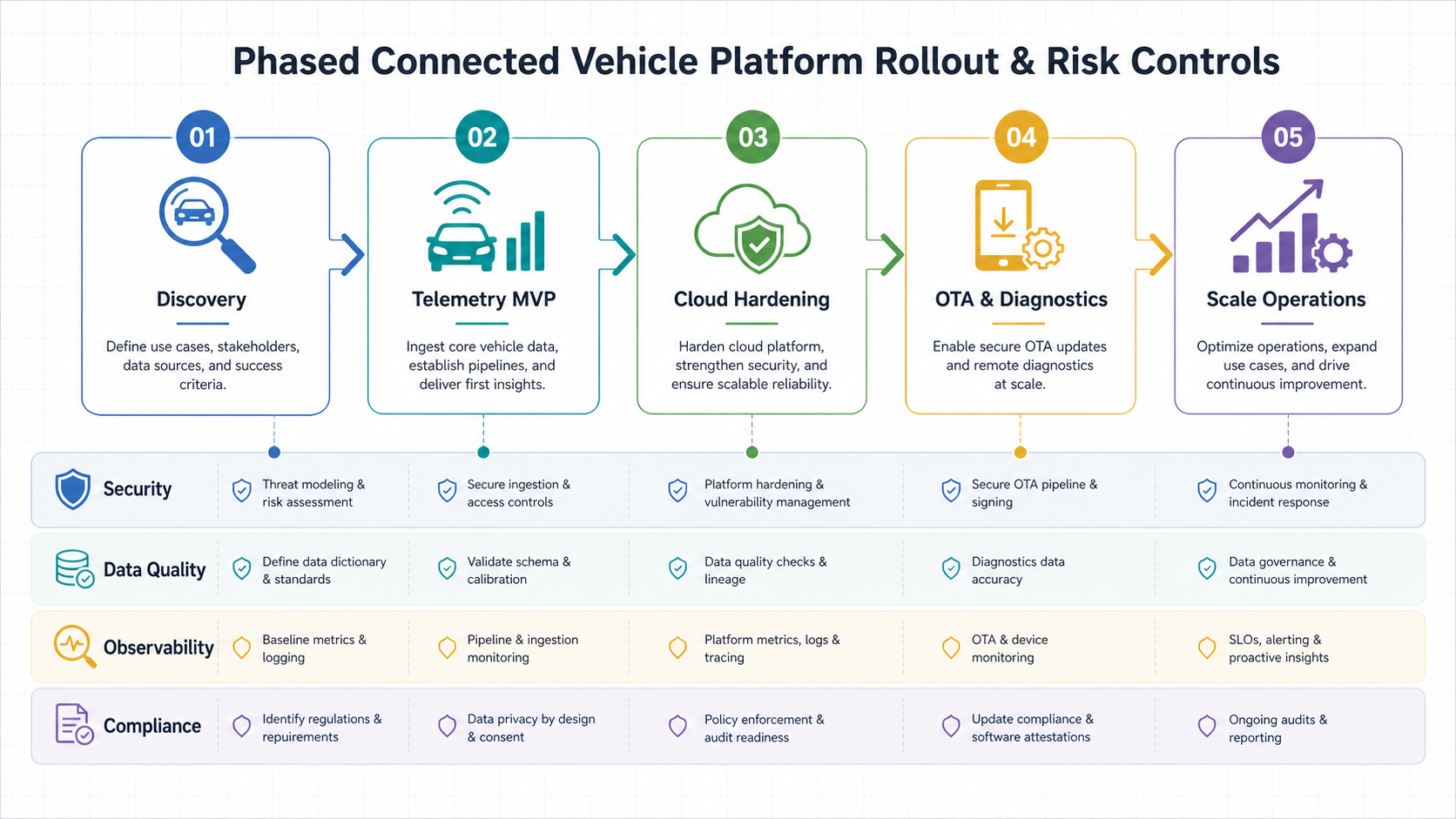
| Phase | Goal | Evidence to collect |
|---|---|---|
| 1. Discovery | Map vehicle signals, user workflows, systems, business outcomes, risks, and ownership. | Signal inventory, workflow map, architecture decisions, integration list, risk register. |
| 2. Telemetry MVP | Connect a limited fleet and turn selected events into useful alerts or dashboards. | Device identity, ingestion reliability, event schema, dashboard feedback, support process. |
| 3. Cloud hardening | Improve resilience, monitoring, data quality, cost controls, and deployment automation. | SLOs, error budgets, queue lag, failed payloads, storage growth, incident runbook. |
| 4. OTA and diagnostics | Add controlled remote actions, firmware campaigns, diagnostic workflows, and audit trails. | Campaign metrics, command logs, rollback criteria, diagnostic case outcomes. |
| 5. Scale operations | Expand vehicles, regions, partners, analytics, and role-specific experiences. | Adoption metrics, SLA trends, partner APIs, data governance, roadmap backlog. |
This phased model also makes vendor decisions easier. Teams can choose off-the-shelf telematics, cloud IoT services, fleet management products, or custom software for different layers, but the architecture still needs one accountable system design.
Build, Buy, or Extend: Platform Decision Criteria
Most connected vehicle platforms should not be built entirely from scratch. The better question is where custom software creates advantage and where proven infrastructure reduces risk. Device connectivity, message streaming, storage, authentication, and monitoring often benefit from managed cloud services. Business workflows, customer experience, diagnostics logic, proprietary data products, partner integrations, and operator tooling often need custom design.
| Use buy or managed services when... | Use custom software when... |
|---|---|
| The capability is infrastructure-heavy and not strategically differentiating. | The workflow is specific to your vehicle, fleet, customer, service, or partner model. |
| Security, scale, and uptime are better handled by a proven cloud service. | The user experience needs to simplify complex operational decisions. |
| The team needs to reduce launch risk and focus on product workflows. | Existing tools force manual work, duplicate entry, or weak data ownership. |
| The managed service supports your regions, data rules, and integration needs. | The platform must combine vehicle data with CRM, ERP, service, warranty, billing, or partner systems. |
The build-vs-buy choice should be revisited after the MVP. Early managed services may be exactly right for proving value, while later custom data products or dashboards may become important once real users and real vehicle data show where the business value sits. Teams comparing delivery models can also use the software development outsourcing to India guide to pressure-test senior engineering capacity, governance, and long-term operating cost.
How NextPage Helps Plan Connected Vehicle Platforms
NextPage helps teams turn connected vehicle ideas into a buildable architecture and phased roadmap. We map vehicle signals, user workflows, cloud services, integrations, data quality risks, dashboards, OTA and diagnostics requirements, and delivery constraints before engineering effort is committed.
For a useful architecture review, bring your vehicle or device types, available telemetry, firmware and gateway constraints, current cloud stack, dashboard users, partner integration needs, security concerns, target launch window, and the first business workflow you want to improve. We will help define the smallest useful release, the platform layers that should be managed versus custom, and the controls needed before scaling beyond the pilot.
Book a connected vehicle platform architecture review with NextPage.