
Quick Answer: Dedicated Development Team Cost In India
For 2026 planning, a dedicated development team in India commonly starts around $9,000-$14,000 per month for a lean 3-person pod, moves toward $18,000-$35,000 per month for a balanced 5-7 person product team, and can reach $40,000-$70,000+ per month for a larger managed team with senior engineering, QA, DevOps, design, delivery leadership, and security coverage.
Those bands are more useful than a single hourly rate because buyers rarely need only developers. A reliable team also needs role clarity, onboarding, QA, delivery management, source-code practices, overlap hours, and replacement coverage. If you only compare developer rates, you can miss the operating cost that determines whether the team actually ships.
If you already know the roles you need, model the first version with the Dedicated India Team Cost Calculator. If you want NextPage to help design and manage the operating model, start with the Your Team in India service path.
What Is Included In A Dedicated Team Budget?
A dedicated team budget should include more than engineering hours. At minimum, plan for developers, QA, onboarding, sprint rituals, communication overlap, code review, documentation, project tools, and delivery coordination. For commercial products, add product analysis, release planning, DevOps, monitoring, security hygiene, and user acceptance support.
The biggest budgeting mistake is treating a dedicated team as a collection of seats. A low monthly rate can become expensive when no one owns architecture, backlog quality, QA gates, release readiness, or stakeholder communication. A slightly higher managed team can be cheaper in practice if it reduces rework and keeps delivery moving.
For teams comparing India against broader outsourcing options, NextPage's software outsourcing in India model explains when team extension, managed pods, and full project ownership make sense.
Role-By-Role Cost Planning Table
Use this table as an early planning model, not a fixed quote. Actual cost changes with stack, seniority, communication requirements, domain complexity, and whether the vendor includes management and QA in the same monthly package.
| Role | Typical allocation | Monthly planning range | When it matters most |
|---|---|---|---|
| Mid-level full-stack developer | Full-time | $3,000-$6,500 | Feature delivery, integrations, frontend/backend tasks, and steady sprint work. |
| Senior developer or tech lead | Full-time or part-time lead | $5,000-$10,000+ | Architecture, code review, technical decisions, and mentoring other engineers. |
| QA engineer | Half-time to full-time | $2,000-$5,500 | Regression testing, acceptance checks, automation, and release confidence. |
| Delivery manager or project manager | Part-time to full-time | $2,500-$7,000 | Planning, reporting, stakeholder syncs, blockers, and sprint governance. |
| UI/UX designer or product analyst | Part-time or phase-based | $2,000-$6,000 | Discovery, user flows, wireframes, backlog clarity, and acceptance criteria. |
| DevOps or cloud engineer | Part-time or specialist | $2,500-$8,000+ | CI/CD, infrastructure, observability, deployment reliability, and security baseline. |
The right question is not whether every role is full-time from day one. It is which roles must be present enough to prevent the team from stalling. Many strong India-based teams start with core developers plus fractional QA and delivery leadership, then add design, DevOps, or specialist roles once the product roadmap justifies them.
Monthly Budget Examples By Team Shape
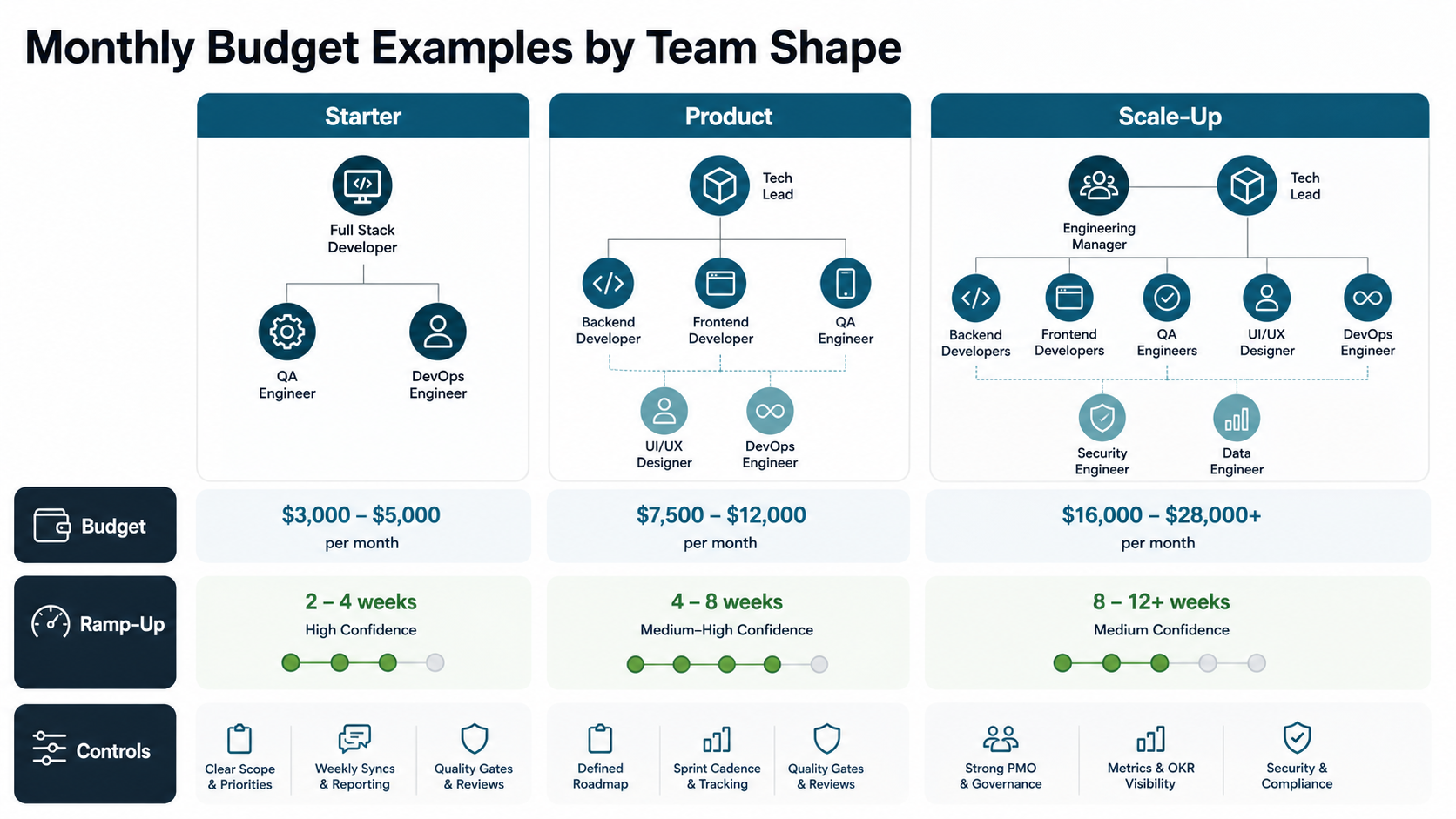
A starter pod might include one full-stack developer, part-time QA, and part-time delivery support. This can work for a validated MVP, small internal product, prototype-to-product handoff, or early backlog cleanup. Budget around $9,000-$14,000 per month when the work is well scoped and technical risk is moderate.
A balanced product team often includes two or three developers, QA, a delivery owner, and part-time design or DevOps support. Budget around $18,000-$35,000 per month depending on seniority and stack. This is the most common shape for companies that need continuous roadmap delivery but do not yet need a large multi-squad setup.
A scale-up team adds a tech lead, multiple engineers, QA automation, design/product support, DevOps, and stronger reporting. Budget around $40,000-$70,000+ per month when you need parallel feature streams, higher release cadence, stronger architecture ownership, or regulated-domain controls.
These ranges should be adjusted for timezone overlap, communication expectations, domain complexity, and specialist skills. AI, data engineering, security, real-time systems, fintech, healthcare, or complex integration work usually pushes the mix toward more senior roles.
How Ramp-Up Affects The Real Cost
Ramp-up is where many dedicated-team budgets go wrong. A new team does not reach full velocity on day one. The first weeks are spent on access, environments, architecture walkthroughs, product context, development conventions, test data, release process, and backlog refinement.
Plan the first 30 days around proof of operating model, not maximum output. The team should complete environment setup, ship one or two bounded tasks, prove pull-request quality, confirm QA workflow, and establish reporting. If that month exposes weak communication or unclear ownership, fix it before adding more people.
The 60-day mark should show predictable sprint cadence. The team should understand the codebase, estimate work more accurately, and identify architecture or process bottlenecks. By 90 days, you should know whether to scale, rebalance seniority, add QA automation, or split the team into focused workstreams.
30/60/90-Day Ramp-Up Plan
| Phase | Main objective | What to check | Budget implication |
|---|---|---|---|
| Days 1-30 | Set up access, rituals, code standards, and first delivery proof. | Environment setup, first PRs, communication quality, QA handoff, backlog clarity. | Expect lower velocity; avoid adding too many roles too early. |
| Days 31-60 | Stabilize sprint cadence and remove process friction. | Estimation accuracy, demo cadence, defect patterns, release readiness, decision latency. | Add fractional design, QA, DevOps, or product support where blockers repeat. |
| Days 61-90 | Scale only after the model is proven. | Throughput, code quality, roadmap confidence, team ownership, support load. | Decide whether to expand roles, rebalance seniority, or keep the team lean. |
This is also why monthly billing should be paired with performance checkpoints. A good vendor will not push a large team before the operating rhythm is clear. A better plan is to start with the smallest complete team that can ship, then scale once the metrics support it.
Hidden Costs That Change The Budget
The headline monthly fee is only one part of the budget. Hidden costs usually appear as slow decisions, unclear acceptance criteria, weak QA coverage, poor documentation, missed timezone overlap, fragile environments, and rework after rushed releases.
There are also direct operating costs: paid tools, cloud environments, test devices, monitoring, design tools, communication platforms, repository access, security scanning, and occasional specialist reviews. These may be small compared with salaries, but they influence productivity and quality.
Attrition and replacement terms matter too. Ask how quickly a developer can be replaced, how knowledge transfer is handled, and whether ramp-up support is included. A vendor that treats replacement as your problem can turn a cheap monthly rate into a delivery delay.
Staff Augmentation Vs Managed Dedicated Team
Staff augmentation is useful when you already have internal leadership. You manage architecture, backlog, sprint planning, QA, releases, and developer performance. The vendor provides people, and your team absorbs the management load.
A managed dedicated team is better when you need capacity plus delivery structure. The vendor helps run rituals, reporting, QA coordination, escalation, and replacements. This usually costs more than raw staff augmentation but reduces the chance that the buyer has to manage every detail.
For broader partner selection criteria, use the supporting guide on software development outsourcing to India. It covers outsourcing models, cost drivers, and how to choose the right level of ownership.
Governance Checklist Before You Sign
- Role scorecards: every role has expected seniority, responsibilities, and evaluation criteria.
- Delivery owner: someone owns sprint planning, blockers, reporting, QA handoff, and release readiness.
- Communication rhythm: meeting cadence, async updates, overlap hours, and escalation channels are explicit.
- Code quality standards: branching, pull requests, review, tests, and documentation are agreed before work starts.
- Security and access: repo, cloud, database, and secret permissions follow least-privilege rules.
- Replacement terms: underperformance, attrition, and knowledge transfer have written handling rules.
- Reporting: you can see progress, risks, decisions needed, and capacity usage without chasing the team.
How To Choose The Right Starting Team
Start with the smallest complete team that can deliver the first measurable outcome. If you are rebuilding an internal workflow, you may need a senior full-stack developer, a part-time QA engineer, and a delivery owner. If you are building a customer-facing SaaS product, you may need frontend, backend, QA, design, and DevOps coverage earlier.
Do not scale headcount to compensate for unclear product direction. More people make coordination harder when the backlog is weak. Spend the first phase tightening scope, acceptance criteria, architecture, and release cadence. Add roles only where bottlenecks are clear.
For NextPage clients, the ideal starting shape usually combines engineering capacity with enough delivery ownership to keep communication, quality, and release planning visible. That is the difference between buying developer hours and building a team that can operate.
How NextPage Plans An India-Based Team
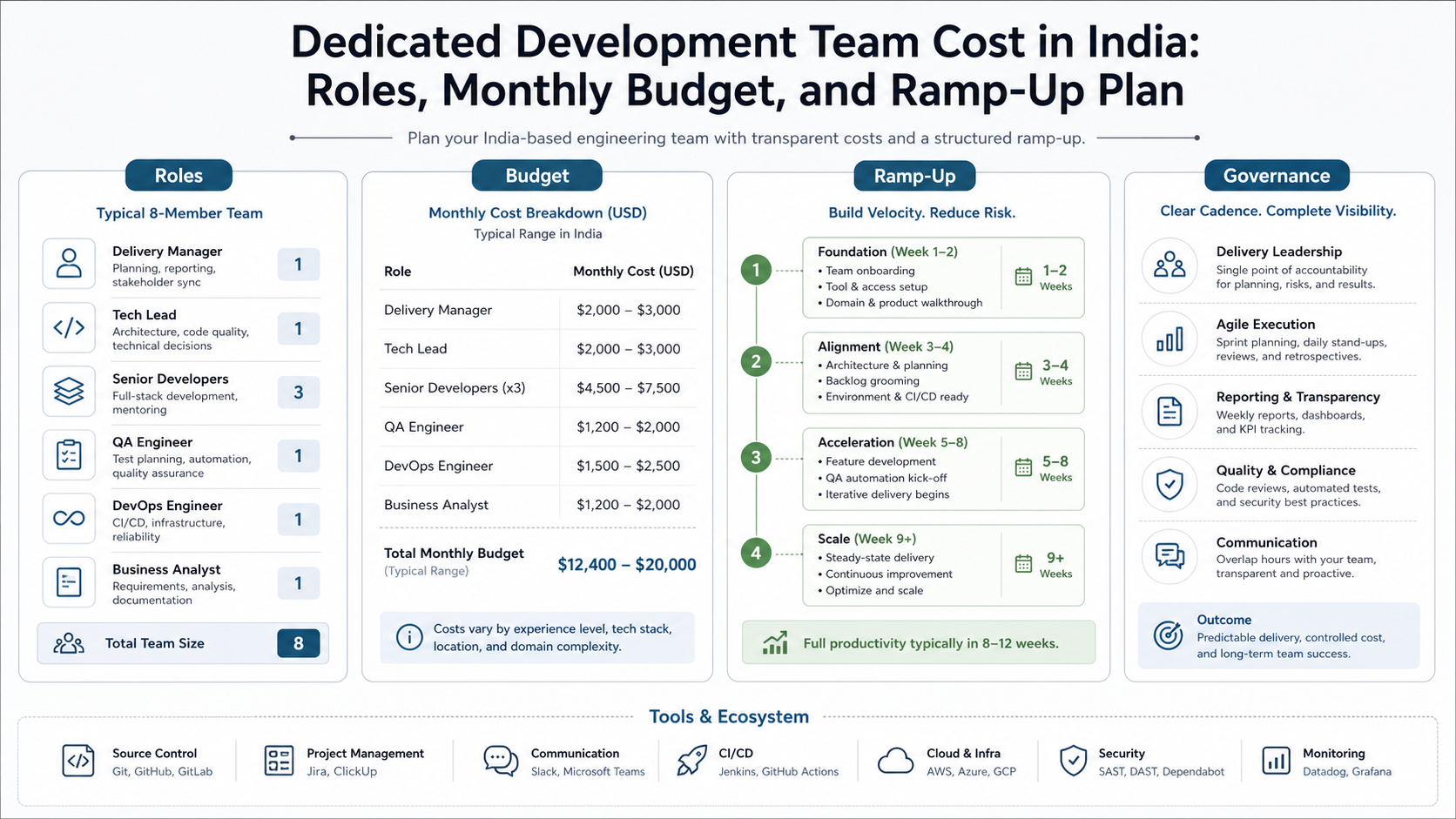
NextPage starts by clarifying the outcome: what the team must ship, how much product direction already exists, which technical risks are known, and what operating support the client can provide internally. From there, the first team shape can be designed around delivery risk rather than arbitrary headcount.
That may mean one developer inside your process, a managed product pod, or a longer-term India-based engineering team with QA and delivery leadership. The best model depends on how much ownership you want to keep and how much operating support you need from the partner.
If you are budgeting now, estimate the first team with the calculator, then use Your Team in India to plan roles, ramp-up, governance, and the right monthly budget before you commit.