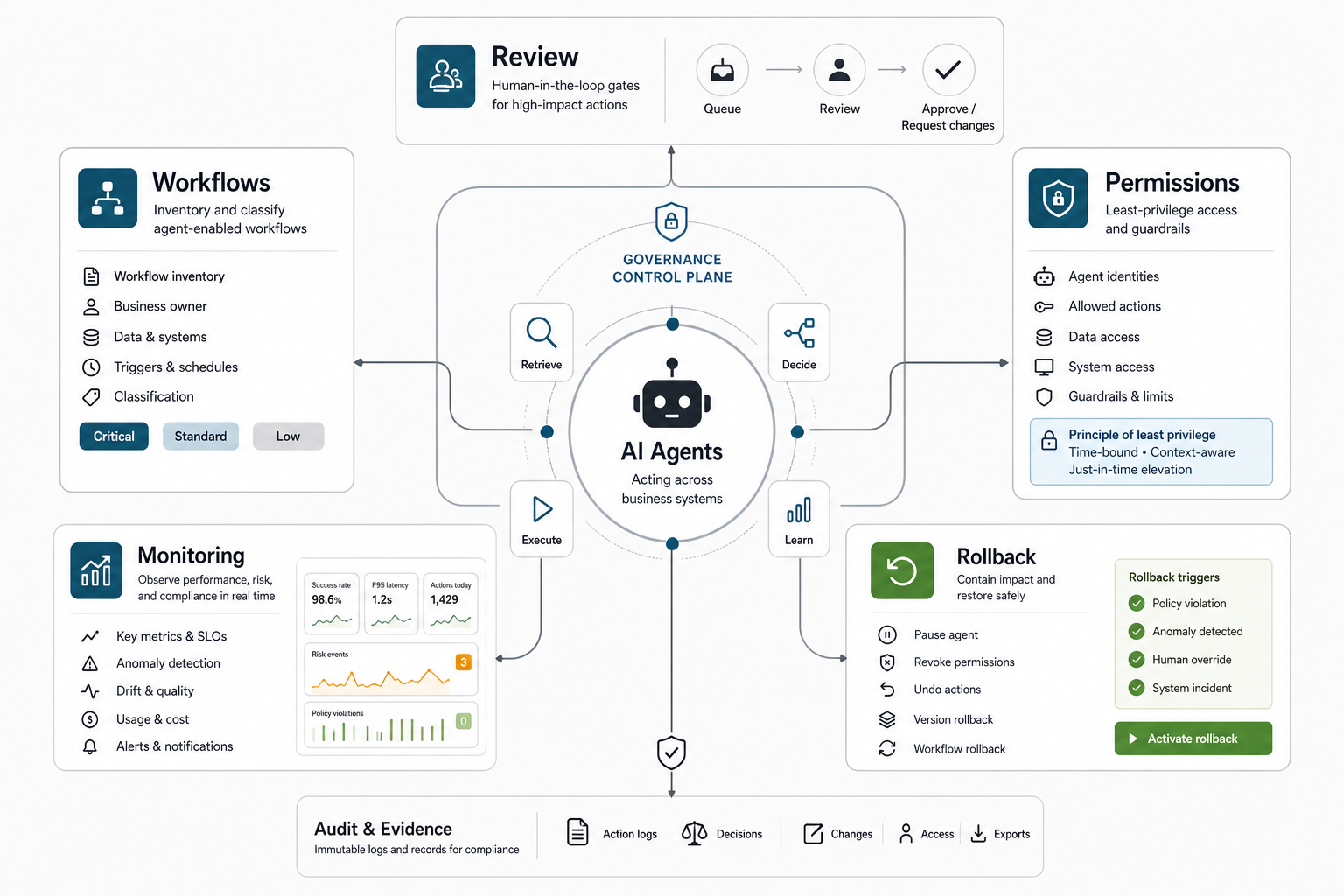

Enterprise AI agent governance is the operating model that decides which agents may act, which systems they may touch, when humans must review decisions, what gets monitored, and how the business rolls back unsafe automation. It is more specific than an AI policy and more operational than a security checklist. It turns agent ambition into workflow inventory, permission envelopes, approval gates, telemetry, audit evidence, and incident playbooks.
That matters because the enterprise software market is moving quickly from AI copilots toward agentic work. Forrester's 2026 enterprise software prediction points to AI agents changing enterprise applications, business models, and workplace culture, with vendors exposing MCP-style integration surfaces and governance modules that combine explainability, audit trails, and compliance monitoring. The practical takeaway for buyers is direct: agents can create value only when the governance layer is designed before authority is expanded.
If your organization is still deciding whether a workflow is ready for agentic automation, start with the AI Agent Readiness Assessment. It forces teams to score workflow clarity, data readiness, integrations, human review, and governance gaps before an agent receives production access.
Quick Answer: Enterprise AI Agent Governance
Enterprise AI agent governance is a lifecycle system for selecting agent use cases, assigning owners, approving permissions, reviewing sensitive actions, monitoring runtime behavior, retaining logs, handling incidents, and retiring or rolling back agents when risk exceeds value.
A workable governance model has seven parts: a workflow inventory, risk classification, permission envelope, human review policy, monitoring and evaluation plan, evidence and audit trail, and rollback playbook. These controls should be attached to each agent workflow, not hidden in a generic AI policy document.
| Governance Layer | Decision to Make | Evidence to Keep |
|---|---|---|
| Workflow inventory | Which business process is the agent allowed to support? | Use-case owner, workflow map, data sources, systems touched, expected outcome. |
| Risk classification | How much business, privacy, compliance, or customer impact can the agent create? | Risk score, affected roles, sensitive data, regulated process notes. |
| Permission envelope | What can the agent read, recommend, draft, execute, or change? | Tool allowlist, credentials, argument schemas, rate limits, blocked actions. |
| Human review | Which actions require approval before execution? | Approval records, reviewer notes, rejected actions, override reasons. |
| Monitoring | How will the business know whether the agent is reliable and useful? | Trace logs, eval results, drift signals, cost metrics, operational KPIs. |
| Rollback | How can the team pause, disable, reverse, or compensate for a bad action? | Disable switch, rollback procedure, owners, incident timeline, regression tests. |
Why Agent Governance Is Different From AI Policy
Traditional AI policies usually cover acceptable use, data handling, vendor review, and human accountability. Agent governance must go further because agents can interact with tools, chain steps, call APIs, use memory, and change operational systems. A policy can say that humans are accountable. Governance has to specify which human reviews which action before which system changes.
For example, a support assistant that drafts replies can operate with low authority. A support agent that refunds orders, updates CRM records, and changes subscription status needs stronger review, logging, and rollback. The model might be the same, but the authority is different. Governance follows authority, not model branding.
This is where many AI pilots fail. Teams start with a demo, then bolt on approvals after stakeholders ask who is responsible for a wrong action. A better path is to treat agents as workflow software from day one. The operating model should define owners, service levels, tool permissions, monitoring thresholds, and incident duties before the pilot touches live data.
The Governance Control Plane
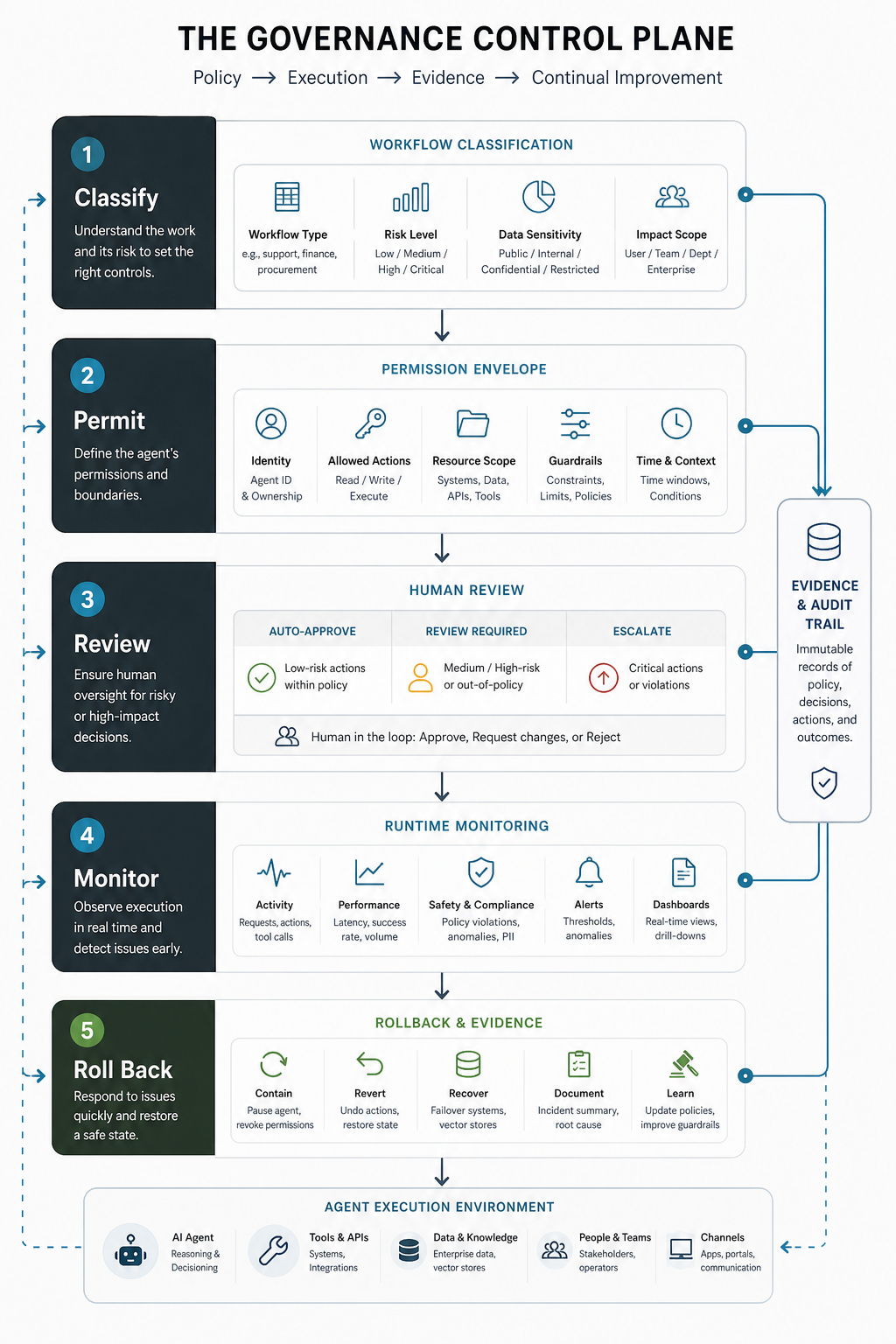
The most useful architecture pattern is a governance control plane around the agent runtime. The agent can plan and act only through controlled interfaces: scoped tools, policy checks, review gates, telemetry, and rollback hooks. This prevents governance from becoming a spreadsheet exercise that no runtime system enforces.
The control plane should answer five questions on every agent run. What workflow is this? What authority is allowed? Does this action require review? What evidence should be logged? What is the rollback route if the result is wrong?
For workflow-heavy teams, this overlaps with AI workflow automation: intake, decisioning, action, review, and monitoring need to be designed as one system. The difference is that agents add dynamic planning and tool selection, so policy checks must operate at each step, not only at the start of the workflow.
Step 1: Inventory Agent Workflows Before Buying Platforms
Start governance with a workflow inventory. List candidate processes, owners, users, systems touched, data sensitivity, external effects, failure modes, and measurable outcomes. A procurement assistant, finance reconciliation agent, sales follow-up agent, claims triage agent, and developer support agent should not share one blanket governance model.
Rank each workflow by value and risk. Strong early candidates are repeatable, well-documented, reversible, and supervised. Weak candidates are ambiguous, politically sensitive, heavily regulated, dependent on undocumented tribal knowledge, or likely to trigger irreversible downstream actions.
The Workflow Automation Opportunity Finder is useful at this stage because it separates automation opportunity from AI excitement. If the process is not repeatable enough for automation, an agent will usually add unpredictability rather than leverage.
Step 2: Define Permission Envelopes
A permission envelope defines what the agent can read, reason over, draft, recommend, execute, and change. It should be narrower than the human user's access and narrower than the platform can technically support. Broad credentials are convenient during demos and dangerous in production.
Use separate modes of authority. Read-only access is different from draft creation. Draft creation is different from submitting for approval. Approval is different from execution. Execution is different from admin-level changes. Each mode should have its own tool interface, logging requirement, and review threshold.
Permission envelopes should also constrain tool inputs. Avoid raw model-generated SQL, shell commands, arbitrary URLs, unrestricted file paths, or free-form API payloads unless a deterministic validator can prove the input is safe for that workflow. The supporting secure AI agent development checklist covers tool permissions, audit logs, and agentic security controls in more depth.
Step 3: Design Human Review That Actually Works
Human review is not a checkbox. It is an interface, a responsibility model, and a workflow timing decision. A reviewer needs enough context to make a decision quickly: the user request, source evidence, proposed tool call, fields that will change, expected impact, confidence level, policy warnings, and rollback path.
Review gates should be risk-based. Low-risk reversible actions may be sampled or auto-approved after measurement. Sensitive, expensive, external, regulated, or irreversible actions should require explicit approval. If reviewers approve everything because the queue is noisy, governance has failed even if the approval screen technically exists.
Design escalation paths as well. The agent should know when to stop and route to an owner: conflicting records, missing source evidence, unusual spend, policy uncertainty, customer complaint risk, privileged access, or a workflow state that does not match expected rules.
Step 4: Monitor Behavior, Not Just Model Quality
Enterprise agent monitoring should include model behavior, tool behavior, workflow outcomes, cost, and user trust. Accuracy scores alone are too narrow. Agents fail through bad tool arguments, unsafe retries, stale context, hidden prompt injection, reviewer over-trust, missed escalation, and business process drift.
Useful metrics include accepted goals, rejected goals, tool attempts, blocked tool calls, validation failures, approval rates, reviewer overrides, downstream reversals, latency, token cost, data-source freshness, customer-impact incidents, and business outcome movement. If an agent is intended to reduce manual triage time, monitor triage quality and cycle time, not just response fluency.
For business cases, connect monitoring to ROI assumptions. The AI Automation ROI Calculator can help teams estimate the hour savings and annual savings they expect, but those assumptions should become runtime measurements after launch.
Step 5: Build a Rollback Plan Before Launch
Rollback is the part of agent governance teams often skip until the first incident. A rollback plan should explain how to pause an agent, revoke tool credentials, disable one tool without disabling the whole system, quarantine memory, reverse database changes, notify affected users, export evidence, and ship regression tests before re-enabling automation.
Not every action can be technically reversed. External emails, customer-facing messages, pricing changes, payments, permission changes, and compliance filings may require compensating actions instead. Governance should classify these before launch so approval gates and communication plans match the real blast radius.
Legacy systems need special attention. If an agent sits on top of brittle internal tools, undocumented admin panels, or aging databases, rollback may be harder than the agent workflow itself. In those cases, use the Legacy Software Modernization Scorecard to evaluate whether stabilization should happen before agent rollout.
Compliance Evidence and Regulated Workflows
Governance is especially important when agent workflows touch hiring, credit, healthcare, insurance, education, critical operations, employee monitoring, or other sensitive decisions. Regulations and frameworks differ by market, but the engineering pattern is consistent: classify risk, document intended use, retain logs, provide human oversight, monitor operation, and prove what happened.
NIST's AI Risk Management Framework organizes AI risk work around Govern, Map, Measure, and Manage functions. That structure maps well to agent governance: establish owners and policies, map workflow risks, measure behavior and impact, then manage risk with controls and response plans.
The EU AI Act also makes human oversight, logging, risk management, documentation, transparency, and monitoring central themes for high-risk AI systems. This article is not legal advice, and not every AI agent is a high-risk AI system, but enterprise teams should design evidence collection early so compliance review is not rebuilt from scratch later.
Vendor and Platform Questions for Agent Governance
When evaluating an agent platform, ask governance questions before asking for a demo of autonomy. Can tools be scoped by role, workflow, tenant, and environment? Can the platform separate planning from execution? Can it require approval before specific actions? Can it log rejected actions and policy failures, not only successful outputs?
Also ask how the platform handles agent memory, prompt/version changes, evaluation sets, incident export, data residency, user impersonation, credential rotation, and vendor-operated agents. If a vendor exposes MCP servers or prebuilt agents inside enterprise software, clarify who owns the permission model, audit trail, and rollback process across connected systems.
Custom builds have different trade-offs. With generative AI development, teams can shape the control plane around their workflow, data, and systems rather than accepting a generic platform model. That flexibility is valuable when business rules, compliance evidence, and integration behavior are more important than a broad prebuilt feature set.
A 90-Day Rollout Plan
Days 1-15: choose the workflow. Pick one workflow with a clear owner, measurable outcome, available data, and manageable risk. Document current cycle time, error patterns, escalation points, and systems touched.
Days 16-30: design the governance control plane. Define the permission envelope, review gates, logging schema, evaluation cases, rollback steps, and launch criteria. Decide what the agent may never do.
Days 31-60: build a supervised pilot. Start with draft-only or read-only behavior where possible. Capture traces, reviewer decisions, blocked actions, tool failures, and user feedback. Fix the workflow before increasing authority.
Days 61-75: expand authority carefully. Allow low-risk actions behind policy checks and monitoring. Keep human review for sensitive or irreversible actions. Compare actual savings, quality, and incident rates against the business case.
Days 76-90: prepare scale or stop. If the pilot works, document the reusable governance pattern and choose the next workflow. If it does not, stop or redesign. Governance should make stopping a weak agent acceptable, visible, and fast.
When to Get Help
Bring in help when agents need to touch production data, customer records, financial actions, regulated workflows, outbound communication, admin systems, or cross-application automations. Those are the points where a prompt issue becomes an operational issue.
NextPage helps teams design AI-agent workflows with scoped permissions, human review, monitoring, RAG and tool controls, and rollout plans. Start with a readiness assessment, then scope the smallest governed agent that can create measurable value without uncontrolled authority.