
Quick Answer: Enterprise AI Readiness Checklist
An enterprise is ready for AI when one business workflow is clear enough to automate or augment, the required data is accessible and governed, integrations can be controlled, users know when humans stay in the loop, and the team can evaluate outputs before the system affects customers, money, safety, or operations. Readiness is not the same as enthusiasm. It is the evidence that an AI idea can move from a demo into a controlled build.
A practical enterprise AI readiness checklist should test ten areas: business case, workflow clarity, data access, data quality, integration permissions, security controls, governance ownership, evaluation design, rollout operations, and change management. If those areas are weak, the next step is not a larger model. It is a narrower pilot, cleaner data boundary, simpler workflow, or stronger operating owner.
If you need a quick first pass, use the AI Agent Readiness Assessment. It scores workflow clarity, data readiness, integration access, and governance notes before you invest in agents, copilots, RAG workflows, or supervised automation.
What Enterprise AI Readiness Really Means
AI readiness is the ability to build, evaluate, deploy, and operate an AI-enabled workflow without relying on luck. It combines product judgment, data engineering, security, process design, and ownership. A team can have access to strong models and still be unready if the workflow is unstable, the data is scattered, permissions are unclear, or nobody owns failures after launch.
NIST's AI Risk Management Framework describes AI risk management as a way to improve trustworthiness across design, development, use, and evaluation. ISO/IEC 42001 frames AI management as a system of policies, objectives, processes, and continual improvement for responsible AI use. For a software team, those ideas translate into build questions: what system are we changing, what risks matter, what evidence will we monitor, and who can stop or adjust the AI workflow?
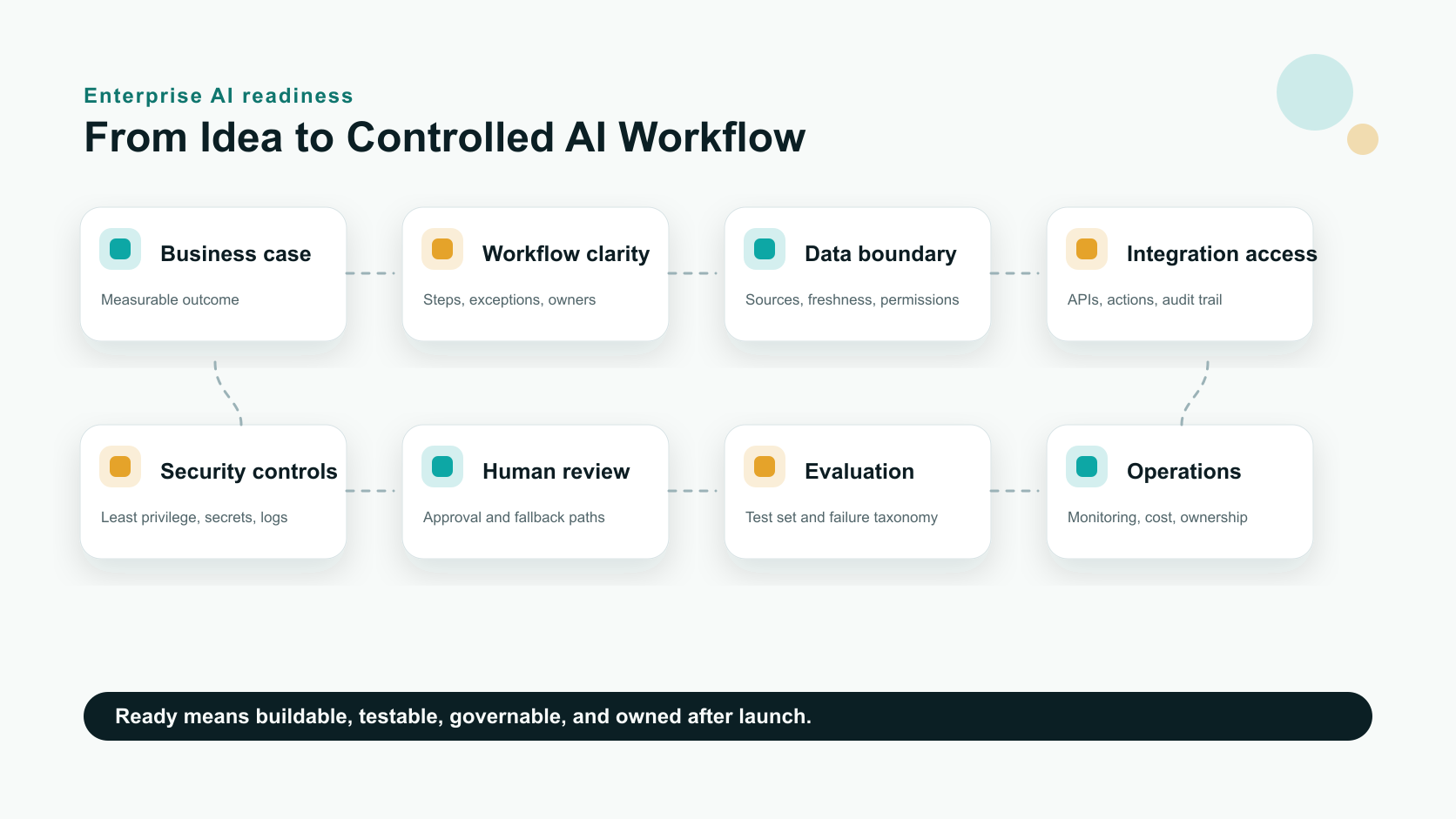
The 10-Point Enterprise AI Readiness Checklist
Use this checklist before funding a proof of concept or asking a vendor for a production estimate.
| Readiness area | What good looks like | Warning sign |
|---|---|---|
| Business case | One measurable outcome such as faster triage, lower support effort, better retrieval, or fewer manual handoffs | The idea is described only as "add AI" |
| Workflow clarity | The current process, exceptions, approval points, and handoffs are documented | Teams disagree on how the work happens today |
| Data access | Required documents, records, APIs, and permissions are known | Critical knowledge lives in inboxes, spreadsheets, or unowned drives |
| Data quality | Data has enough structure, freshness, ownership, and cleanup rules for the use case | Teams expect the model to fix stale or contradictory source data |
| Integration access | The system can read, write, or request actions through controlled APIs | The AI needs broad credentials or manual copy-paste to work |
| Security controls | Roles, secrets, data boundaries, logging, and least-privilege permissions are planned | The demo uses production data with unclear retention or access rules |
| Human review | High-impact actions have approvals, confidence thresholds, and fallback paths | The AI is expected to decide without escalation rules |
| Evaluation | There is a test set, acceptance criteria, failure taxonomy, and review cadence | The team only checks a few sample prompts |
| Operations | Monitoring, incident response, model/version changes, and cost visibility have owners | Nobody owns the system after launch |
| Adoption | Users know what the AI does, when to trust it, and how to override it | The rollout assumes behavior change will happen automatically |
How to Score AI Readiness
A simple scoring model is enough for the first decision. Score each area from 0 to 2: 0 means missing or risky, 1 means partially ready, and 2 means ready enough for a controlled build. A score below 10 usually means the team should clean up the workflow or data boundary before building. A score from 10 to 15 can support a narrow pilot. A score from 16 to 20 can support a production discovery and architecture phase.
The score should not be used to approve every AI idea. It should help compare candidate workflows. A low-risk internal knowledge assistant may be ready with a lower score than an autonomous workflow that updates customer records, triggers payments, or sends regulated communications.
Data Readiness and Knowledge Access
Most enterprise AI projects slow down because the data boundary is vague. Before choosing a model, list the sources the system needs: policies, product docs, customer records, tickets, contracts, transactions, ERP data, CRM data, files, emails, or warehouse tables. Then decide whether the AI should retrieve, summarize, classify, recommend, draft, or act on that information.
For knowledge-heavy workflows, retrieval architecture is often more important than model choice. LLM development work may include RAG, permissions-aware search, structured business data, evaluation sets, and integration with the systems where work already happens. If the source data is unowned or contradictory, the readiness task is to fix the corpus and access model before building a polished chat interface.
Workflow and Integration Readiness
An AI system needs a workflow narrow enough to test. "Improve operations" is too broad. "Classify inbound support requests, retrieve policy context, draft a response, and route low-confidence cases to a team lead" is buildable. That level of detail reveals the required integrations, permissions, exception states, and human review points.
This is where AI development services should feel like software delivery, not a model demo. The team needs API contracts, audit logs, background jobs, admin controls, observability, and rollback. If the workflow is likely to become an agent, compare the scope with practical agent patterns in What Is Agentic AI? and the budget drivers in AI Agent Development Cost.
Security, Governance, and Human Review
Governance becomes real when it changes how the system is built. The team should know which data can enter prompts, which systems the AI can access, which actions need approval, how outputs are logged, and how users challenge or override the result. Sensitive workflows also need retention rules, vendor review, secret management, access reviews, and incident response planning.
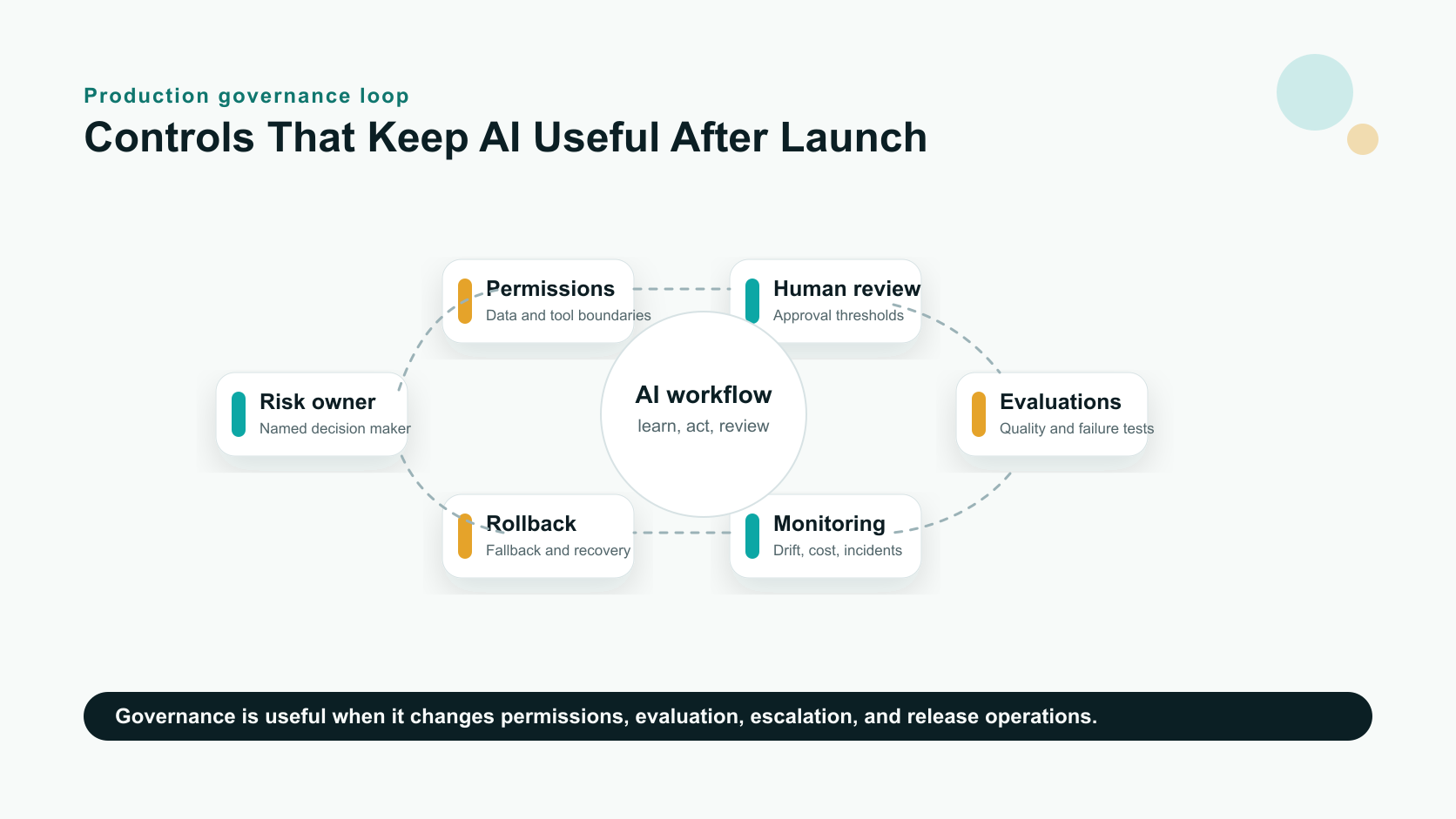
NIST's Generative AI Profile highlights that generative AI introduces risks that should be identified and managed according to the organization's goals and priorities. ISO/IEC 42001 similarly emphasizes a management system for AI-related risks and opportunities. In practical terms, readiness means the project has a risk owner, not just a model owner.
Evaluation, Monitoring, and Operations
Evaluation should start before launch. Build a small test set from real examples, expected answers, unacceptable failures, edge cases, and policy constraints. For a support assistant, that might include ticket categories, policy lookups, escalation cases, tone requirements, and refusal cases. For an internal copilot, it may include retrieval accuracy, citation quality, permission boundaries, and task completion.
Production monitoring should track more than uptime. Watch answer quality, retrieval misses, escalation rates, user overrides, latency, token or model cost, data-source freshness, drift in common requests, and incidents. For generative workflows, generative AI development should include evaluation, moderation, prompt and retrieval design, and operating controls as first-class work.
When to Pilot, Harden, or Pause
The readiness decision should lead to one of three actions.
- Pilot: use a narrow, reversible workflow with limited users, controlled data, and clear success metrics.
- Harden: move a proven pilot toward production by adding permissions, monitoring, evaluation, support workflows, and governance evidence.
- Pause: fix source data, workflow ownership, API access, security controls, or user adoption risks before building.
Pausing is not failure. It is often the lowest-cost way to prevent an AI initiative from becoming an expensive demo. The strongest pilots usually start where the business workflow is painful, repetitive, measurable, and safe to supervise.
How NextPage Helps With AI Readiness
NextPage helps teams turn AI interest into a buildable plan. That can mean scoring candidate workflows, mapping data and integration readiness, designing a RAG or agent architecture, building evaluation sets, and defining the human-review and monitoring model needed for production.
Start with the AI Agent Readiness Assessment if you want a fast check. If the workflow is ready for hands-on delivery, NextPage can help with AI development services, LLM development, and generative AI development that connects the model layer to real data, approvals, systems, and operating controls.