
Quick Answer: How Much Does It Cost To Hire Dedicated Developers In India?
In 2026, a realistic planning range for hiring dedicated developers in India is roughly $15-$30 per hour for junior engineers, $25-$50 per hour for mid-level engineers, and $40-$80+ per hour for senior, lead, cloud, AI, or architecture-heavy roles. Monthly full-time equivalents often land between about $2,400 and $10,000+ per developer before adding project management, QA, security, product ownership, onboarding, and vendor governance.
Those numbers are useful only as planning bands. The real decision is whether you are buying a person, a managed delivery setup, or a complete product pod. A low hourly rate can become expensive if the team lacks senior review, QA coverage, clear communication, replacement terms, or ownership of delivery outcomes.
If you want a managed India-based setup rather than loose staff augmentation, start with the hire dedicated developers in India service path or model a first team with the dedicated India team cost calculator.
When A Dedicated Developer Model Makes Sense
A dedicated developer model works best when you need steady engineering capacity for months, not a one-off task. It fits SaaS teams extending a roadmap, founders building an MVP after validation, agencies needing reliable delivery capacity, and companies modernizing internal tools while their internal team stays focused on core operations.
The model is weaker when the scope is tiny, the work is undefined, or the business cannot provide timely product decisions. Dedicated developers are not a substitute for product clarity. They are most effective when the buyer can define outcomes, prioritize a backlog, review work regularly, and make decisions about tradeoffs.
India is attractive because the talent pool is broad across web, mobile, backend, QA, cloud, and AI-adjacent engineering. But the market is uneven. The difference between a successful engagement and a frustrating one usually comes down to vetting, communication, project governance, code quality standards, and how fast the vendor can resolve underperformance.
Compare The Three Common Team Models
Before comparing prices, decide which operating model you need. The wrong model can make even a strong developer underperform.
| Model | Best for | What you manage | Main risk |
|---|---|---|---|
| Staff augmentation | Adding one or two developers to an existing internal team. | Architecture, backlog, code review, QA, sprint rituals, and delivery ownership. | Low cost can hide high management load. |
| Managed dedicated team | Ongoing product work where you want engineers plus PM, QA, process, and replacement support. | Business priorities, product decisions, and acceptance criteria. | Vendor must be strong enough to own delivery discipline, not just staffing. |
| Product pod | MVPs, feature squads, modernization streams, or roadmap ownership with cross-functional delivery. | Strategy, budget, domain input, and executive decisions. | Costs more than raw developers but usually reduces coordination risk. |
If you already have a CTO, tech lead, QA process, and sprint rhythm, staff augmentation can work. If you are missing those layers, a managed dedicated team is usually safer. If you need outcomes rather than capacity, a product pod or software outsourcing in India model may be the better fit. For a broader contract comparison, use the fixed price, time and material, and dedicated team guide before locking the commercial model.
A practical rule: choose raw staff augmentation only when your internal team can absorb the developer immediately. Choose a managed dedicated team when the vendor must supply sprint hygiene, code review, QA ownership, reporting, and replacement coverage. Choose a product pod when the buyer wants roadmap outcomes rather than individual capacity.
What Should Be Included In The Monthly Cost?
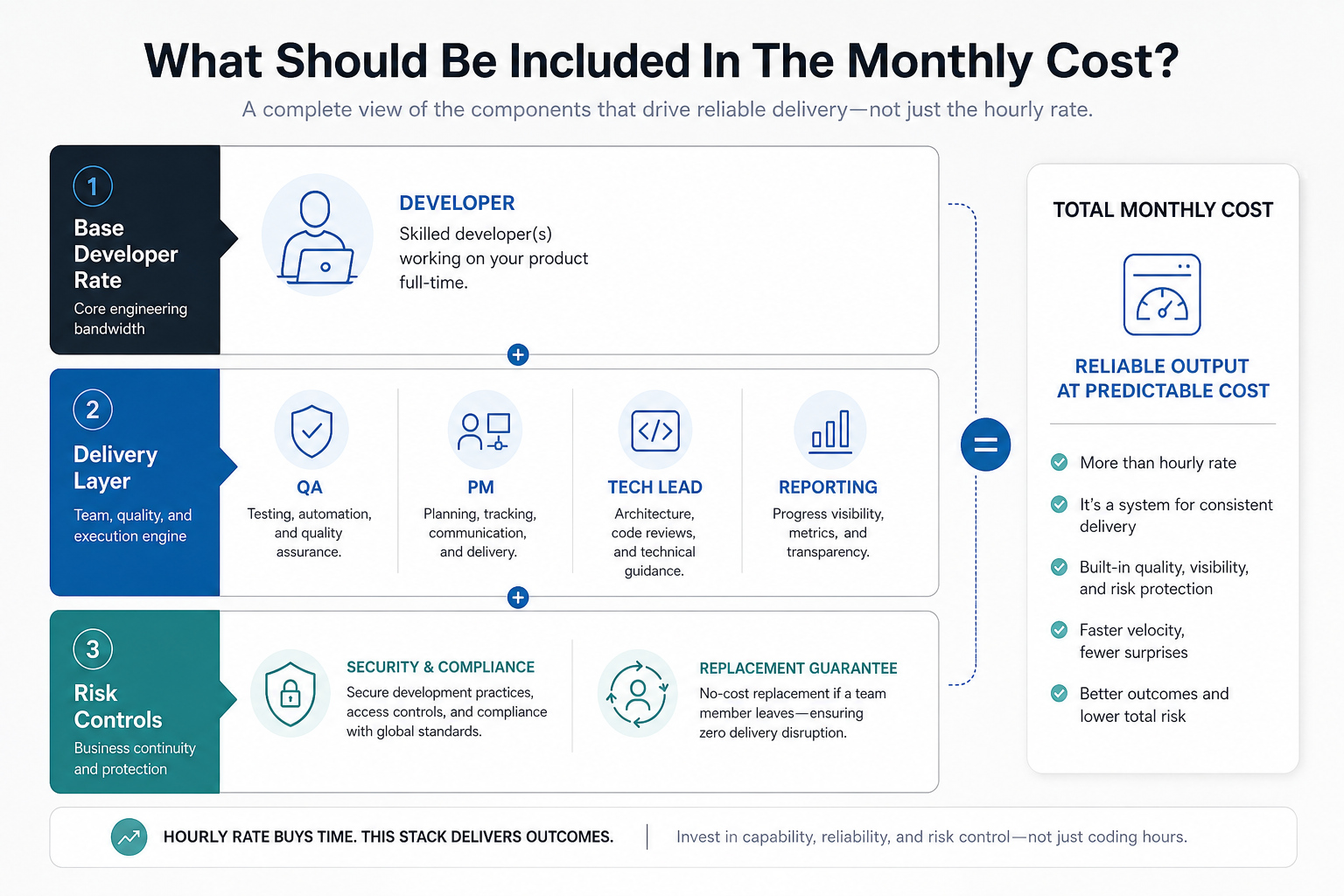
A monthly developer price should not be evaluated in isolation. Ask what is included around the developer. A strong engagement may include technical screening, onboarding, PM support, QA process, engineering leadership, documentation, code review, security practices, communication rituals, replacement coverage, and offboarding support.
For a single mid-level developer, a lean arrangement may only include the engineer and basic account management. For a two-to-five-person team, the monthly plan should usually include some delivery leadership, QA coverage, sprint planning, demos, and reporting. For a critical product team, you may also need architecture review, DevOps support, security checks, and product management.
That is why hourly comparisons can mislead. A developer at $28 per hour with no review, QA, or PM layer can cost more in rework than a $40 per hour developer inside a better delivery system. The buyer should compare total cost of reliable output, not raw seat price.
A Practical Cost Planning Table
Use these ranges for early planning, then validate them against the actual stack, seniority, overlap hours, and delivery model.
| Role or setup | Planning range | Use it when |
|---|---|---|
| Junior developer | $15-$30/hour | You have senior oversight and need help with well-defined tasks, QA support, bug fixes, or low-risk features. |
| Mid-level developer | $25-$50/hour | You need feature delivery, integrations, backend/frontend work, and predictable sprint execution. |
| Senior developer or lead | $40-$80+/hour | You need architecture decisions, code review, complex integrations, performance work, or leadership for others. |
| Specialist roles | Premium above standard senior rates | You need AI/ML, data engineering, cloud-native, security, DevOps, or niche platform experience. |
| Managed team layer | Often priced as PM/QA/leadership allocation | You need delivery accountability, not only developer time. |
For a simple planning exercise, multiply hourly rate by 160 hours for one full-time developer. Then add the delivery layer: QA, PM, senior review, infrastructure, paid tools, communication overlap, and any specialist support. This gives a more realistic monthly budget than a rate-card comparison. If you are shaping a multi-person pod, compare the result with the dedicated development team cost in India guide so team-level roles are not missed.
What Drives The Price Up Or Down?
Seniority is the obvious driver, but it is not the only one. Rates rise when the role requires complex architecture, AI or data skills, cloud infrastructure, security knowledge, regulated-domain experience, strong English communication, timezone overlap with the US or Europe, or leadership of other engineers.
Rates can be lower when the work is routine, well documented, testable, and managed by your internal team. They should not be lower because the vendor skips vetting, QA, documentation, or replacement guarantees. Those shortcuts usually surface later as delivery risk.
Contract length also matters. Longer commitments can reduce monthly cost, but they should include performance checkpoints. A flexible month-to-month model may cost more but can be useful during discovery or early MVP work. The best structure often starts with a short paid trial or discovery sprint, then scales once the working model is proven.
How To Vet Dedicated Developers Before You Commit
Vetting should test the actual work the developer will do. Resume screening is not enough. Ask for relevant project history, code review habits, debugging approach, communication style, and examples of tradeoffs they made under constraints. For senior developers, evaluate architecture judgment and ability to simplify complexity.
A useful interview sequence includes a role scorecard, technical screening, practical discussion, communication check, and a short paid work sample when possible. The goal is not to run an academic exam. It is to answer whether this person can deliver in your context with your stack, your pace, and your team structure.
For managed teams, also interview the delivery owner. Ask how sprint planning works, how QA is handled, how blockers are escalated, how code review is enforced, how replacements work, and who owns security and IP hygiene. A vendor that can only talk about resumes is not offering a managed team. The same diligence applies to broader offshore software development checklist items such as IP transfer, access controls, and release governance.
Onboarding Plan For The First 30 Days
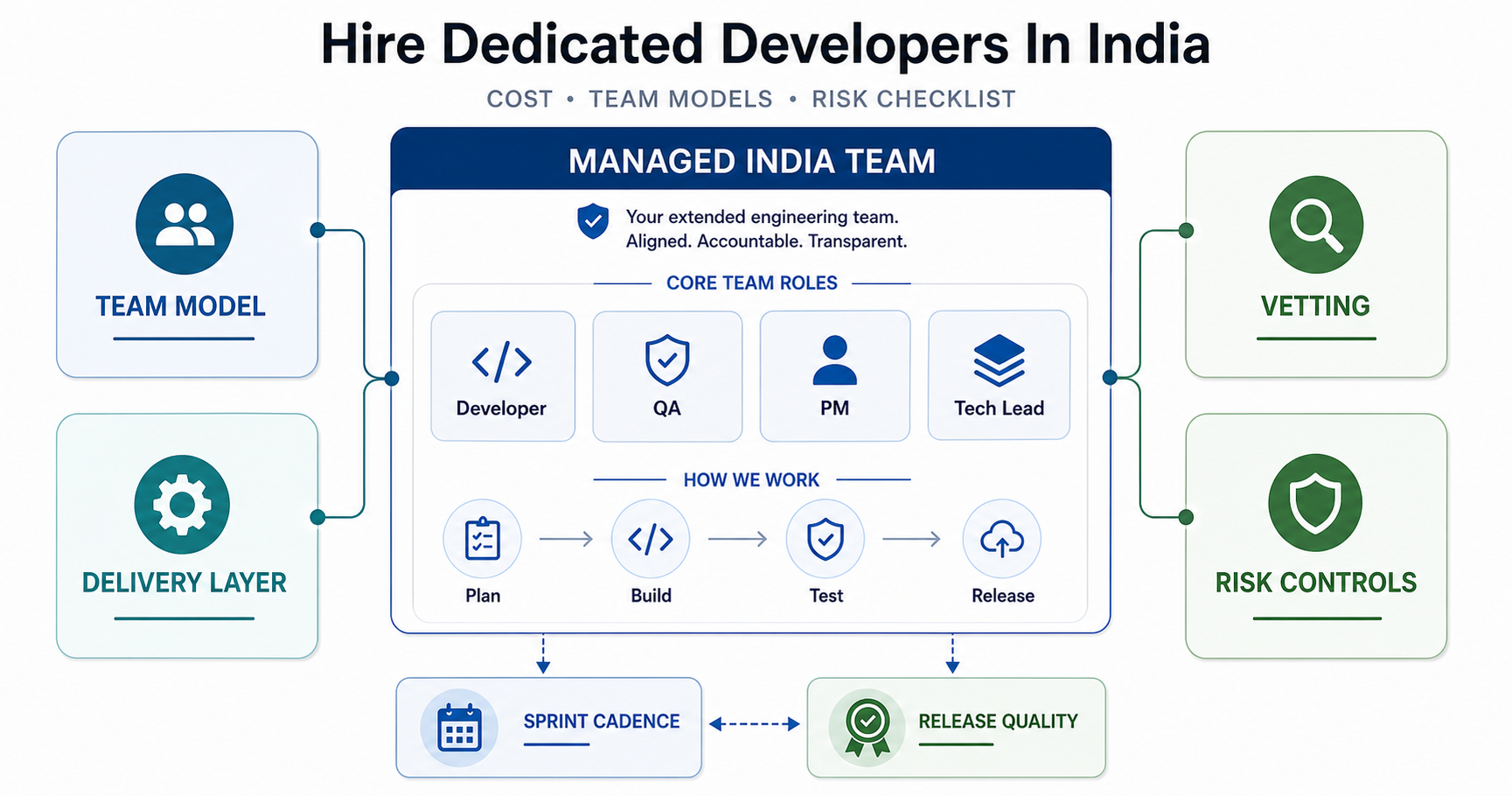
The first month should prove the operating model. Do not throw a new developer at a vague backlog and wait for velocity. Create a structured ramp-up.
In week one, confirm repo access, environment setup, architecture overview, communication channels, working hours, security rules, and the first small task. In week two, assign a bounded feature or bug with clear acceptance criteria and review the first pull request carefully. In week three, evaluate speed, code quality, communication, and QA handoff. In week four, decide whether to continue, replace, add roles, or adjust the model.
For a larger setup, define the rituals early: weekly planning, daily async updates, demo cadence, backlog grooming, QA signoff, release notes, and monthly capacity review. NextPage's your team in India model is designed around this kind of managed operating rhythm.
Risk Checklist Before Signing A Dedicated Team Contract
- Role clarity: each role has a scorecard, expected seniority, responsibilities, and evaluation criteria.
- Delivery ownership: someone owns sprint planning, blocker escalation, QA flow, and release readiness.
- Code quality: pull requests, code review, branching, testing, and documentation standards are explicit.
- Security and access: repo, cloud, database, secrets, and production permissions follow least-privilege rules.
- IP and confidentiality: contract terms cover ownership, NDA, subcontracting, asset use, and offboarding.
- Replacement terms: the vendor explains what happens if a developer underperforms or leaves.
- Timezone overlap: meeting hours and async update expectations are practical for both sides.
- Reporting: you can see sprint progress, risks, open decisions, and upcoming capacity needs.
Vendor Risk Scorecard Before You Scale
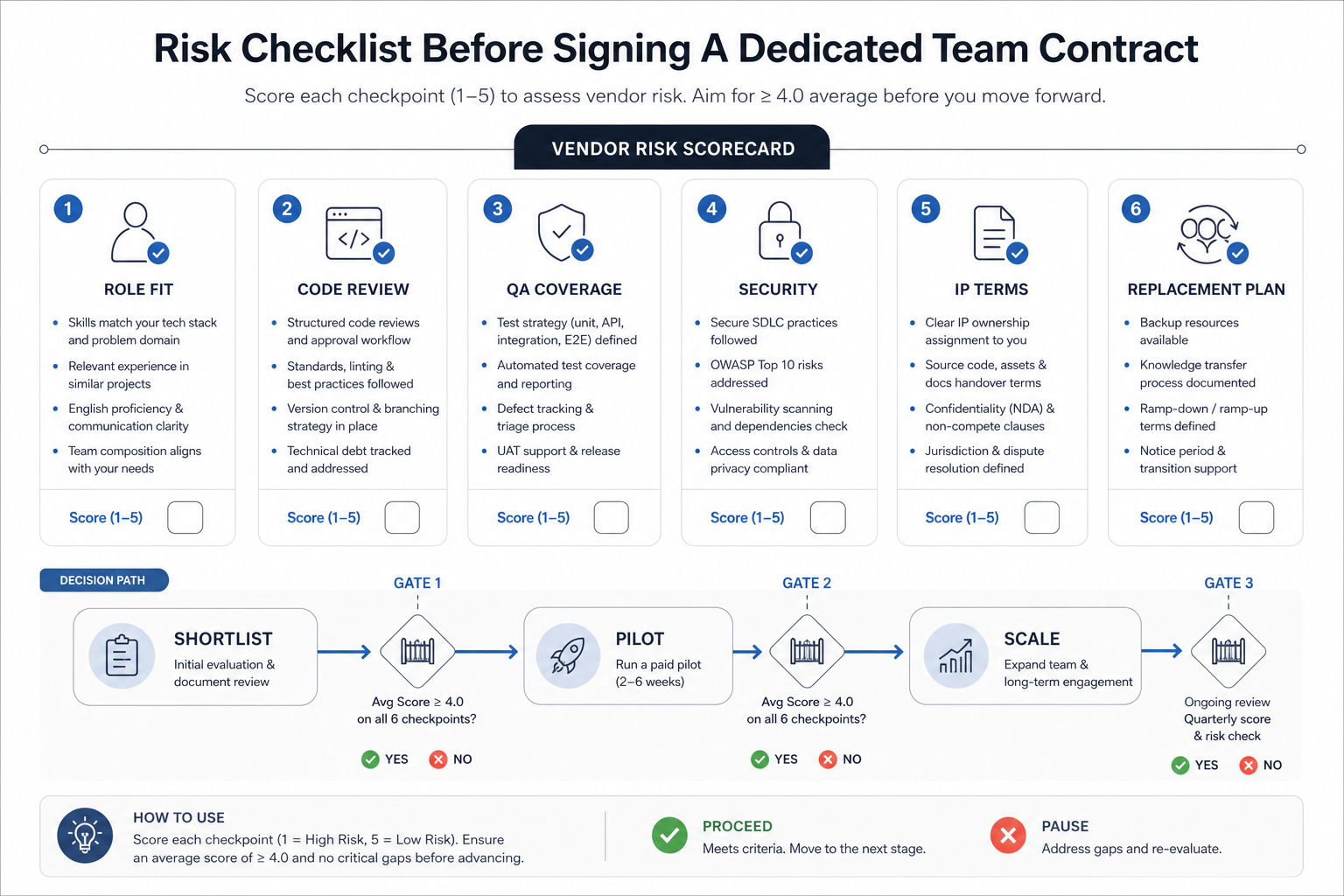
Before you move from interviews to a long contract, score the vendor across six checkpoints: role fit, code review, QA coverage, security, IP terms, and replacement plan. A strong partner should be able to show how each checkpoint works in practice, not only describe it in sales language.
Use a short paid pilot when the risk is high or the role is senior. The pilot should include a real repository, a bounded feature or fix, pull-request review, QA handoff, and a demo. If the average score is below 4 out of 5 across the checkpoints, pause and resolve the gaps before scaling the team.
Red Flags When Hiring Dedicated Developers
Be cautious when a vendor promises senior talent at unusually low rates, refuses to let you interview developers, cannot explain QA practices, uses vague contract language around IP, avoids naming who manages delivery, or pushes a large long-term contract before a small working phase.
Also watch for overstaffing. Some teams add developers before requirements, architecture, and release process are mature enough to absorb them. More people can make delivery slower if the operating model is weak. Scale after the first developer or small team proves the cadence.
How NextPage Helps Build A Dedicated India Team
NextPage positions dedicated developers as part of a delivery system. The goal is not just to add people. It is to create a team that can understand your product, work inside a clear sprint rhythm, protect code quality, and scale without forcing you to manage every operational detail.
Depending on the engagement, that can mean one developer added to your existing workflow, a managed pod with QA and PM support, or an India-based team that handles roadmap delivery under your product direction. The right model depends on your current leadership capacity, technical risk, timeline, and budget.
If you are comparing India-based developers now, use the cost calculator to estimate the first team shape, then plan a dedicated developer team with NextPage around the roles, governance, and risk controls your project actually needs.