
Quick Answer: What Is Narrow AI for Business?
Narrow AI is artificial intelligence built for a specific task or a tightly bounded workflow. It can classify a support ticket, detect a risky transaction, forecast demand, recommend the next best product, extract fields from a document, or summarize a known knowledge base. It does not understand every business problem, set its own strategy, or move safely outside the scope it was designed to handle.
That limitation is exactly why narrow AI is useful in business. A focused system is easier to measure, govern, integrate, and improve. Instead of asking whether AI can transform everything, the better question is: which repeated decision, prediction, classification, or content workflow can AI improve enough to justify implementation?
For most companies, practical AI adoption starts with narrow AI. IBM describes narrow AI as the only AI capability category that exists in deployed form today, while Google Cloud separates traditional prediction/classification AI from generative AI use cases. The winning business use cases have clear inputs, enough historical or operational data, a measurable output, and a human owner who knows what should happen when confidence is low.
Why Narrow AI Is the AI Most Companies Actually Use
Business conversations about AI often jump to autonomous agents or general intelligence. Real deployments are usually narrower. A model scores invoices for exception risk. A classifier routes inbound emails. A recommendation system ranks products. A retrieval workflow helps staff search policies. A forecasting model estimates inventory needs for the next week.
These systems create value because they sit inside existing operations. They do not need to know everything. They need to perform one job reliably enough to reduce manual effort, improve response speed, catch patterns earlier, or help teams make a better decision.
This is why narrow AI is not a lesser category for business teams. It is the practical category. A scoped AI system can be tested against historical examples, monitored in production, and improved as the workflow changes. That makes it a better starting point than open-ended AI experiments with unclear ownership.
Narrow AI Examples by Business Workflow
The easiest way to understand narrow AI is to map examples to work your team already does. Each example below has a defined input, a specific AI task, and an outcome the business can measure.
| Business workflow | Narrow AI task | Example output | What to measure |
|---|---|---|---|
| Customer support | Classify and route requests | Priority, topic, escalation path | First response time, resolution time, deflection quality |
| Finance operations | Detect anomalies | Risk score for transactions or invoices | False positives, missed issues, review hours saved |
| Sales operations | Score and enrich leads | Fit score, missing fields, next action | Qualified pipeline, handoff speed, conversion lift |
| Retail and ecommerce | Recommend products | Personalized ranking or bundle suggestion | Conversion rate, average order value, retention |
| Supply chain | Forecast demand | Expected quantity by location or SKU | Stockouts, overstock, forecast error |
| Document-heavy teams | Extract structured data | Fields from PDFs, forms, contracts, or claims | Processing time, accuracy, exception rate |
| Product teams | Detect behavior patterns | Churn risk, feature adoption signals, cohort segments | Retention, activation, support load |
These are narrow AI examples because each system has a bounded job. The model is not trying to run the company. It is improving one repeated judgment or task.
How Narrow AI Works in a Business System
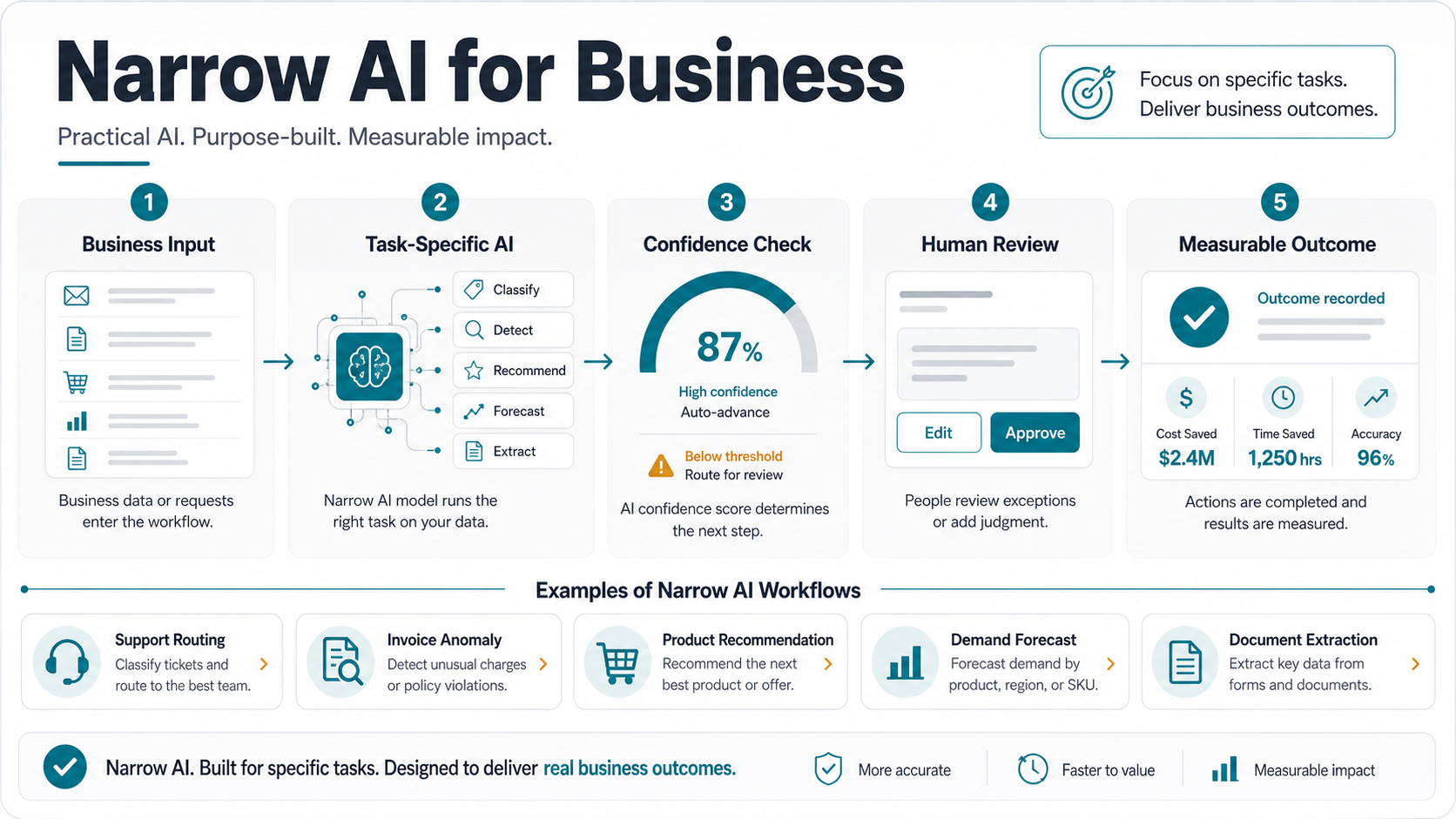
A useful narrow AI system usually has five parts. First, the workflow has to be defined clearly enough that the system knows what input it receives and what output it should produce. Second, the team needs representative data or examples. Third, the model or AI service must be selected for the task: classification, prediction, extraction, ranking, generation support, or anomaly detection. Fourth, the system must connect to the tools where people actually work. Fifth, performance has to be measured over time.
This is where many AI pilots fail. The model may be capable, but the workflow is vague, the data is inconsistent, or no one defines what a good output means. Narrow AI is not just a model choice. It is a product and operations choice.
If the workflow is repeatable and the value is measurable, an AI automation ROI calculator can help estimate whether the hours saved and quality improvements justify a prototype. Teams still comparing candidate workflows can use the Workflow Automation Opportunity Finder to rank repeatability, data readiness, risk, and value before choosing a first AI pilot.
Where Narrow AI Fits Best
Narrow AI is strongest when a task has repeated patterns and a clear success measure. It performs well when examples are available, the desired output can be checked, and the system can be retrained or adjusted as conditions change.
- High-volume classification: ticket topics, document types, product categories, quality issues, or risk levels.
- Prediction from historical data: churn, demand, lead fit, fraud risk, equipment maintenance, or delivery delays.
- Structured extraction: invoice fields, claim details, contract terms, onboarding documents, or compliance records.
- Recommendation and ranking: products, content, next-best actions, support articles, or internal knowledge results.
- Guided content assistance: summaries, draft responses, call notes, research briefs, or knowledge-base answers with review.
- Monitoring and anomaly detection: unusual usage, transaction risk, operational exceptions, or security signals.
These patterns are often good candidates for AI development services because they need more than a standalone prompt. They need data access, workflow design, evaluation, permission rules, and production monitoring. When the use case is mainly about routing tasks, approvals, and system handoffs, compare the scope with business process automation services before assuming a model-heavy build is required.
Narrow AI vs Generative AI vs AI Agents
Narrow AI describes the scope of the system. Generative AI describes a kind of model that creates text, images, code, or other content. AI agents describe systems that can plan steps and use tools toward a goal. These categories overlap, but they are not the same thing.
A generative AI support assistant is still narrow if it only answers support questions from an approved knowledge base. A lead-enrichment agent is still narrow if it only researches a lead, updates a CRM, and asks for review before sending anything. A machine learning model that predicts churn is narrow even if it uses no generative AI at all.
The practical question is not which label sounds most advanced. The practical question is which workflow needs classification, prediction, retrieval, generation, tool use, or a combination. If the system depends on retrieval, evaluation, and workflow automation, LLM development may be the right path. If it depends on forecasting, scoring, or pattern detection from structured data, machine learning development may be a better fit.
For a deeper comparison, see Generative AI vs AI Agents vs Agentic AI.
The Limits of Narrow AI Business Teams Should Plan Around
Narrow AI is powerful because it is bounded, but the boundaries matter. A system trained to classify support tickets will not automatically understand pricing strategy. A recommendation engine can optimize for clicks while harming margin. A document extractor can miss edge cases when a vendor changes a template. A chatbot can answer confidently when the underlying knowledge is stale unless retrieval and review controls are in place.
Business teams should plan around six limits.
- Scope rigidity: the system works inside the task it was designed for and needs redesign or retraining when the task changes.
- Data dependency: biased, incomplete, old, or inconsistent data will limit output quality.
- Confidence gaps: the system needs thresholds, escalation paths, and review queues for uncertain cases.
- Interpretability needs: regulated or high-stakes workflows may require explainable scoring, audit logs, and documented decisions.
- Integration complexity: AI value often depends on CRM, ERP, help desk, product, document, or data warehouse access.
- Operational drift: customer behavior, policies, products, and data formats change, so monitoring cannot be optional.
These limits should not stop AI adoption. They should shape the implementation plan.
When Off-the-Shelf AI Is Enough
Not every narrow AI use case needs custom development. Off-the-shelf tools are often the right starting point when the task is common, the risk is low, the workflow can adapt to the tool, and the data does not require deep integration. Examples include transcription, basic meeting summaries, first-pass copy drafts, simple image tagging, generic analytics summaries, and standard chatbot widgets.
The danger is treating a generic tool as if it understands proprietary operations. If the tool cannot access the right data, follow your rules, explain its decisions, or fit into the handoff process, the team may save time in one step while creating rework somewhere else.
Use off-the-shelf AI for learning and low-risk productivity. Move toward configured or custom AI when the workflow affects revenue, customer experience, compliance, operational cost, or decisions your team must defend.
When to Build Custom Narrow AI
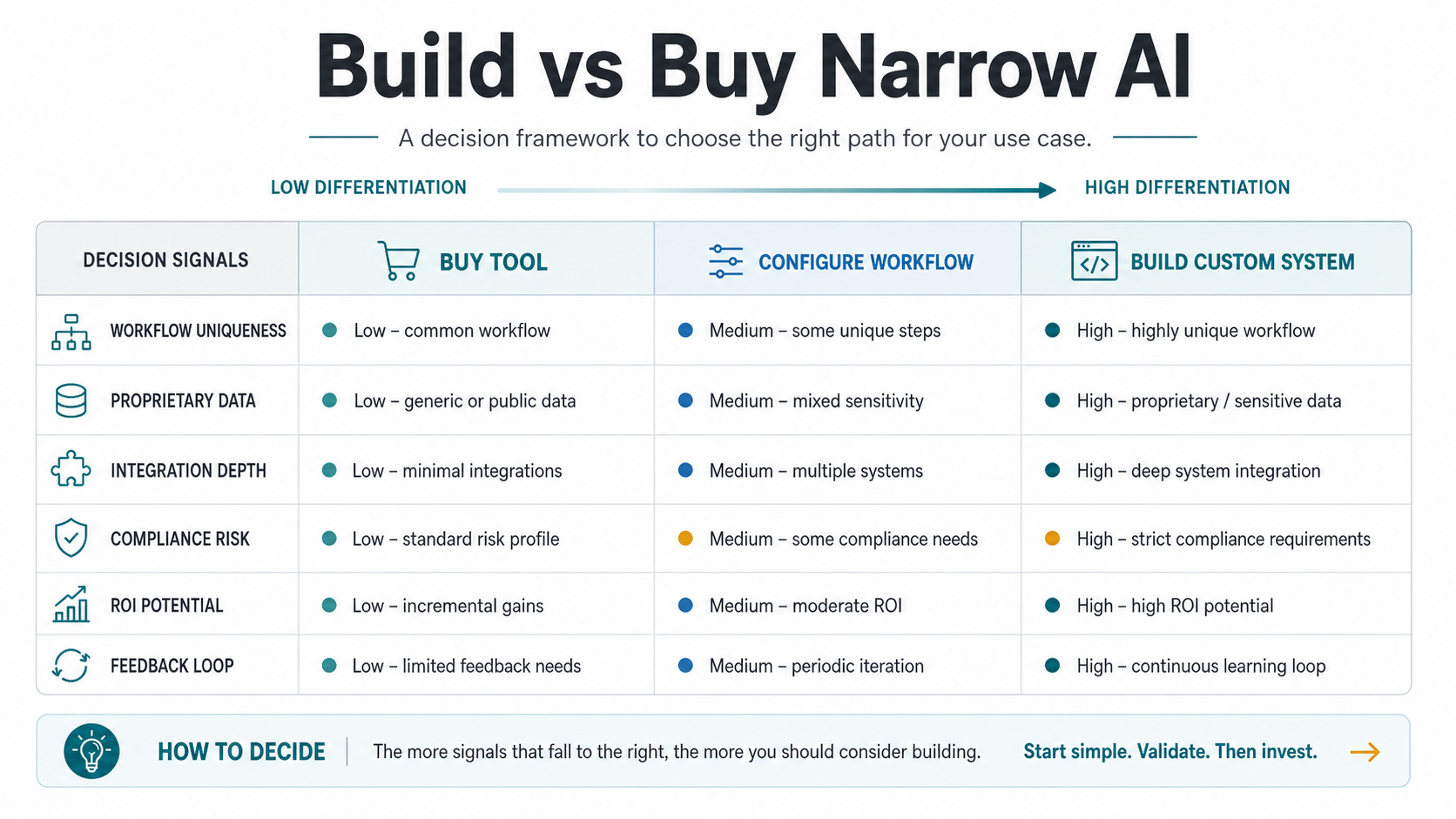
Custom narrow AI is worth considering when the task is important enough that generic tools cannot capture the business logic. The strongest cases usually have proprietary data, repeated manual work, measurable cost or revenue impact, and a workflow that needs integration with existing systems.
Build or configure a custom system when at least some of these conditions are true:
- The workflow depends on internal data, domain rules, permissions, or exception handling.
- Accuracy needs to be measured against your own examples, not a generic benchmark.
- The AI output must trigger actions in CRM, ERP, support, finance, operations, or product tools.
- The use case has compliance, audit, security, or customer-risk requirements.
- The business needs a feedback loop so reviewers can improve the system over time.
- The expected savings, speed, or revenue lift is large enough to justify a production implementation.
This is where AI development services should start with workflow scoping, data review, prototype design, evaluation criteria, and an operating plan. A narrow AI project is not done when the model answers once. It is done when the system improves a real workflow reliably.
A Practical Selection Framework
Before building, score the use case across six questions.
- Is the workflow specific? Name the input, decision, output, owner, and success metric.
- Is there enough data or examples? The team needs historical records, labeled examples, documents, or expert-reviewed samples.
- Can quality be evaluated? Define accuracy, precision, recall, review time, cost savings, or acceptance criteria.
- What happens when AI is uncertain? Low-confidence cases need routing, escalation, or human approval.
- Where must it integrate? Identify the systems of record and the tools where users will see or act on the output.
- Does the ROI justify production work? Estimate hours saved, risk reduced, speed improved, or revenue enabled.
If the answers are vague, start with discovery or a prototype. If the answers are clear, the use case may be ready for implementation. Teams exploring more autonomous workflows can also use the AI Agent Readiness Assessment to check data readiness, workflow clarity, integration access, and review controls.
Turn Narrow AI Examples Into a Production Roadmap
A useful narrow AI shortlist should become a delivery roadmap, not a gallery of possible tools. Start with one workflow where the business can name the input, decision, owner, review path, system of record, and success metric. Then decide whether the first release should prove data quality, model quality, integration value, or operating governance.
| Roadmap step | Decision to make | Evidence to collect |
|---|---|---|
| Workflow discovery | Which repeated task deserves AI support first? | Current volume, cycle time, handoffs, error patterns, and owner pain |
| Data readiness | Can the system see representative examples? | Sample records, labels, documents, edge cases, permissions, and quality gaps |
| Prototype | Can AI meet the quality bar on real examples? | Acceptance criteria, failure categories, confidence thresholds, and review notes |
| MVP integration | Where should the output appear in daily work? | CRM, ERP, help desk, product, warehouse, dashboard, or admin workflow access |
| Production controls | How will the system stay trustworthy? | Monitoring, audit logs, feedback loop, retraining plan, fallback path, and cost controls |
The roadmap should also show where product software and operations meet. NextPage's WorkLoom operations platform case study is a useful reference for teams thinking about AI inside a workflow-heavy operations surface, because the value depends on task state, accountability, dashboards, and repeatable handoffs rather than a model alone.
How NextPage Approaches Narrow AI Projects
NextPage treats narrow AI as a production workflow, not a demo. The work starts by choosing a specific business outcome and identifying the repeated task where AI can help. Then we review the available data, define quality targets, design the human review path, and decide whether the right approach is a configured LLM workflow, a machine learning model, a retrieval system, an automation pipeline, a lightweight AI agent, or a hybrid.
For some teams, the best first step is a small prototype that proves whether the model can meet the target. For others, it is a data readiness sprint or workflow map. For mature teams, it may be a production integration with monitoring and feedback loops.
If you have a practical AI use case in mind, start with the workflow: what decision should become faster, more consistent, or less manual? From there, NextPage can help decide whether to buy, configure, or build the narrow AI system that fits. If the workflow may need tool use, memory, or multi-step autonomy, start with AI agent development readiness before giving the system authority to act.