
Quick Answer: What Does An OTT App Cost?
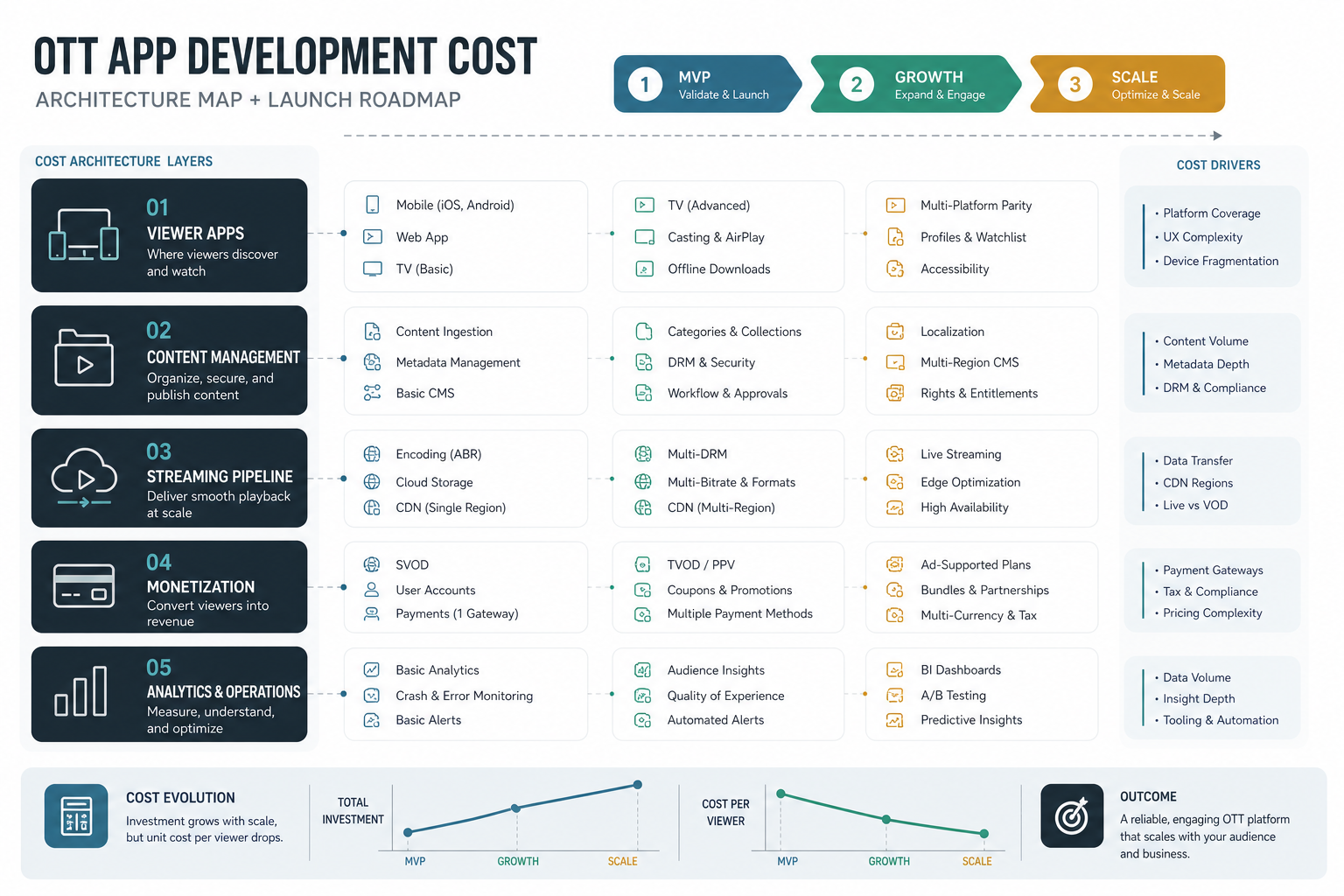
An OTT app usually costs more because of the streaming system around the app, not because video screens are hard to draw. A focused MVP for one or two platforms, a basic content library, user accounts, subscriptions, secure playback, analytics, and admin tooling can start around $35,000-$80,000. A stronger growth release with more device coverage, richer content management, better recommendations, multi-plan subscriptions, coupons, support workflows, and a more resilient video pipeline often lands around $80,000-$200,000. A scale-ready OTT product with smart TV apps, live streaming, multi-region CDN planning, DRM rules, advanced entitlements, ad-supported plans, data pipelines, and operational dashboards can move beyond $200,000 and keep growing with content volume and traffic.
The real estimate depends on five decisions: where viewers will watch, how content is prepared and delivered, how access is monetized, how rights and security are enforced, and how much the business needs to learn from viewer behavior. If you need a directional range before a full technical scope, start with the custom software cost estimator and then refine the streaming-specific assumptions.
Why OTT Budgets Expand So Quickly
OTT platforms combine product design, mobile app development, media infrastructure, billing, content operations, analytics, and customer support. Each layer can be simple at launch or complicated enough to become its own project.
- Platform coverage: iOS, Android, web, smart TV, Fire TV, Roku, Apple TV, Chromecast, and gaming consoles all have different UI, QA, playback, release, and support costs.
- Video pipeline: ingestion, transcoding, adaptive bitrate ladders, HLS or DASH packaging, storage, CDN delivery, captions, thumbnails, and preview clips must be planned before content scales.
- Monetization: subscriptions, free trials, coupons, bundles, pay-per-view, ads, rentals, tax, invoicing, refunds, and entitlement rules create backend complexity.
- Rights and security: DRM, regional availability, download limits, concurrent stream limits, account sharing controls, and license rules affect architecture and user experience.
- Operations: editors, support teams, finance teams, and growth teams need dashboards, audit trails, moderation, payment events, quality-of-experience monitoring, and release controls.
That is why a good OTT estimate starts with a product boundary, not a feature wish list. The first release should prove that the audience wants the content and that the business can operate the service reliably.
OTT Cost Bands by Launch Phase
| Phase | Typical Scope | Planning Budget | What Pushes It Higher |
|---|---|---|---|
| MVP | Mobile or web-first viewer app, accounts, basic catalog, secure playback, subscriptions, simple CMS, core analytics | $35k-$80k | Multiple native platforms, offline downloads, live streams, custom video player work, complex subscription rules |
| Growth | iOS, Android, web, richer CMS, recommendations, coupons, bundles, better support tools, multi-CDN or wider CDN coverage | $80k-$200k | Smart TV apps, multi-region publishing, advanced DRM, partner integrations, higher content volume |
| Scale | TV apps, live/VOD mix, advanced entitlements, ad-supported plans, data warehouse, operational dashboards, high availability | $200k+ | Major live events, rights windows, multi-currency billing, ad decisioning, heavy personalization, enterprise governance |
These bands are planning ranges, not quotes. A creator-led education platform and a sports streaming product may both be OTT apps, but their cost profiles are completely different. Live sports, regional rights, ad insertion, and peak traffic planning are different from a curated on-demand course library.
Platform Rollout Decision Matrix
The fastest way to inflate an OTT budget is to launch every surface at once. Platform order should follow audience behavior, content type, payment model, and support capacity.
| Rollout Choice | Use It When | Budget And Delivery Impact |
|---|---|---|
| Mobile-first | The audience discovers content through phones, creator communities, fitness, learning, or short-form sessions. | Lower first-release complexity, but still needs strong playback QA, push notifications, subscriptions, and analytics. |
| Web plus mobile | The platform needs easy account setup, browser viewing, admin workflows, and marketing attribution. | Adds responsive playback, web billing decisions, SEO/content pages, and cross-device resume logic. |
| TV-first expansion | Long-form viewing, family viewing, sports, films, or premium entertainment are central to the business model. | Raises QA, navigation, app-store, remote-control UX, DRM, and support cost across device ecosystems. |
| Live-event readiness | Revenue depends on live classes, sports, concerts, launches, conferences, or pay-per-view events. | Requires rehearsal, low-latency planning, peak concurrency, incident response, refunds, and observability. |
A practical roadmap often launches one primary viewing surface, proves watch behavior and payments, then expands to TV, live events, downloads, and ad-supported models. Use NextPage's mobile app development cost guide to sanity-check platform expansion before treating every device as day-one scope.
Streaming Architecture Decisions That Change Cost
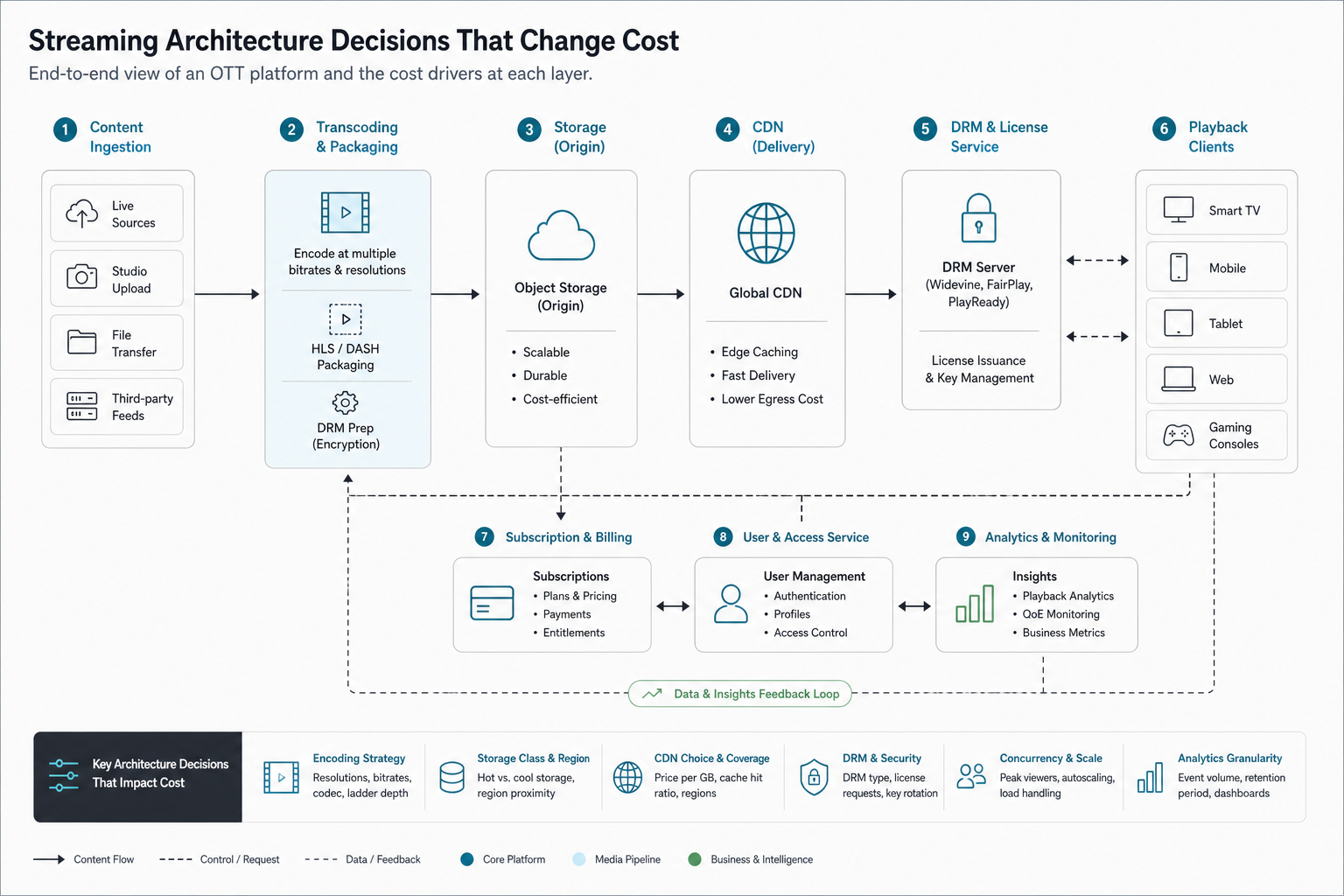
Streaming architecture has a direct budget impact because every quality promise becomes a system responsibility.
Apple's HLS documentation describes live and on-demand delivery over web infrastructure and content delivery networks, with adaptive playback based on network conditions. That matters because most serious OTT products need adaptive bitrate output, stream validation, and device-aware playback testing. Google Widevine documentation shows why DRM is not just a checkbox: license requests, business rules, supported platforms, encryption schemes, and playback clients all influence implementation. Stripe's subscription documentation also shows why billing is a workflow, not a payment button; subscriptions need lifecycle events, payment behavior, entitlements, upgrades, downgrades, unpaid states, cancellations, and webhooks.
In practical terms, your budget changes when you add:
- More playback targets: mobile, browser, TV, casting, and console clients multiply QA and player behavior.
- More encoding profiles: resolutions, bitrates, codec choices, captions, audio tracks, and thumbnails add processing and storage cost.
- More delivery promises: low latency, live events, multi-region CDN coverage, and high peak concurrency need stronger architecture.
- More content protection: DRM licensing, offline viewing, watermarking, account sharing rules, and regional access controls add service logic.
- More billing states: trials, discounts, bundles, renewals, failed payments, refunds, invoices, taxes, and entitlements affect backend and support workflows.
Ongoing Operating Costs To Plan Before Launch
The build estimate is only the first budget. OTT products also carry recurring infrastructure, media processing, storage, CDN, player, DRM, analytics, support, app-store, payment, moderation, QA, and maintenance costs. These costs rise with catalog size, watch time, regions, peak concurrency, live events, and the number of supported devices.
Plan the operating model before launch: who uploads content, who monitors playback failures, who handles failed payments, who owns app-store releases, who reviews support trends, and who responds when a live event fails. A low build quote is not useful if the product cannot be operated after release.
For scale planning, connect the OTT estimate to cloud performance optimization services and long-term mobile app maintenance assumptions. Streaming products need release care, observability, and cost governance after the MVP ships.
Feature Stack For An OTT Platform
A useful OTT roadmap separates customer-visible features from the operating system behind them.
- Viewer app: onboarding, login, home feed, search, content detail pages, watchlist, continue watching, player, settings, notifications, and support.
- Content operations: upload, transcoding trigger, metadata, categories, collections, thumbnails, captions, publish scheduling, rights windows, and editorial workflows.
- Monetization: free plans, SVOD, TVOD, pay-per-view, coupons, trials, bundles, family plans, invoices, taxes, refunds, and entitlement checks.
- Trust and security: secure sessions, DRM rules, device limits, concurrent streams, abuse signals, regional access controls, and audit trails.
- Analytics and operations: playback quality, churn signals, content performance, conversion funnels, failed payments, support issues, and release health.
The first release rarely needs the deepest version of every layer. A focused mobile-first or web-first launch can validate the audience, payment model, and content workflow before expanding into TV apps, advanced personalization, live events, or ads. That is the kind of product boundary NextPage shapes through mobile app development planning, especially when streaming UX, payments, and release quality have to work together.
MVP Scope: What To Build First
An OTT MVP should prove three things: viewers can find content they care about, the business can monetize access, and the team can operate the content pipeline without chaos. A practical first release often includes one primary viewer surface, accounts, catalog browsing, search, secure playback, subscription checkout, entitlement checks, a basic CMS, upload and publish workflows, analytics, and admin support views.
Push these items to later unless they are central to the launch thesis: multiple smart TV apps, personalized recommendations, live streaming, offline downloads, ad-supported plans, multi-currency checkout, advanced partner portals, editorial A/B testing, and complex rights automation. If the scope still feels too broad, use the MVP Scope Builder to separate launch-critical work from later-phase items.
Monetization Models and Billing Complexity
OTT monetization choices are architecture choices. A simple paid subscription has a different system shape from a platform with free trials, coupons, pay-per-view events, rentals, family plans, bundles, creator payouts, or ad-supported tiers.
| Model | Best Fit | Cost Impact |
|---|---|---|
| SVOD subscriptions | Recurring libraries, courses, fitness, memberships | Requires billing lifecycle, renewals, entitlements, failed-payment handling, and cancellation flows |
| TVOD or rentals | Films, events, premium content drops | Adds purchase windows, playback expiry, receipts, refunds, and support scenarios |
| Pay-per-view | Sports, conferences, live performances | Adds event readiness, peak traffic planning, fraud prevention, and incident response |
| Ad-supported tiers | Large catalogs with broad audience reach | Adds ad decisioning, measurement, consent, reporting, and player integration complexity |
| Hybrid bundles | Platforms with multiple audiences or partners | Adds plan logic, entitlement rules, analytics segmentation, and finance reconciliation |
For many early OTT teams, the safest launch path is a simple subscription or single-purchase model with clean entitlement logic. Add complex monetization only when the content strategy and audience data justify it.
Timeline For An OTT App Build
A realistic OTT build usually moves through four stages.
- Discovery and architecture: 2-4 weeks to define platforms, content workflow, monetization, rights rules, media pipeline, vendor boundaries, and first-release success metrics.
- MVP build: 10-16 weeks for the primary viewer app, account flows, catalog, player, payments, entitlement checks, admin tools, analytics, QA, and launch preparation.
- Growth release: 8-12 more weeks for additional platforms, richer CMS workflows, improved recommendations, promotions, deeper analytics, and stronger support tooling.
- Scale hardening: 10-20 more weeks for live streaming, smart TV expansion, multi-region delivery, advanced DRM, high availability, data pipelines, and operational dashboards.
The timeline gets longer when platform approvals, DRM agreements, content provider onboarding, payment review, app store review, or partner contracts are still unresolved. Decide those dependencies before committing to a launch date.
Before the release date is fixed, run the viewer, billing, admin, player, and analytics flows through a launch checklist. The mobile app QA launch checklist is a useful companion because OTT failures often happen at the intersection of playback, device state, payments, and account access.
OTT Release Readiness Checklist
- Playback coverage: validate startup time, buffering, subtitles, casting, quality switching, and resume behavior across the launch device set.
- Billing and entitlement states: test trials, upgrades, downgrades, failed payments, cancellations, refunds, expired rentals, and account recovery.
- Content operations: confirm upload, metadata, thumbnails, captions, scheduling, rights windows, takedowns, and audit trails.
- Security and rights: check DRM license behavior, session security, regional access, device limits, download rules, and admin permissions.
- Observability: monitor playback errors, CDN issues, payment failures, app crashes, support tickets, and content performance from day one.
- Incident response: rehearse live-event escalation, refund decisions, support scripts, rollback plans, and stakeholder communication.
This readiness work is where OTT product planning becomes operational software planning. If the release will include live events, premium content, or paid subscriptions, budget for DevOps consulting services, QA evidence, and support runbooks before launch rather than after the first outage.
Mistakes That Inflate OTT App Budgets
- Starting with every device: TV apps are valuable, but they should follow evidence about where the audience actually watches.
- Ignoring content operations: a beautiful viewer app fails if the team cannot upload, tag, schedule, secure, and update content reliably.
- Underestimating playback QA: browser, OS, device, network, casting, caption, DRM, and payment states all need testing.
- Building custom media infrastructure too early: use managed encoding, storage, CDN, player, and billing components unless differentiation requires ownership.
- Overcomplicating monetization: too many plans, bundles, coupons, and event types slow launch and confuse reporting.
- Measuring only signups: OTT teams need watch time, playback failures, content completion, churn, payment recovery, and support data.
How NextPage Scopes An OTT Platform
NextPage starts by separating the viewer experience, media pipeline, monetization model, and operating workflow. For an OTT product, that means deciding which audience the first release serves, which platforms are essential, which content workflow must be reliable on day one, which billing states are required, and which analytics the business needs to make its next investment decision.
From there, we shape the smallest build that can validate the content business safely, then expand toward more devices, better personalization, deeper operations, and scale architecture when the audience proves the case. Start with the custom software cost estimator, narrow the first release with the MVP Scope Builder, or use NextPage's mobile app development service when you need a reviewed roadmap for a streaming product.