
Quick Answer: What Is Product Discovery Before Development?
Product discovery before development is the short, structured work that turns a product idea into a buildable plan. It clarifies the target user, the problem, the workflow, the first-release scope, the riskiest assumptions, the technical constraints, and the evidence needed before a team commits to full software development.
The output is not a long document for its own sake. A useful discovery sprint gives founders and product leaders a decision record: what to build now, what to delay, what to prototype, what to validate, what might affect budget, and what the development team needs to estimate with confidence.
For teams planning a first release, discovery is often the difference between asking for a vague app quote and walking into development with a focused MVP scope, a risk register, and a plan that can survive real users. It is also the point where founders should decide whether they need a prototype, a technical proof of concept, or a build-ready MVP backlog instead of treating every idea as an engineering task.
Why Skipping Discovery Creates Build Risk
Software projects rarely fail because the team did not have enough feature ideas. They fail because the most important decisions were made too late. Teams start design before they understand the workflow. They estimate before integrations are known. They build admin screens before defining who owns the process. They add payment, reporting, notifications, roles, and automation before deciding which outcome the first release must prove.
Skipping discovery pushes uncertainty into development, where it is more expensive to fix. A requirement that sounds small in a sales call can become a major delivery risk if it involves legacy data, third-party APIs, compliance review, multiple user roles, or manual exception handling. Discovery surfaces those details while the cost of changing direction is still low.
This matters most when the product involves new workflows, custom software, operational users, integrations, regulated data, AI features, or marketplace logic. In those cases, discovery is not delay. It is scope control.
What Product Discovery Should Decide
A strong discovery process answers practical questions before development starts. The goal is to reduce ambiguity enough that a team can choose the right first release and estimate it responsibly.
| Discovery area | Question it answers | Output |
|---|---|---|
| Problem and audience | Who has the pain and why does it matter now? | Problem brief, audience segments, success metric |
| User journey | How does the workflow happen from start to finish? | Journey map, roles, handoffs, edge cases |
| Feature priority | What must ship in the first version? | Must-have, should-have, later, and discard list |
| Technical assumptions | What systems, data, APIs, or platforms affect the build? | Architecture notes, integration list, unknowns |
| Risk and validation | What could invalidate the plan? | Risk register, proof points, prototype or PoC plan |
| Estimate inputs | What does the team need to price and sequence work? | MVP backlog, release plan, dependencies, constraints |
When those decisions are missing, development starts with assumptions. When they are explicit, the project can move faster because the team is not discovering the product while trying to build it. This is also where a supporting MVP development guide can help teams translate discovery outputs into scope, cost, and timeline expectations.
Product Discovery Checklist Before Development
Use this checklist before asking a software team for a fixed estimate. If several rows are still unclear, the project needs more discovery before full development starts.
| Checklist item | What good looks like | Why it lowers build risk |
|---|---|---|
| First user and job | One primary user segment and one job-to-be-done are named clearly. | Prevents a first release that tries to satisfy every stakeholder. |
| Workflow map | The current and future-state journey show roles, handoffs, exceptions, and approvals. | Exposes operational complexity before design and engineering estimates. |
| No-scope list | Deferred features, excluded audiences, and manual workarounds are documented. | Protects the MVP from roadmap creep. |
| Technical unknowns | Integrations, data quality, permissions, AI behavior, platform choice, and security needs are visible. | Identifies assumptions that can change the architecture or delivery plan. |
| Validation plan | Each risky assumption has an owner, proof method, and decision deadline. | Keeps discovery evidence-based instead of workshop-only. |
| Estimate package | User stories, acceptance notes, milestones, dependencies, and launch criteria are ready. | Gives the delivery team enough context to price and sequence the build responsibly. |
If the biggest uncertainty is whether the experience makes sense, compare the next step with a prototype vs MVP decision first. If the workflow is clear and the question is budget, move into scope and estimate planning.
The Discovery Sprint Workflow
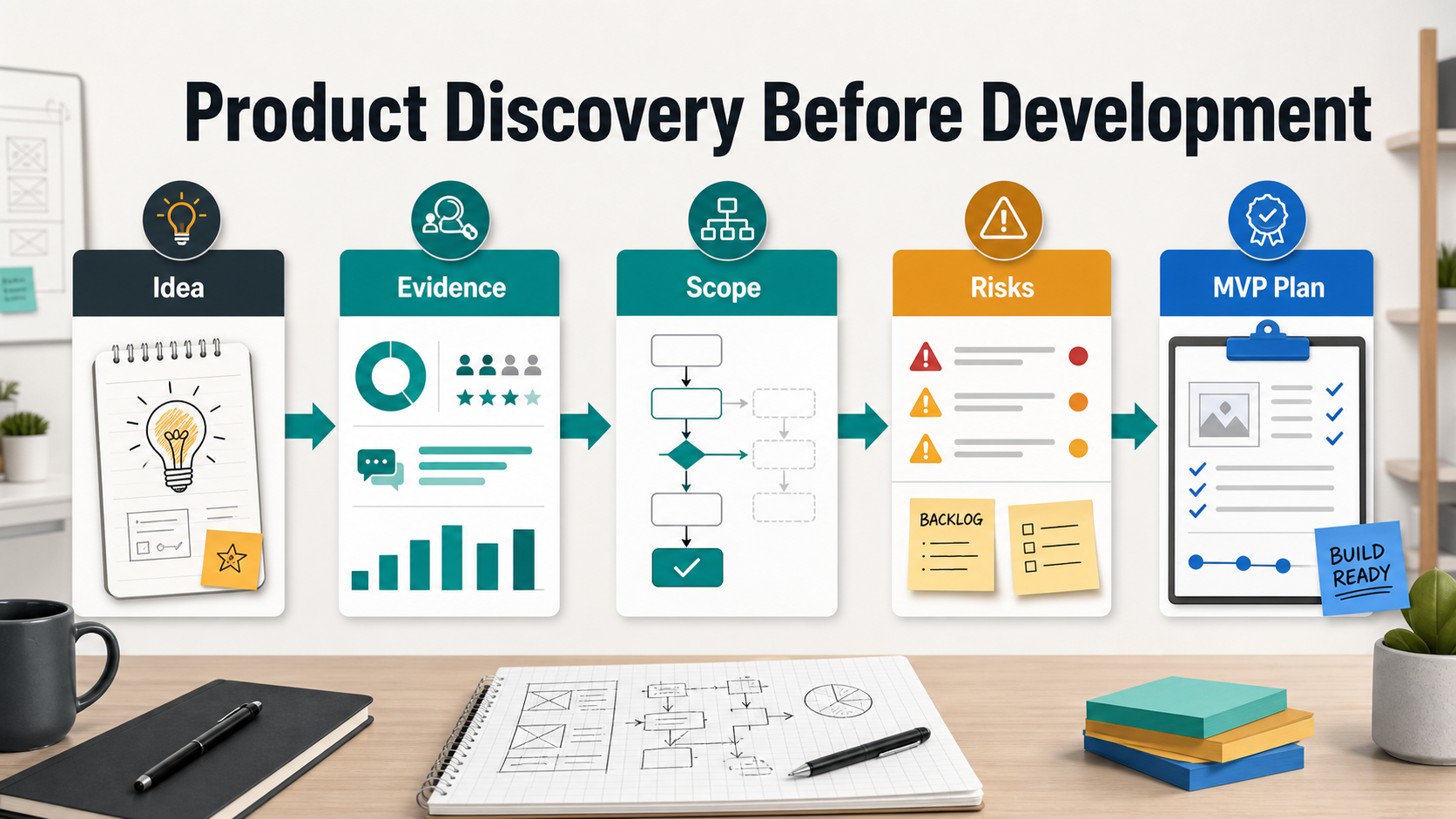
Discovery does not need to be a months-long strategy exercise. For many MVPs, a focused sprint is enough to move from idea to build-ready scope. The exact depth depends on risk, but the workflow usually follows five steps.
Step 1: Define the Business Outcome
Start by naming the outcome the product should create. That might be faster bookings, fewer manual support tasks, better compliance tracking, higher conversion, cleaner field operations, or a new paid product line. If the outcome is vague, feature decisions will be vague too.
The discovery brief should define the user, the pain, the current workaround, the business reason for solving it, and the first metric that would prove progress.
Step 2: Map the User Journey
Map the workflow as it happens today and as it should happen in the first release. Include customers, staff, admins, vendors, managers, and any systems that exchange data. This is where hidden complexity appears: approvals, exceptions, permissions, notifications, file uploads, audit trails, manual checks, and reporting needs.
For MVP development, journey mapping keeps the first release focused on the smallest workflow that can prove value.
Step 3: Prioritize the First Release
Discovery should separate features into build now, build later, validate first, and remove. The first release should include only the features needed to prove the core workflow, not every feature that might exist in the mature product.
A useful prioritization conversation asks: does this feature reduce launch risk, prove user demand, enable payment, protect security, support operations, or create measurable learning? If not, it may belong in a later release.
Step 4: Test the Risky Assumptions
Some assumptions need interviews. Some need a clickable prototype. Some need a proof of concept. Some need a technical spike against an API, data source, AI model, or legacy system. The discovery team should not test everything. It should test the assumptions that could change the build plan.
Examples include whether users will complete a complex onboarding flow, whether a vendor API supports the required data, whether an AI workflow can meet accuracy expectations, or whether the product needs native mobile features instead of a responsive web app.
Step 5: Turn Decisions Into Estimate Inputs
The final step is converting discovery into a backlog and build plan. That means user stories, acceptance notes, open questions, dependencies, third-party services, data migration needs, security requirements, release sequence, and milestone assumptions.
Teams can then use a scope tool such as the MVP Scope Builder to organize the first release before requesting a detailed estimate.
Discovery Decision Gates Before Development
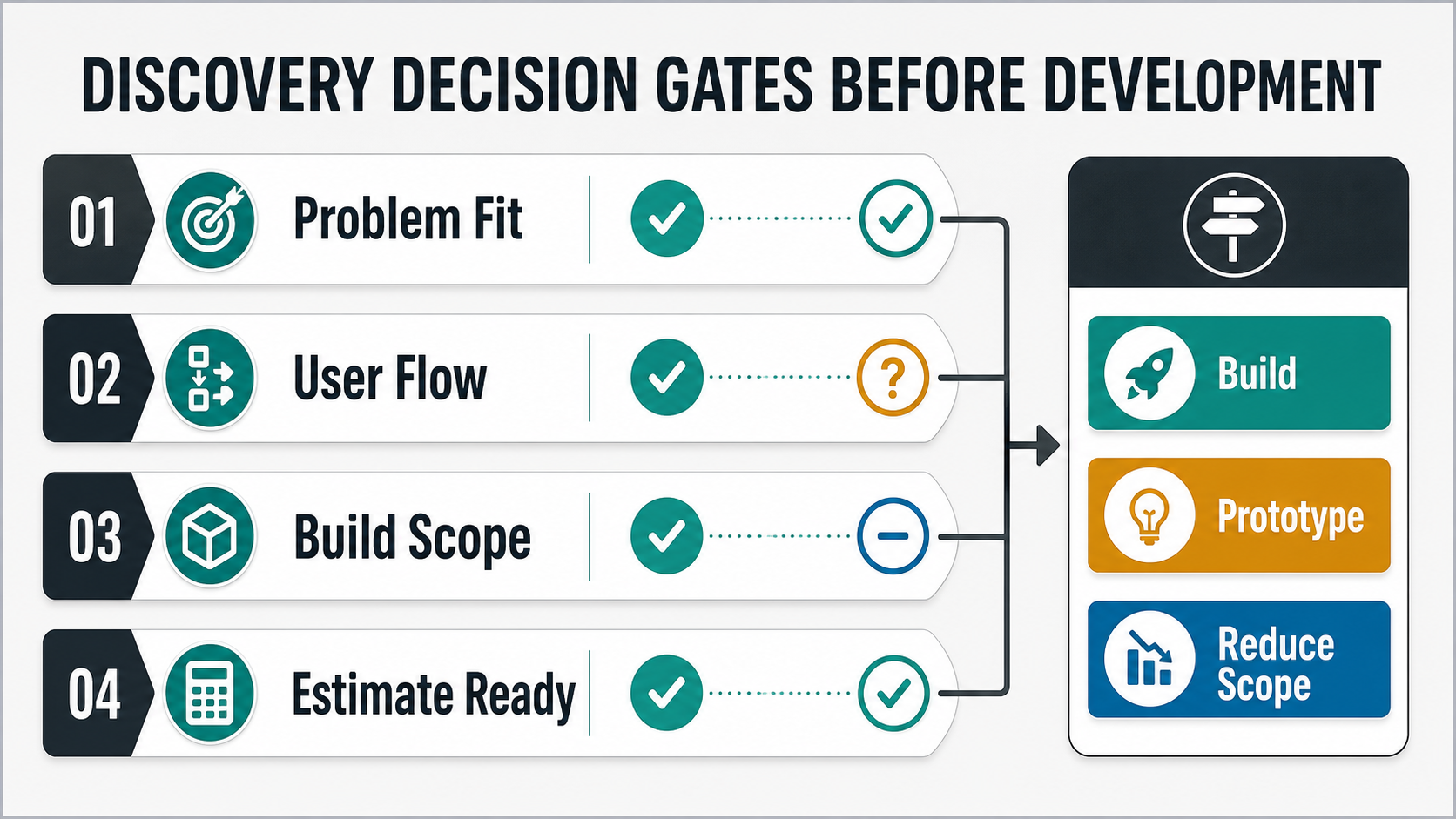
Discovery should end with a decision, not just a workshop recap. Before moving into development, check four gates.
- Problem fit: the team knows who the user is, what pain matters, and what measurable outcome the product should improve.
- User flow: the main workflow, roles, handoffs, and exceptions are clear enough to design the first release.
- Build scope: the must-have features are separated from later enhancements and nice-to-have ideas.
- Estimate readiness: integrations, data, security, platforms, assumptions, and risks are visible enough to plan the team and timeline.
If a gate is weak, the answer is not always to stop. Sometimes the right move is a lightweight prototype, a technical spike, a smaller MVP, or a staged release plan.
What a Good Discovery Package Includes
A good discovery package should be useful to business stakeholders, designers, developers, and future operators. It should make the next build decision easier.
- Problem brief: audience, current pain, desired outcome, constraints, and success metric.
- User journeys: primary flows, role differences, handoffs, edge cases, and operational exceptions.
- Feature priority: first-release scope, deferred features, discarded ideas, and why each choice was made.
- Prototype or wireframes: enough visual structure to test workflow and reduce design ambiguity.
- Technical notes: platform choice, integrations, data model concerns, authentication, permissions, hosting, and security considerations.
- Risk register: key assumptions, probability, impact, mitigation, and owner.
- Estimate inputs: backlog, milestones, dependencies, environments, launch criteria, and open decisions.
This package gives a custom software development team the context needed to estimate and build without guessing at the product strategy.
How Discovery Improves Cost and Timeline Estimates
Discovery does not magically make software cheaper. It makes the scope clearer, which makes the estimate more honest. Better estimates come from knowing the number of user roles, screens, workflows, integrations, data models, reports, permissions, environments, and validation steps required for the first release.
Without discovery, teams often estimate from a feature list. That misses the complexity behind the features. A simple notification can require user preferences, templates, delivery retries, audit logs, localization, admin controls, and compliance review. A simple dashboard can require data cleanup, permission rules, aggregation logic, and performance work. For budget planning after discovery, compare assumptions against a custom software development cost breakdown before locking the roadmap.
Discovery turns those hidden details into visible planning inputs. If the first release is still broad, the team can use a custom software cost estimator to compare scope scenarios before locking the roadmap.
How To Triage Product Risk Before Development
Discovery should not give every unknown the same weight. Rank risks by how likely they are to change the first release, budget, timeline, or go/no-go decision. A landing-page experiment may be enough for demand risk. A clickable prototype may be enough for usability risk. A technical spike may be necessary for integration, AI accuracy, data migration, or compliance risk.
NextPage usually treats risk triage as a delivery decision: prove the unknown that would be most expensive to discover during engineering, then keep the MVP narrow enough that the first release can still ship.
When Lightweight Discovery Is Enough
Not every project needs a deep discovery phase. A lightweight discovery sprint may be enough when the workflow is familiar, the users are easy to reach, the integrations are simple, and the first release is small. In that case, discovery can focus on scope, wireframes, user stories, and estimate inputs.
Deeper discovery is useful when the product has multiple roles, operational dependencies, uncertain demand, legacy systems, regulated data, new AI behavior, marketplace mechanics, or budget sensitivity. The more expensive the wrong build would be, the more discovery should happen before engineering starts.
Common Discovery Mistakes To Avoid
- Starting with screens instead of decisions. Wireframes help, but only after the workflow and problem are clear.
- Calling every feature a must-have. If everything is critical, the first release is not prioritized.
- Ignoring operational users. Admins, support teams, finance, and managers often expose the complexity customers never see.
- Skipping technical feasibility. API limits, legacy data, security needs, and platform constraints can change the plan.
- Leaving assumptions unowned. Every major unknown should have an owner and a next validation step.
- Treating discovery as a one-time event. Discovery should continue lightly through delivery as new evidence appears.
How NextPage Runs Discovery Before Development
NextPage uses discovery to create build clarity, not ceremony. The work starts with the outcome, maps the workflow, identifies users and constraints, prioritizes the first release, and turns open questions into a practical risk and validation plan.
For some teams, the result is a focused MVP scope. For others, it is a prototype, a technical proof of concept, or a decision to reduce scope before spending more. The point is to make the next development decision with better evidence.
If you have a product idea but the first release is still unclear, start with the MVP Scope Builder. It will help you organize users, features, assumptions, and launch goals before turning the idea into a development plan. When the scope is stable enough for delivery, NextPage can turn that package into an estimate-ready MVP development plan or a broader custom software development roadmap.