
Quick Answer: Prototype vs MVP
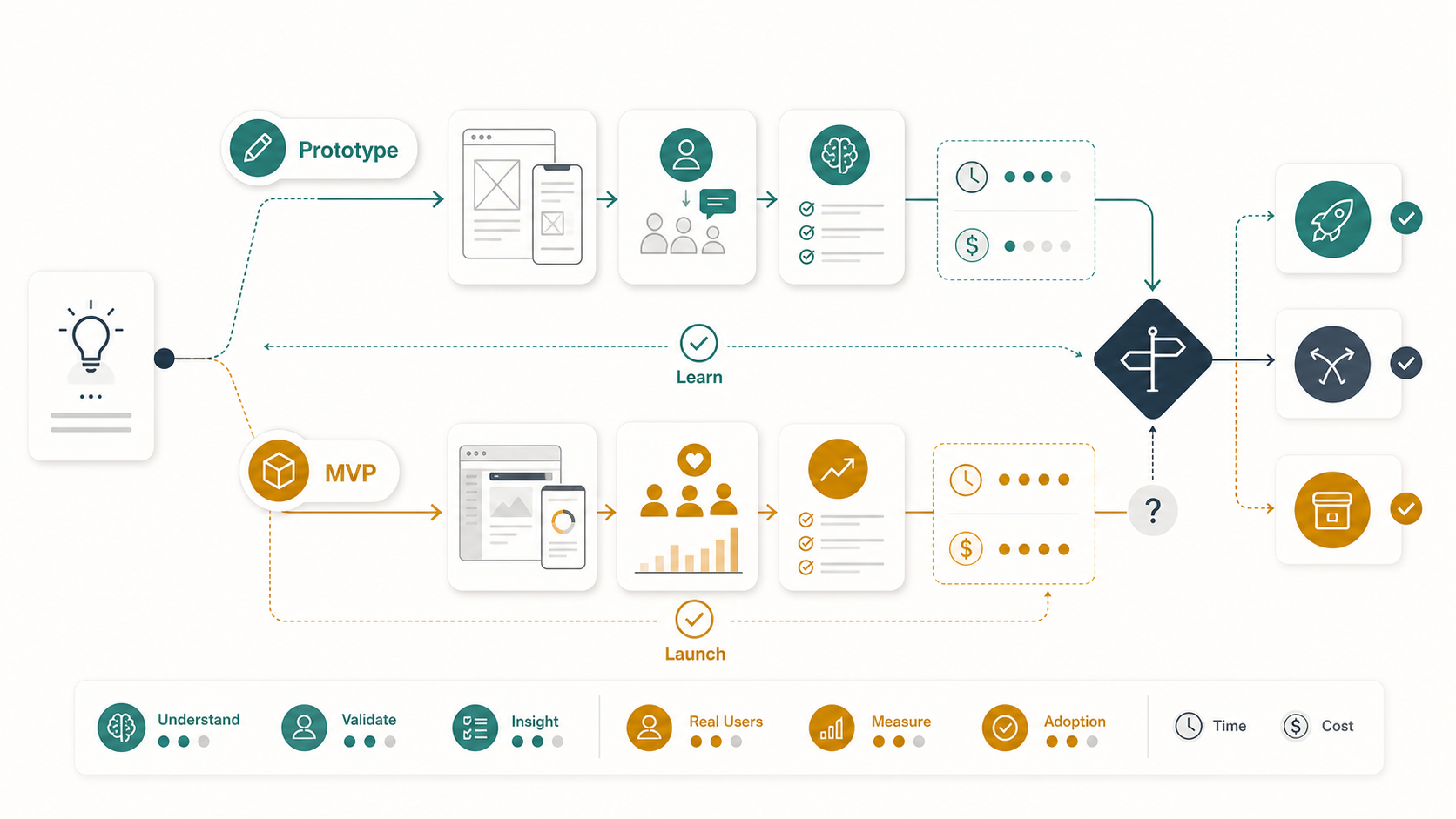
A prototype helps you test how a product should look, feel, and flow before you invest in production development. An MVP is a usable first release that real users can complete the core workflow in, so your team can measure demand, adoption, operational load, and launch risk.
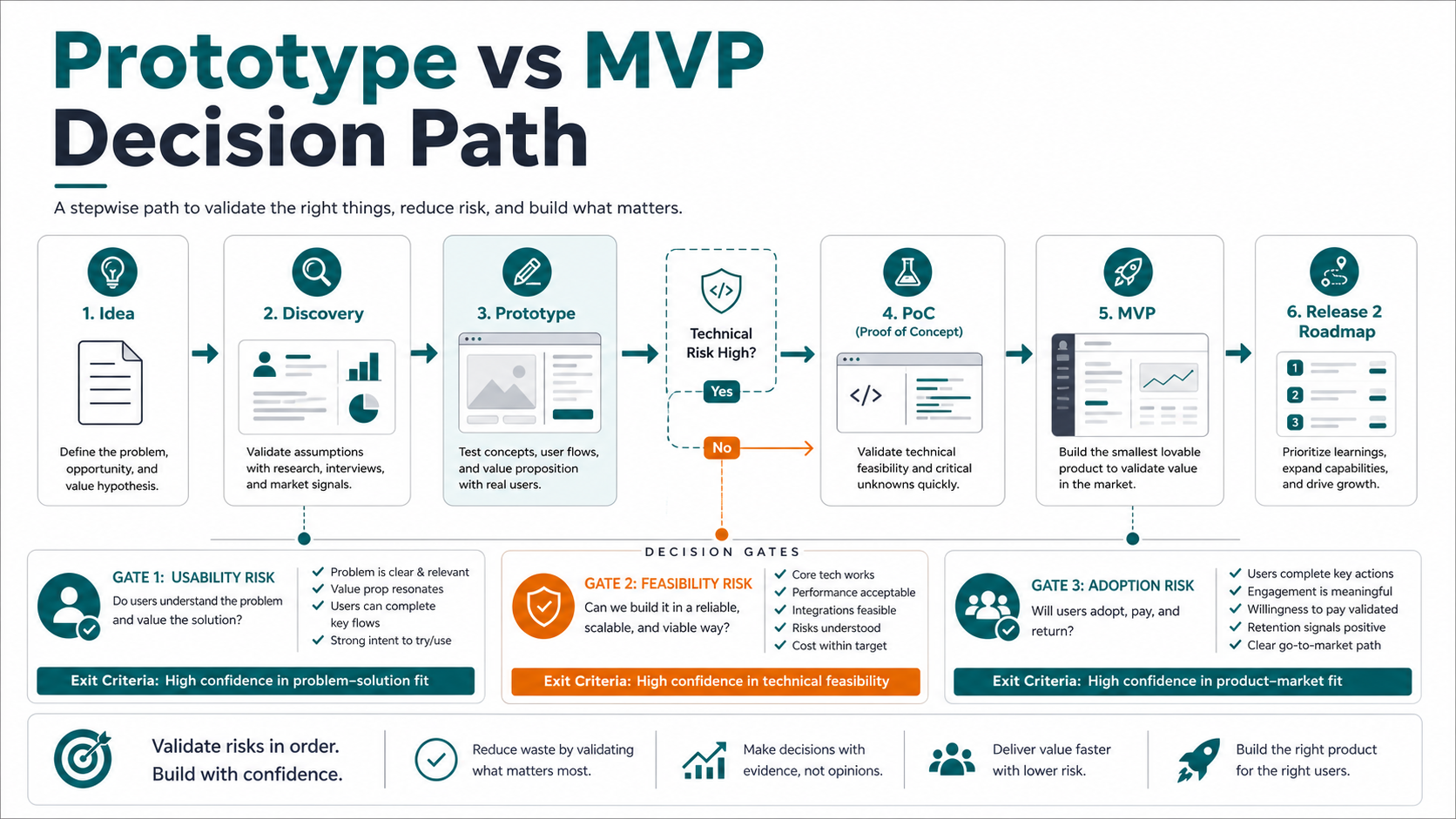
Use a prototype when the main uncertainty is usability, stakeholder alignment, investor storytelling, or whether the workflow makes sense. Use an MVP when the main uncertainty is whether real users will adopt, pay for, or repeatedly use the product. If the biggest risk is technical feasibility, build a proof of concept before either one.
For most early software ideas, the clean sequence is discovery, prototype, optional PoC, MVP scope, MVP build, and release-two planning. If you already know the workflow and need a first-release boundary, start with the MVP Scope Builder before estimating the build.
What Is a Prototype?
A prototype is a lightweight model of the product. It may be a paper sketch, clickable Figma flow, no-code mockup, app shell, or limited interactive model that shows the intended experience without becoming the final production product.
The point is not to prove market demand. The point is to make an idea visible enough to discuss, test, revise, and reduce ambiguity. A prototype helps answer whether users understand the problem, whether the value proposition is clear, whether the screens are in the right order, and whether stakeholders agree on what will be built.
Prototypes are especially useful when the product depends on customer experience, complex onboarding, multiple roles, sales demos, or investor conversations. They are also useful when a founder has the business concept but needs to translate it into a buildable workflow. A focused product discovery before development phase can turn that workflow into evidence instead of opinions.
What Is an MVP?
An MVP, or minimum viable product, is the smallest launchable version of the product that delivers the core value proposition to real users. It includes enough product, admin, data, security, analytics, and operational support to learn from actual usage without pretending version one is the full platform.
A strong MVP is intentionally narrow, not unfinished. It should support one primary audience, one core workflow, measurable success criteria, and a clear plan for what happens after launch. That is why MVP planning belongs close to MVP development, not only UI design.
An MVP is the right format when you need evidence from the market. That evidence might be activation, completion, retention, paid conversion, operational workload, sales confidence, or support volume. A prototype can tell you whether the journey makes sense. An MVP tells you whether the product deserves more investment.
Prototype vs MVP vs PoC: The Practical Difference
| Decision Area | Prototype | MVP | PoC |
|---|---|---|---|
| Main question | Does the flow and experience make sense? | Will real users adopt and complete the core workflow? | Can the risky technical assumption work? |
| Audience | Founders, designers, stakeholders, interview users, investors | Early adopters, pilot customers, internal operators, paying users | Engineering, product leaders, technical stakeholders |
| Build depth | Visual or interactive model with limited production logic | Launchable product with core features and enough operations to support users | Narrow technical experiment or spike |
| Typical output | Clickable flow, wireframes, interactive mockup, usability notes | Working first release, analytics, feedback, backlog for release two | Feasibility finding, architecture recommendation, risk note |
| Best timing | Before full design and development estimates | After the core workflow and first-release scope are clear | Before prototype or MVP when feasibility is uncertain |
| Primary risk reduced | Usability and alignment risk | Market and launch risk | Technical feasibility risk |
The common mistake is using one format to answer the wrong question. A polished prototype cannot prove retention. A coded MVP is an expensive way to discover that the user flow is confusing. A PoC cannot prove demand unless real users also experience the product value.
When to Build a Prototype First
Build a prototype first when the product idea is promising but the experience is still vague. This is common when the team has a feature list, a market pain, or a founder vision, but not a clear screen flow, role map, or evidence-backed no-scope list.
- You need stakeholder alignment. A prototype makes abstract product discussions concrete before development starts.
- The workflow is complex. Multi-step onboarding, approvals, bookings, dashboards, marketplaces, or role-based admin flows need visual testing before estimates are reliable.
- You need usability feedback. A clickable prototype can expose confusing language, missing steps, and unnecessary friction quickly.
- You need a demo before funding. Investors and partners often need to see the product story before the first release exists.
- You are comparing product directions. It is cheaper to test two or three prototype directions than to code the wrong MVP.
A prototype should end with decisions: what changed, what users understood, what still feels risky, and what belongs in the first release. If it only produces pretty screens, it has not done enough work.
Prototype Exit Criteria Before You Fund an MVP
Do not move from prototype to MVP just because the prototype looks polished. Move forward when the evidence says the first release can be narrowed without guessing.
| Evidence Area | Ready Signal | If It Is Weak |
|---|---|---|
| User segment | You can name the first buyer or user group and explain why the problem is urgent for them. | Run more interviews and narrow the audience before coding. |
| Core workflow | Users can complete the key task in the prototype without heavy explanation. | Revise the flow and test again before estimating development. |
| Value proposition | Users can repeat the product value in their own words. | Rework positioning, onboarding, and first-screen copy. |
| No-scope list | The team agrees what will not be in version one. | Use scope scoring before the MVP becomes a full platform plan. |
| Technical unknowns | The riskiest integrations, AI behavior, data model, or performance assumptions are understood. | Run a PoC or technical spike before committing to MVP architecture. |
This exit gate is where many teams save the most money. If user feedback says the workflow is still unclear, another prototype iteration is cheaper than rebuilding the same confusion in production code.
When to Build an MVP First
Build an MVP when the core workflow is understood and the next important question requires real usage data. This usually means the team already knows the target audience, first user outcome, required platform, and success metric.
- You need adoption evidence. The team must learn whether users will start, complete, and repeat the core action.
- You need operational learning. Support, admin, approvals, notifications, and exceptions must be tested in real conditions.
- You need commercial signal. Pricing, conversion, qualified demand, or sales confidence cannot be validated by a clickable prototype alone.
- You have pilot users waiting. If a credible early user group exists, a focused MVP can create stronger evidence than another round of mockups.
- You know what not to build yet. A no-scope list is a sign the team is ready to protect version one.
Before committing to the build, use the custom software cost estimator to compare the likely budget impact of user roles, integrations, platforms, admin depth, AI features, and QA effort.
MVP Evidence Scorecard
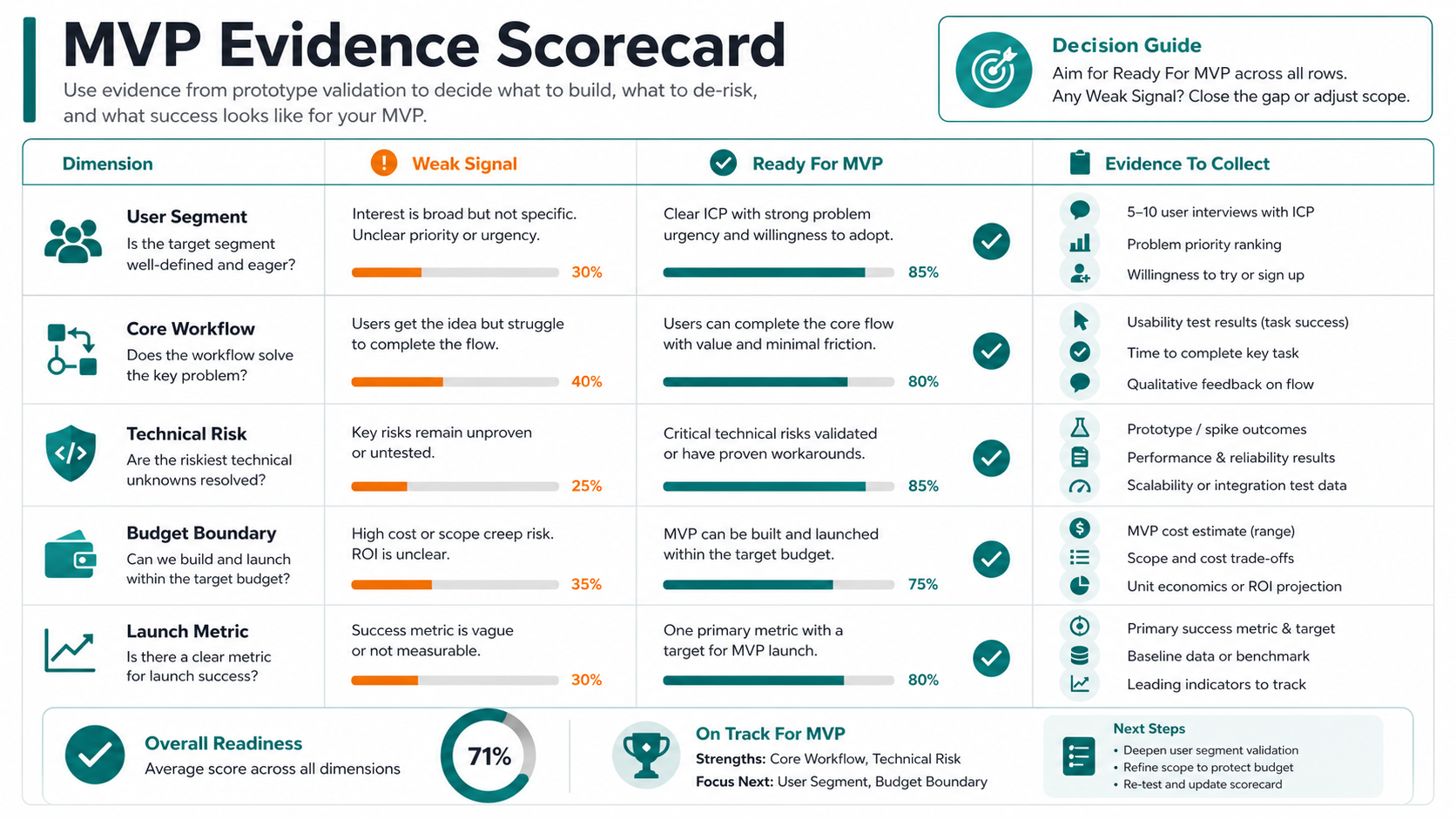
A practical MVP decision should score five things before development starts: the user segment, the core workflow, the technical risk, the budget boundary, and the launch metric. If any one of those is vague, the MVP can still be built, but the risk should be explicit and owned.
- User segment: do you know who version one is for and why they will care now?
- Core workflow: can users complete the main job with minimal explanation?
- Technical risk: are integrations, AI features, payments, performance, data migration, or compliance assumptions understood?
- Budget boundary: can the MVP be delivered inside the target investment range without pretending later-phase features are launch-critical?
- Launch metric: is there one primary measure that will tell the team whether release one worked?
If the scorecard is weak, reduce scope before increasing budget. If the scorecard is strong, the MVP can move from design discussion into delivery planning.
Prototype vs MVP Cost and Timeline
Costs vary by product complexity, location, team shape, and quality expectations, but the planning logic is consistent: prototypes are cheaper because they reduce design and alignment risk, while MVPs cost more because they must support real users.
| Work Type | Typical Timeline | Directional Planning Range | What Pushes It Higher |
|---|---|---|---|
| Low-fidelity prototype | 2-7 days | $1,000-$5,000 | Multiple user roles, alternate flows, more research sessions |
| Clickable product prototype | 1-4 weeks | $5,000-$20,000 | Complex workflows, design system depth, investor-ready polish, usability testing |
| Technical PoC | 1-4 weeks | $5,000-$30,000 | API uncertainty, AI accuracy testing, legacy data, infrastructure or security constraints |
| Lean MVP | 6-12 weeks | $20,000-$70,000 | Native mobile apps, multiple roles, payments, integrations, admin tools, analytics |
| Complex MVP | 12-24+ weeks | $70,000-$180,000+ | Compliance, multi-tenant logic, migration, deep workflow automation, partner APIs |
These ranges are planning bands, not quotes. For a deeper budget breakdown by roles, integrations, QA, infrastructure, and maintenance, pair this article with the custom software development cost guide.
How to Decide What to Build First
Use the uncertainty to choose the artifact. Do not start with the artifact and then look for a reason to justify it.
- If the risk is desirability, interview users and prototype the core flow.
- If the risk is usability, create a clickable prototype and run task-based feedback sessions.
- If the risk is feasibility, run a PoC or technical spike before designing a larger release.
- If the risk is adoption, build a narrow MVP that can be used by real users.
- If the risk is cost control, narrow the scope with the MVP Scope Builder before requesting a build estimate.
The strongest product plans often include both a prototype and an MVP. The prototype reduces ambiguity before development. The MVP turns that sharper plan into a measurable first release.
Funding Stage and Team Stage Guide
| Stage | Best Next Step | Why |
|---|---|---|
| Raw idea | Discovery plus low-fidelity prototype | Clarifies the audience, problem, workflow, and no-scope list before money is spent on production work |
| Pre-seed or pitch preparation | Clickable prototype, optional PoC | Creates a fundable product story and tests risky assumptions before an MVP budget is locked |
| Pilot customer identified | Focused MVP | Real users can validate adoption, operations, and commercial signal |
| Internal operations product | Prototype, then MVP | Operators need workflow clarity first, then a launchable tool that handles exceptions |
| Technical unknown is the blocker | PoC before prototype or MVP | Architecture, AI, data, API, or compliance uncertainty can change the plan |
This is where custom software development planning should become practical. The right first step is the one that reduces the most expensive unknown.
What Belongs in Release Two?
A healthy MVP plan should already name the likely release-two backlog. That does not mean those items belong in version one. It means the team has a controlled path for expanding after real usage data arrives.
Release two often includes broader role support, deeper admin reporting, automation, advanced analytics, secondary platforms, localization, CRM or ERP integrations, referral loops, and richer onboarding. For mobile-heavy products, compare those decisions with the mobile app development cost guide because platform count, native features, QA, and store release work can change budget quickly.
Before launch, define which metrics will trigger release-two investment. Useful triggers include activation rate, completed core actions, paid conversion, support tickets per active user, retention, referral behavior, and operator workload. Pair that metric plan with a pre-launch QA checklist so the first users do not become the test plan.
Common Mistakes When Choosing Between Prototype and MVP
- Calling a prototype an MVP. If users cannot use it to complete the core job in real conditions, it is not an MVP.
- Skipping the prototype because development feels more productive. Coding too early can lock the team into a weak workflow.
- Building a full product and calling it an MVP. If version one serves every audience and edge case, it is probably not minimal.
- Ignoring operations. An MVP needs enough admin, support, analytics, and exception handling to survive launch.
- Measuring opinions instead of behavior. Prototype feedback is useful, but MVP validation should measure what users actually do.
- Using a PoC as market validation. A technical proof only proves the technical path, not demand.
How NextPage Helps Teams Choose the Right Path
NextPage treats prototype vs MVP as a product-risk decision. We start by identifying what is most uncertain: user flow, technical feasibility, launch readiness, cost, or market adoption. Then we shape the right next step instead of defaulting to a large build.
For some teams, that means a clickable prototype and a tighter first-release scope. For others, it means a technical PoC before architecture decisions. For teams with users ready to test, it means a focused MVP that can launch, measure behavior, and create the evidence needed for release two.
If you are not sure what belongs in version one, use the MVP Scope Builder. If you already have a scope and need a directional budget, use the custom software cost estimator. The better the first decision, the cleaner the build plan becomes.