
Quick Answer: Build, Buy, Or Hybrid?
Most product teams should buy a recommendation engine when the use case is standard, data access is simple, and speed matters more than deep control. Build a custom recommendation engine when recommendations are part of the product moat, the ranking logic depends on proprietary data, or the system must fit unusual workflows, compliance rules, or integration patterns. Choose a hybrid approach when a SaaS tool can accelerate the first release, but the business still needs a custom data layer, business rules, analytics, or orchestration around it.
The right choice is not only a budget question. It depends on data maturity, catalog complexity, business rules, real-time requirements, explainability, experimentation, integration depth, and who will own model quality after launch. NextPage treats recommendation systems as practical AI recommendation engine development services work: start with the product decision, then choose the simplest architecture that can produce measurable lift without creating hidden operating risk.
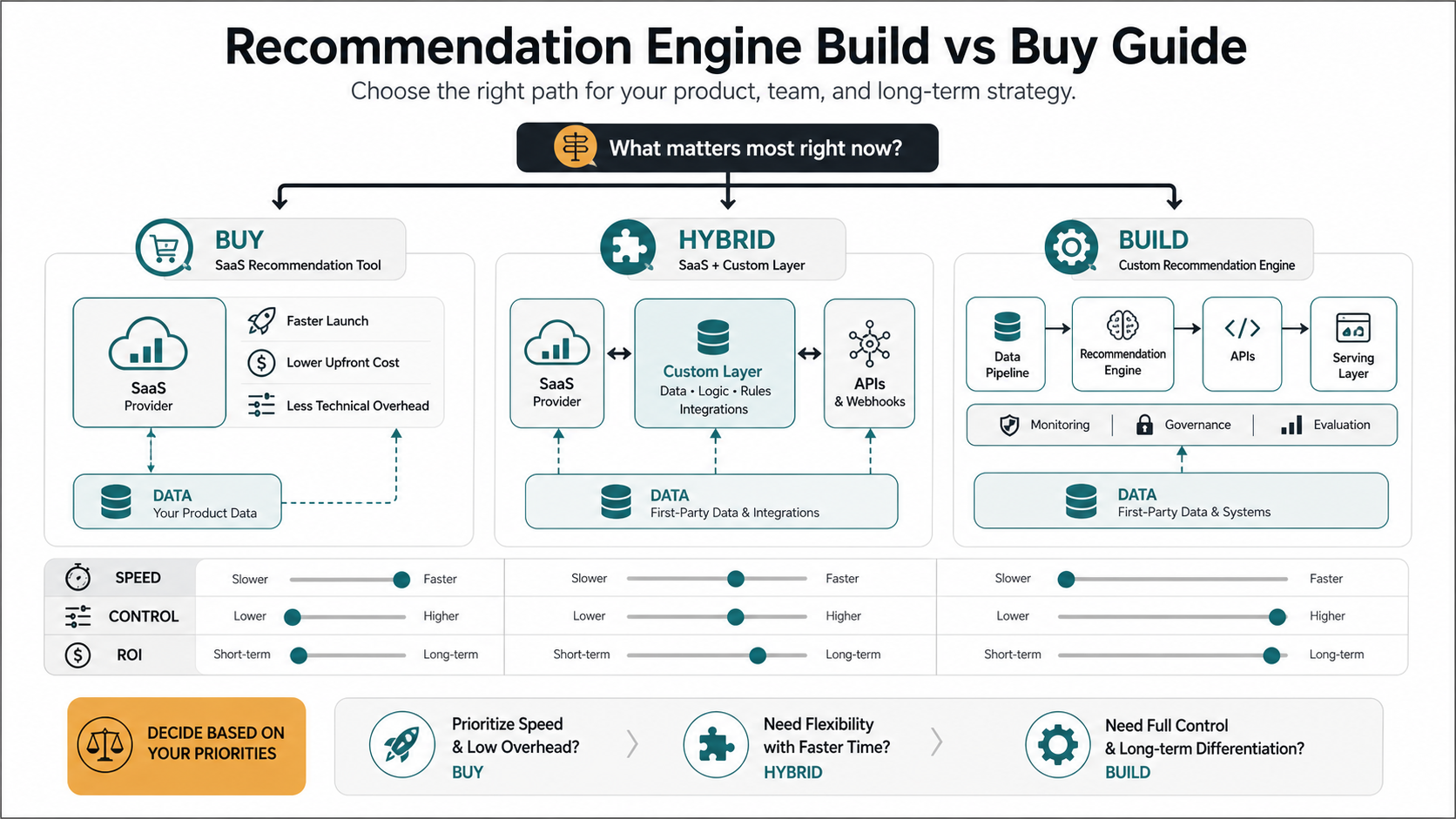
Recommendation Engine Build vs Buy Decision Table
Use this table as a first-pass decision filter. It will not replace architecture discovery, but it can show where the buying conversation should go next. If the decision is still unclear after this scan, run the Build vs Buy Decision Tool with your real data, integration, governance, and ownership constraints.
| Decision Area | Buy SaaS | Hybrid | Build Custom |
|---|---|---|---|
| Speed to first release | Fastest when connectors and data fit | Moderate; SaaS accelerates core scoring while custom work handles gaps | Slowest initially because data, models, APIs, evaluation, and admin tools must be built |
| Data control | Limited by vendor ingestion, schema, retention, and feature support | Shared; first-party data layer can normalize and govern inputs | Highest; team controls feature engineering, storage, access, feedback, and retention |
| Recommendation logic | Best for common product, content, or user-similarity patterns | Good when vendor ranking needs business rules or custom orchestration | Best when ranking logic is a differentiator or must reflect complex business constraints |
| Integration depth | Good for standard eCommerce, CMS, CDP, or analytics connectors | Best for teams with several systems and changing workflows | Best for proprietary platforms, unusual catalogs, marketplace logic, or strict internal APIs |
| Governance and explainability | Depends on vendor transparency and logs | Can add business-level audit and review layers | Highest possible control, but only if the team designs auditability from the start |
| Long-term cost | Predictable subscription, but usage or revenue-based pricing can grow | Moderate; subscription plus custom integration and support | Higher upfront cost with more control over marginal cost and roadmap |
A Practical 2026 Decision Framework
For 2026 planning, treat recommendation capability as a product system rather than a model purchase. The decision should start with four questions: where recommendations appear, which user or catalog signals are reliable, what business rules must override scoring, and which metric will prove the system is better than the current experience.
The strongest build-vs-buy decision now includes a proof gate before contract signature or custom build kickoff. Test the path with real catalog data, sparse-user scenarios, cold-start products, permission rules, latency needs, explainability requirements, and the event stream that will measure lift after launch.
For eCommerce and marketplace teams, a related planning pass is the product recommendation engine roadmap, which breaks the work into catalog data, behavior events, ranking surfaces, feedback loops, and measurement. That roadmap is useful whether the final choice is SaaS, hybrid, or custom.
What AI-Assisted Development Changes In 2026
AI-assisted delivery changes the build-vs-buy conversation, but it does not remove the operating work behind a recommendation engine. Code generation can make prototypes, data connectors, admin screens, and evaluation dashboards faster to assemble. It does not automatically solve event quality, catalog normalization, privacy approvals, online experiments, latency budgets, rollback design, or accountability for model quality after launch.
For 2026 planning, treat AI-assisted build speed as one input in the decision, not the whole decision. Building becomes more attractive when the recommendation workflow is strategically specific and the team can own the data and release process. Buying still makes sense when the pattern is standard, vendor connectors fit, and the business needs proven capability quickly. Hybrid remains useful when AI-assisted custom work can wrap a vendor scoring layer with better data preparation, controls, analytics, and product-specific governance.
When Buying A SaaS Recommendation Tool Makes Sense
Buying is often the right answer when recommendations support the product but do not define the product. If the team needs "similar products," "frequently bought together," "popular in this category," or "recommended articles" using standard data and existing platform connectors, a SaaS tool can reduce time to value. Teams building a broader subscription product should also compare the recommendation decision against SaaS development services needs such as tenant data boundaries, admin controls, analytics, billing, and roadmap ownership.
SaaS is strongest when the catalog is clean, events are already tracked, privacy constraints are manageable, and the team can accept vendor-defined ranking controls. It also helps when the company does not yet have ML engineering capacity or does not want to operate model monitoring, feature pipelines, experimentation, and retraining workflows.
The risk is hidden fit. A SaaS tool can look fast during a demo but slow down when catalog structure, business rules, regional inventory, promotions, content taxonomy, or user permissions do not match vendor assumptions. Before signing, test the tool with your real event data, real catalog edge cases, and the metrics that matter to your product.
When A Custom Recommendation Engine Is Worth Building
Custom development is worth considering when recommendations drive conversion, retention, order value, user trust, or marketplace liquidity enough to become a strategic system. It is also the better path when the business has proprietary behavioral data, domain-specific ranking rules, multiple data sources, strict governance, or unusual real-time requirements. In those cases, recommendation work becomes part of broader custom software development, because the data model, APIs, admin controls, and product surfaces must work together.
A custom engine gives the team control over data collection, feature engineering, scoring logic, API design, experimentation, quality evaluation, and feedback loops. That work still depends on disciplined machine learning development services, because the model, serving layer, evaluation plan, and product workflow have to improve together. That control matters when you need to blend collaborative filtering, content-based similarity, rules, inventory constraints, margin logic, human curation, or explainability into one product experience.
The tradeoff is operating responsibility. Custom systems need owners for data quality, model quality, monitoring, experiments, drift, privacy, and rollout safety. If nobody can own those after launch, a custom build may become a fragile internal system rather than a durable product capability.
When A Hybrid Recommendation Architecture Is Best
Hybrid is often the practical middle path. A team can use a SaaS recommendation service for first release scoring while building a custom layer around data normalization, business rules, user permissions, experimentation, analytics, and downstream APIs. This keeps launch moving without surrendering every decision to the vendor.
Hybrid also fits companies with changing strategy. For example, an eCommerce brand may start with SaaS recommendations, add a custom merchandising layer for promotions and inventory, then later replace the model layer if recommendation quality becomes a competitive priority. A media platform may buy content similarity first, but keep its own user-interest graph and moderation rules.
Treat hybrid as AI workflow automation, not just tool configuration. The value comes from the handoff between data sources, vendor APIs, custom business logic, analytics dashboards, and review processes. Make those handoffs visible before the first release.
Cost Drivers Buyers Often Miss
Recommendation-engine cost is shaped by more than algorithm choice. The major cost drivers are data readiness, event tracking, catalog cleanup, integration count, experimentation design, governance, UI changes, analytics, and ongoing quality ownership.
Before funding a custom build, use the AI Automation ROI Calculator to size the value of the recommendation workflow. For custom development budgets, compare the expected scope against the custom software development cost drivers and run a first-pass estimate with the Custom Software Cost Estimator.
| Cost Driver | Why It Matters | Build-vs-Buy Impact |
|---|---|---|
| Data readiness | Events, catalog fields, user IDs, outcomes, and consent states must be reliable | Poor data weakens both SaaS and custom options |
| Integration depth | Recommendations must appear in product surfaces and feed back outcomes | Standard connectors favor SaaS; complex systems favor hybrid or custom |
| Business rules | Ranking may need inventory, margin, compliance, merchandising, or editorial controls | More rules usually push teams toward hybrid or custom |
| Evaluation and experimentation | Teams need A/B tests, holdouts, conversion metrics, and quality reviews | Some SaaS tools include this; custom builds must design it |
| Governance | Privacy, explainability, audit logs, and retention policies affect launch readiness | High governance needs raise the value of control |
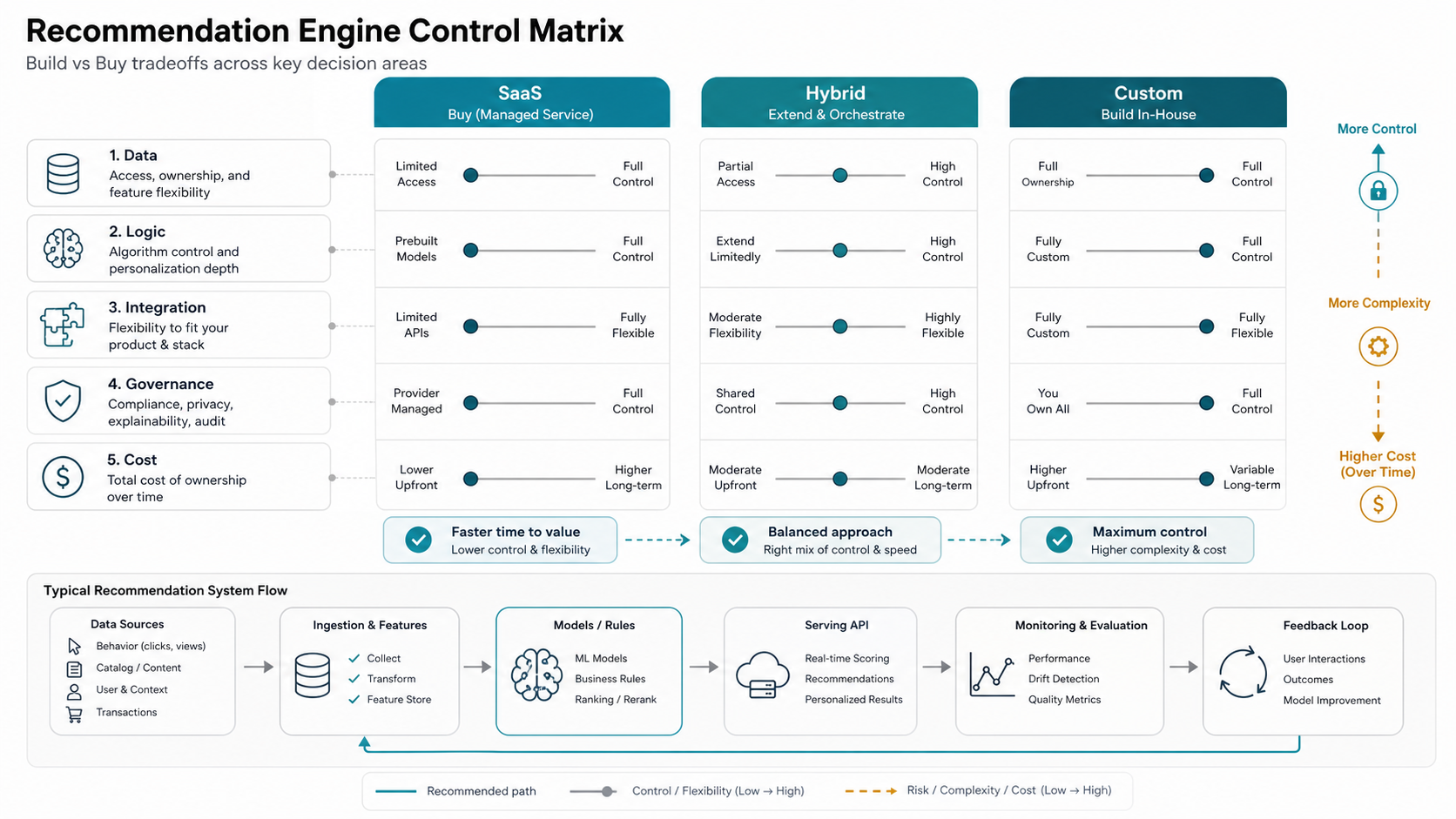
Control Matrix: Data, Logic, Integration, Governance, And Cost
The simplest way to compare options is to separate control from complexity. SaaS often has the fastest time to value, but less control. Custom development gives maximum control, but also adds ownership. Hybrid architectures work when a product team needs to balance both.
Operating Ownership After Launch
The most common build-vs-buy mistake is underestimating post-launch ownership. A bought tool still needs owners for event quality, catalog cleanup, recommendation placement, experiment design, vendor configuration, privacy review, and metric interpretation. A custom engine adds model evaluation, feature pipelines, monitoring, retraining, rollback behavior, and product analytics.
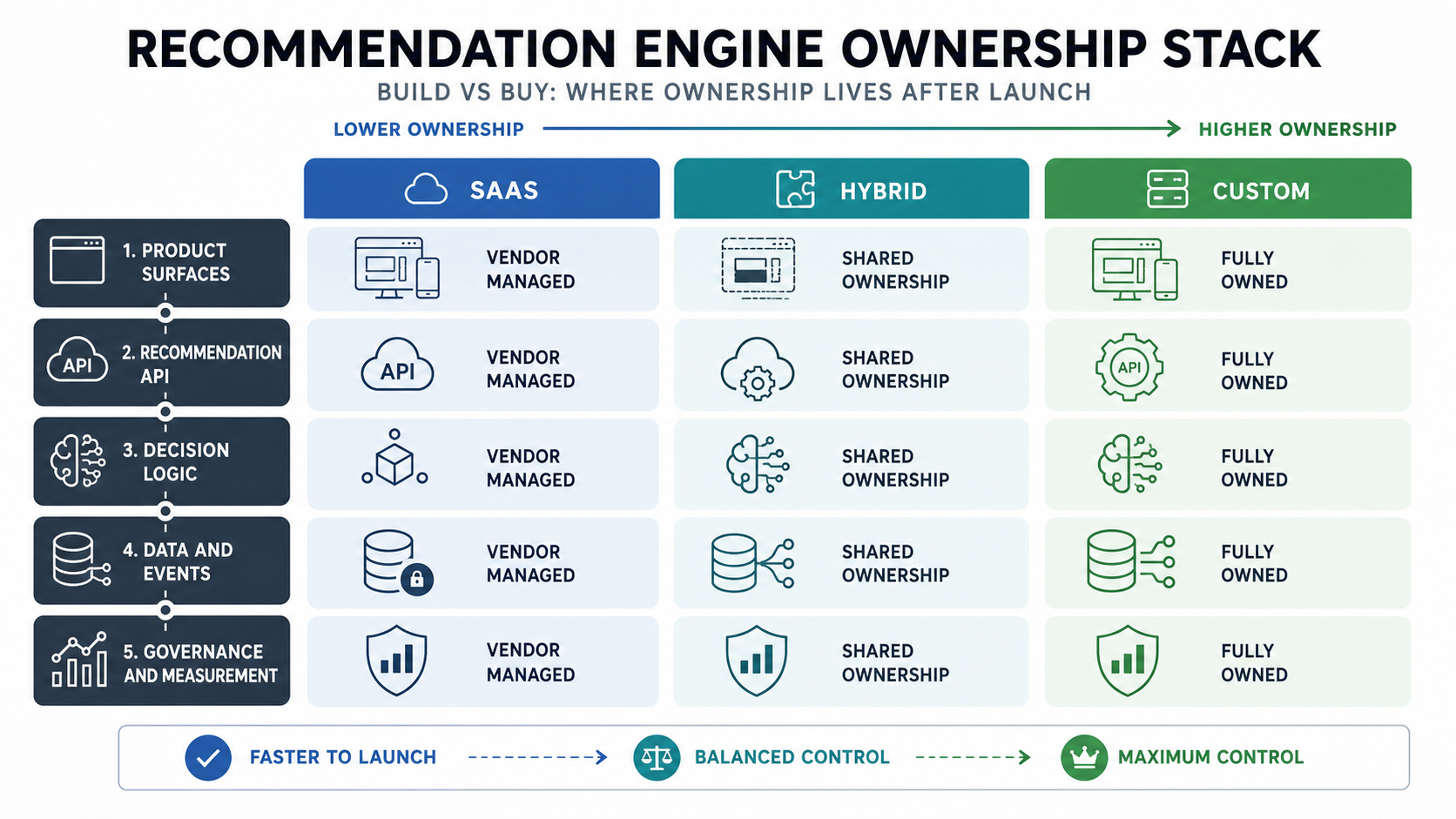
Use ownership as a gating question. If your team cannot assign owners for data quality, metric review, and release safety, buy or hybridize first. If recommendation quality is a strategic differentiator and your team can operate the full stack, custom development can be justified. The HeatPilot portfolio case study shows the same principle in an AI recommendation surface: the recommendation is useful because it sits beside evidence, controls, and operating context.
Questions To Ask Before Choosing A Vendor Or Build Partner
Whether you buy a tool or hire a build partner, the evaluation should test real product fit. A sales demo is not enough. Ask for a small proof using your actual catalog, behavioral events, business constraints, and success metric so the team can see recommendation quality, integration effort, and governance evidence before committing.
- Data fit: What events, catalog fields, user identifiers, consent states, and feedback signals are required?
- Cold start: How does the system recommend for new users, new products, sparse catalogs, or seasonal products?
- Business controls: Can teams pin, suppress, boost, segment, or explain recommendations?
- Integration: How will recommendations be served to web, mobile, email, CMS, search, CRM, or internal tools?
- Measurement: Which metrics prove value: conversion, average order value, retention, engagement, discovery, support deflection, or margin?
- Production proof: Can the vendor or build partner show latency, fallback behavior, audit logs, experiment design, and rollback controls on a realistic sample?
- Governance: What logs, permissions, privacy controls, model-change controls, and data-retention policies exist?
- Exit path: If strategy changes, can you export data, preserve learnings, and move to another model or architecture?
For partner selection, use a broader custom software development company checklist and compare the recommendation-system choice with the wider build vs buy software in 2026 tradeoffs. Recommendation engines are not isolated algorithms; they are product, data, integration, and operating systems.
Build-vs-Buy Checklist For Product Teams
Use this checklist before choosing a path.
- Buy when the recommendation pattern is standard and the data model fits vendor connectors.
- Buy when the first release must launch quickly and deep customization is not required.
- Choose hybrid when a vendor can provide useful scoring but your product needs custom data preparation, business rules, analytics, or governance.
- Choose hybrid when the team may replace the model layer later but wants to preserve a custom orchestration layer now.
- Build when recommendation quality directly affects product differentiation, marketplace liquidity, customer retention, or revenue per session.
- Build when proprietary data, unusual ranking rules, permission-aware recommendations, compliance, or real-time systems make vendor fit weak.
- Do not build if nobody will own data quality, model evaluation, monitoring, experiments, and post-launch iteration.
This is the same practical logic behind the narrow AI build-vs-buy checklist: buy standard capability, configure when workflow fit matters, and build when proprietary data plus control creates measurable advantage.
How NextPage Helps Recommendation-System Teams Decide
NextPage helps teams decide whether recommendation capability should be bought, built, or hybridized. We map the product workflow, audit available data, define success metrics, identify integration and governance constraints, and design an MVP path that avoids unnecessary ML complexity.
Our AI development services cover controlled AI workflows, data integration, model-backed product features, evaluation, dashboards, and production software delivery. If a recommendation engine is on your roadmap, bring your catalog structure, event data, target surfaces, current tooling, and business constraints. We will help you decide whether a SaaS tool is enough, where a hybrid layer is useful, and when a custom engine is worth the investment.