
Quick Answer: Travel App Development Cost
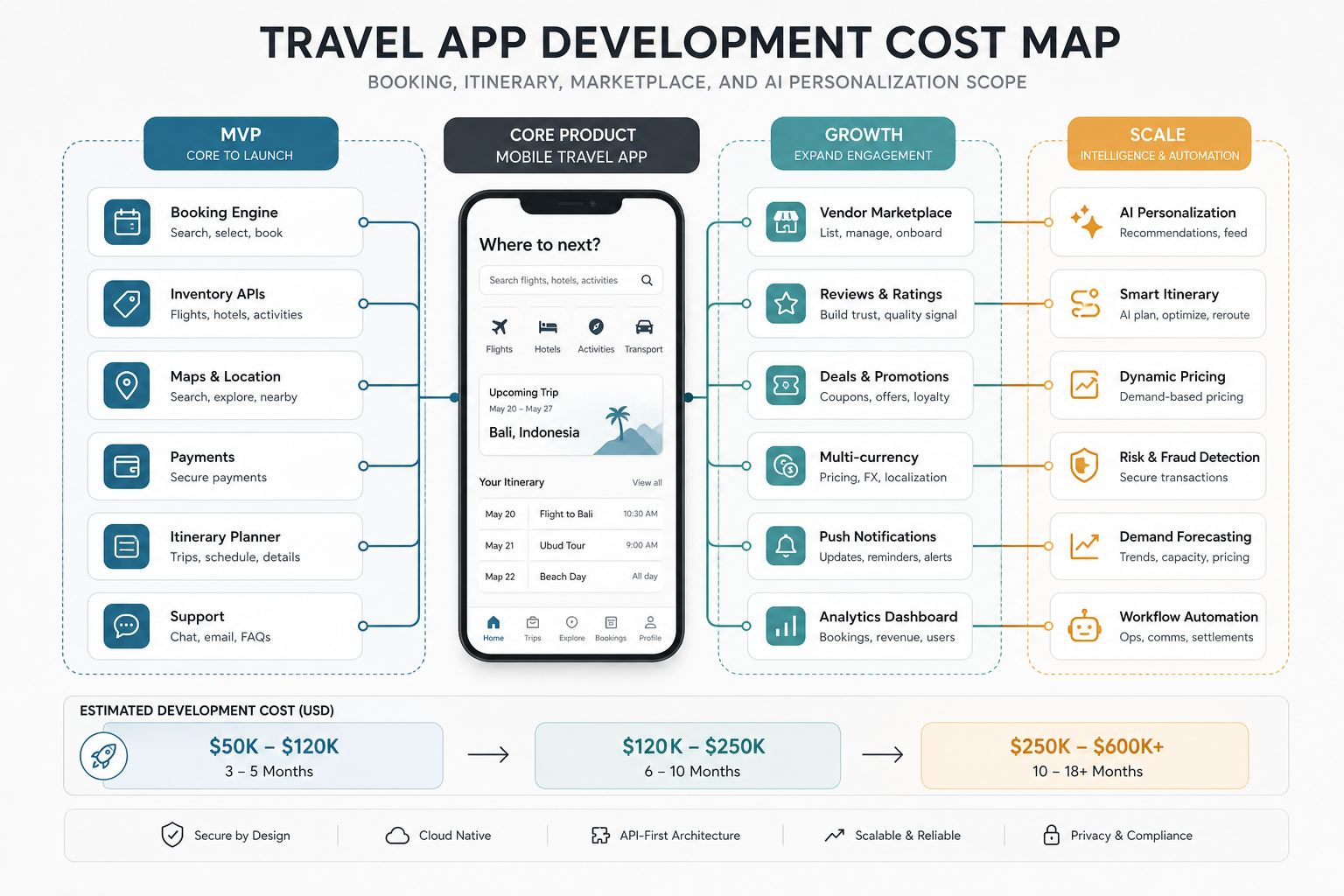
Travel app development cost depends on whether you are building a simple itinerary planner, a booking-enabled mobile app, a supplier marketplace, or a full online travel platform with AI personalization. A focused travel MVP with account setup, destination search, saved trips, itinerary planning, notifications, basic admin, and analytics can often be planned around $40,000-$85,000. A booking app with hotel, activity, transport, or package inventory, payments, cancellations, support workflows, and operational dashboards often moves into the $85,000-$220,000 range. A travel marketplace or OTA-style platform with supplier onboarding, dynamic pricing, GDS or channel-manager integrations, multi-currency payments, loyalty, AI recommendations, and data infrastructure can move past $220,000 and into the $500,000+ range.
Those bands are planning ranges, not quotes. The final estimate changes when the product needs live availability, flight or hotel APIs, maps, route planning, commissions, refunds, vouchers, marketplace payouts, multilingual content, offline access, loyalty, personalized recommendations, or enterprise reporting. If you need a directional number before discovery, start with the Custom Software Cost Estimator, then validate the assumptions around suppliers, integrations, and operations.
The SparxIT reference article frames travel app cost around app type, feature complexity, development team, booking engines, maps, payment gateways, AI itineraries, AR/VR experiences, and platform selection. NextPage uses that as a market signal, then scopes the budget around the operating model: planner, booking app, niche marketplace, agency platform, or travel operations system. In 2026, the expensive part is rarely the first mobile screen; it is the combination of live supplier data, payments, cancellation rules, support visibility, and post-booking operations.
What Type Of Travel Product Are You Building?
A travel app is not one product category. A trip planner, hotel booking app, tour marketplace, corporate travel tool, destination guide, transportation app, loyalty app, and custom agency portal all have different cost drivers. The first scoping question is not “iOS or Android?” It is “what does the app need to transact, coordinate, and operate?”
A planner can be lean because it focuses on profiles, saved destinations, itinerary blocks, notes, recommendations, sharing, and reminders. A booking app adds inventory, price rules, payment flows, cancellation policies, confirmation emails, support cases, and supplier communication. A marketplace adds vendor onboarding, commissions, payouts, listing quality controls, review moderation, dispute handling, and admin operations. A full travel platform adds data feeds, search performance, high availability, fraud controls, loyalty, and advanced reporting.
For mobile-first products, the foundation usually looks like a mobile app development engagement with backend APIs, admin tooling, and integrations around it. If the core value is an agency portal, supplier console, or booking operations dashboard, the estimate may look closer to Web App Development Cost.
Cost Bands By Travel App Scope
Travel cost bands become easier to discuss when scope is grouped by operating model. The same “booking” feature can mean a simple inquiry request, a direct hotel checkout, a multi-supplier package, or a marketplace transaction with commissions and refunds.
| Scope | Typical Product | Planning Range | What Raises Cost |
|---|---|---|---|
| Travel Planning MVP | Destination discovery, saved trips, itinerary builder, reminders, profile, CMS/admin, analytics | $40,000-$85,000 | Offline mode, collaboration, AI itinerary generation, maps, multilingual content, custom CMS |
| Booking-Enabled App | Search, availability, booking flow, payments, cancellations, notifications, support console, reporting | $85,000-$220,000 | Supplier APIs, GDS/channel managers, refunds, vouchers, loyalty, multi-currency, fraud controls |
| Travel Marketplace Or OTA Platform | Vendor onboarding, listings, commissions, payouts, package builder, review moderation, analytics, AI personalization | $220,000-$500,000+ | High-scale search, dynamic pricing, complex settlement, enterprise integrations, data warehouse, personalization engine |
A custom travel marketplace has some overlap with ecommerce and services marketplaces. If your model includes vendor listings, commissions, payouts, reviews, and catalog-style discovery, compare the estimate with eCommerce App Development Cost and adjust for travel-specific inventory, cancellation, tax, and supplier workflows.
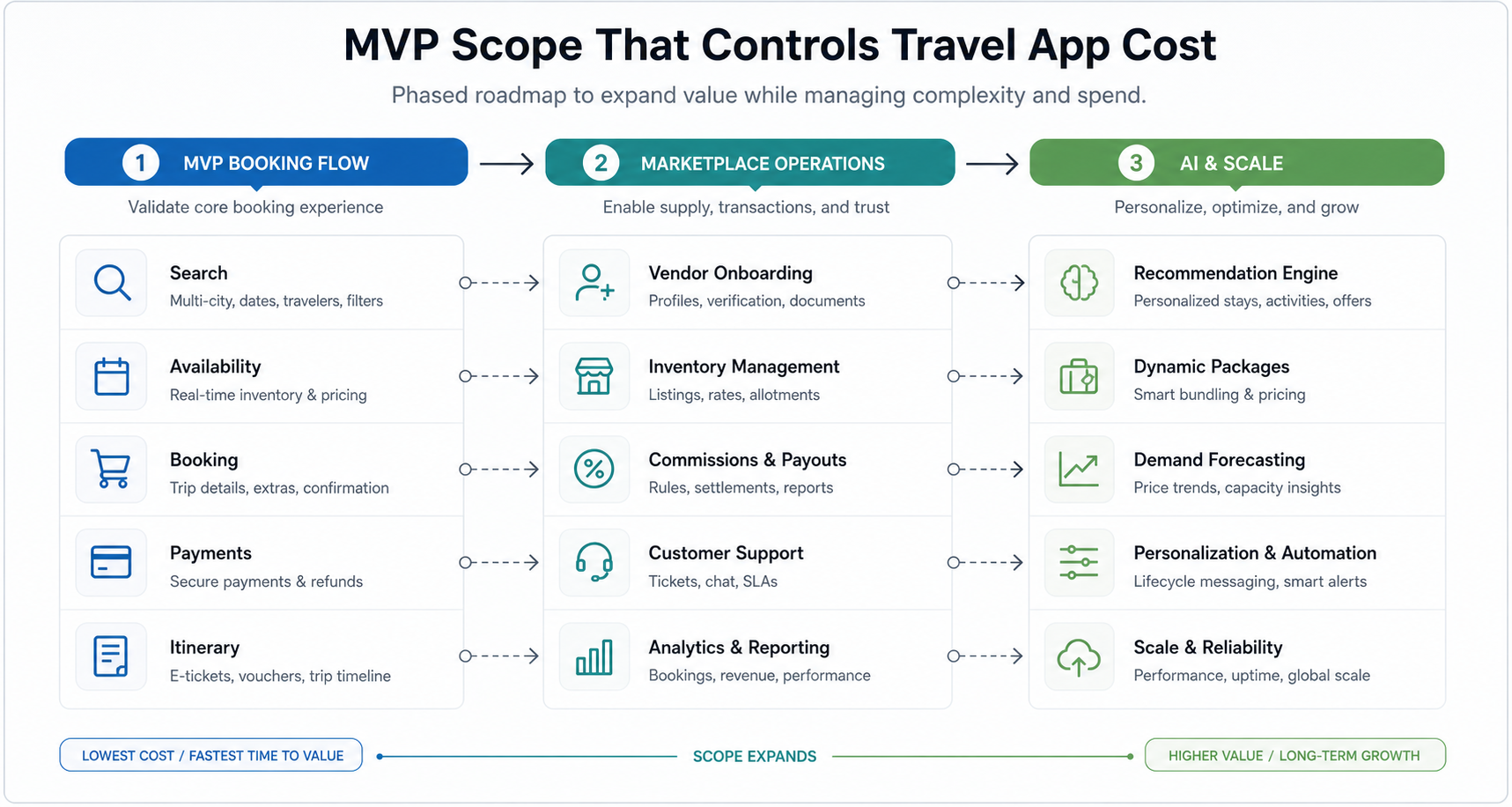
MVP Scope That Controls Travel App Cost
A strong travel MVP proves one core journey before turning into a general-purpose booking platform. For example, a destination planner may validate itinerary creation and sharing before connecting live inventory. A tour marketplace may validate listings, inquiry, payment, and supplier response before adding complex bundling. A hotel or activity booking app may start with one supplier category, one geography, and limited cancellation rules.
The MVP should still include the operational parts that keep the product usable: admin content management, booking status, notifications, customer support notes, basic reporting, and a way to correct failed or disputed transactions. These workflows are often less visible than the mobile UI, but they prevent launch-day support problems.
Qdrant returned adjacent NextPage posts on transportation and booking workflows. For travel products with routing, location, and movement components, the Guide To Transportation App Development and Real-Time Tracking: GPS Integration For Taxi Booking Apps are useful supporting references.
Booking, Inventory, And GDS Integrations
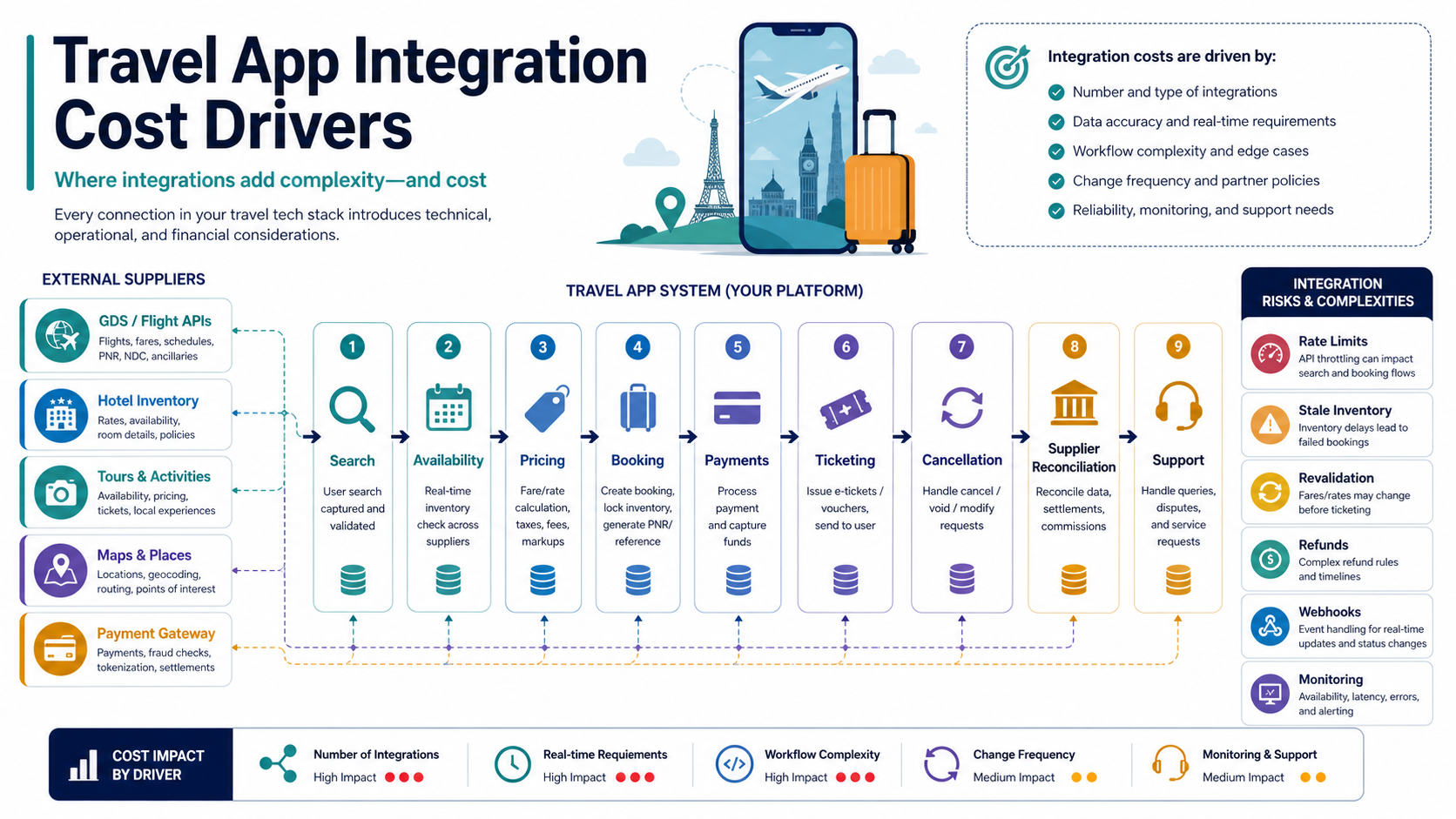
Booking and inventory integrations are usually the largest travel app cost driver. A simple request-to-book flow can use internal inventory and manual confirmation. A live booking product needs availability checks, pricing rules, payment authorization, booking holds, confirmation, cancellation, refunds, email/SMS notifications, and support workflows. A mature platform may also need channel managers, hotel APIs, flight providers, GDS connectivity, tour inventory, car rentals, insurance, or package bundling.
Each supplier integration has its own API quality, authentication, rate limits, error states, sandbox behavior, commercial approvals, and test data limitations. The engineering work is not only connecting endpoints. It includes mapping supplier data into a reliable product model, designing fallback states, preventing double bookings, logging every transaction, and giving support teams enough visibility to resolve customer issues. Official travel API catalogs such as Amadeus group capabilities across flight search, booking, hotels, destination content, tours, and activities, which is useful for planning, but every chosen supplier still needs contract-level testing before it can be treated as production inventory.
| Integration Risk | Why It Changes Cost | Roadmap Control |
|---|---|---|
| Availability revalidation | Search results can become stale before checkout. | Recheck price and inventory before payment authorization. |
| Booking state mismatch | Supplier confirmation, payment, ticketing, and customer email may not complete together. | Use explicit booking states, idempotency keys, retries, and support-visible logs. |
| Refund and cancellation rules | Policies differ by supplier, geography, fare, room type, and timing. | Model cancellation windows, partial refunds, vouchers, and manual escalation paths. |
| Rate limits and outages | Search and price calls can fail during peak demand. | Add caching rules, graceful degradation, monitoring, and fallback inventory paths. |
| Reconciliation | Finance teams must match customer payments, supplier invoices, commissions, refunds, and disputes. | Plan operational exports, dashboards, and transaction audit trails from release one. |
If your product needs a marketplace-style model with multiple vendors, compare the travel-specific work against Marketplace App Development Cost. The travel version usually adds availability, cancellation windows, tax/fee calculations, seasonal pricing, inventory synchronization, and supplier service-level controls.
Maps, Location, And Real-Time Travel Data
Maps and location features can be lightweight or expensive depending on what they must do. Showing saved places on a map is simple compared with route optimization, live tracking, offline maps, geofenced alerts, nearby recommendations, weather overlays, transit options, or multi-stop itinerary timing. Each layer can introduce licensing, API usage, caching, data freshness, and mobile battery considerations.
Travel products also need content freshness. Destination details, opening hours, local restrictions, pricing, cancellation rules, weather, traffic, and event schedules can change quickly. A production-ready app should define what data is first-party, what comes from suppliers, what comes from APIs, what users can edit, and what the operations team can override from an admin panel.
For transportation-heavy travel ideas, Qdrant surfaced taxi booking and real-time tracking posts. Those are not travel-marketplace guides, but the architecture lessons around GPS, peak demand, and infrastructure are relevant when the product includes rides, transfers, route status, or live pickup flows.
Marketplace, Vendor, And Operations Scope
Travel marketplaces often cost more than founders expect because the vendor and operations side is as important as the traveler experience. Suppliers need onboarding, verification, listing setup, calendar or inventory controls, pricing rules, availability windows, policies, media, documents, support communication, payout details, and performance reporting. Internal teams need moderation, refunds, complaints, approvals, dispute handling, and financial reconciliation.
Commission logic should be scoped early. A fixed commission is simple. Category-specific commissions, promotions, coupons, agency discounts, affiliate tracking, partial refunds, supplier penalties, and wallet credits create more backend and finance work. If the product supports multi-currency payments or international suppliers, the scope grows again. Marketplace payment platforms such as Stripe Connect support connected accounts, application fees, transfers, disputes, and refunds, but the product team still has to decide who is merchant of record, when suppliers get paid, how chargebacks are handled, and what happens when a customer refund occurs after supplier payout.
A lean MVP can defer some marketplace automation by limiting the supplier category and geography, using manual approval steps, and starting with clear cancellation rules. But it should not defer the data model that records bookings, supplier obligations, payment state, and customer communication.
AI Personalization And Itinerary Planning
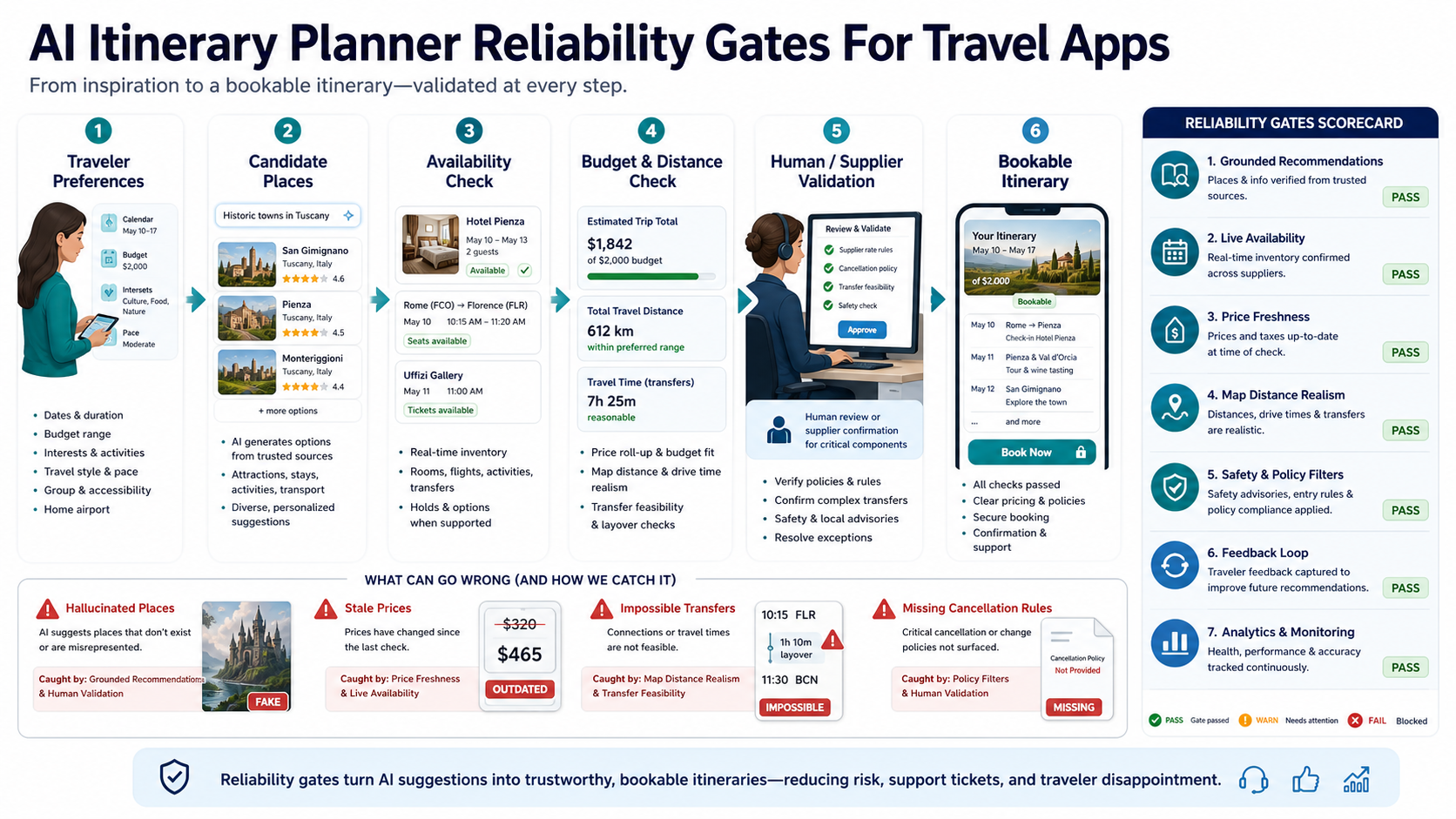
AI can make a travel app more useful, but it should be scoped as a product feature with evaluation and guardrails, not as a novelty. Practical early uses include itinerary suggestions, destination matching, content summarization, customer support triage, trip budget estimates, package recommendations, and supplier ranking. Higher-risk automation includes changing bookings, interpreting visa or entry rules, making refund decisions, or sending customers to unavailable inventory without human review.
The first version can use AI as assisted planning: generate itinerary options from user preferences, budget, timing, group type, and saved interests, then let the user edit and confirm. That gives the team measurable data on acceptance, edits, conversion, and support impact. Treat AI recommendations as untrusted until they pass product gates: grounded destination data, live availability checks, price freshness, realistic travel time, cancellation-policy visibility, safety and accessibility filters, and a feedback loop for rejected suggestions. For repeated operational tasks, the AI Automation ROI Calculator can help decide whether custom AI work has enough volume to justify build cost.
Qdrant did not return strong indexed NextPage matches for the exact AI travel personalization query, so the article keeps AI claims practical and connects the budget conversation to ROI, data readiness, and human review rather than forcing weak internal links.
Team, Timeline, And Delivery Plan
A travel planning MVP often takes 10-16 weeks with a lean product team: product manager, UX/UI designer, mobile or full-stack engineers, backend engineer, QA, and DevOps support. A booking-enabled app usually needs 16-30 weeks because supplier integrations, payments, booking state, cancellations, and support workflows must be tested together. A marketplace or OTA-style platform is usually delivered in phases over 6-12 months or more.
| Phase | Typical Work | Output |
|---|---|---|
| Discovery And Product Model | Audience, geography, supplier type, booking rules, integration shortlist, payment model, MVP cuts | Scope, architecture plan, assumptions, estimate, and delivery roadmap |
| Prototype And UX Validation | Search, itinerary, booking, traveler account, supplier/admin workflows, design system | Clickable prototype and validated user journey |
| MVP Build | Apps, backend APIs, CMS/admin, booking state, payments, notifications, analytics | Testable release candidate with operational workflows |
| Integration And Launch Readiness | Supplier API testing, payment edge cases, cancellations, support scripts, monitoring, SEO basics | Launch checklist and risk register |
| Scale Releases | Marketplace automation, AI personalization, loyalty, dynamic packaging, reporting, data warehouse | Roadmap tied to conversion, operations, and unit economics |
Feature Checklist By Module
A realistic estimate groups features by module so stakeholders can see which teams, vendors, and risks drive cost.
| Module | MVP Features | Growth Features |
|---|---|---|
| Traveler App | Signup, profile, search, saved trips, itinerary, booking request or checkout, notifications, support | Personalization, collaboration, loyalty, offline access, multilingual UX, wallet or credits |
| Booking And Inventory | Availability, pricing, booking state, confirmation, cancellation basics, admin override | GDS/channel integrations, dynamic packages, vouchers, refunds, multi-currency, fraud checks |
| Supplier And Marketplace | Vendor profiles, listing setup, availability controls, approvals, support communication | Commissions, payouts, performance dashboards, dispute workflows, automated moderation |
| Maps And Travel Data | Saved places, route notes, nearby items, weather or status links | Offline maps, route optimization, geofencing, live tracking, real-time disruption alerts |
| Admin And Analytics | Users, bookings, content, support notes, basic reports, exports | Data warehouse, cohort analytics, demand forecasting, supplier scoring, AI review queues |
Budget Mistakes To Avoid
The most common mistake is estimating a travel app like a static content app when the business actually needs live booking, supplier operations, refunds, support, and reconciliation. The second is adding too many supplier categories before proving demand in one focused journey. The third is underestimating edge cases: failed payments, expired availability, duplicate bookings, cancelled inventory, time zone confusion, voucher rules, and customer service escalations.
Another mistake is treating AI as a substitute for clean product data. AI itinerary planning works better when destinations, activities, constraints, prices, availability, policies, and user preferences are structured. Without that foundation, AI output becomes harder to trust and support.
Also budget for maintenance. Travel products need ongoing work for mobile OS updates, supplier API changes, payment issues, seasonal content, security patches, analytics, support tooling, and conversion improvements. A transactional travel app should usually reserve 20-30% of initial build cost per year for maintenance and continuous improvement. If the roadmap includes dashboards for demand, supplier performance, support volume, or cohort conversion, plan those as part of custom dashboard development services rather than as a reporting afterthought.
How NextPage Scopes Travel Apps
NextPage scopes travel products by mapping the traveler journey, supplier model, booking state, money flow, data sources, support operations, and growth plan before estimating screens. We identify whether the first release is a planner, booking app, marketplace, agency portal, or operations platform. Then we split the roadmap into MVP, integration launch, and scale releases so the first budget validates the workflow without hiding operational risk.
For a destination planner, that may mean itinerary creation, sharing, content, reminders, and retention loops. For a booking app, it may mean availability, checkout, cancellation rules, payments, confirmations, and support visibility. For a marketplace, it may mean vendor onboarding, listings, commissions, dispute workflows, payouts, and analytics.
If you are planning a travel product, estimate the first release with the Custom Software Cost Estimator, then use discovery to validate supplier integrations, booking rules, AI scope, admin operations, and launch risks behind the number. When the first release needs native traveler UX plus backend operations, a mobile app development company should scope the app, APIs, admin tooling, analytics, and support workflows together instead of estimating screens in isolation.