Portfolio case study

DeviceBridge: Bluetooth hardware companion mobile app

A cross-platform hardware companion app and Bluetooth connectivity layer that lets field teams discover nearby devices, pair safely, stream measurements, issue commands, recover dropped sessions, and keep Android and iOS behavior aligned.

Name changed to respect NDA.

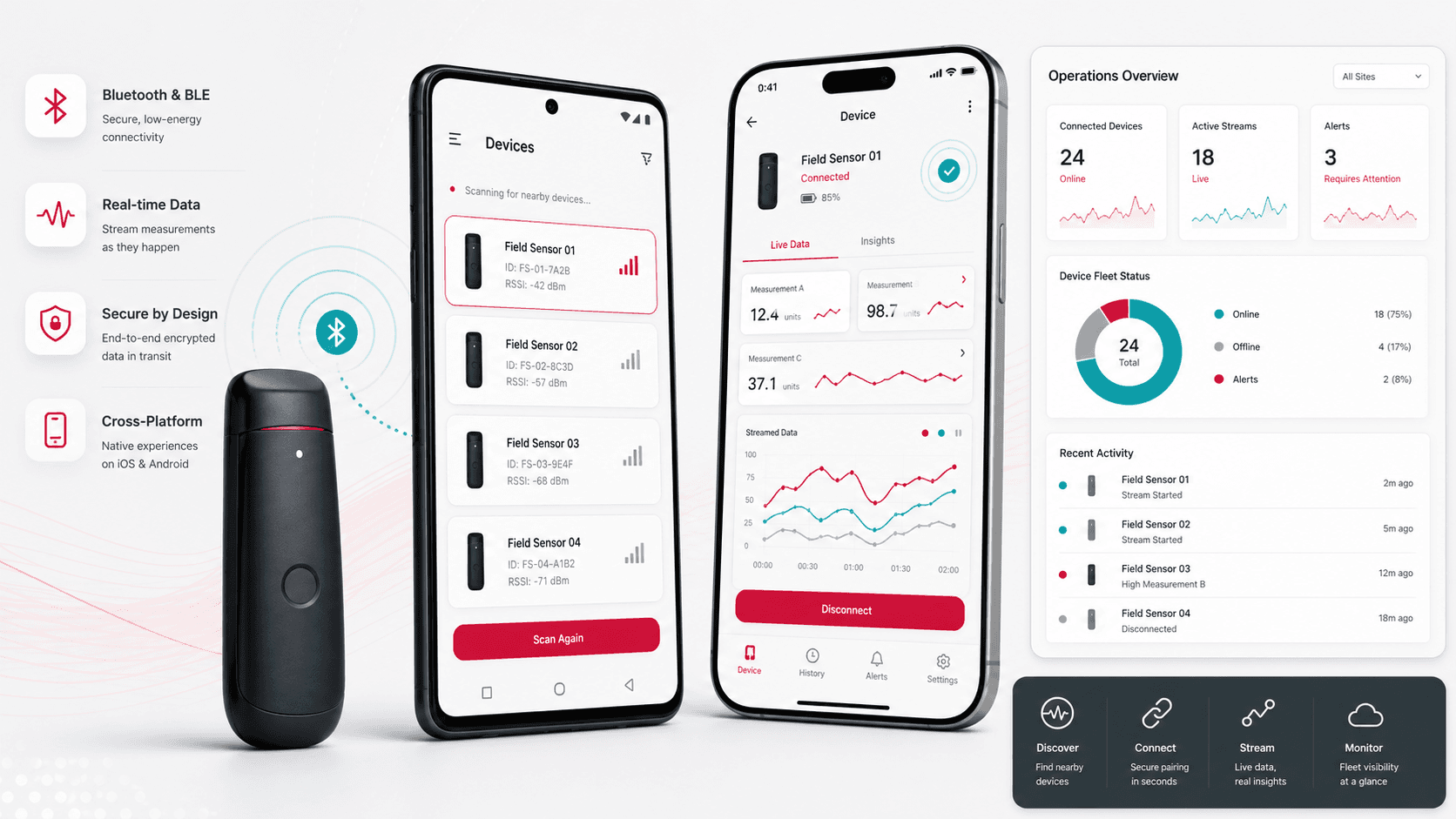
Cross-platform Bluetooth companion app visual with Android and iOS screens, device discovery cards, connection states, wireless signal paths, and streamed measurement lines
Project scope

Native Bluetooth module engineering for an Appcelerator Titanium mobile product, including Android RFCOMM connectivity, iOS CoreBluetooth BLE workflows, device discovery, pairing, read/write commands, buffering, timeout handling, and JavaScript event bridges

2
native mobile platforms
BLE
device discovery and streaming
RFCOMM
Android socket connection support
Events
state and recovery callbacks

Timeline

Cross-platform mobile device connectivity layer and hardware companion app foundation

A hardware app needed reliable Bluetooth behavior across both mobile platforms

The product depended on nearby device connectivity, but Android and iOS expose very different Bluetooth APIs, permission models, pairing behavior, connection states, and stream semantics. The app needed one predictable product layer above both native stacks.

  • Android required pairing, PIN/passkey handling, socket creation fallbacks, connection timeouts, and stream read recovery
  • iOS required BLE service discovery, characteristic subscription, notification handling, central-manager state recovery, and buffered message assembly
  • The JavaScript app layer needed consistent events for device discovery, successful connections, dropped sessions, read data, write failures, and Bluetooth-off states
  • Field users needed the app to recover cleanly when devices moved out of range, powered down, renamed themselves, or returned partial stream data

A native connectivity bridge wrapped in a cross-platform app surface

DeviceBridge exposes platform-native Bluetooth behavior through app-friendly modules so the product can handle discovery, pairing, connection lifecycle, command writes, measurement reads, and recovery without duplicating device logic in every screen.

  • Android Titanium module for classic Bluetooth device selection, bond management, RFCOMM socket connection, read/write streams, and timeout events
  • iOS Titanium module for CoreBluetooth scanning, service and characteristic discovery, notification subscriptions, command writes, and connection-state events
  • Buffered data handling so partial BLE notifications can be assembled before the app consumes streamed measurements
  • Event-driven JavaScript bridge that keeps app screens responsive to found devices, connected state, Bluetooth-off errors, dropped sessions, and end-of-stream recovery paths

Product surfaces

What the platform brought together

The work spanned core product operations, daily user workflows, data-heavy coordination, and resilient platform management.

Device discovery and selection

The app can scan for nearby hardware, collect device names and identifiers, expose indexed results to the UI, and let users choose the active device.

  • Android discovery events for found devices, discovery completion, and name-change updates
  • iOS BLE scanning against custom service UUIDs with advertisement-name capture
  • Device list state that tracks the current peripheral or Bluetooth device separately from the UI

Pairing and connection lifecycle

Native connection code handles the platform-specific edge cases that make hardware apps fragile when users are in the field.

  • Android bond creation, PIN/passkey attempts, secure/insecure socket fallback, UUID extraction, and connection timeout handling
  • iOS central-manager restoration, powered-off and unsupported-state handling, service discovery, characteristic discovery, and reconnect paths
  • Unified connection, timeout, dropped, stopped, and connection-failed events for the application layer

Command and measurement stream

The app can send commands to hardware and receive streamed data through a consistent message model.

  • Android writes bytes across an active socket with throttled byte delivery and read-thread timeout protection
  • iOS writes UTF-8 command payloads to a dedicated BLE command characteristic with response tracking
  • Read events return decoded stream data so the app can render measurements, status, logs, or device responses

Resilience and offline field behavior

The product includes defensive states for partial messages, lost sessions, inactive Bluetooth hardware, slow connections, and demo-mode testing.

  • Ring-buffer handling for BLE fragments and last-line delivery from streamed data
  • Explicit Bluetooth off, unsupported, timeout, dropped, and end-of-stream events
  • Demo flows to simulate discovery, connection, logging, and downloads during app testing

Module depth

Dedicated product blocks for the highest-value workflows

For large platforms, the conversion story depends on showing how each major module solves a specific operating problem, not only listing features.

Hardware trust

Device Discovery That Operators Can Understand

A hardware companion app fails fast if users cannot find the right device. The native modules expose nearby hardware as UI-ready discovery events with names, addresses or UUIDs, result indexes, and discovery completion signals.

Source evidence includes Android discovery receivers and iOS CoreBluetooth scanning against custom service UUIDs.

  • Scans for known hardware rather than asking users to navigate operating-system Bluetooth screens
  • Captures device names from Android devices and iOS advertisement data
  • Keeps discovery lifecycle separate from connected-device state
  • Surfaces Bluetooth-off and unsupported-device errors before the main workflow breaks

Connection recovery

A Shared App Contract Above Two Native Bluetooth Stacks

Android classic Bluetooth and iOS BLE behave differently, so the product needed a shared contract for the higher-level app: discover, choose, connect, write, read, recover, and stop.

Source evidence includes Android socket connection threads and iOS service/characteristic discovery callbacks.

  • Unifies connection success, timeout, failed, dropped, stopped, and end-of-stream states
  • Keeps platform-specific UUID, characteristic, socket, and notification handling inside native modules
  • Protects the UI from blocking reads and slow connection attempts
  • Allows product screens to react to events instead of polling device state

Data flow

Streaming Measurements With Buffering And Command Writes

The app layer needed more than a connection flag. It needed command writes, read events, fragmented BLE data handling, and recoverable streams that could support live measurements or device logs.

Source evidence includes Android read/write stream threads and an iOS ring buffer used for BLE notification fragments.

  • Writes command payloads to Android socket streams and iOS BLE characteristics
  • Assembles partial BLE notification data before returning usable message lines
  • Emits read events with decoded values for product screens
  • Includes demo-mode logging and download simulation for test harnesses

Buyer priorities

What mattered most to the people evaluating the platform

Prospective buyers want to know whether the work solved real workflow, adoption, reliability, data, and operations problems. These priorities shaped the product decisions.

Field reliability

Bluetooth products are judged in the moment a device fails to connect. The implementation focused on explicit states, retries, timeouts, and recoverable failure events.

  • Connection timeouts prevent the app from hanging on unreachable devices
  • Dropped and end-of-stream events let the app guide users back to recovery
  • Bluetooth-off and unsupported states make hardware limitations visible early

Cross-platform consistency

The product needed Android and iOS to feel like one app even though the native APIs underneath were completely different.

  • Titanium module boundaries gave the JavaScript app a consistent event surface
  • Native code absorbed platform-specific service, socket, characteristic, and pairing details
  • Shared product language made discovery, connection, read, write, and stop states portable

Hardware integration control

The app had to work with custom service and characteristic identifiers instead of a generic consumer Bluetooth flow.

  • iOS scans and subscribes around known custom BLE service and characteristic UUIDs
  • Android supports UUID fallback paths and device pairing flows
  • Command and stream paths are separated so the product can evolve device protocols safely

System model

How the platform connects roles, workflows, and product surfaces

The product architecture brings every role into the same operating model, with shared data moving cleanly between web, mobile, media, and notification layers.

Discover to connected workflow

Nearby hardware moves through scan, select, pair, connect, stream, and recover states.

Two native stacks, one app layer

Android Bluetooth and iOS CoreBluetooth sit behind a shared Titanium event bridge used by the product screens.

Operational states

The product exposes discoverable states for found devices, connected sessions, reads, timeouts, dropped links, and Bluetooth-off conditions.

Technology

The Stack We Used And Why

The stack section is written for buyers who need to understand the product architecture, operational trade-offs, and long-term maintainability of the system.

Mobile app shell

Used to keep the product cross-platform while still allowing native device integration where the operating systems diverged.

Appcelerator TitaniumJavaScriptNative module bridgeEvent-driven UI integration

Android connectivity

Used for classic Bluetooth device discovery, pairing, RFCOMM sockets, read/write streams, and fallback connection behavior.

JavaAndroid BluetoothAdapterBluetoothDeviceBluetoothSocketRFCOMMGradle

iOS connectivity

Used for BLE scanning, central-manager state handling, service discovery, characteristic notifications, command writes, and buffered reads.

Objective-CCoreBluetoothCBCentralManagerCBPeripheralCBCharacteristicXcode

Device protocol layer

Used to translate hardware commands and streamed responses into application-level events.

Custom service UUIDsCommand characteristicsNotification characteristicsUTF-8 payloadsRing buffer

Resilience and testing

Used to keep the app diagnosable when Bluetooth behavior changes by device, operating system version, or physical environment.

Connection timeoutsRead timeoutsDropped-session eventsDemo modeTest harness flows

Why Native Modules Sat Under A Cross-Platform App

The product needed a shared app layer, but Bluetooth behavior had to remain close to the operating system APIs.

  • Titanium let the app keep shared JavaScript product screens
  • Java and Objective-C modules gave direct access to Android Bluetooth and iOS CoreBluetooth APIs
  • The app consumed device events instead of carrying platform-specific Bluetooth logic in every workflow

Why The Connection Layer Was Event Driven

Hardware sessions can fail for physical, operating-system, permission, or device-state reasons. Event-driven design made those states visible.

  • Device-found, discovery-finished, connected, timeout, read, dropped, and failed events mapped hardware behavior to UI states
  • Read and connection work stayed off the main interaction path
  • Explicit stop and recovery events helped the product avoid silent failures

Why Buffering Mattered

BLE data can arrive in fragments. The product needed clean messages, not random chunks of a measurement stream.

  • The iOS module keeps a ring buffer for notification fragments
  • The app can receive assembled lines when streamed data reaches a boundary
  • The same pattern can support logs, measurements, status updates, or device responses

Delivery

How the product came together

The work moved from domain modeling to core platform delivery, mobile adoption, and operational hardening.

1

Map device behavior

Identify the discovery, pairing, connection, command, read, and failure states the app needed to support.

2

Build native bridges

Implement Android and iOS modules around the platform Bluetooth APIs while exposing app-friendly methods and events.

3

Normalize app events

Translate platform-specific callbacks into shared app events for discovery, connection, reads, writes, and recovery.

4

Harden field behavior

Add timeouts, buffering, stop paths, dropped-session handling, and simulated flows for testing without live hardware.

Operational depth

What made the platform usable after launch

The strongest case studies are not only feature lists. They show how the system is operated, monitored, governed, and improved when real users depend on it.

Timeout protection

Connection and read work is guarded so slow or unreachable hardware does not leave the product stuck.

  • Android connection attempts use a timeout wrapper around socket connect
  • Read operations emit timeout events when data does not arrive
  • Failure events let the app recover instead of silently waiting

Platform-state handling

The app can react when Bluetooth is off, unsupported, resetting, unauthorized, or disconnected.

  • iOS central-manager states map to app-visible errors and listening states
  • Android bond-state and name-change receivers keep device state current
  • Stop and discovery controls separate active sessions from scanning sessions

Stream diagnostics

Read, write, dropped, and end-of-stream events make hardware behavior easier to diagnose during support.

  • Read events include decoded values from the hardware stream
  • Write-failed events identify command delivery problems
  • Dropped and end-of-stream events distinguish connection loss from intentional stops

Results

The measurable and observable lift from the work

The strongest improvements are the ones a buyer can connect to daily work: fewer disconnected tools, safer operations, clearer workflows, and more reliable product behavior.

2 platforms

Native Coverage

Android and iOS received separate native Bluetooth modules while the product retained one cross-platform app contract.

6 states

Recovery Visibility

Found, connected, read, timeout, dropped, and failed states gave the app enough context to guide users through hardware sessions.

BLE + socket

Device Protocol Reach

The implementation covered iOS BLE service/characteristic workflows and Android classic Bluetooth socket communication.

Buffered

Cleaner Stream Reads

Fragmented notification data could be assembled before the app consumed measurement or log lines.

Outcome

A stronger operating system for bluetooth hardware companion mobile app

The platform reduced tool fragmentation and gave each role a clearer path from live activity to day-to-day action.

A hardware companion app foundation that hides native Bluetooth complexity behind a shared product layer

Android connection support for pairing, socket fallbacks, read/write streams, and connection timeout recovery

iOS BLE support for scanning, service discovery, characteristic subscriptions, command writes, buffering, and state restoration

A resilient event model that helps product screens handle field-device discovery, live data, dropped links, and Bluetooth state changes

FAQ

Frequently Asked Questions About DeviceBridge

Answers about the bluetooth hardware companion mobile app scope, platform model, technology choices, operational workflows, and related build patterns.

What Kind Of Product Does This Case Study Represent?

It represents a cross-platform mobile companion app for custom Bluetooth hardware, including device discovery, connection lifecycle, command writes, streamed reads, buffering, and recovery states across Android and iOS.

Why Does Bluetooth Hardware Usually Need Native Mobile Work?

Bluetooth behavior differs sharply between Android and iOS. A reliable product often needs native modules for pairing, socket or BLE connection handling, service discovery, characteristic subscriptions, permission states, and recoverable error events.

Can This Pattern Support Medical, Industrial, Or Field-Service Devices?

Yes. The same architecture can support connected sensors, test equipment, field-service hardware, medical peripherals, diagnostics tools, asset trackers, and other device workflows where mobile apps need reliable local connectivity.

What Should A Buyer Prepare Before Building A Similar Hardware App?

The most useful inputs are device protocol documentation, service and characteristic UUIDs, pairing requirements, sample commands, expected stream format, failure scenarios, target devices, and field conditions for connectivity testing.

Related services

Build a similarly ambitious product without starting from a blank page.

We can help scope the web, mobile, AI, media, and operating layers needed for your own platform.

Start a project inquiry