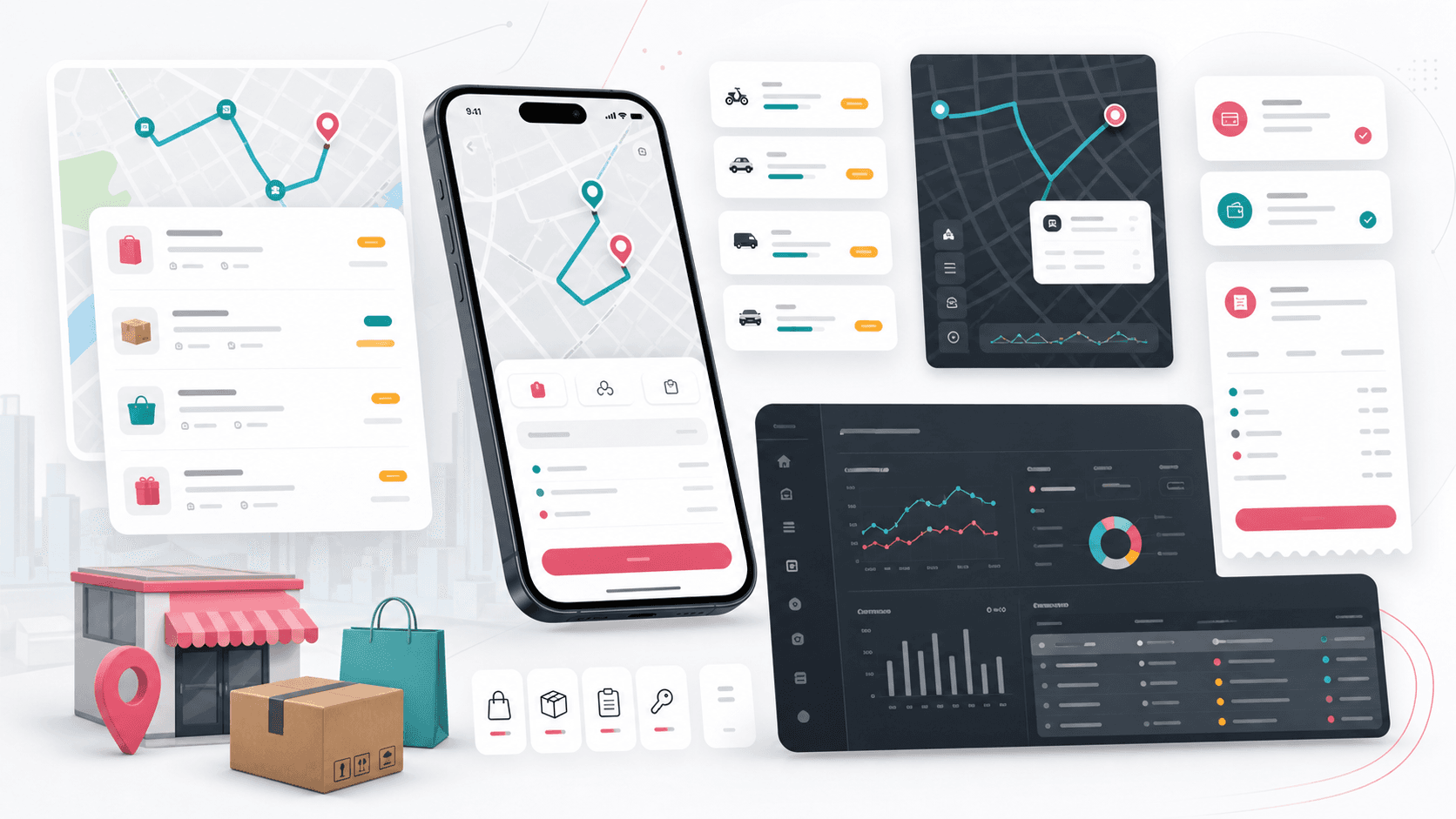
DispatchLane: On-demand delivery and local errands marketplace
A multi-surface on-demand logistics marketplace that connects customer delivery requests, driver bidding, route-aware job execution, payments, chat, support, and back-office operations through one API platform.
API platform, customer mobile apps, driver mobile app, marketplace workflows, payments, messaging, maps, and operational tooling
4
source surfaces reviewed
3
mobile app roles
20+
API workflow areas
Live
maps, chat, payments, and push loops
Timeline
Multi-platform delivery marketplace build and iterative operations support
Local delivery workflows needed one reliable operating layer
The product needed to support multiple delivery categories, mobile ordering, driver availability, competitive bids, receipts, payments, communication, and admin oversight without forcing users or operators to stitch together separate tools.
Customer ordering had to support errands, courier jobs, ride-style trips, food, groceries, item photos, saved cards, scheduling, and order edits
Driver workflows needed onboarding, vehicle records, live availability, bidding, route guidance, collection, delivery confirmation, earnings, and withdrawal handling
Marketplace operations required pricing rules, regions, support tickets, announcements, FAQ content, store catalogs, user settings, and live map visibility
Payments, messaging, push notifications, geocoding, media uploads, and mobile platform differences all had to work through a coherent backend contract
A marketplace platform across customer, driver, and API operations
DispatchLane brings customer mobile ordering, driver field execution, and marketplace administration together through a .NET API layer with native Android and iOS customer clients plus a dedicated Android driver app.
Customer apps guide users through pickup/drop-off selection, category-specific order builders, bid review, payment, live status, chat, help, and order history
A serverless-ready API layer keeps marketplace state, pricing rules, user roles, payments, support, and media handling consistent across apps.
Job, bid, client, partner, vehicle, region, store, product, payment card, receipt, support, FAQ, announcement, and media controllers
Region-based pricing, estimated time operations, suggested prices, client push prices, job type reporting, and live map feeds
Swagger-documented API, error logging, profiling, output caching, email/SMS helpers, push notifications, and API tests for core service areas
Payments, Trust, And Communication
Marketplace trust depends on payment readiness, driver accountability, visible status, and quick communication during live jobs.
Stripe-backed card handling, payment approval requests, tips, receipts, partner earnings, bank details, and withdrawal requests
Twilio-powered chat and token flows connect users and drivers around active jobs
Firebase push notifications, ratings, support requests, help content, legal screens, and app settings support operational confidence
Module depth
Dedicated product blocks for the highest-value workflows
For large platforms, the conversion story depends on showing how each major module solves a specific operating problem, not only listing features.
Revenue and liquidity
Bidroom Marketplace
The bidroom turns each job into a live marketplace moment where customers compare price, distance, ETA, driver information, and job fit before accepting a provider.
Source evidence included bid controllers, client bid acceptance, driver bid placement, swipe/list bid screens, map-aware bid models, and cancellation states.
Driver bids capture price, suggested price, distance, time, vehicle context, partner rating, and status
Customer bid screens support bid comparison, acceptance, cancellation, and active order transitions
Admin and reporting endpoints surface job counts, job type summaries, and live marketplace activity
Field execution
Driver Route And Proof Flow
The driver app supports the operational path from going live through pickup, collection, route progress, receipt capture, barcode/package confirmation, and order completion.
Source evidence included driver fragments for maps, head-to-pickup, collection, package scanning, receipt scanning, trips, earnings, and order completion.
Route maps, location tracking, and pickup/drop-off states help drivers move through active work
Receipt, image, and package scanning flows add proof to delivery records
Trip stats, earnings, balance updates, and withdrawal requests support driver retention
Operations control
Pricing, Regions, And Support
Marketplace operators can shape regional availability, price rules, estimated-time logic, support status, content, and live map visibility from the backend layer.
Source evidence included region operation services, estimated-time rules, suggested pricing rules, support request workflows, announcements, FAQ, store, product, and admin live-map endpoints.
Region and price-rule models keep marketplace economics configurable by geography and service type
Support requests, announcements, FAQ content, and help media reduce operational load
Live map and job-detail endpoints give operators a better view of active marketplace state
Mobile trust
Native Client Apps
Separate native customer apps for Android and iOS let the marketplace support platform-specific UX patterns while sharing the same API contract.
Source evidence included Android fragments, iOS storyboards/controllers, shared order and bid models, payment screens, chat managers, maps, places, Firebase, and API request layers.
Android and iOS clients both support authentication, ordering, bidroom, payment, help, chat, and order history workflows
Maps, places, and route models keep job creation and tracking grounded in location context
Firebase and Crashlytics support push messaging and production app health monitoring
Buyer priorities
What mattered most to the people evaluating the platform
Prospective buyers want to know whether the work solved real workflow, adoption, reliability, data, and operations problems. These priorities shaped the product decisions.
Marketplace Conversion
Customers need fast job creation, clear bid comparison, trustworthy payment, and visible status before they will rely on a local delivery marketplace.
Category-specific flows reduce friction for courier, food, grocery, errands, and ride-style requests
Bidroom comparison gives customers price, timing, vehicle, and provider signals before acceptance
Saved payment, receipt, tip, rating, and order-history flows complete the transaction loop
Driver Supply
Drivers need a field app that makes onboarding, availability, bidding, route progress, proof capture, and payouts feel dependable.
Compliance and vehicle onboarding keep driver eligibility close to the work surface
Go-live, bid, route, collection, receipt, scan, and completion flows support active job execution
Earnings, trip stats, balance updates, and withdrawal workflows help drivers understand their work value
Operational Resilience
Marketplace teams need enough backend control to tune pricing, support users, track live activity, and recover from edge cases.
Region and pricing rules support geography-specific marketplace behavior
Support, FAQ, announcements, and help media give operators direct levers for customer communication
Logging, profiling, Swagger documentation, tests, and mobile crash reporting improve maintainability
System model
How the platform connects roles, workflows, and product surfaces
The product architecture brings every role into the same operating model, with shared data moving cleanly between web, mobile, media, and notification layers.
Marketplace Operating Loop
Customer requests, driver bids, payment approval, route execution, receipt capture, ratings, and support close into one repeatable marketplace cycle.
Three Mobile Roles
Customer Android, customer iOS, and driver Android apps share one backend while each role gets a purpose-built workflow.
API-Centered Platform
Jobs, bids, pricing, users, vehicles, payments, chat, push notifications, media, and admin workflows sit behind a common API layer.
Technology
The Stack We Used And Why
The stack section is written for buyers who need to understand the product architecture, operational trade-offs, and long-term maintainability of the system.
Backend/API
Used for marketplace orchestration across jobs, bids, users, drivers, vehicles, payments, media, pricing, support, and admin operations.
ASP.NET CoreC#AWS LambdaSwagger/OpenAPIJWTNUnit
Customer Mobile Apps
Used for native ordering, maps, payments, chat, order history, help, and customer bidroom experiences across Android and iOS.
Used for API documentation, errors, profiling, cache behavior, release builds, and production support across the marketplace.
ELMAHMiniProfilerOutput cachingCrashlyticsRobolectricCI-ready mobile builds
Why Native Mobile Surfaces
The product depends on maps, camera capture, push notifications, payment flows, and field reliability, which justified native customer and driver experiences.
Native Android and iOS customer apps could fit platform conventions while sharing one marketplace API
A dedicated Android driver app kept field workflows focused on availability, routes, proof, and earnings
Mobile libraries for maps, places, chat, storage, crash reporting, and camera capture shortened delivery risk
Why A Dedicated API Layer
Marketplace state moves across customers, drivers, operators, payments, chat, and support, so a single API contract was essential.
Controllers and services grouped the product around jobs, bids, users, partners, vehicles, stores, media, and regions
Swagger documentation and API tests made mobile integration easier to reason about
Serverless-ready deployment kept the API suitable for variable marketplace traffic
Why Operations Features Came Early
On-demand marketplaces fail when support, pricing, driver verification, payouts, and live status are treated as afterthoughts.
Region and pricing rules gave operators levers to shape marketplace economics
Support requests, FAQ, announcements, help content, and legal flows reduced ambiguity
Receipts, ratings, transaction records, and withdrawal requests supported accountability on both sides
Delivery
How the product came together
The work moved from domain modeling to core platform delivery, mobile adoption, and operational hardening.
1
Model The Marketplace
Define job types, customer requests, driver bids, region rules, trip states, payments, support, and operational reporting before expanding app screens.
2
Build The API Contract
Create controllers, services, models, validators, and tests for the workflows that customer and driver apps would share.
Add pricing rules, support controls, live map feeds, logging, profiling, crash reporting, and app-health signals for ongoing marketplace support.
Operational depth
What made the platform usable after launch
The strongest case studies are not only feature lists. They show how the system is operated, monitored, governed, and improved when real users depend on it.
Region-Aware Economics
The backend included region operations, estimated time rules, client push pricing, suggested prices, and job type summaries so operators could tune supply and demand.
Customer flows supported card validation, payment approval, bid acceptance, job images, receipts, tips, ratings, support requests, chat, and order history.
Payment readiness
Live communication
Order records
Results
The measurable and observable lift from the work
The strongest improvements are the ones a buyer can connect to daily work: fewer disconnected tools, safer operations, clearer workflows, and more reliable product behavior.
Customer + driver apps
Marketplace Surfaces
The product separated customer ordering from driver execution while keeping both surfaces on the same API foundation.
Bid-based jobs
Revenue Flow
Jobs could move through bid placement, acceptance, payment, route execution, receipt capture, tip, rating, and completion states.
Operational API
Control Layer
Operators had API support for pricing, regions, stores, products, users, vehicles, support, announcements, FAQ, media, and live activity.
Outcome
A stronger operating system for on-demand logistics marketplace
The platform reduced tool fragmentation and gave each role a clearer path from live activity to day-to-day action.
A complete on-demand logistics marketplace architecture spanning customer mobile ordering, driver field execution, and API-driven operations
Native Android and iOS customer experiences for signup, job creation, maps, bidroom, payment, chat, help, order history, and account management
A dedicated Android driver experience for onboarding, availability, bidding, route progress, scans, receipts, trips, earnings, vehicles, bank details, and withdrawals
A backend operations layer for jobs, bids, region pricing, stores, products, users, vehicles, cards, support, announcements, FAQ, media, push notifications, chat tokens, and admin reporting
FAQ
Frequently Asked Questions About DispatchLane
Answers about the on-demand logistics marketplace scope, platform model, technology choices, operational workflows, and related build patterns.
What Kind Of Platform Does DispatchLane Represent?
DispatchLane represents an on-demand delivery and local errands marketplace with customer mobile apps, a driver field app, and an API layer for marketplace operations.
Why Does A Delivery Marketplace Need Separate Customer And Driver Apps?
Customers need a fast ordering and bid-review experience, while drivers need field tools for availability, route progress, proof capture, earnings, and withdrawals. Separate apps keep each workflow focused.
What Makes The API Layer Important?
The API coordinates jobs, bids, users, drivers, vehicles, payments, media, maps, chat, push notifications, pricing rules, support, and admin visibility so mobile apps do not carry marketplace logic alone.
Can This Pattern Support Other Delivery Models?
Yes. The same marketplace pattern can support courier networks, local errands, store pickup, food delivery, ride-style requests, multi-stop jobs, field services, and white-label logistics platforms.
Related services
Build a similarly ambitious product without starting from a blank page.
We can help scope the web, mobile, AI, media, and operating layers needed for your own platform.