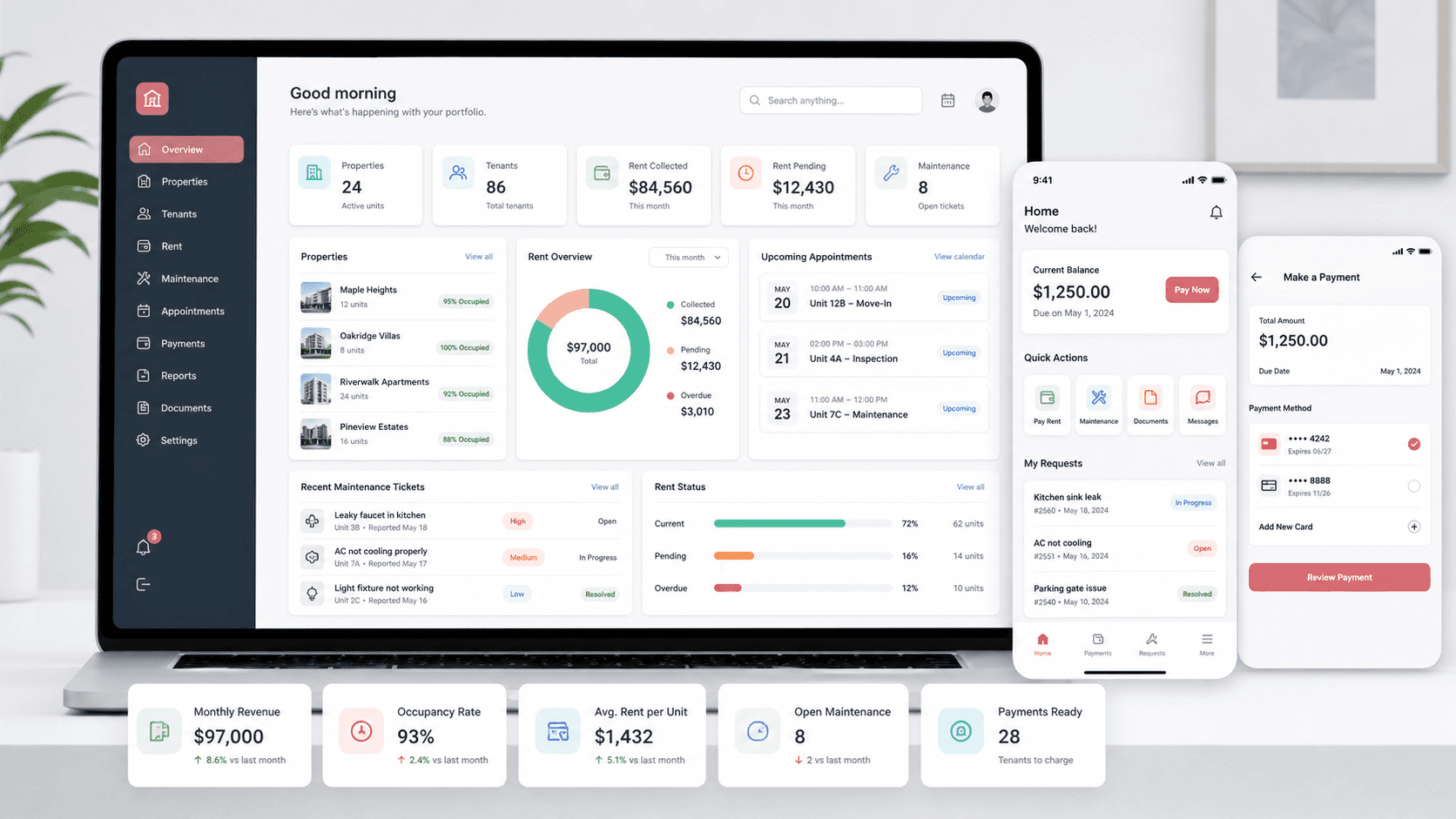
LeaseLedger: Property rental management web platform
A property rental management platform that gives landlords and property managers one operating workspace for property records, tenant onboarding, rent status, maintenance requests, appointments, payments, and role-aware tenant self-service.
Web app engineering, landlord and tenant workflow design, Node API integration, database-backed operations, email automation, payment readiness, and admin dashboard delivery
2
role-aware workspaces
3
core operating modules
Search
property, tenant, and maintenance records
Payments
rent collection readiness
Timeline
Rental operations platform build for landlord, tenant, and maintenance coordination workflows
Rental operations needed one reliable workspace
Property managers needed to move tenant records, property inventory, rent context, maintenance issues, and tenant communication out of scattered spreadsheets and manual follow-ups.
Landlords needed fast access to property, tenant, and maintenance lists with search and update flows
Tenants needed a simpler place to view rental actions, maintenance status, payment prompts, and requests
Managers needed email handoffs for new tenant access and password recovery without manual copying
The product needed to connect a React admin surface with API-backed data, secure roles, and payment-ready workflows
A role-aware rental management platform for daily operations
LeaseLedger brings landlord dashboards, tenant records, property profiles, maintenance coordination, payment readiness, and tenant self-service into one web platform with API-backed workflows.
Role-based navigation separates landlord management views from tenant service views
Property, tenant, and maintenance modules support create, update, list, search, and detail workflows
Dashboard cards summarize active units, tenant counts, maintenance load, rent status, and upcoming appointments
Email and payment integrations support onboarding, password recovery, tenant communication, and rent collection paths
Product surfaces
What the platform brought together
The work spanned core product operations, daily user workflows, data-heavy coordination, and resilient platform management.
Property portfolio management
Landlords can maintain structured property records and use searchable lists to keep rental inventory current.
Property creation and editing for name, address, city, state, zip, country, type, year built, and owner context
Property list search for quickly finding units, buildings, and locations
Dashboard-ready property counts and occupancy-oriented operating context
Tenant onboarding and records
Tenant workflows collect profile, contact, rental assignment, and access details in one managed flow.
Tenant profile forms for name, date of birth, age, gender, email, phone, property, unit, and password setup
Role assignment for tenant-facing access after landlord-managed onboarding
Automated email handoff for tenant details and account communication
Maintenance coordination
Maintenance requests become searchable operating records instead of ad hoc messages.
Maintenance creation and update flows for title, details, due date, assignee information, and status context
Landlord and tenant navigation into maintenance lists for issue tracking
Search endpoints for quickly finding active or historical maintenance records
Rent and payment readiness
The platform includes the product foundation for rent status, tenant payment prompts, and card-based payment workflows.
Tenant dashboard surfaces for outstanding rent, rental context, maintenance, and service requests
Square payment form integration readiness for card collection and rent payment experiences
Payment, rent, appointment, report, and document navigation patterns for the expanded rental operating model
Buyer priorities
What mattered most to the people evaluating the platform
Prospective buyers want to know whether the work solved real workflow, adoption, reliability, data, and operations problems. These priorities shaped the product decisions.
Landlord efficiency
The platform needed to make repeated rental operations faster for teams managing multiple tenants and properties.
Searchable tables reduce time spent looking for tenant, property, and maintenance records
Create and edit forms keep rental data structured instead of buried in messages
Dashboard counts make daily workload easier to scan
Tenant service clarity
Tenant-facing navigation needed to make rent, rentals, maintenance, applications, and requests easier to understand.
Role-aware menus hide landlord-only controls from tenant users
Tenant dashboard cards group outstanding rent, maintenance, requests, and rental context
Email handoffs help tenants receive account details without a separate manual process
Operational extensibility
Rental platforms evolve toward payments, documents, reports, appointments, and service messaging, so the foundation needed room to grow.
API-backed modules support future reporting and deeper dashboard metrics
Payment components prepare the product for rent collection workflows
Role and navigation structure can expand into applications, documents, and tenant communication
System model
How the platform connects roles, workflows, and product surfaces
The product architecture brings every role into the same operating model, with shared data moving cleanly between web, mobile, media, and notification layers.
Property to payment workflow
A rental record moves from property setup to tenant assignment, rent visibility, maintenance handling, and payment follow-up.
Landlord and tenant workspaces
Landlords manage records and operations while tenants see rent, rental, maintenance, application, and request actions.
Rental platform foundation
React routes, role state, Express APIs, MySQL records, email automation, uploads, and payment components work together as one operating platform.
Technology
The Stack We Used And Why
The stack section is written for buyers who need to understand the product architecture, operational trade-offs, and long-term maintainability of the system.
Web app
Used for the browser-based landlord and tenant workspaces where property managers run day-to-day rental operations.
Redux Form supports repeated data-entry patterns across property, tenant, and maintenance modules
Material UI and Bootstrap provide dense operational controls for tables, forms, cards, and side navigation
Why A Node API Layer
The platform needed backend endpoints for data retrieval, search, email delivery, upload handling, and dashboard summaries.
Express routes group tenant, property, maintenance, search, email, and dashboard requests
Sequelize and SQL queries provide direct access to the rental operations data model
CORS and HTTPS support browser access to the API service
Why Payment Readiness Matters
Rent collection is a natural extension of property management, so the product needed payment surfaces without making the first release only about payments.
Tenant dashboard patterns make payment prompts visible in context
Square components provide a foundation for secure card entry
Rent, payment, document, and report navigation leaves room for a broader rental operating suite
Delivery
How the product came together
The work moved from domain modeling to core platform delivery, mobile adoption, and operational hardening.
1
Map rental operating roles
Define landlord and tenant navigation, access boundaries, property records, tenant onboarding, maintenance flow, and rent-oriented dashboard needs.
2
Build the management modules
Implement property, tenant, maintenance, dashboard, login, signup, and password workflows with reusable admin UI patterns.
3
Connect APIs and records
Wire the frontend to API-backed lists, search endpoints, dashboard counts, email templates, uploads, and database-backed rental records.
4
Prepare payment and service expansion
Add payment form readiness, tenant-facing service cards, and navigation paths for rent, documents, reports, appointments, and support workflows.
Operational depth
What made the platform usable after launch
The strongest case studies are not only feature lists. They show how the system is operated, monitored, governed, and improved when real users depend on it.
Searchable operating records
The core modules expose searchable lists so property teams can find records quickly during daily work.
Tenant search across profile and account fields
Property search across address, type, location, and owner fields
Maintenance search across issue title, details, assignee, and date context
Role-aware rental navigation
Landlord and tenant users see different navigation patterns around the same rental operating model.
Landlords see property, tenant, and maintenance management lists
Tenants see rent, rental, maintenance, application, and service request actions
Role state keeps the interface focused on the current user type
Communication and onboarding
Email templates and password recovery routes reduce manual handoff when new tenants enter the platform.
Tenant detail email flow after account creation
Password recovery email flow for account access
Reusable HTML templates for transactional communication
Results
The measurable and observable lift from the work
The strongest improvements are the ones a buyer can connect to daily work: fewer disconnected tools, safer operations, clearer workflows, and more reliable product behavior.
Unified
Rental Workspace
Property, tenant, maintenance, rent, and payment-oriented actions are organized under one operating surface.
Role-aware
Cleaner Access
Landlords and tenants receive different navigation and workflow entry points without needing separate products.
Searchable
Faster Lookup
Property, tenant, and maintenance records can be searched through dedicated API-backed workflows.
Payment-ready
Rent Collection Path
Tenant dashboard and Square payment components create a foundation for rent collection and payment follow-up.
Outcome
A stronger operating system for property rental management platform
The platform reduced tool fragmentation and gave each role a clearer path from live activity to day-to-day action.
A React property rental management web app with dashboard, landlord navigation, tenant navigation, property lists, tenant lists, maintenance lists, onboarding, login, signup, and password recovery workflows
A Node and Express API layer for dashboard counts, tenant records, property records, maintenance records, search endpoints, uploads, and transactional email flows
Role-aware product surfaces that separate landlord management tasks from tenant rent, rental, maintenance, application, and request views
A payment-ready rental operations foundation with Square card form components, tenant payment prompts, and room to expand into documents, reports, appointments, and applications
FAQ
Frequently Asked Questions About LeaseLedger
Answers about the property rental management platform scope, platform model, technology choices, operational workflows, and related build patterns.
What Kind Of Platform Does LeaseLedger Represent?
LeaseLedger represents a property rental management platform with landlord dashboards, property records, tenant onboarding, maintenance coordination, searchable operating lists, tenant self-service, email handoffs, and payment-ready rent workflows.
Why Do Rental Platforms Need Both Landlord And Tenant Workspaces?
Landlords need control over records, units, maintenance, and rent operations, while tenants need a simpler service view for payments, maintenance, rental context, documents, and requests. Role-aware workspaces keep each side focused.
How Did The Platform Support Maintenance Coordination?
The platform included maintenance creation, update, list, and search flows with title, details, date, assignee, role, and creator context so issues could be tracked as structured records.
Can This Pattern Support Larger Property Operations?
Yes. The same architecture can extend into rent ledgers, lease documents, applications, inspections, automated reminders, owner reporting, tenant chat, multi-property analytics, and payment reconciliation.
Related services
Build a similarly ambitious product without starting from a blank page.
We can help scope the web, mobile, AI, media, and operating layers needed for your own platform.