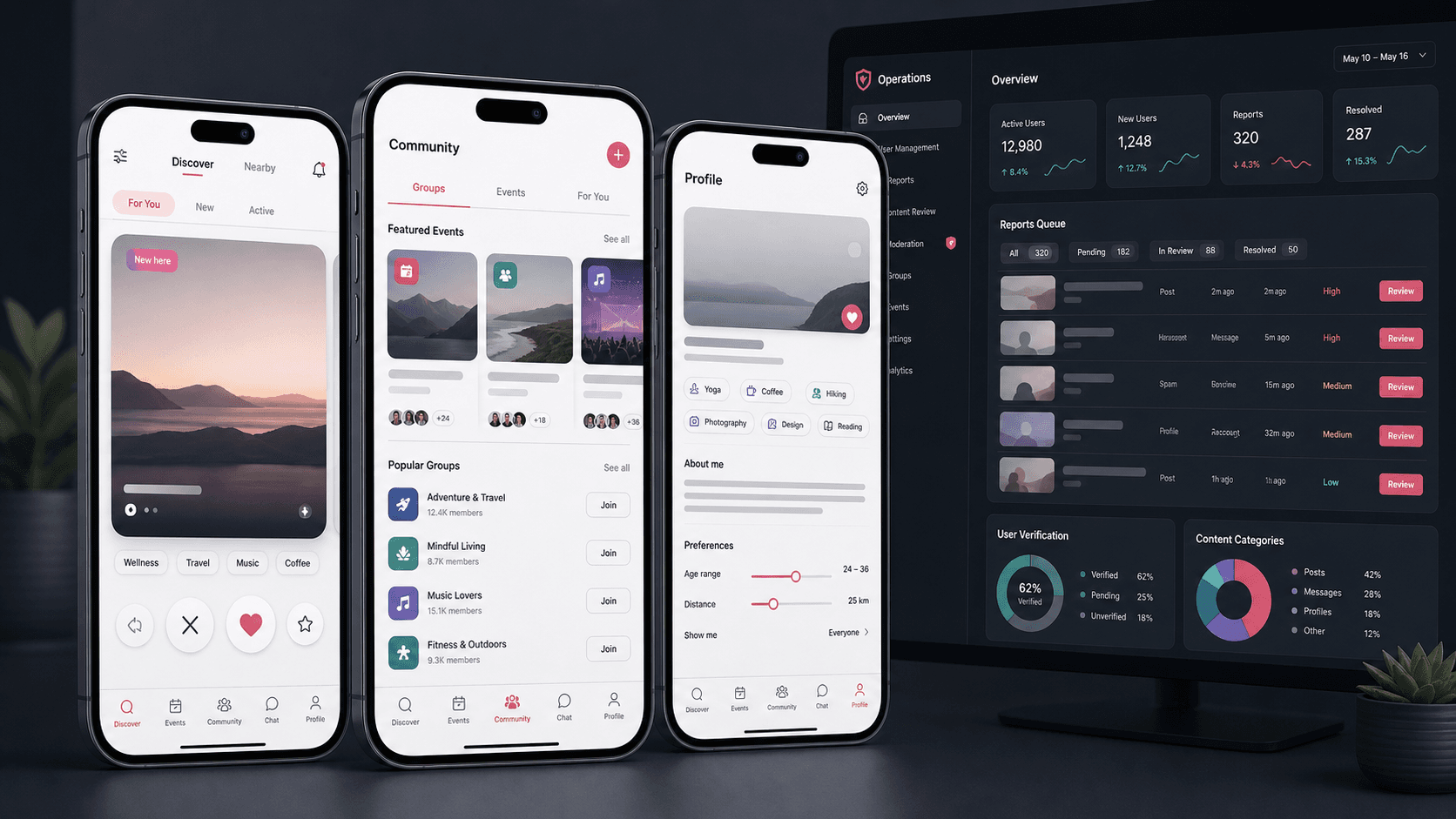
Moderly: Mobile dating and lifestyle community app
A Flutter-led dating and lifestyle community platform with anime-interest onboarding, phone verification, profile discovery, galleries, likes, matches, conversations, location-aware feeds, premium paths, and a supporting operations console for moderation and governance.
Flutter mobile app engineering, GraphQL product integration, ASP.NET API support, React admin engineering, moderation workflows, and platform operations delivery
Flutter
primary mobile app
GraphQL
member and match workflows
REST
support API foundation
2
role-gated operator types
Timeline
Mobile-first community platform build with Flutter onboarding, GraphQL app workflows, REST API support, and supporting admin, moderation, content, and operations layers
A social discovery product needed both user delight and operational control
The product was centered on a mobile dating and lifestyle community experience, but that experience needed both a polished onboarding funnel and enough back-office depth to keep profiles, matches, media, reports, events, groups, content, and settings trustworthy at scale.
The mobile app needed to support anime-interest positioning, phone-based onboarding, profile-driven discovery, galleries, location context, and trust-sensitive interactions
GraphQL-backed product workflows had to cover users, feeds, matches, conversations, messages, photos, stickers, likes, reports, favorite anime, music interests, and premium status
Events, groups, achievements, snippets, templates, and settings had to support the customer-facing app experience
Reported users and reported media required review screens, detail views, approval actions, and deletion paths
Admin and manager roles needed separate access without exposing every platform-control action to every operator
A mobile community product with a role-aware operations layer
Moderly pairs the primary Flutter community app with a secured browser workspace where administrators and managers can govern users, reports, content, events, groups, achievements, and app configuration.
Flutter app experience framed around onboarding, phone verification, profile context, anime affinity, discovery, matching, conversations, and user trust
Role-based menu configuration separates full administrator controls from manager-level operations
API helpers centralize user, report, event, group, file, snippet, template, setting, role, and achievement endpoints for the platform
Product surfaces
What the platform brought together
The work spanned core product operations, daily user workflows, data-heavy coordination, and resilient platform management.
Mobile dating and lifestyle experience
The public product story centers on the user-facing Flutter app where members onboard, verify their phone, share profile context, discover people through anime and lifestyle interests, and build community trust.
Dark-mode onboarding introduces a distinct anime-led dating premise before account creation
Phone number entry, OTP verification, resend timing, and returning-user paths give the app a practical identity funnel
Profile, gallery, favorite anime, music, location, likes, matches, conversations, and message models create a richer discovery base than a swipe-only experience
GraphQL community product layer
The mobile app is backed by a typed GraphQL product layer for member profiles, recommendations, matching, chat-adjacent flows, safety actions, and premium access.
Feed and user queries include galleries, favorite anime, music interests, matches, profile metadata, premium state, and verification status
Conversation and message models support match-linked communication with attachments, stickers, and sender context
Community engagement system
Events, groups, achievements, snippets, templates, and settings support the mobile experience by keeping community activity configurable and fresh.
Event operations for creating, approving, reviewing, and removing community programming
Group management workflows that support interest-led community spaces
Achievement, snippet, and template tools for repeatable app content and engagement patterns
User and role administration
The operations console gives teams a practical way to support the mobile member base without weakening access boundaries.
User list and detail routes with first name, last name, email, role, and active-status indicators
Add-user workflow, role lookups, and status-change API integration
Authenticated route protection and persistent session handling through a shared API core
REST API support foundation
A supporting API layer covers the repeatable account and operations flows that a mobile-first community product needs around identity, profile data, files, and configuration.
Signup, login, token-backed profile lookup, password recovery, and account-status actions for member and operator access
Role-aware user listing, user detail, save, delete, and block workflows for account operations
File, snippet, template, and app-setting endpoints that support reusable content and app configuration flows
Reported content moderation
Reported users and media move through dedicated queues so safety work is separated from general member administration.
Reported-user table with reporter, reported member, reason, and action date fields
Reported-media list and detail routes connected to file report endpoints
Approve, reject, delete, and detail-review actions for moderation decisions
Events, groups, and achievements
Community programming for the mobile app can be maintained inside the same operations console instead of scattered across support requests.
Event list, detail, save, approval, rejection, and deletion flows
Group management screens backed by group save, list, detail, and delete APIs
Achievement list and detail flows for managing recognition content inside the product
Content and app configuration
Reusable configuration screens let operators maintain mobile-app-facing copy, templates, snippets, uploads, and application settings.
Template and snippet management with create, list, detail, and delete actions
App setting screens with modification metadata and editable key-based records
File upload helpers, rich text editing dependencies, and shared form controls for content-heavy admin work
Buyer priorities
What mattered most to the people evaluating the platform
Prospective buyers want to know whether the work solved real workflow, adoption, reliability, data, and operations problems. These priorities shaped the product decisions.
Mobile user trust
A dating and lifestyle app has to feel safe, current, and community-aware for users before the supporting operations layer can matter.
Phone verification, profile setup, galleries, interests, location, likes, matches, and conversations give the mobile experience more substance than a generic feed
Reporting and media review workflows support safer member interactions
Configurable snippets, templates, and settings keep app-facing content easier to maintain
Trust and safety
Dating and lifestyle communities need clear moderation workflows because reported behavior and media can affect user trust quickly.
Reported users and reported media have separate review paths
Approval, rejection, and deletion actions are connected to backend endpoints
Role-gated access keeps moderation tools within the operator workspace
Maintainable platform delivery
The project needed a practical operating foundation that could keep adding mobile product modules without re-solving navigation, tables, forms, and API calls each time.
Shared hooks handle API fetching, pagination, toasts, viewport behavior, user state, and uploads
React Bootstrap components and reusable form controllers keep dense screens consistent
Redux layout state and route flattening support multiple admin shell configurations
System model
How the platform connects roles, workflows, and product surfaces
The product architecture brings every role into the same operating model, with shared data moving cleanly between web, mobile, media, and notification layers.
Mobile community and operations loop
Mobile onboarding, anime interests, profiles, galleries, likes, matches, conversations, reports, media files, templates, snippets, and settings connect through one product and operations loop.
Admin and manager access model
Administrators and managers share the same platform foundation while menu visibility and sensitive operations remain role-aware.
Mobile app with admin platform foundation
The mobile product is supported by Flutter routes, reusable mobile widgets, GraphQL models, API helpers, hooks, Redux layout state, and Bootstrap-based admin layouts.
Technology
The Stack We Used And Why
The stack section is written for buyers who need to understand the product architecture, operational trade-offs, and long-term maintainability of the system.
Flutter mobile app
Used for the primary iOS and Android member experience, including onboarding, authentication, profile setup, discovery, and app theming.
FlutterDartAutoRouteFlutter BlocHydrated BlocReactive Forms
Mobile backend integration
Used to connect the app to typed member, feed, match, conversation, photo, report, location, sticker, anime, music, and premium workflows.
Used as a supporting backend layer for account access, user administration, profile fields, media records, content snippets, templates, app settings, logging, and API documentation.
ASP.NET CoreC#JWT tokensNPocoMySQLSwagger
Admin frontend
Used to build the browser-based operations layer that supports the mobile dating and lifestyle app across user management, moderation, events, groups, achievements, content, and settings.
Used to support snippets, templates, file records, rich text editing, media review, and configuration records inside the admin workflow.
React Draft WYSIWYGSimpleMDEFile upload helpersReusable form inputs
Why Flutter For The Member App
The primary experience needed to feel mobile-native while still moving quickly across iOS and Android with one shared product foundation.
Flutter kept onboarding, phone auth, verification, profile setup, and discovery screens in one mobile codebase
AutoRoute made the early account journey explicit across onboarding, entry, account creation, verification, and profile completion
Bloc-based state management fit the app needs for onboarding progress, auth requests, OTP state, and reusable service flows
Why GraphQL For Community Workflows
The dating product relies on connected member data, so the app benefits from typed requests that can fetch profile, match, gallery, interest, and conversation context together.
GraphQL queries let feed and profile screens pull only the member context each view needs
Generated models reduce mismatch risk across users, photos, matches, conversations, messages, reports, and premium status
Mutations keep account creation, phone verification, likes, reporting, location updates, uploads, and profile edits organized around product actions
Why React For The Admin Workspace
The mobile app needed a modular operations console where tables, forms, side navigation, detail screens, and moderation actions could support many community areas consistently.
React made repeated admin screens easier to compose from reusable table, form, layout, and route patterns
React Router kept user, report, event, group, achievement, setting, snippet, and template areas addressable
TypeScript helped keep route props, table rows, API parameters, and shared components more explicit
Why API Helpers And Hooks
The admin panel had many backend-backed flows, so repeated request, pagination, loading, and error behavior needed to be centralized.
API helpers grouped endpoint behavior by product area instead of scattering URLs across screens
The shared useApi hook kept list fetching, pagination, success callbacks, and toast errors predictable
Upload and file helpers made media-heavy moderation and content work easier to extend
Why A REST Support Layer
Not every operational workflow needed to be expressed as a rich social graph; account, file, setting, and content maintenance paths benefited from simple versioned endpoints.
JWT-backed endpoints keep login, current-user lookup, profile saves, password flows, and user status changes explicit
CRUD-style endpoints fit snippets, templates, files, and key-based app settings that operators manage repeatedly
Swagger documentation, logging, and profiling support the maintenance side of the platform
Why Role-Gated Navigation
Community operations required different access boundaries for administrators and managers while preserving one interface framework.
Menu items declare allowed users for each administrative area
Protected routes keep authenticated surfaces behind the admin layout
Role separation supports operational delegation without exposing all controls universally
Delivery
How the product came together
The work moved from domain modeling to core platform delivery, mobile adoption, and operational hardening.
1
Map mobile and operating areas
Turn the dating and lifestyle product into clear user-facing and operator-facing modules for onboarding, verification, profiles, discovery, reports, events, groups, achievements, content, and settings.
2
Build the mobile account journey
Create the first-run app flow around anime-led positioning, account creation, phone verification, OTP handling, and profile completion.
3
Build the admin shell
Create a protected React workspace with layouts, side navigation, route flattening, authentication checks, and reusable UI primitives.
4
Connect backend workflows
Wire mobile and admin modules to GraphQL and API helpers for listing, details, saving, deleting, reporting, approving, rejecting, uploading, location updates, and status changes.
5
Harden repeated operations
Add search, pagination, loading states, date formatting, toasts, file handling, and consistent detail routes so operators can work through records reliably.
Operational depth
What made the platform usable after launch
The strongest case studies are not only feature lists. They show how the system is operated, monitored, governed, and improved when real users depend on it.
Typed mobile product schema
The mobile app has a GraphQL schema shaped around real dating-community actions instead of only generic account screens.
Feed, profile, match, conversation, message, gallery, photo, sticker, anime, music, like, report, location, and premium records are modeled explicitly
Phone verification and sign-in flows are backed by dedicated mutations and reusable auth blocs
Generated GraphQL classes give app code typed access to nested member and conversation state
Dedicated moderation queues
Reported users and reported media are split into focused views instead of being buried inside generic user management.
Report tables show who reported the issue, who or what was reported, the reason, and the action date
Media review uses file endpoints and detail pages for deeper inspection
Approve, reject, and delete actions keep trust workflows inside the admin console
Reusable module pattern
Most operating areas follow a list, detail, save, and delete pattern, making the console easier to extend as the product grows.
Users, events, groups, achievements, snippets, templates, settings, and files use consistent helper shapes
Shared table and page title components reduce repeated screen scaffolding
Search and pagination are passed through common hooks and UI components
Content configuration inside operations
Templates, snippets, settings, and uploads give non-engineering operators a path to maintain app-facing content and configuration.
Template and snippet CRUD flows support reusable app content
App settings expose key-based configuration records with modification metadata
File upload and editor dependencies support media and content-heavy admin work
Results
The measurable and observable lift from the work
The strongest improvements are the ones a buyer can connect to daily work: fewer disconnected tools, safer operations, clearer workflows, and more reliable product behavior.
Flutter + GraphQL
Mobile Foundation
The primary app experience can move across onboarding, verification, profile setup, discovery, matching, media, and messaging-adjacent flows from one typed mobile foundation.
Role-gated
Operator Access
Administrator and manager users can be given appropriate menu access without maintaining separate admin products.
Moderation queues
Trust Workflow
Reported users and reported media have dedicated routes and API actions for practical community safety operations.
Reusable CRUD
Faster Expansion
Common table, search, form, API, and route patterns make new admin modules easier to add.
Content controls
Operator Independence
Templates, snippets, settings, uploads, and achievement records can be maintained through the admin console.
Outcome
A stronger operating system for mobile dating and lifestyle community platform
The platform reduced tool fragmentation and gave each role a clearer path from live activity to day-to-day action.
A Flutter-led dating and lifestyle community platform supported by onboarding, phone verification, profile, interest, discovery, match, conversation, content, events, groups, and trust workflows
A GraphQL product layer for users, feeds, likes, matches, conversations, galleries, reports, stickers, anime interests, music interests, location, and premium status
A supporting ASP.NET REST API for login, signup, current-user lookup, password workflows, user administration, files, snippets, templates, and app settings
A secured React operations console for managing the community product from one browser workspace
Role-aware navigation across users, reported content, events, groups, achievements, snippets, templates, and settings
Dedicated moderation workflows for reported users and reported media, including review and action endpoints
FAQ
Frequently Asked Questions About Moderly
Answers about the mobile dating and lifestyle community platform scope, platform model, technology choices, operational workflows, and related build patterns.
What Kind Of Product Does Moderly Represent?
Moderly represents a Flutter-led dating and lifestyle community platform with anime-interest onboarding, phone verification, profile discovery, galleries, likes, matches, conversations, events, groups, content engagement, and a supporting admin console for moderation and operations.
Why Does A Dating App Need A Supporting Operations Platform?
A dating app needs a supporting operations platform when community safety, user status, reports, media review, events, content templates, and app configuration need to be managed from one governed layer.
How Did The Stack Support The Mobile Community Product?
The mobile product used Flutter for the iOS and Android experience, AutoRoute for account and profile journeys, Bloc for stateful flows, GraphQL for typed community data, ASP.NET REST services for supporting account and configuration workflows, and React for the operations console. React Router organized secured admin modules, Redux managed layout state, and API helper modules connected moderation, content, and status workflows to backend services.
Can This Pattern Support Other Community Platforms?
Yes. The same admin architecture can support dating apps, lifestyle networks, creator communities, social discovery products, membership apps, event communities, and other platforms that need moderation plus operator-managed content.
Related services
Build a similarly ambitious product without starting from a blank page.
We can help scope the web, mobile, AI, media, and operating layers needed for your own platform.