Portfolio case study

PulseVenue: Nightlife venue discovery and community mobile platform

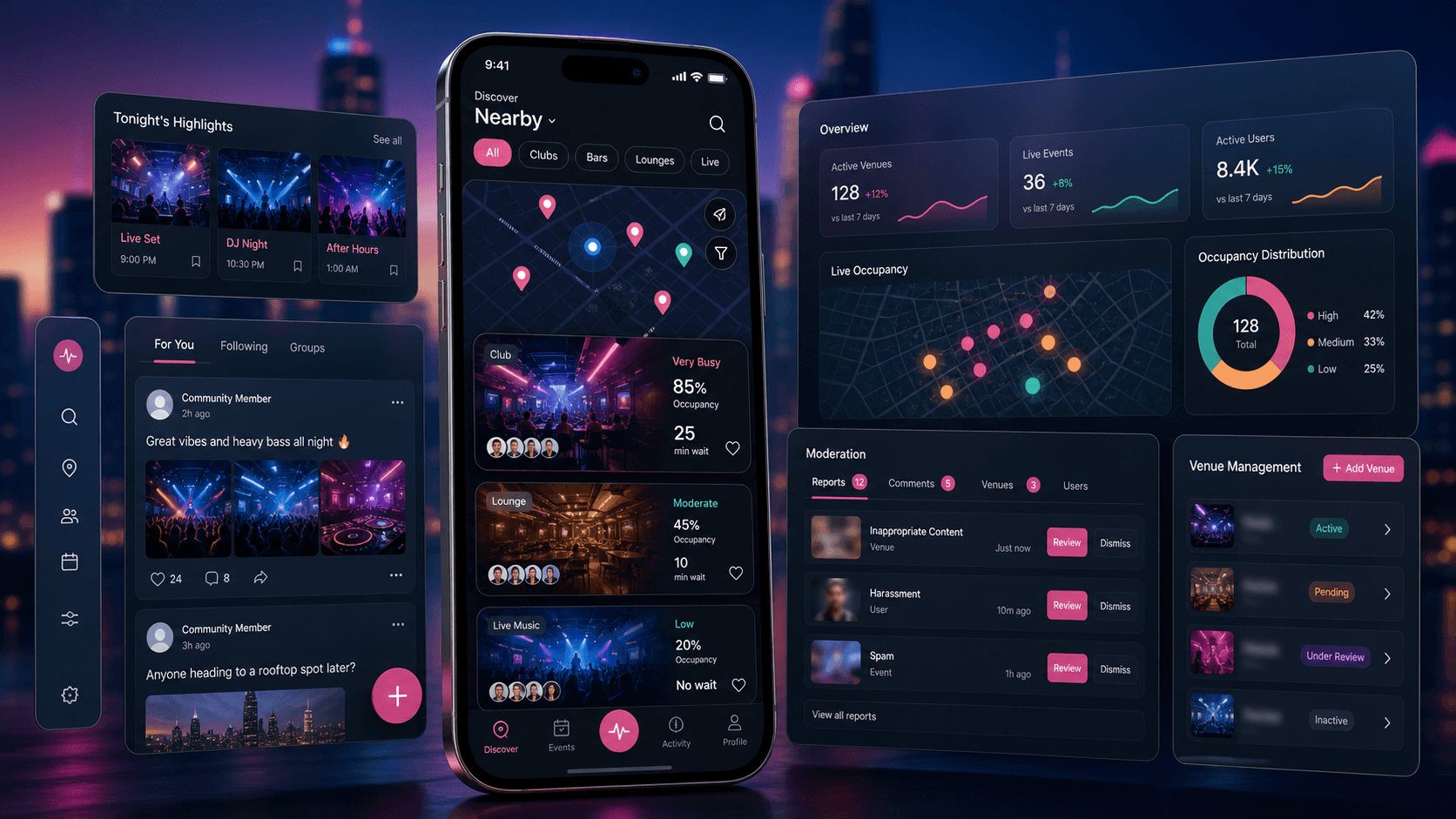
A mobile nightlife discovery and community platform that connects nearby venue search, map-based club discovery, profile onboarding, posts, reactions, comments, event context, and admin moderation into one operating system.

Name changed to respect NDA.

Nightlife venue discovery platform visual with mobile map discovery, club cards, occupancy signals, event activity, posts, and admin moderation surfaces
Project scope

Mobile app engineering, React admin console, Ionic and Capacitor delivery, location workflows, social posting, Facebook authentication, moderation controls, and API integration

2
connected product surfaces
Map
nearby venue discovery
Social
posts, comments, reactions
Admin
users, clubs, content, moderation

Timeline

Two-surface nightlife product build with consumer mobile app, admin console, discovery, social, and moderation workflows

Nightlife discovery needed location context and community signals

The product needed to help users find nearby clubs, understand what was happening at a venue, share posts, and keep the community usable without relying on a static directory or manual operations.

  • Users needed location-aware club discovery with nearby results, map movement, search, and venue detail views
  • Venue pages had to expose practical nightlife signals such as address, distance, price, wait time, occupancy, opening state, and busy or quiet time windows
  • The mobile experience needed social posting, photos, comments, reactions, friends, and Facebook-assisted identity flows
  • Operators needed a browser console for users, team members, clubs, posts, comments, and spam triggers

A consumer app backed by a venue and moderation console

PulseVenue combines an Ionic mobile app for nightlife discovery and social participation with a React administration console for venue data, community content, users, team access, comments, and moderation triggers.

  • Nearby club discovery with map pins, geolocation, autocomplete search, venue detail routing, and fallback location behavior
  • Club detail pages for about, events, updates, occupancy, wait time, price, address, distance, opening state, and best-time signals
  • Social posting workflows for visit plans, photos, venue selection, time picking, comments, reactions, blocking, and reported content flows
  • React admin console for club management, users, team members, posts, comments, spam triggers, filtering, pagination, and detail views

Product surfaces

What the platform brought together

The work spanned core product operations, daily user workflows, data-heavy coordination, and resilient platform management.

Nearby nightlife discovery

The mobile app turns current location and map movement into venue discovery instead of asking users to browse a flat list.

  • Map-based nearby club results with venue markers, current-location state, drag-to-refresh behavior, and detail navigation
  • Search and autocomplete support for finding clubs beyond the initial map position
  • Venue detail routes carrying place, latitude, and longitude context into the next screen

Club detail and attendance signals

Venue pages give users the practical information needed before committing to a night out.

  • About, events, and updates tabs for separating core venue information from activity feeds
  • Wait time, occupancy, price, distance, opening status, peak time, best time, busy time, quiet time, and drink-policy fields
  • Occupant list entry points and bookmark controls that make the venue page feel active rather than static

Posts, reactions, and community loops

The app gives users ways to share plans, photos, comments, likes, and local activity around venues.

  • Post creation and editing with title, date, time, description, venue selection, image upload, and geolocation context
  • Post feeds with infinite loading, comments, reaction types, user-post filtering, and edit controls for owned posts
  • Blocking and flagging paths that support community safety without requiring support staff to intervene manually every time

Admin control and moderation

The browser console lets operators maintain the club directory, review user activity, and manage community controls.

  • User tables with search, status filtering, role visibility, flagged count, and user detail navigation
  • Club forms for address autocomplete, location, capacity, fees, wait time, peak/off-peak timing, ratio, and image upload
  • Post, comment, team-member, and spam-trigger sections that support content operations and moderation workflows

Module depth

Dedicated product blocks for the highest-value workflows

For large platforms, the conversion story depends on showing how each major module solves a specific operating problem, not only listing features.

Discovery

Map-Led Venue Search

Buyers get a mobile discovery layer that can support local nightlife, clubs, lounges, music venues, and event-heavy destinations.

Source review showed nearby map loading, geolocation fallback, search/autocomplete, venue marker popovers, and club detail navigation.

  • Current-location and map-drag refresh behavior
  • Venue marker cards with address and detail routing
  • Search flows for club discovery outside the immediate map area

Operations

Venue Data Management

Operators can keep high-impact venue data current, including capacity, fees, location, wait times, and timing guidance.

Source review showed admin club forms, country/state/city loading, address autocomplete, file upload, and timing fields.

  • Club creation and editing with structured address data
  • Capacity, entry-fee, drinks, ratio, wait-time, and time-window fields
  • Reusable admin form controls and data tables

Trust

Community Moderation Layer

The product includes practical controls for flagged users, blocked users, flagged posts, comments, and spam-trigger management.

Source review showed status filters, flagged counts, block/flag API paths, comment sections, and spam-trigger admin routes.

  • Flagged user and post handling
  • Comment and post administration
  • Spam trigger configuration for repeat moderation patterns

Buyer priorities

What mattered most to the people evaluating the platform

Prospective buyers want to know whether the work solved real workflow, adoption, reliability, data, and operations problems. These priorities shaped the product decisions.

Discovery speed

Users needed to find relevant venues quickly from their current context, especially on mobile while planning or already out.

  • Map-first discovery reduces the friction of comparing nearby places
  • Distance, opening state, price, and time signals help users decide faster
  • Autocomplete and fallback location behavior make discovery more resilient

Community engagement

The app needed repeat-use loops beyond one-time venue lookup.

  • Posts, comments, reactions, and photos give users reasons to return
  • Friends and social identity flows support community formation around nightlife activity
  • Visit plans and venue-linked posts connect social activity to real places

Operator control

A nightlife community product needs operational control over venues, users, content, and abuse patterns.

  • Admin tables and forms keep clubs, users, posts, comments, and team access manageable
  • Spam triggers and flagged counts make moderation work visible
  • Role-aware admin access separates consumer activity from operator tools

System model

How the platform connects roles, workflows, and product surfaces

The product architecture brings every role into the same operating model, with shared data moving cleanly between web, mobile, media, and notification layers.

Nearby to venue detail

A map-first workflow moves from current location to club marker, detail view, timing signals, and social activity.

Two connected surfaces

The mobile app handles discovery and community activity while the admin console controls venues, users, posts, comments, and spam triggers.

Community safety roles

Users, friends, team members, moderators, and admins each interact with the product through role-appropriate controls.

Technology

The Stack We Used And Why

The stack section is written for buyers who need to understand the product architecture, operational trade-offs, and long-term maintainability of the system.

Mobile app

Used for the consumer experience across login, signup, nearby discovery, club detail pages, posts, comments, friends, and profile-adjacent workflows.

IonicReactTypeScriptCapacitoriOSAndroid

Location and social integrations

Used to support map discovery, autocomplete search, geolocation permissions, social identity, and mobile device behavior.

Google MapsGoogle PlacesGeolocationFacebook LoginCapacitor plugins

Admin console

Used for structured operations across users, team members, clubs, posts, comments, and spam-trigger controls.

ReactTypeScriptMaterial UIReact RouterReact Hook FormSCSS

API and data workflows

Used to connect authentication, user sessions, venue records, post media, reactions, comments, blocking, and moderation actions.

REST APIsAxiosBearer sessionsFile uploadsPaginationRuntime config

Why Ionic And Capacitor

The product needed one mobile codebase that could still access native device capabilities for location, status bar behavior, Facebook login, and platform packaging.

  • Ionic provided mobile navigation, menus, pages, segments, modals, action sheets, and infinite loading
  • Capacitor connected the React app to iOS and Android project shells
  • Native plugins supported geolocation, location accuracy, Facebook login, keyboard, haptics, and app lifecycle behavior

Why A Separate Admin Console

Consumer nightlife discovery and operator workflows have different information density, permission, and speed requirements.

  • The mobile app stayed focused on discovery, posting, and venue context
  • The admin console used tables, filters, forms, and detail pages for repetitive operations
  • Moderation controls lived with operators instead of being mixed into consumer screens

Why Location Data Was Core

Nightlife decisions depend on proximity, timing, and venue state, so location could not be treated as a decorative map.

  • Current user coordinates and fallback coordinates kept the nearby experience usable
  • Map drag refresh behavior supported exploratory browsing
  • Venue detail routes preserved place and coordinate context for deeper screens

Delivery

How the product came together

The work moved from domain modeling to core platform delivery, mobile adoption, and operational hardening.

1

Map the nightlife loop

Define how users move from signup into nearby discovery, club detail review, event context, posts, comments, and return engagement.

2

Build the mobile experience

Implement Ionic screens for login, signup, nearby maps, clubs, friends, posts, comments, and venue-linked posting.

3

Create the operations console

Add browser-based controls for users, team members, clubs, posts, comments, spam triggers, and repeatable CRUD workflows.

4

Connect moderation and API behavior

Wire API clients, bearer sessions, file uploads, blocking, flagging, comments, reactions, and runtime configuration.

Operational depth

What made the platform usable after launch

The strongest case studies are not only feature lists. They show how the system is operated, monitored, governed, and improved when real users depend on it.

Venue operations

Venue data was structured so operators could maintain discovery quality as club information changed.

  • Address autocomplete with latitude and longitude storage
  • Capacity, entry fee, drinks, ratio, wait time, and best-time fields
  • Country, state, city, image, and timing controls in the admin form

Community controls

The product included more than publishing tools; it included ways to reduce bad community behavior.

  • User status and flagged-count visibility in the admin console
  • Block user and flag post actions from the mobile experience
  • Comment and spam-trigger sections for operational review

Mobile release surface

The app was prepared as a packaged iOS and Android experience rather than only a mobile web interface.

  • Capacitor iOS and Android project shells
  • Mobile plugin setup for device permissions and platform behavior
  • Service worker and app manifest assets for installable behavior

Results

The measurable and observable lift from the work

The strongest improvements are the ones a buyer can connect to daily work: fewer disconnected tools, safer operations, clearer workflows, and more reliable product behavior.

2 surfaces

Consumer And Admin

The build connected a consumer mobile app with a browser admin console for venue, user, and content operations.

Location

Discovery Engine

Nearby maps, search, coordinates, and club detail routing turned venue discovery into a mobile-first workflow.

Social

Community Loop

Posts, comments, reactions, friends, photos, and venue-linked plans created repeat-use paths beyond a directory.

Moderation

Operational Trust

Blocked users, flagged posts, comments, flagged counts, and spam triggers gave operators practical control.

Outcome

A stronger operating system for nightlife venue discovery and community platform

The platform reduced tool fragmentation and gave each role a clearer path from live activity to day-to-day action.

A mobile-first nightlife discovery platform instead of a static club directory

Map-led nearby venue search with club detail pages, practical timing signals, and venue-linked activity

Social posting, comments, reactions, friends, photo uploads, and Facebook-assisted identity flows

An admin console for users, team members, clubs, posts, comments, spam triggers, and content operations

FAQ

Frequently Asked Questions About PulseVenue

Answers about the nightlife venue discovery and community platform scope, platform model, technology choices, operational workflows, and related build patterns.

What Kind Of Nightlife App Does PulseVenue Represent?

PulseVenue represents a nightlife venue discovery and community app with nearby maps, club detail pages, posts, comments, reactions, friends, venue-linked plans, and admin moderation.

Why Was A Custom App Needed Instead Of A Directory Template?

The product needed real mobile behavior: geolocation, map movement, venue detail state, post creation, image uploads, comments, reactions, blocking, flagging, Facebook login, and admin operations tied together.

How Does The Admin Console Support The Mobile Product?

The admin console manages users, clubs, posts, comments, team members, and spam triggers so the mobile community can stay current and moderated without manual database work.

Can This Pattern Support Other Local Discovery Products?

Yes. The same pattern can support bars, lounges, music venues, local events, tourism discovery, campus communities, city guides, and other location-based community products.

Related services

Build a similarly ambitious product without starting from a blank page.

We can help scope the web, mobile, AI, media, and operating layers needed for your own platform.

Start a project inquiry