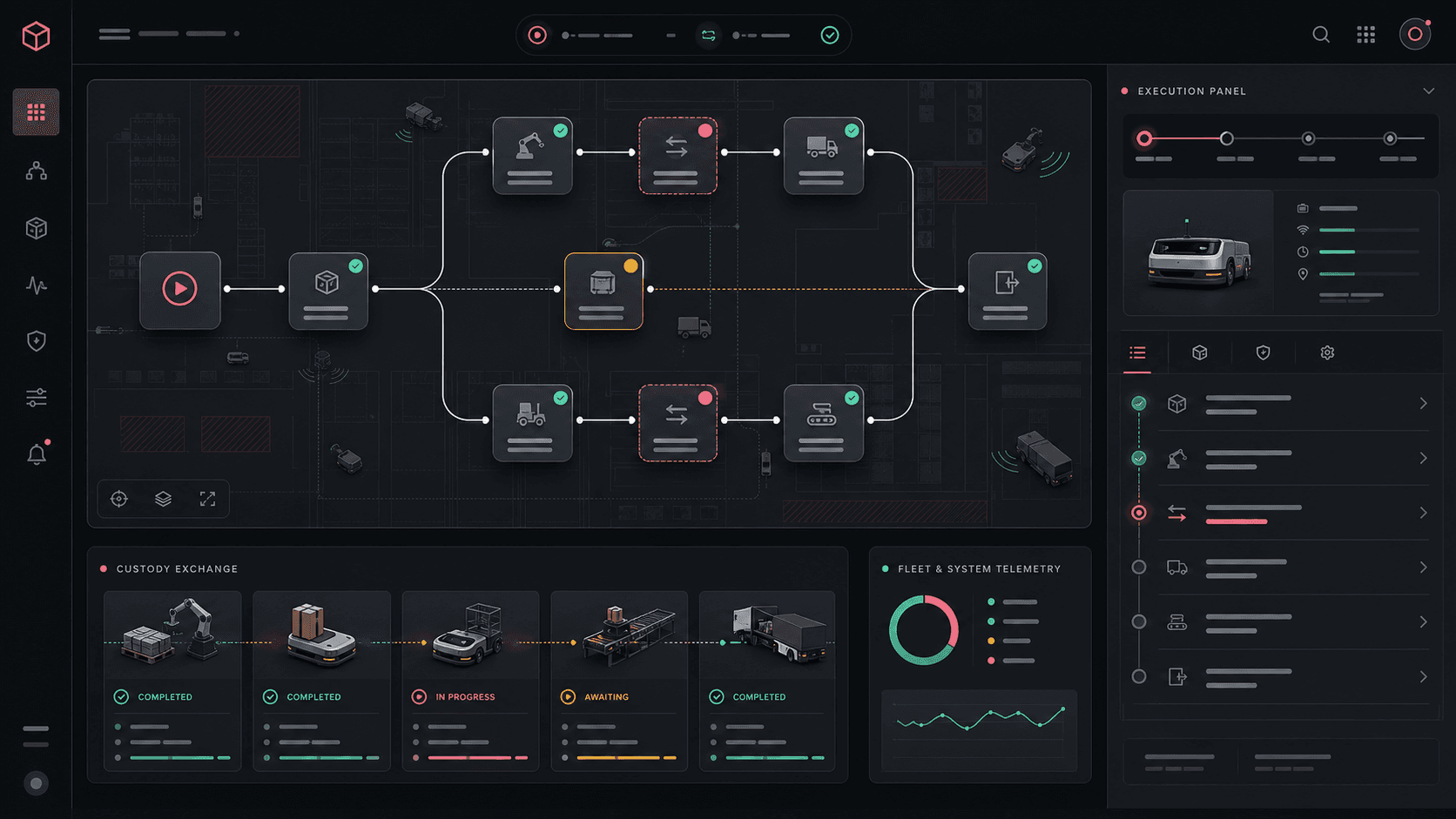
A visual workflow orchestration platform for autonomous logistics teams, connecting cargo pickup, custody exchange, rental pickup, dispatch authorization, and execution telemetry into one builder-to-runner experience.
Product engineering for a visual workflow builder, execution importer, blockchain authorization flow, and logistics action model
2
core workflow surfaces
4
logistics action templates
1
builder-to-dispatch loop
Web3
signed execution path
Timeline
Workflow product foundation and orchestration prototype evolved into a complete operations platform story
Autonomous operations needed a safer way to describe field work
Logistics teams that coordinate vehicles, cargo, custody handoffs, and field agents need workflows that are understandable to operators before they become executable instructions.
Operators needed reusable action templates instead of one-off dispatch instructions
Parameterized workflows needed validation before they could be handed to execution services
Authorization and relay steps needed to stay visible without overwhelming day-to-day users
A visual workflow builder with an executable dispatch path
RouteForge turns field operations into a node-based workflow canvas, lets operators export reusable workflow definitions, then imports those definitions into an instantiation surface for signed execution.
React Flow canvas for arranging actions, parameters, assignments, triggers, and completion edges
Import and export workflow bundles that preserve add-on actions, layout, zoom, and operator inputs
Typed connection rules that prevent invalid data flow between workflow nodes
Execution flow that prepares task graphs, assignment maps, parameters, and dispatch metadata
Product surfaces
What the platform brought together
The work spanned core product operations, daily user workflows, data-heavy coordination, and resilient platform management.
Visual workflow builder
Operators build logistics workflows as connected nodes instead of writing fragile procedural instructions.
Drag-and-drop action nodes for relocation, custody exchange, cargo pickup, cargo surrender, and rental pickup
Typed handles for string, tuple, boolean, parameter, and assignment connections
Local layout persistence for canvas position, zoom, and in-progress workflow state
Workflow import and instantiation
Saved workflows can be imported into an execution surface where parameters are collected and workflow graphs are parsed.
Workflow bundles include add-on action definitions and rendered graph state
Parameter fields render from the imported workflow instead of being hard-coded
Parser turns nodes and edges into assignments, action objects, parent-child dependencies, and task groups
Custody and cargo action model
The product model focuses on real logistics moments: pickup, surrender, custody transfer, and supervised verification.
Cargo acquisition and cargo surrender templates model solo custodian actions
Rental pickup supports vehicle and renter roles for asset-release workflows
Signed dispatch and relay operations
Execution is prepared as a structured request after wallet authorization and workflow instance creation.
Wallet integration supports signed workflow instantiation before relay submission
Dispatch payload includes parsed parameters, assignments, action DAG, task map, and workflow instance metadata
Operator feedback surfaces success and failure states for relay responses
Module depth
Dedicated product blocks for the highest-value workflows
For large platforms, the conversion story depends on showing how each major module solves a specific operating problem, not only listing features.
Builder
Workflow Canvas For Nonlinear Logistics
The builder gives operations teams a visual way to connect cargo, custody, relocation, parameter, and assignment nodes while enforcing connection rules.
Source evidence showed a React Flow canvas with custom node types, add-on action loading, typed handles, export bundles, reset controls, and persisted canvas state.
Drag actions onto a canvas and connect trigger, finished, parameter, and assignment handles
Prevent many-to-one target connections when the data model requires one input
Reject mismatched source and target data types before a workflow is saved
Export workflow JSON with layout and action add-ons for later execution
Execution
Instantiation Surface For Signed Dispatch
The execution view imports saved workflows, renders parameter inputs, builds the action graph, creates a signed workflow instance, and relays the dispatch payload.
Source evidence included an importer, workflow parser, task grouping logic, wallet signer setup, chain registry configuration, and relay submission path.
Import workflow bundles with custom action definitions
Generate parameter inputs from the workflow graph
Parse action dependencies into a dispatch-ready task structure
Show dispatch success and failure feedback to the operator
Operations
Reusable Action Templates For Field Coordination
The platform can grow through add-on action definitions, giving teams a controlled way to add domain-specific workflow blocks.
Source evidence included JSON action templates for cargo acquisition, cargo surrender, supervised custody exchange, and rental vehicle pickup.
Define required inputs, agent roles, and capability requirements for each action
Load action templates into the canvas without rewriting the core builder
Represent cargo and vehicle handoff workflows with role-aware task ownership
Keep dispatch logic generic while action definitions stay domain-specific
Buyer priorities
What mattered most to the people evaluating the platform
Prospective buyers want to know whether the work solved real workflow, adoption, reliability, data, and operations problems. These priorities shaped the product decisions.
Operator confidence
A logistics workflow tool has to make complex routing and handoff logic visible before execution.
Visual graph editing makes sequences and dependencies easier to review
Typed connections reduce accidental mismatches between parameters and actions
Exported bundles give teams a repeatable artifact for review and reuse
Controlled execution
Dispatch should happen only after the workflow is parsed, parameterized, authorized, and relayed through the expected channel.
The execution view separates workflow design from workflow instantiation
Wallet authorization creates a deliberate checkpoint before relay submission
Structured payloads make downstream dispatch services easier to validate
Domain extensibility
Autonomous operations change quickly, so the platform needed an action model that can add new workflow blocks without rebuilding the whole product.
Role and capability fields support richer dispatch matching over time
The same builder can support cargo, custody, vehicle, and future field workflows
System model
How the platform connects roles, workflows, and product surfaces
The product architecture brings every role into the same operating model, with shared data moving cleanly between web, mobile, media, and notification layers.
Builder to dispatch workflow
Operators design the graph, export the workflow, import it for execution, authorize the instance, and relay tasks.
Roles across cargo handoffs
Custodians, givers, receivers, witnesses, vehicles, and renters each participate in workflow steps with specific responsibilities.
Orchestration platform layers
The workflow UI, graph parser, signed instance, and relay service form one route from planning to execution.
Technology
The Stack We Used And Why
The stack section is written for buyers who need to understand the product architecture, operational trade-offs, and long-term maintainability of the system.
Workflow UI
Used for the browser-based workflow design surface where operators compose and review logistics actions.
ReactReact FlowJavaScriptTypeScriptCSS modules
Workflow model
Used to define reusable action templates, typed connections, parameter inputs, graph parsing, and task grouping.
Used to support import/export, workflow reuse, browser delivery, and operator feedback during execution.
WebpackCreate React AppAxiosToastrBrowser storage
Why A Visual Graph
Operations workflows often become risky when they are hidden inside code or one-off dispatch forms.
Node graphs make dependencies and handoffs reviewable by technical and non-technical users
Typed handles help catch invalid connections at design time
Canvas state persistence supports iterative workflow design
Why Add-On Actions
The product category needs domain-specific actions without turning every new operation into a custom UI project.
JSON action definitions separate workflow semantics from the core canvas
Role metadata supports dispatch matching and future capability checks
Reusable templates make cargo, custody, and vehicle operations easier to standardize
Why Signed Dispatch
Autonomous operations benefit from a deliberate authorization layer before tasks reach execution services.
Wallet signing creates an explicit operator checkpoint
Structured task payloads are easier to audit and relay
Workflow instance metadata ties execution back to the designed graph
Delivery
How the product came together
The work moved from domain modeling to core platform delivery, mobile adoption, and operational hardening.
1
Model logistics actions
Turn cargo pickup, surrender, custody exchange, relocation, and rental pickup into reusable workflow primitives.
2
Build the canvas
Create a node-based builder with typed handles, custom action loading, export support, and operator feedback.
3
Parse for execution
Transform imported workflow graphs into parameters, assignments, actions, dependencies, and task groups.
4
Authorize and relay
Prepare the signed workflow instance and relay the structured dispatch payload to execution services.
Operational depth
What made the platform usable after launch
The strongest case studies are not only feature lists. They show how the system is operated, monitored, governed, and improved when real users depend on it.
Validation before execution
The builder checks connection shape and type compatibility while operators are still designing the workflow.
Left-hand handles accept only one upstream connection
Source and target handle types are compared before edges are added
Invalid add-on handle definitions surface as operator-visible errors
Reusable workflow artifacts
Exported workflow bundles preserve enough context to recreate and execute the workflow later.
Bundles include workflow graph data and add-on action definitions
Canvas zoom and position are saved with the workflow
Imported bundles render parameter forms dynamically
Dispatch observability
Execution feedback gives operators a clear signal when relay succeeds or fails.
Relay response codes drive success or failure messages
Workflow instance identifiers connect dispatch output back to the signed instance
Console traces keep payload structure visible during operational debugging
Results
The measurable and observable lift from the work
The strongest improvements are the ones a buyer can connect to daily work: fewer disconnected tools, safer operations, clearer workflows, and more reliable product behavior.
Graph-first
Workflow Clarity
The platform translates field operations into a visual graph that can be reviewed before dispatch.
Template-led
Operational Reuse
Cargo, custody, and rental actions can be modeled as reusable blocks rather than one-off forms.
Signed
Execution Control
Dispatch is routed through an explicit authorization step before relay.
Typed
Safer Composition
Connection rules reduce invalid workflow wiring before a workflow reaches execution.
Outcome
A stronger operating system for autonomous logistics workflow orchestration platform
The platform reduced tool fragmentation and gave each role a clearer path from live activity to day-to-day action.
A workflow builder that lets operators assemble autonomous logistics procedures visually
A reusable action-template model for cargo, custody, relocation, and rental pickup workflows
An import and instantiation flow that turns saved graphs into parameters, assignments, task maps, and dispatch payloads
A signed execution path that creates a deliberate checkpoint between workflow design and field dispatch
FAQ
Frequently Asked Questions About RouteForge
Answers about the autonomous logistics workflow orchestration platform scope, platform model, technology choices, operational workflows, and related build patterns.
What Kind Of Product Does RouteForge Represent?
RouteForge represents an autonomous logistics workflow orchestration platform where operators can design, validate, export, import, authorize, and dispatch cargo and custody workflows.
Why Use A Visual Builder For Logistics Workflows?
Visual builders help teams review sequencing, dependencies, roles, handoffs, and parameter flow before a workflow becomes executable. That matters when the workflow affects cargo, vehicles, custody, or field agents.
Can This Pattern Support Robotics Or Fleet Operations?
Yes. The same pattern can support robotics task planning, fleet dispatch, warehouse handoffs, field-service routing, rental pickup, delivery custody, and other operations where reusable task graphs need controlled execution.
What Should A Buyer Prepare Before Building A Similar Platform?
The most useful inputs are domain action definitions, user roles, required capabilities, dispatch constraints, authorization rules, execution endpoints, workflow examples, and failure states that operators need to understand.
Related services
Build a similarly ambitious product without starting from a blank page.
We can help scope the web, mobile, AI, media, and operating layers needed for your own platform.