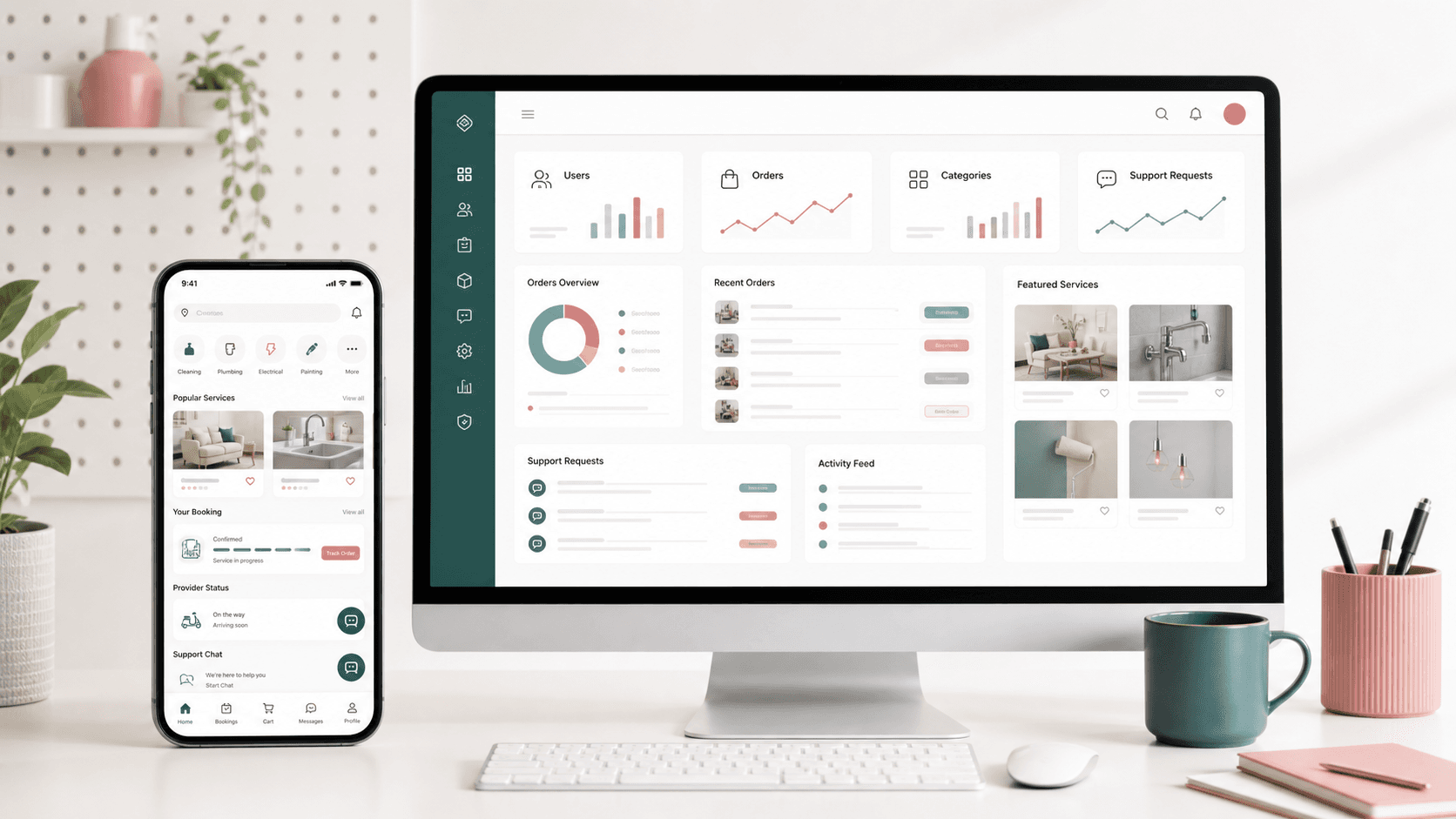
Portfolio case study

ServiceNest: Home services marketplace and field-service operations platform

A mobile-first home services marketplace that connects customers with local providers, supports service discovery and booking, manages provider availability and earnings, and gives admins operational control across orders, categories, users, support, and featured services.

Name changed to respect NDA.

Home services marketplace visual with mobile booking, provider order tracking, support chat, location updates, and admin operations dashboard
Project scope

Mobile marketplace engineering, provider workflows, admin console, booking and cart flows, payments, location tracking, push notifications, multilingual UI, and support chat

2
marketplace roles
5
order states
2
language-ready app
Admin
operations console

Timeline

Dual-sided marketplace build with mobile app, provider workflows, and admin operations

Local service booking needed trust, scheduling, and operational control

The product had to help customers find reliable home service providers while giving providers a simple way to publish services, manage jobs, receive payments, and stay reachable through the order lifecycle.

  • Customers needed service discovery, category filtering, favorite services, carts, checkout, order history, payment, tracking, and reviews in one mobile experience
  • Providers needed profile management, service creation, pricing, availability hours, sub-services, order acceptance, earnings visibility, bank details, and job status handling
  • Operations teams needed user, order, category, featured service, support request, and chat tooling without exposing customer or provider data publicly
  • The marketplace needed push notifications, location updates, multilingual labels, support workflows, and authenticated API calls across both app and admin surfaces

A role-aware home services marketplace with mobile and admin layers

ServiceNest connects customer booking, provider execution, and admin operations through a shared service catalog, order model, support workflow, payment path, and location update loop.

  • Ionic React mobile app with customer and provider tabs, side menus, authentication, profile flows, and multilingual interface support
  • Service catalog with categories, sub-categories, provider services, multiple pricing types, service photos, favorites, filters, cart, checkout, and order details
  • Provider operations for service publishing, availability windows, order history, wallet/earnings views, bank details, support requests, and job status updates
  • React admin console for users, orders, categories, featured services, support requests, and admin support chat

Product surfaces

What the platform brought together

The work spanned core product operations, daily user workflows, data-heavy coordination, and resilient platform management.

Customer service discovery and booking

Customers can browse categories, drill into sub-category services, evaluate service details, select sub-services, save favorites, and build a cart before checkout.

  • Category, featured service, filter, favorite, detail, cart, and checkout screens create a full discovery-to-booking path
  • Service detail pages combine provider details, ratings, distance, pricing, sub-services, and due-date selection
  • Checkout converts selected services into an API-backed order with generated order references and payment handoff

Provider service and job management

Providers get their own operational workspace for creating services, setting hours, managing sub-services, reviewing jobs, and tracking payment history.

  • Provider tabs separate home, wallet, order history, services, profile, support, and bank-detail workflows
  • Service forms support photos, categories, sub-categories, service types, prices, opening hours, closing hours, and multi-service bundles
  • Order history and order detail flows let providers confirm, progress, cancel, complete, and review jobs

Order, payment, and location lifecycle

The platform models the service visit as an operational lifecycle rather than a static booking confirmation.

  • Order APIs support creation, history, status updates, cancellation, completion, feedback, and provider earnings
  • Payment screens and order-processing endpoints connect checkout to paid service fulfillment
  • Geolocation and map workflows let provider movement be updated and displayed during active jobs

Support and admin operations console

Admin and support teams can oversee marketplace health from a separate React console while customers and providers use the mobile app.

  • Admin routes cover users, orders, categories, featured services, support requests, and admin chat
  • Search, filtering, pagination, status badges, edit forms, and detail pages make operational work manageable
  • Rocket.Chat-backed support surfaces connect mobile users and providers with admin support workflows

Module depth

Dedicated product blocks for the highest-value workflows

For large platforms, the conversion story depends on showing how each major module solves a specific operating problem, not only listing features.

Marketplace liquidity

Service Catalog And Sub-Service Bundles

The catalog supports provider-created services, sub-services, price options, operating hours, categories, and featured placement so buyers can compare real service options instead of seeing a flat lead form.

Source evidence includes provider service APIs, category APIs, service detail screens, sub-service selection, featured-service admin pages, and provider service creation forms.

  • Providers can publish multiple services with images and hours
  • Customers can select sub-services and quantities before checkout
  • Admins can manage categories and featured service promotion

Field execution

Order Status And Live Location Loop

Jobs move through confirmation, in-progress, completion, cancellation, payment, feedback, and location-tracking moments so service work can be coordinated after booking.

Source evidence includes order models, provider status actions, user and provider order history screens, location save/fetch APIs, map rendering, and review submission endpoints.

  • Customers and providers both see order history and detail flows
  • Provider location can be saved during an active job and fetched for customer tracking
  • Ratings and feedback close the quality loop after completion

Support efficiency

Mobile-To-Admin Support Chat

The platform includes support requests and admin-support chat so service issues can be handled inside the operational system instead of scattered across calls and emails.

Source evidence includes mobile admin-support screens, Rocket.Chat service utilities, admin support routes, support request forms, and support request listing/detail pages.

  • Customers and providers can reach support from the mobile menu
  • Admins have a dedicated support request area and chat workspace
  • Authenticated chat and API calls keep support tied to the user context

Buyer priorities

What mattered most to the people evaluating the platform

Prospective buyers want to know whether the work solved real workflow, adoption, reliability, data, and operations problems. These priorities shaped the product decisions.

Trust in local providers

A services marketplace needs enough profile, rating, location, order, and support context for buyers to feel comfortable booking work in their home.

  • Service detail pages surface ratings, distance, provider information, and feedback
  • Order tracking and status updates reduce uncertainty after checkout
  • Support and review flows give users recourse when a job needs attention

Provider adoption

Provider-side tooling has to be fast enough for independent service workers to use between jobs.

  • Provider navigation focuses on jobs, wallet, services, support, bank details, and profile
  • Service forms support photos, categories, hours, and bundles without a separate back-office dependency
  • Push notification and order counts keep providers oriented around active demand

Admin control

Marketplace operators need the ability to manage taxonomy, featured supply, users, orders, and support before the network scales.

  • Admin console routes separate user management, order operations, catalog management, promotions, and support
  • Search, filters, pagination, and status badges help operators scan dense lists
  • Shared API endpoints keep mobile and admin operations aligned

System model

How the platform connects roles, workflows, and product surfaces

The product architecture brings every role into the same operating model, with shared data moving cleanly between web, mobile, media, and notification layers.

Customer, provider, and admin roles

The platform separates booking, service execution, and operational control while keeping all roles tied to the same marketplace state.

From discovery to completed job

A customer moves from category browsing through service selection, cart, checkout, tracking, completion, and feedback.

Marketplace operations layer

Mobile app, API clients, support chat, push notifications, location updates, payment processing, and admin tooling operate as one product system.

Technology

The Stack We Used And Why

The stack section is written for buyers who need to understand the product architecture, operational trade-offs, and long-term maintainability of the system.

Mobile app

Used for customer booking, provider workflows, profile management, push notifications, location tracking, and multilingual service flows.

Ionic ReactCapacitorTypeScriptReact RouterReact Hook Form

Admin console

Used for marketplace operations across users, orders, categories, featured services, support requests, and admin support chat.

ReactTypeScriptCoreUIReactstrapAxiosReact JS Pagination

Marketplace APIs and data

Used to coordinate authentication, users, addresses, categories, provider services, carts, orders, payments, feedback, files, and support requests.

REST APIsBearer authenticationAxios interceptorsFile upload APIsRole-aware API clients

Engagement and operations

Used for provider/customer notifications, support chat, location updates, payment processing, and language-ready UI.

OneSignalRocket.ChatGoogle MapsCapacitor Geolocationi18nextPayment gateway integration

Why Ionic And Capacitor

The product needed a mobile app experience that could ship across iOS and Android while keeping marketplace screens, forms, tabs, and native capabilities in one React codebase.

  • Ionic components supported mobile navigation, tabs, modals, forms, and page transitions
  • Capacitor enabled native device capabilities such as geolocation and app packaging
  • React and TypeScript kept the app logic aligned with the admin console skill set

Why A Separate Admin Console

Marketplace operators needed dense operational screens that are different from the mobile experience used by customers and providers.

  • CoreUI and Reactstrap supported table-heavy admin lists and forms
  • Dedicated routes separated users, orders, categories, featured services, support, and chat
  • Shared API conventions kept admin actions close to mobile marketplace state

Why Chat, Push, And Location Were Core

Home service bookings create uncertainty once the job leaves the screen, so communication and operational signals matter as much as catalog browsing.

  • Push notifications bring customers and providers back to time-sensitive job updates
  • Support chat keeps issue resolution inside the product experience
  • Location updates make active jobs easier to coordinate

Delivery

How the product came together

The work moved from domain modeling to core platform delivery, mobile adoption, and operational hardening.

1

Map the marketplace roles

Define how customers, providers, and admins move through separate but connected workflows.

2

Build the service catalog and booking path

Create category browsing, service details, sub-service selection, cart, checkout, and order creation.

3

Add provider and operations tooling

Give providers and admins the screens they need to keep supply, jobs, and support moving.

4

Connect real-time service signals

Layer in push notifications, location tracking, support chat, payments, feedback, and multilingual labels.

Operational depth

What made the platform usable after launch

The strongest case studies are not only feature lists. They show how the system is operated, monitored, governed, and improved when real users depend on it.

Role-aware mobile navigation

The app switches between customer and provider tabs and menu items based on logged-in role.

  • Customers see home, cart, profile, favorites, notifications, support, and admin support entries
  • Providers see home, wallet, order history, services, profile, support, bank details, and admin support entries
  • Redirect logic routes each role to the correct starting point after login

Structured order state

The order model tracks provider, client, service, due date, amount, payment status, cancellation, completion, ratings, and feedback.

  • Customer and provider order history screens read from shared order APIs
  • Providers can confirm or update order status from job detail workflows
  • Customers can submit reviews and ratings after service completion

Admin marketplace controls

The admin panel gives operators dedicated surfaces for the marketplace areas that usually require manual intervention.

  • Users and addresses can be reviewed and updated
  • Categories, sub-categories, and featured services can be managed
  • Support requests and admin chat keep issue handling visible

Results

The measurable and observable lift from the work

The strongest improvements are the ones a buyer can connect to daily work: fewer disconnected tools, safer operations, clearer workflows, and more reliable product behavior.

Connected

Marketplace Roles

Customers, providers, admins, and support teams received distinct workflows tied to the same service and order data.

Operational

Job Lifecycle

Booking, payment, status updates, tracking, completion, cancellation, feedback, and earnings all became part of the product flow.

Scalable

Admin Control

Operators gained tooling for users, orders, categories, featured services, support requests, and admin support conversations.

Outcome

A stronger operating system for home services marketplace and provider operations platform

The platform reduced tool fragmentation and gave each role a clearer path from live activity to day-to-day action.

A cross-platform home services mobile app with customer discovery, provider service management, cart, checkout, orders, payment handoff, support, notifications, and profile workflows

A provider operations layer for service publishing, sub-service bundles, availability hours, order history, wallet/earnings, bank details, job tracking, and feedback

A React admin console for users, orders, categories, featured services, support requests, and admin support chat

A public-safe portfolio page that positions the work as a complete marketplace and field-service operations platform without exposing real repository names, app names, API hosts, source screenshots, keys, or private identifiers

FAQ

Frequently Asked Questions About ServiceNest

Answers about the home services marketplace and provider operations platform scope, platform model, technology choices, operational workflows, and related build patterns.

What Kind Of Product Does This Case Study Represent?

It represents a dual-sided home services marketplace where customers book local providers, providers manage service delivery, and admins oversee marketplace operations.

Why Does A Home Services Marketplace Need Provider Tools?

Provider adoption determines marketplace supply. Providers need a fast way to publish services, define pricing and hours, manage orders, track earnings, and reach support from the same app.

How Does Admin Tooling Improve A Services Marketplace?

Admin tooling helps operators manage taxonomy, featured supply, users, orders, support requests, and chat workflows before operational issues slow down the marketplace.

Can This Architecture Support Other Local Service Verticals?

Yes. The same pattern can support cleaning, repairs, beauty services, pet care, mobile mechanics, fitness coaching, home nursing, field inspection, and other appointment-led service marketplaces.

Related services

Build a similarly ambitious product without starting from a blank page.

We can help scope the web, mobile, AI, media, and operating layers needed for your own platform.

Start a project inquiry