
Quick Answer: AI Agents For Logistics Control Towers
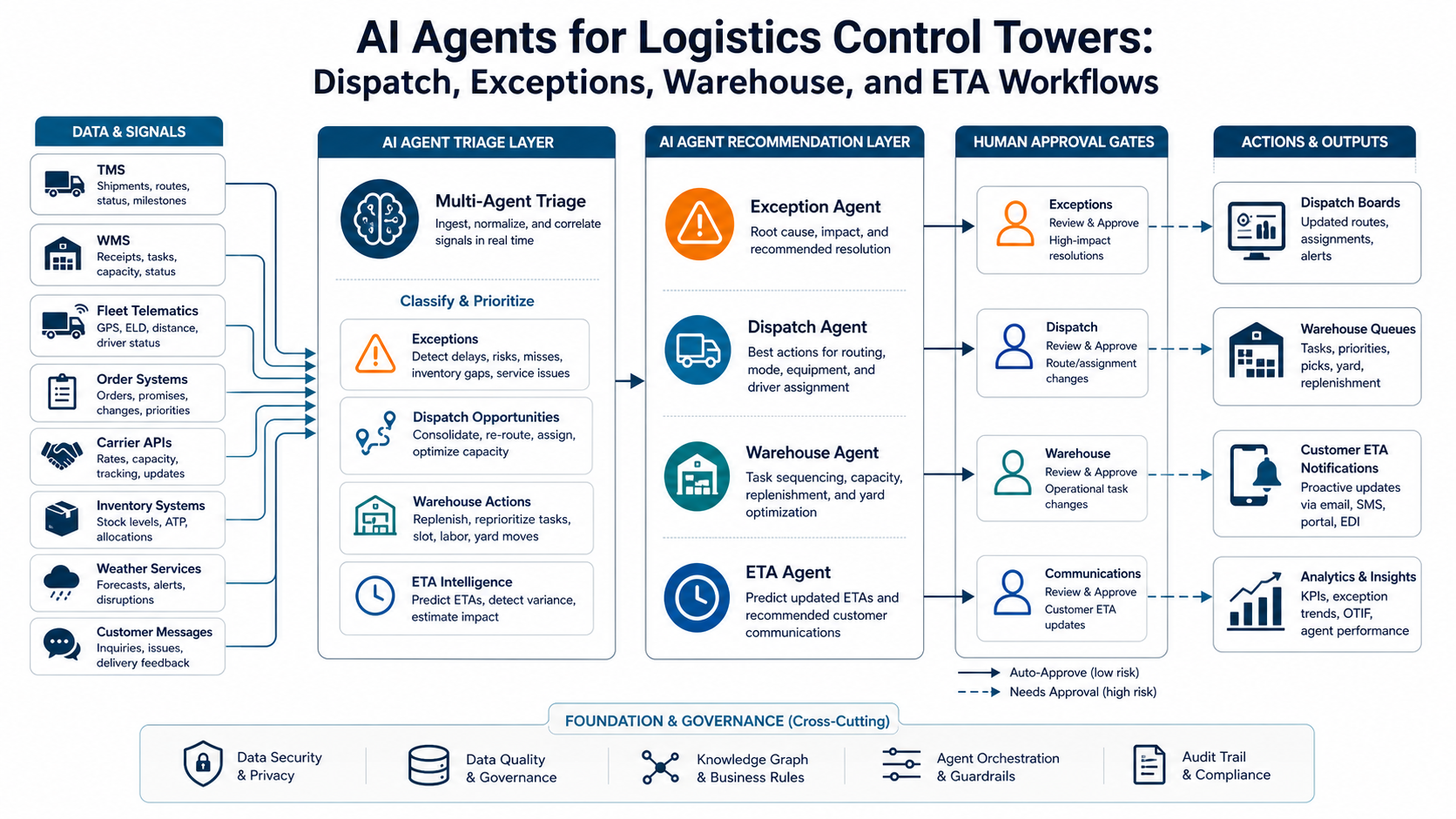
AI agents for logistics control towers monitor operational signals, detect exceptions, recommend the next action, update connected systems, and escalate risky decisions to people. The useful version is not a generic logistics chatbot. It is an operations workflow layer that sits across the transportation management system, warehouse management system, carrier portals, fleet telematics, inventory data, weather feeds, customer messages, and analytics dashboards.
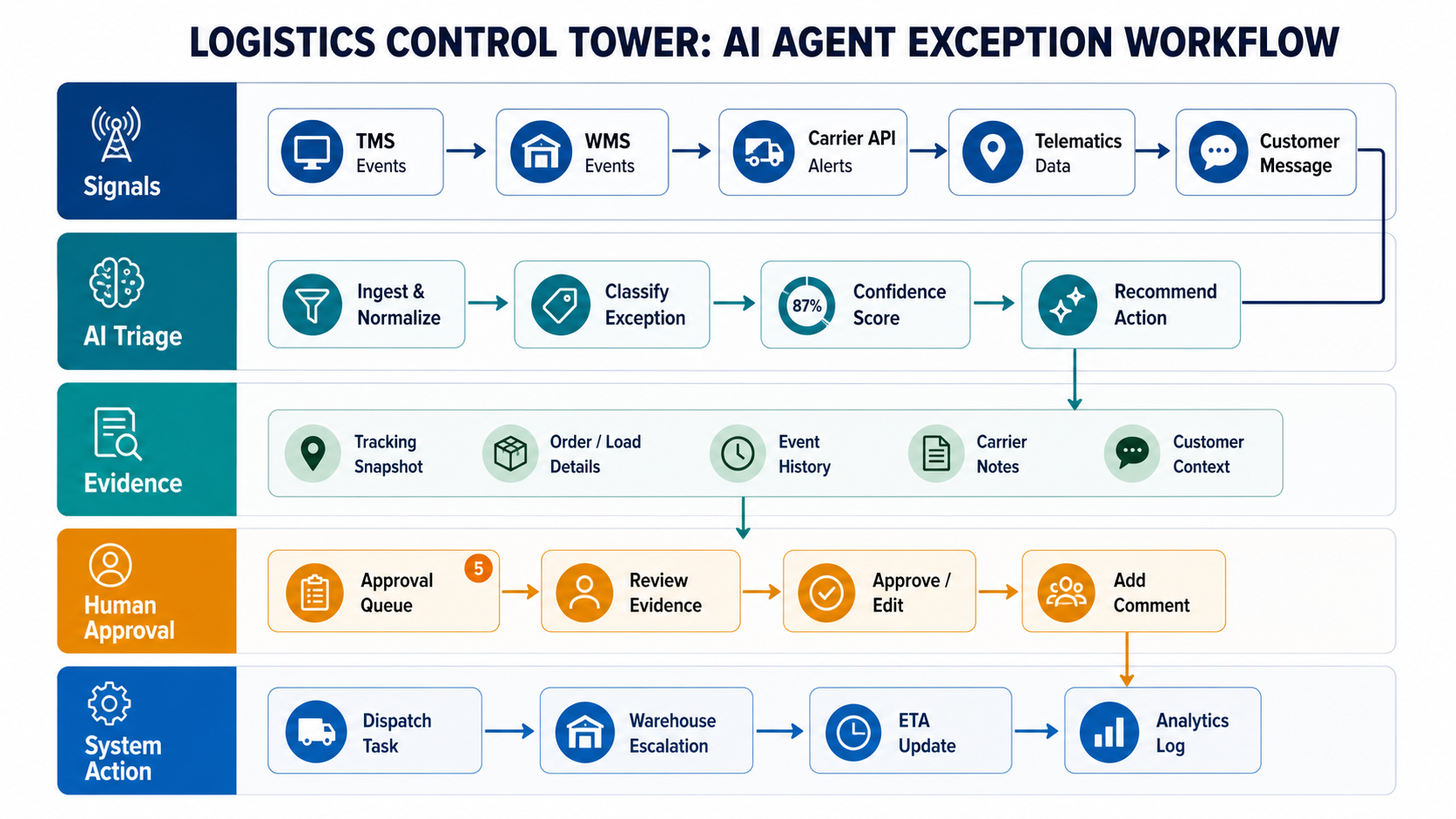
The first goal is exception management. A control-tower agent should notice delayed shipments, route changes, missed scans, dock congestion, stock conflicts, proof-of-delivery gaps, and customer ETA questions before they become manual firefighting. Then it should classify the issue, gather context, suggest actions, and ask for approval when the decision changes cost, customer commitments, capacity, inventory, or service-level risk.
NextPage usually starts this work by scoring workflow clarity, data readiness, integration access, and review controls with an AI Agent Readiness Assessment. If the dispatch or warehouse process is still managed by tribal knowledge, the first version should assist humans before it starts changing live logistics records.
Where Control-Tower Agents Fit
A logistics control tower brings shipment, fleet, warehouse, carrier, order, inventory, and customer data into one operating view. An AI agent adds a decision layer on top of that view. It watches events, interprets what changed, looks up the affected order or lane, compares the issue against rules, and proposes the next operational step.
That means the agent should not replace the control tower interface. Dispatchers, warehouse leads, customer success teams, and transportation managers still need boards, maps, queues, alerts, and audit trails. The agent is most useful when it reduces the time spent switching systems, checking stale data, writing repetitive updates, and deciding which exception needs attention first.
In 2026 planning, treat agentic supply-chain software as a governed operating layer rather than a fully autonomous black box. Gartner forecasted in April 2026 that supply-chain management software with agentic AI capabilities would grow from less than $2 billion in 2025 to $53 billion by 2030, which means buyers will see far more agent-enabled logistics tools. The reliable pattern is still visibility first, recommendation second, and controlled execution only after the team can trace the source event, confidence level, approval rule, and system write.
For broad supply-chain planning topics such as demand forecasting, procurement risk, inventory planning, and supplier visibility, see the NextPage guide to AI in supply chain management. For industry-specific solution design, compare those patterns with NextPage AI agents for automotive and logistics operations and AI solutions for logistics. This article focuses on execution control: shipments already moving, warehouse work already queued, and customer promises already exposed.
High-Value Exception Workflows
The best first workflows are frequent, measurable, and bounded by clear human approval rules. Start with the exceptions that already create status meetings, Slack threads, phone calls, spreadsheet trackers, or customer complaints.
| Exception | What the agent checks | What it can recommend | Human approval trigger |
|---|---|---|---|
| Delayed shipment | Carrier events, GPS location, SLA window, customer priority, route alternatives | Update ETA, notify customer, reroute, change carrier contact path | Premium customer, penalty risk, cost increase, or missed delivery promise |
| Route change | Traffic, weather, driver hours, capacity, delivery windows, fuel impact | Suggest alternate route or dispatch sequence | Higher cost, compliance risk, or customer commitment change |
| Warehouse bottleneck | Dock queue, pick status, labor capacity, inventory availability, outbound cutoff | Reprioritize wave, split order, move dock appointment, escalate shortage | Inventory substitution, labor overtime, or high-value order impact |
| Proof-of-delivery gap | Scan history, driver app data, customer confirmation, photo/signature status | Request missing POD, open investigation, draft customer update | Dispute, claim, damaged goods, or chargeback risk |
| Customer ETA request | Latest route status, carrier milestone, promised window, account notes | Draft accurate update with confidence and source evidence | Low confidence, angry sentiment, or enterprise account |
Fleet-heavy teams should connect these workflows to their existing telematics and dispatch capabilities. The NextPage post on fleet management app features is a useful companion when the agent depends on GPS tracking, driver behavior, route optimization, maintenance alerts, and dispatch visibility.
Control-Tower Agent Architecture
A production logistics agent needs five layers: event intake, operational context, decision orchestration, tool actions, and review telemetry.
The event layer listens to TMS shipments, WMS tasks, carrier milestones, telematics pings, EDI/API updates, order status, customer messages, and external data such as weather or traffic. The context layer retrieves the shipment, customer, lane, route, inventory, SLA, warehouse workload, driver, carrier, and historical exception pattern. The orchestration layer classifies the issue, decides whether to answer, recommend, call a tool, or escalate. The action layer writes controlled updates to dispatch queues, tickets, customer notifications, carrier tasks, or internal dashboards. The telemetry layer records what happened, why it happened, who approved it, and how the outcome changed.
This is why many control-tower agents belong inside a broader AI development services engagement, or a focused AI agent development company build, rather than a prompt-only experiment. The model is only one part of the system. The reliability comes from integration design, data contracts, physical telemetry, permissions, evaluations, retry handling, monitoring, and human review.
Modern logistics teams should also plan for physical visibility, not just software events. Yard activity, temperature excursions, dock congestion, missed scans, damaged freight, and driver constraints can make the system of record lag behind the real operation. A control-tower agent should expose those uncertainty gaps, ask for better evidence, and route the exception to a human before it writes a decision back into TMS, WMS, ERP, or customer communication tools.
Integration Map For TMS, WMS, And Carrier Systems
Most logistics control towers fail or succeed at the integration layer. The agent needs current, permissioned access to the systems where exceptions originate and where decisions are executed.
- TMS: shipment status, route plan, carrier assignment, rate/cost fields, service-level windows, pickup and delivery milestones.
- WMS: pick/pack/ship status, dock appointments, inventory allocation, backorders, labor constraints, wave priority, cutoff times.
- Fleet telematics: vehicle location, driver hours, route adherence, fuel, maintenance events, incident data, geofence arrivals.
- ERP and order systems: customer priority, order value, inventory promise, billing impact, credit holds, return or claim status.
- Carrier and 3PL APIs: milestone updates, tracking events, exception codes, proof of delivery, claims, appointment changes.
- Customer channels: email, chat, portal messages, support tickets, WhatsApp/SMS updates, account manager notes.
NextPage portfolio patterns such as FreightLens show why logistics operations software needs role-aware queues, audit trails, reporting, and data-import controls before automation starts changing records.
When the integration scope is still unclear, estimate it before building. A control tower connected to three APIs, one warehouse database, and read-only notifications is a different project from a multi-region agent that can update TMS records, create warehouse tasks, and trigger customer communications. The same budget logic in custom software development cost applies: workflow risk, integration depth, data quality, and governance drive effort more than the number of screens.
Human Approval And Risk Controls
Logistics agents should automate observation before they automate commitment. The agent can classify and summarize almost every exception, but it should not silently change delivery promises, spend money, reassign capacity, substitute inventory, or issue customer-facing apologies without the right controls.
Use four operating modes. In read-only mode, the agent monitors and summarizes. In draft mode, it prepares updates, tasks, or recommended dispatch actions for a person. In approval mode, it can execute after a dispatcher, warehouse lead, or account owner approves the action. In automated mode, it executes only for proven low-risk cases with monitoring and rollback rules.
The approval interface should show the affected shipment or order, source events, confidence level, recommended action, business impact, customer impact, system writes, and reason for escalation. The reviewer should be able to approve, edit, reject, reassign, or convert the case into a future evaluation example.
Do not let the agent act on stale digital records when the physical operation may have changed. Cold-chain exceptions, dock congestion, driver hours, damaged freight, detention charges, customs holds, and carrier relationship issues often need sensor data, photos, notes, calls, or human context before the next action is safe. The best control-tower agents surface that missing visibility instead of pretending the database is complete.
ETA And Customer Communication Design
Customer ETA updates are one of the highest-value use cases because they combine operational data, language, and trust. But they are also risky because a wrong update can create missed commitments, service credits, angry calls, or account escalations.
A useful ETA agent should separate evidence from message. Evidence includes latest scan, GPS location, carrier status, route delay, warehouse queue, and confidence range. The message should be channel-aware: concise for SMS, complete for email, structured for portals, and escalation-ready for account teams. It should also say when the ETA is uncertain instead of inventing precision.
Human review is especially important for high-value customers, repeated delays, cold-chain or regulated shipments, penalties, disputed deliveries, and customers who have already escalated. The agent can still save time by drafting the update and attaching the evidence a person needs to approve it quickly.
Metrics That Show Real Control-Tower Impact
Measure whether the agent improves operations, not whether it creates more notifications. A busy alert stream can make the control tower worse if it distracts dispatchers from the highest-value exceptions.
| Metric | What it tells you | How to use it |
|---|---|---|
| Exception detection time | How quickly the system notices operational risk | Track by lane, carrier, warehouse, and exception type |
| Time to decision | How long it takes to choose a next action | Compare manual triage against agent-assisted workflows |
| Approval rate | Whether recommendations are useful to operators | Review rejected recommendations for missing data or weak rules |
| ETA accuracy | Whether customer promises improved | Segment by confidence band and carrier data quality |
| Manual touches per exception | How much system-switching the agent removes | Use to estimate hours saved and queue load reduction |
| Cost per resolved exception | Labor, model, integration, and escalation cost per outcome | Model payback with the AI Automation ROI Calculator |
Track failure categories from the first pilot: stale carrier data, missing WMS status, bad exception taxonomy, route constraints not modeled, customer priority missing, permission issue, tool-call failure, or unclear approval owner. Those categories tell the team what to fix before expanding automation.
Logistics Agent Pilot Scorecard
Before expanding the agent, score each candidate workflow against exception volume, data freshness, integration access, approval ownership, customer risk, and ROI potential. This keeps the first release focused on work that is painful enough to matter but controlled enough to supervise safely.
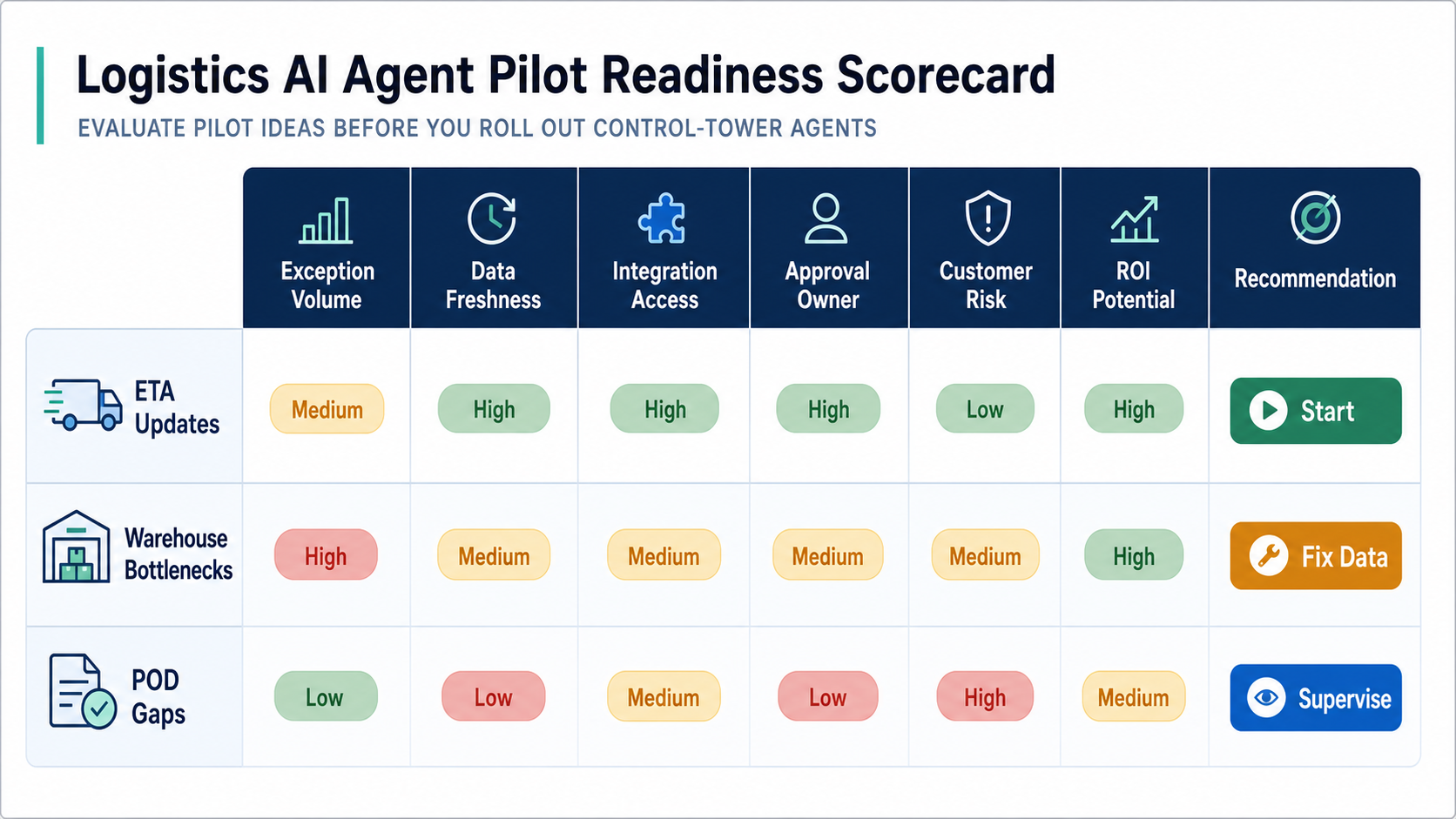
For many logistics teams, ETA updates are a good first agent-assist workflow because they have clear inputs, a human approval owner, visible customer value, and measurable savings. Warehouse bottlenecks can deliver strong ROI, but they usually need cleaner WMS events and escalation rules first. Proof-of-delivery gaps often require more supervision because customer risk and evidence quality vary by carrier, lane, and dispute type.
Rollout Plan For Logistics Teams
The safest rollout starts with visibility and recommendation, then moves toward controlled action. Each phase should have a narrow workflow, clear owner, success metric, and rollback path.
| Phase | Scope | Release gate |
|---|---|---|
| Discovery | Map exception types, systems, owners, data latency, escalation rules, and customer impact | Approved first workflow and data-access plan |
| Agent assist | Summaries, exception classification, evidence gathering, and suggested next steps | Recommendations accepted by operators often enough to continue |
| Supervised pilot | Draft ETA updates, dispatch tasks, warehouse escalations, and approval queues | Low error rate, clear audit trail, and working approval flow |
| Controlled automation | Automated updates for low-risk exceptions with monitoring | Stable data quality and defined rollback path |
| Workflow expansion | Add more lanes, warehouses, carriers, customer segments, and action types | Each new workflow passes evaluation before launch |
The broader architecture resembles AI workflow automation: intake, classification, retrieval, tool actions, approvals, monitoring, and feedback. The logistics-specific challenge is that operational data changes quickly and a small system write can affect cost, capacity, and customer trust.
Common Mistakes To Avoid
- Starting with too many exception types. Pick one high-volume workflow before asking the agent to understand the whole network.
- Confusing visibility with control. A dashboard can show an exception; an agent needs rules, permissions, tool actions, and review paths to resolve it.
- Ignoring data latency. If carrier events or warehouse scans arrive late, the agent must express uncertainty and avoid overconfident ETA promises.
- Automating customer updates before internal trust exists. Start by helping operators, then expand to customer-facing communication.
- Skipping audit trails. Logistics teams need to know which source changed, which recommendation was accepted, and who approved the action.
- Measuring only automation rate. Rejected recommendations, wrong ETAs, escalations, and exception recurrence are more useful safety signals.
Readiness Checklist
Use this checklist before building a logistics control-tower AI agent:
- Exception taxonomy: The team can name top exception types, volume, severity, owners, and current handling steps.
- System access: TMS, WMS, telematics, carrier, ERP, and customer-channel data can be read safely.
- Action boundaries: The team knows which actions are read-only, draft-only, approval-only, or automated.
- Approval rules: Cost, SLA, customer tier, safety, compliance, and inventory decisions have clear escalation paths.
- Data quality: Latency, missing fields, duplicate events, and conflicting sources are understood.
- Evaluation set: The team has real examples with expected classification, recommended action, and escalation reason.
- Operations owner: Someone owns taxonomy updates, workflow tuning, QA, analytics, and incident response.
- ROI model: The team can estimate hours saved, faster response time, fewer manual touches, and better customer communication.
How NextPage Builds Logistics Control-Tower Agents
NextPage designs logistics AI agents by starting with the operating workflow, not the model. We map exception types, data sources, system permissions, action boundaries, approval rules, customer communication paths, evaluation examples, and reporting needs. Then we recommend the smallest reliable version that can reduce firefighting without creating uncontrolled operational risk.
For some teams, that first version is an agent-assist layer for dispatchers. For others, it is a warehouse exception queue, ETA communication assistant, carrier follow-up workflow, or cross-system control-tower pilot connected to TMS, WMS, ERP, telematics, and customer portals. The right starting point depends on where delays, manual touches, and customer escalations are most visible.
If you are planning AI agents for a logistics control tower, start with one exception that is frequent, documented, measurable, and painful enough to justify integration work. Build the review loop first. Automate only after the system can show where its recommendation came from, which action it took, how operators can improve the workflow over time, and which conditions still require human ownership. NextPage can also map the integration path for AI logistics software when the workflow needs route, warehouse, carrier, and customer systems working together.