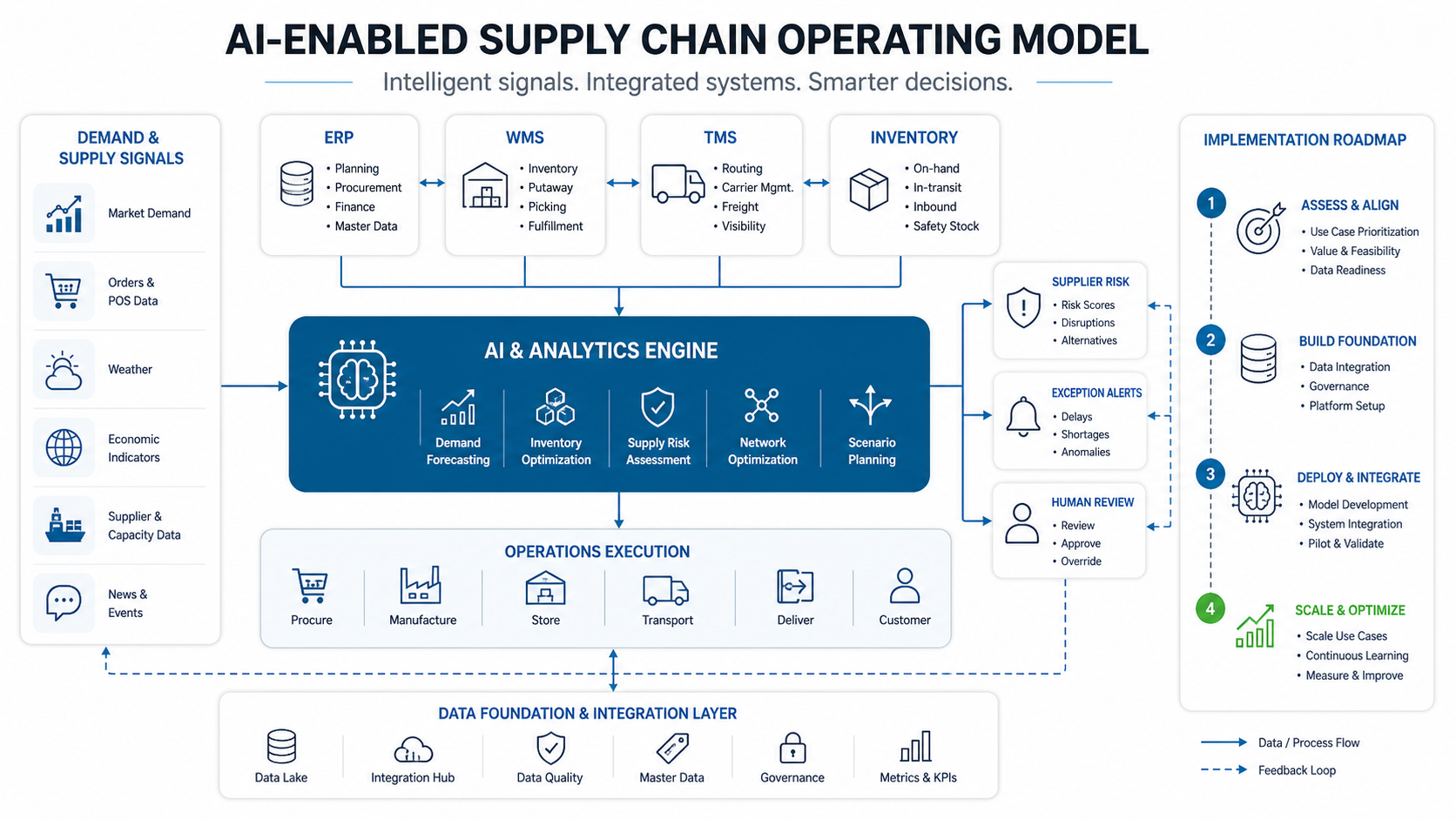

Quick Answer: AI in Supply Chain Management
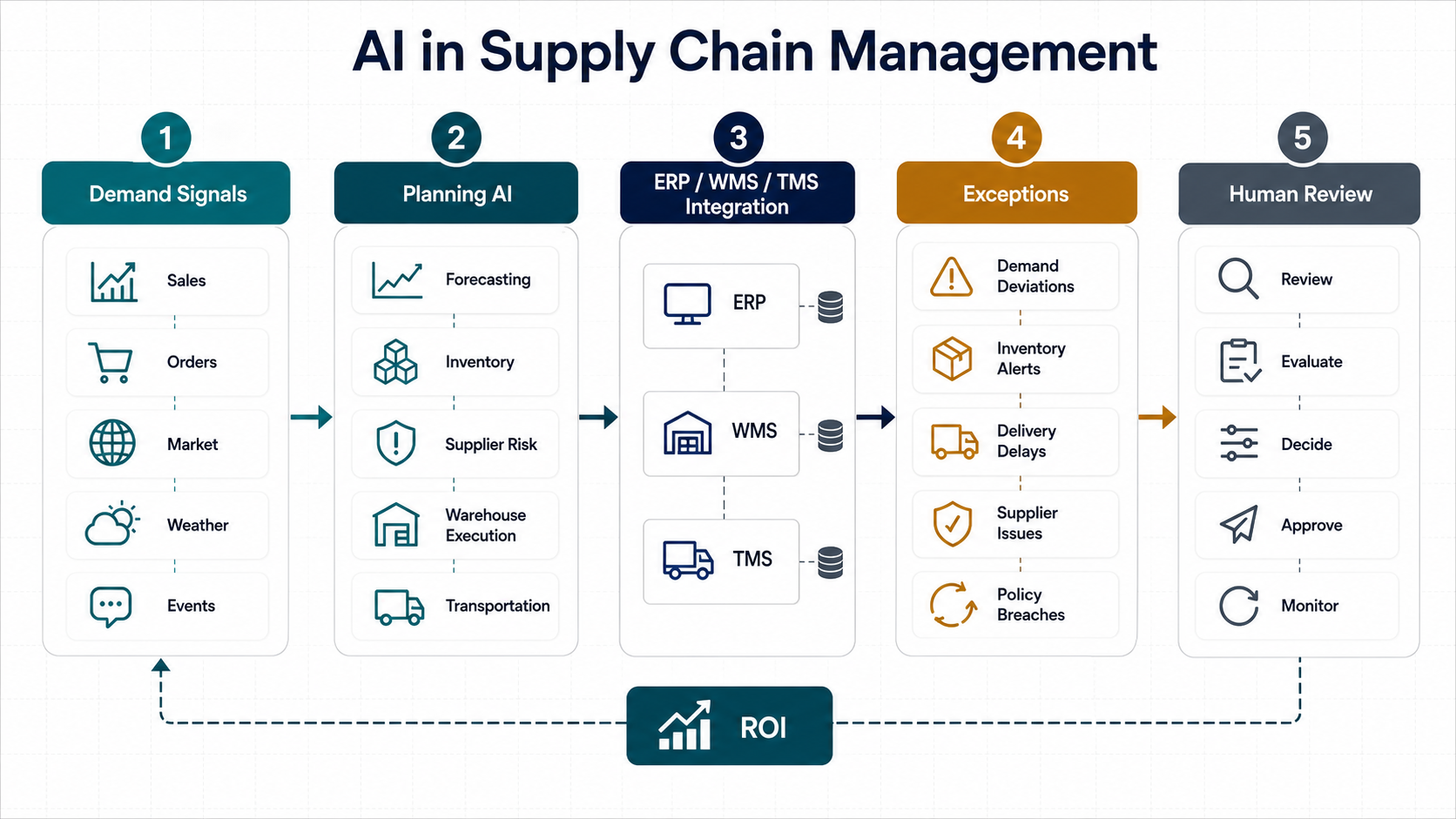
AI in supply chain management uses machine learning, optimization, document intelligence, and workflow automation to improve planning and execution decisions across demand forecasting, inventory, procurement, warehousing, transportation, supplier risk, and exception management. The strongest implementations do not sit beside the operation as a dashboard experiment. They connect to the ERP, WMS, TMS, procurement, finance, and analytics systems that already run the business.
The practical goal is not to automate every supply-chain decision. It is to help planners see risk earlier, compare options faster, and act with cleaner context. A good AI workflow can forecast demand, flag a stockout risk, recommend a replenishment action, explain the tradeoff, and route the final decision to the right human owner.
If you are evaluating where to start, use the AI Agent Readiness Assessment to check workflow clarity, data readiness, integration access, and human-review controls before committing to a supply-chain AI build.
Why Supply Chain AI Is Different From Generic Automation
Supply-chain work is full of linked decisions. A forecast change affects purchasing, warehouse capacity, cash flow, transportation planning, and customer promises. That makes AI useful, but it also makes careless automation risky.
Generic automation follows a fixed rule. Supply-chain AI works better when the system can learn from history, detect weak signals, and compare alternatives under constraints. For example, a simple rule can reorder stock when inventory drops below a threshold. An AI-assisted workflow can combine demand signals, lead-time variability, supplier performance, promotion plans, seasonality, and service-level targets before recommending the next action.
That difference is why supply-chain AI should be scoped around decisions, not around tools. The question is not "Should we add AI?" The better question is "Which recurring planning or execution decision would improve if the team saw better predictions, risk signals, or recommendations?"
Highest-Value AI Use Cases in Supply Chain Management
Most organizations should start with use cases where data already exists, review is natural, and the output can be measured. The table below separates strong first candidates from workflows that usually need more integration and governance.
| Use case | What AI helps with | Systems involved | Useful metric |
|---|---|---|---|
| Demand forecasting | Predicts demand by SKU, channel, region, or customer segment | ERP, sales history, POS, ecommerce, BI | Forecast accuracy and bias |
| Inventory optimization | Recommends reorder points, safety stock, and allocation priorities | ERP, WMS, planning tools | Stockouts, excess inventory, service level |
| Supplier risk monitoring | Flags late deliveries, quality drift, concentration risk, and disruption signals | Procurement, ERP, supplier portals, external data | Late orders and supplier exception rate |
| Warehouse prioritization | Suggests pick, pack, labor, and replenishment priorities | WMS, order management, labor planning | Cycle time and order accuracy |
| Transportation exceptions | Detects shipment delays, routing issues, and carrier risk | TMS, carrier feeds, customer service | On-time delivery and exception response time |
| Control tower workflows | Combines signals into alerts, recommendations, and escalation paths | ERP, WMS, TMS, BI, ticketing | Time to detect and resolve exceptions |
For financial planning, start with the AI Automation ROI Calculator. It helps turn planner time, exception volume, review effort, and automation potential into a directional savings estimate before engineering starts.
Demand Forecasting and Inventory Optimization
Demand forecasting is usually the entry point because the business already understands the pain: stockouts, excess inventory, slow-moving SKUs, unreliable replenishment, and planning cycles that depend too heavily on spreadsheets. AI can help by learning from order history, promotions, seasonality, regional demand, channel behavior, lead times, and external signals.
The better forecast is only useful if it changes an operating decision. A forecast model should connect to inventory policy, replenishment logic, purchase planning, or allocation workflows. Otherwise the team gets another number to debate instead of a decision to improve.
This is where machine learning development matters. Forecasting and inventory models need data pipelines, feature engineering, evaluation, retraining, exception handling, and monitoring. The model is one part of the system; the surrounding workflow decides whether planners trust it.
Procurement and Supplier Risk
Procurement teams can use AI to identify supplier risk, summarize vendor performance, compare quotes, classify spend, review contracts, and spot purchase-order exceptions. The best early use case is usually not autonomous buying. It is better decision support for buyers and category managers.
For example, an AI workflow can flag suppliers with rising lead-time variability, quality issues, late ASN patterns, or concentration risk. It can then create a short explanation for the buyer: affected SKUs, open orders, expected impact, suggested alternatives, and the confidence behind the recommendation.
Human review is essential because procurement decisions affect relationships, contracts, cash, compliance, and product availability. AI should make risk visible earlier and reduce manual analysis, not hide the reasoning behind a black-box recommendation.
Warehouse and Transportation Execution
Warehouse and transportation teams operate under time pressure. AI can help by prioritizing exceptions, predicting bottlenecks, recommending carrier or route changes, and identifying orders that need intervention before customers are affected.
In warehouse operations, AI-assisted workflows can prioritize replenishment, slotting, labor planning, returns triage, and quality inspection queues. In transportation, AI can help with ETA prediction, carrier-risk scoring, tendering recommendations, route exceptions, and customer-service alerts. For execution-heavy teams, the related guide to AI agents for logistics control towers goes deeper on exception workflows, approval paths, and TMS/WMS/carrier integrations.
The important design choice is escalation. If a shipment is likely to miss a delivery window, the system should not only show a red alert. It should explain why the risk exists, suggest the next action, identify who owns the decision, and log what happened after the action was taken.
ERP, WMS, and TMS Integration Architecture
Supply-chain AI fails when it cannot read the right data or write recommendations into the right workflow. Most production implementations need integration with ERP for master data and orders, WMS for inventory and warehouse execution, TMS for shipments and carrier signals, procurement systems for supplier data, and BI or lakehouse infrastructure for analytics history.
A practical architecture has five layers: data ingestion, identity and permissions, model or rules services, workflow orchestration, and monitoring. Each layer needs ownership. The ERP remains the system of record. AI services generate forecasts, risk scores, summaries, or recommendations. Workflow software routes those outputs to planners, buyers, warehouse supervisors, transportation managers, or customer-service teams.
For many organizations, this becomes custom software development because the work is not just model selection. It includes API design, field mapping, approval states, exception queues, audit logs, permission boundaries, and operational reporting.
Data Readiness and Governance
AI quality depends on supply-chain data quality. Before building, teams should review SKU and product master data, supplier records, lead-time history, order status consistency, inventory accuracy, customer and channel mapping, and exception reason codes. Weak data does not always block a project, but it changes what the first version should attempt.
Governance should also be part of version one. The team needs to define which recommendations require approval, which systems AI can read, which fields it can update, how decisions are logged, and what happens when the system is uncertain.
| Control | Question to answer | Recommended pattern |
|---|---|---|
| Decision ownership | Who approves purchasing, allocation, shipment, and supplier actions? | Human-in-the-loop for material changes |
| Data boundaries | Which systems can AI read and write? | Role-based access and scoped connectors |
| Model confidence | When is a recommendation too uncertain? | Escalate, explain, or suppress low-confidence output |
| Audit trail | Can the team explain what changed? | Log inputs, recommendation, approver, and action |
| Monitoring | How will drift and failures be detected? | Track quality metrics, exceptions, and user feedback |
For broader software readiness, NextPage's digital transformation strategy roadmap explains why modernization often has to start at the software and data layer before AI can create dependable operating value.
Implementation Roadmap for Supply Chain AI
A useful roadmap starts narrow, proves trust, and expands only after the workflow is measurable. The first implementation should be small enough to ship and important enough to matter.
- Choose one decision workflow. Pick a recurring decision such as replenishment risk, late shipment triage, supplier exception review, or demand-forecast adjustment.
- Map the data path. Identify required fields, owners, data freshness, system APIs, and missing quality signals.
- Define the review model. Decide which outputs are suggestions, which can update systems, and which require manager approval.
- Build an evaluation set. Use historical examples to test whether recommendations would have helped real planners.
- Pilot with one team or lane. Measure accuracy, adoption, time saved, exception resolution, and false positives.
- Operationalize monitoring. Track model quality, data drift, integration failures, and business outcomes.
- Expand by workflow, not by hype. Add new SKUs, facilities, regions, suppliers, or transportation lanes after the first workflow is stable.
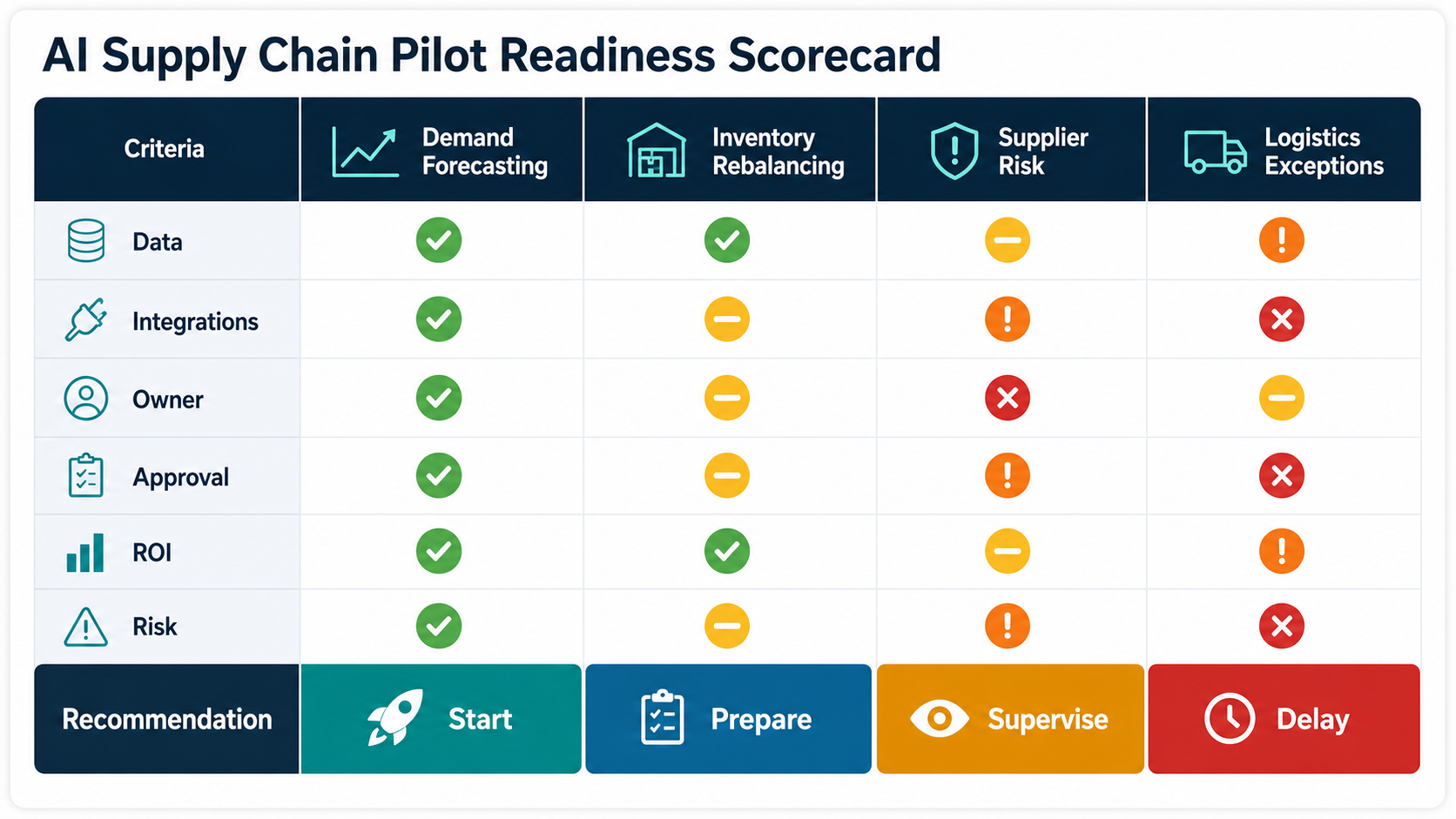
This roadmap supports a practical AI development services engagement because it connects business decisions, data pipelines, integrations, model behavior, and human review into one delivery plan.
Build vs. Buy: How to Decide
Supply-chain platforms increasingly include AI features. Buying can be the right choice when the use case is standard, the data already lives inside the platform, and the workflow does not require deep customization. Building is more appropriate when the workflow spans multiple systems, uses proprietary operating logic, or needs custom approvals and reporting.
A useful rule is simple: buy the commodity layer, build the differentiating workflow. If a platform already offers reliable ETA prediction or demand planning for your exact data model, use it. If your advantage comes from how you combine supplier behavior, customer commitments, inventory strategy, and operating constraints, a custom workflow may be worth building.
Many teams end up with a hybrid approach: platform AI for standard planning features, custom integration for exception handling, and tailored dashboards or agents for cross-system decisions.
How NextPage Helps With Supply Chain AI
NextPage approaches supply-chain AI as production software, not a model demo. We start by mapping the operational decision, the systems involved, the data quality, the review controls, and the business metric that should improve.
That may lead to a forecasting model, a risk-scoring workflow, a control-tower exception queue, an AI assistant for planners, or a custom integration layer between ERP, WMS, TMS, and analytics systems. Relevant NextPage portfolio patterns include RouteForge for autonomous logistics workflow orchestration, FreightLens for freight operations and revenue audit workflows, and StockWise for purchasing and inventory operations. The right solution depends on the workflow, not on the newest AI feature name.
If your team is deciding where AI belongs in supply chain operations, start with one high-volume decision and one measurable pain point. From there, the implementation can move from readiness assessment to prototype, pilot, production integration, and monitored rollout.