
Quick Answer: Computer Vision Development Cost in 2026
Computer vision development cost depends on the business problem, the visual data available, the accuracy target, the amount of labeling work, the model approach, the deployment environment, and the integrations needed after the model works. A simple proof of concept can be scoped in weeks. A production visual inspection system, OCR workflow, video analytics platform, or edge AI rollout needs a larger roadmap because the team must handle data collection, annotation quality, latency, hardware, privacy, monitoring, and retraining.
As a planning range, a focused computer vision discovery sprint or proof of concept often starts around $10k-$35k. A controlled MVP for one use case usually lands around $35k-$120k. A production workflow with integrations, dashboards, monitoring, and edge or cloud deployment can move into the $120k-$350k range. Multi-site, safety-critical, regulated, or high-volume deployments can exceed that and should be phased.
If you are still defining the first release, use NextPage's MVP Scope Builder to narrow the release, compare the broader engineering budget with the custom software cost estimator, and use this guide to decide what should be in the pilot versus the later production roadmap.
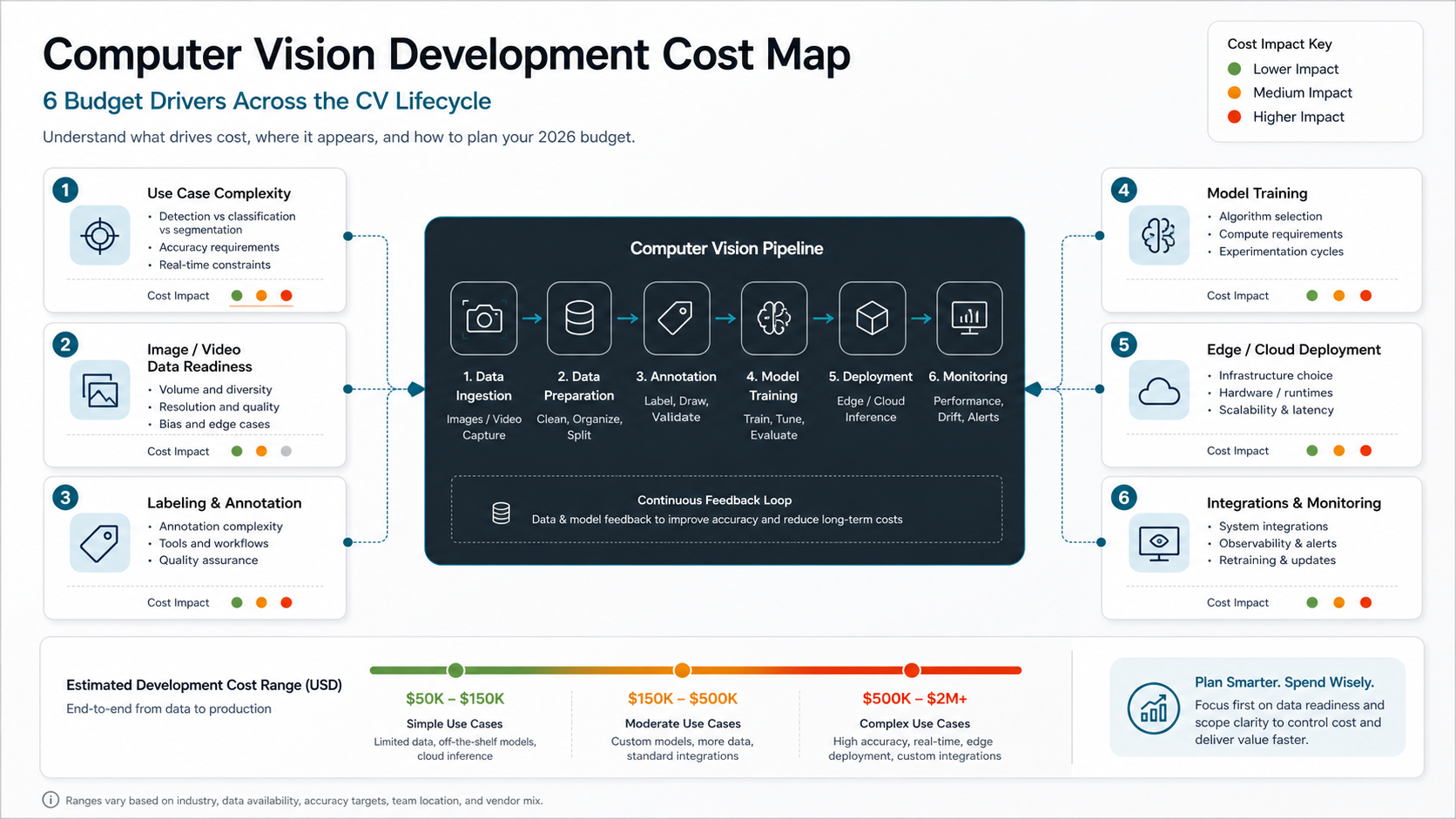
What Actually Drives Computer Vision Development Cost?
The expensive part of computer vision is not only training a model. The real work is turning messy visual input into a reliable operational system. Teams need enough representative images or video, clear labels, test cases, hardware or cloud decisions, latency targets, human review, exception handling, and integration with the workflow that will use the result.
The OrangeMantra reference page positions computer vision across edge AI deployment, object detection and tracking, image segmentation, facial recognition, OCR, video analytics, model frameworks, cloud platforms, edge devices, and annotation tools. Those capabilities are useful signals for scoping, but a buyer still needs to know which parts change budget and risk.
| Cost driver | What changes the estimate | Why it matters |
|---|---|---|
| Use case complexity | Classification, OCR, detection, segmentation, tracking, anomaly detection, or multi-camera analytics | More complex vision tasks need more data, more testing, and tighter performance targets |
| Data readiness | Existing image/video quality, camera angles, lighting variation, coverage, bias, and edge cases | Weak data usually creates more work than model code |
| Labeling and QA | Bounding boxes, masks, keypoints, OCR fields, double review, and label guidelines | Annotation quality directly affects model quality and rework |
| Model strategy | Cloud vision API, open-source model, transfer learning, custom training, or specialized edge model | The simplest model that meets the target usually lowers both build and support cost |
| Deployment environment | Cloud inference, on-device inference, edge gateway, factory floor, mobile app, or offline mode | Latency, hardware, bandwidth, and uptime requirements change architecture |
| Integration and operations | ERP, WMS, CRM, QA dashboard, alerting, human review, analytics, and retraining workflows | Production value comes from acting on detections, not from an isolated model demo |
This is why a quote should begin with the workflow and the decision the model will support. A retail shelf-monitoring model, a warehouse damage-detection workflow, a medical document OCR feature, and a factory defect inspection system all use computer vision, but they do not have the same data, risk, hardware, or support profile.
Computer Vision Budget Ranges by Scope
Use these bands for planning, not as fixed quotes. Region, team structure, camera setup, labeling volume, compliance, accuracy requirements, and support expectations can shift the budget materially.
| Scope band | Typical build | Planning budget band | Best fit |
|---|---|---|---|
| Discovery and proof of concept | Use-case workshop, sample data audit, baseline model, feasibility report, demo flow | $10k-$35k | Testing whether computer vision can solve the workflow before funding production |
| Focused MVP | One use case, curated data, labeling process, model iteration, basic app or dashboard, limited users | $35k-$120k | Visual inspection, OCR extraction, counting, detection, or a controlled analytics workflow |
| Production workflow | Model pipeline, integrations, admin controls, monitoring, alerting, feedback loop, support plan | $120k-$350k | Operational systems where detections trigger reviews, tasks, reports, or downstream actions |
| Edge or multi-site rollout | Device selection, camera calibration, offline handling, deployment automation, fleet monitoring | $250k+ phased program | Factories, warehouses, stores, vehicles, kiosks, or environments with latency and hardware constraints |
A pilot can be valuable even when it does not produce a production model. It should answer whether the data is good enough, whether the accuracy target is realistic, whether false positives are tolerable, and whether the workflow creates enough business value. For broader software budgeting, compare these bands with NextPage's custom software development cost guide.
Data and Labeling Are Usually the Budget Swing Factor
Computer vision projects fail when teams underestimate data work. The model needs to see the real variation it will face after launch: camera angles, blur, shadows, damaged objects, rare defects, seasonal packaging, different skin tones, reflective surfaces, occlusions, clutter, and confusing background objects. If the dataset only covers ideal examples, the demo may look good while production accuracy collapses.
Labeling also has levels. Image classification labels are cheaper than bounding boxes. Bounding boxes are usually cheaper than segmentation masks. OCR fields, keypoints, multi-object tracking, and defect severity labels need stronger guidelines and review. When the outcome affects safety, compliance, payments, medical workflows, or customer trust, double review and audit trails become part of the real cost.
A practical data plan should define source systems, permission to use images or video, retention rules, sampling strategy, labeling schema, quality review, disagreement handling, and a retraining loop. NextPage's machine learning development service is relevant when the project needs data pipelines, prediction workflows, model deployment, and ongoing improvement rather than a one-off demo.
Architecture Decisions: Cloud API, Custom Model, or Edge AI
Architecture should follow the workflow. A cloud computer vision API may be enough for OCR, moderation, common object detection, or quick prototyping. A custom model is usually needed when the object, defect, product, medical document, shelf layout, or operating condition is specific to your business. Edge AI becomes important when latency, bandwidth, privacy, offline operation, or hardware control matters.
| Option | Cost profile | Budget risk | Use when |
|---|---|---|---|
| Cloud vision API | Lower build effort, usage-based operating cost | May not fit domain-specific objects or strict privacy needs | Common OCR, image tagging, moderation, and fast feasibility testing |
| Custom trained model | Higher data, labeling, and evaluation effort | Accuracy depends on dataset quality and edge-case coverage | You need business-specific detection, segmentation, inspection, or visual classification |
| Hybrid cloud pipeline | Moderate to high engineering effort | Data transfer, storage, latency, and monitoring must be designed | You need central analytics, dashboards, review queues, and periodic retraining |
| Edge deployment | Higher hardware, optimization, and release-management cost | Device constraints, camera quality, heat, network, and version drift matter | You need real-time inference, offline processing, privacy control, or low bandwidth use |
Edge deployments should include hardware selection, camera placement, model compression, update strategy, observability, and fallback behavior. Cloud deployments should include data security, storage, throughput, monitoring, and cost controls. Either way, model quality is only one part of the system.
A Safer Computer Vision Implementation Roadmap
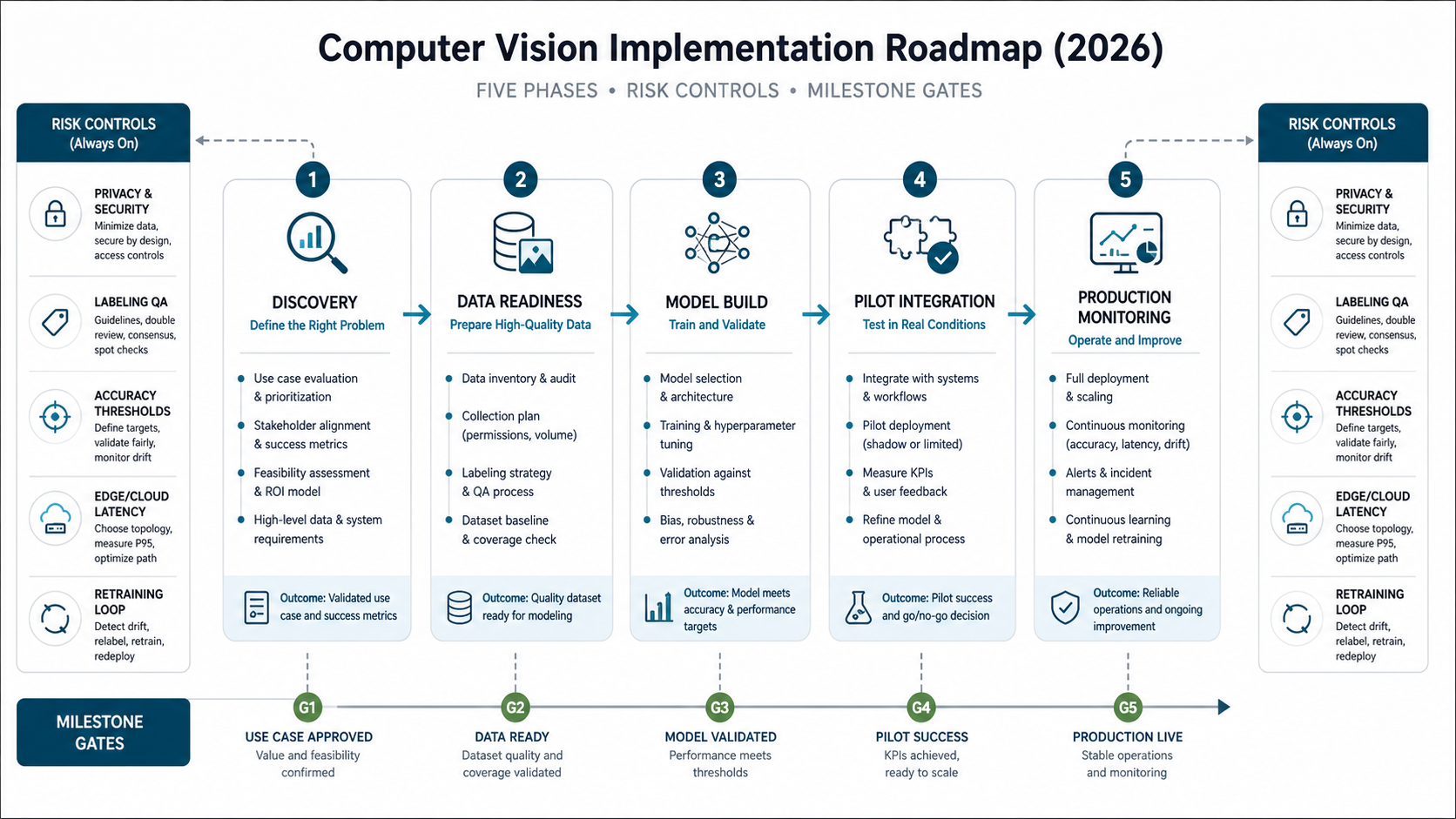
The safest roadmap moves from value proof to production hardening. Skipping data readiness or pilot integration often creates expensive rework.
| Phase | What to prove | Typical output |
|---|---|---|
| 1. Discovery | The use case is valuable, measurable, and narrow enough for a first release | Scope brief, ROI hypothesis, risk list, success metrics, data-access plan |
| 2. Data readiness | Images or video represent real conditions and can be legally used and labeled | Dataset inventory, labeling rules, quality checklist, baseline sample set |
| 3. Model build | A model can meet target accuracy on held-out examples and known edge cases | Baseline model, evaluation report, false-positive analysis, improvement backlog |
| 4. Pilot integration | The model can support a real workflow with human review and useful feedback | Limited deployment, dashboard or API, review queue, alerts, KPI measurement |
| 5. Production monitoring | The system can operate reliably as data, hardware, and business conditions change | Monitoring, drift checks, retraining process, incident plan, support runbook |
For projects that require model monitoring, deployment workflows, and governance, NextPage's MLOps implementation checklist can help the team plan data contracts, evaluation, deployment, drift detection, and ownership.
How to Plan ROI Before Funding the Build
A computer vision project should have a measurable business case before production spend increases. Good ROI cases often involve repeated visual review, quality inspection, document extraction, inventory counting, safety monitoring, claims evidence, warehouse checks, checkout friction, or field-service verification. The value can come from labor saved, faster cycle time, fewer defects, reduced loss, better compliance, or improved customer experience.
Before estimating, quantify the current workflow: how many images, videos, documents, inspections, or incidents are reviewed per week; how much time each review takes; what error rate is tolerable; how often humans must override the model; and what happens when the system misses something. Then compare the cost of the pilot and production rollout against the annual value. The AI Automation ROI Calculator can help translate repeated review work into a payback range.
If you are comparing in-house hiring, freelancers, or an outsourced AI delivery pod, review NextPage's software development outsourcing to India guide and the Dedicated India Team Cost Calculator for team-shape planning.
Common Computer Vision Cost Mistakes to Avoid
Most budget overruns happen before model training starts. Teams expand the use case too early, assume existing images are representative, skip label QA, or choose an edge deployment before latency and privacy requirements are proven. A smaller first release is usually safer when it proves one decision path, one data source, and one review workflow before expanding to more cameras, sites, or model types.
| Mistake | Budget impact | Better planning move |
|---|---|---|
| Starting with too many use cases | More data, labels, edge cases, and stakeholder reviews than the pilot can absorb | Rank use cases by value, feasibility, data access, and operational risk before funding build work |
| Underestimating label quality | Model rework, inconsistent evaluation, and poor confidence in pilot results | Write annotation rules, sample edge cases, and review labels before scaling labeling volume |
| Choosing edge AI too early | Hardware, optimization, rollout, and monitoring costs arrive before value is proven | Prototype in the simplest environment that can prove accuracy, latency, and workflow value |
| Treating the model as the product | The demo works, but operations still lack alerts, review queues, integrations, and ownership | Plan the workflow around who acts on detections and how exceptions are reviewed |
For broader AI operating-model decisions, compare this roadmap with NextPage's AI workflow automation guide and the machine learning consulting company checklist. Those resources help separate model experiments from production workflows with governance, monitoring, and measurable ROI.
Computer Vision Cost Planning Checklist
- Define the exact visual decision the system must support.
- Choose the first use case by value, feasibility, data availability, and risk.
- Inventory image and video sources, permissions, quality, retention, and edge cases.
- Decide whether labels are classification, boxes, masks, keypoints, OCR fields, or severity levels.
- Set accuracy, precision, recall, latency, and human-review thresholds before model training.
- Choose cloud, custom, edge, or hybrid architecture based on workflow constraints.
- Plan integrations with the system that will use detections, not only a dashboard.
- Budget for monitoring, drift detection, retraining, support, hardware upkeep, and data refreshes.
- Connect each phase to measurable ROI before expanding to more sites or use cases.
How NextPage Helps Scope Computer Vision Work
NextPage helps teams turn computer vision ideas into buildable software plans. We map the workflow, available data, labeling needs, model strategy, deployment environment, integrations, monitoring requirements, and ROI case before recommending a prototype, MVP, production pipeline, or edge rollout.
If you are planning a pilot, bring sample images or videos, the current review process, the desired action after detection, target accuracy, user roles, and operational constraints to a scoping call. We will help identify the riskiest assumptions, choose a practical first release, and define the roadmap that can prove value without overbuilding.
Plan a computer vision MVP with NextPage AI development services.