
Quick Answer: DevOps Consulting For SaaS Teams
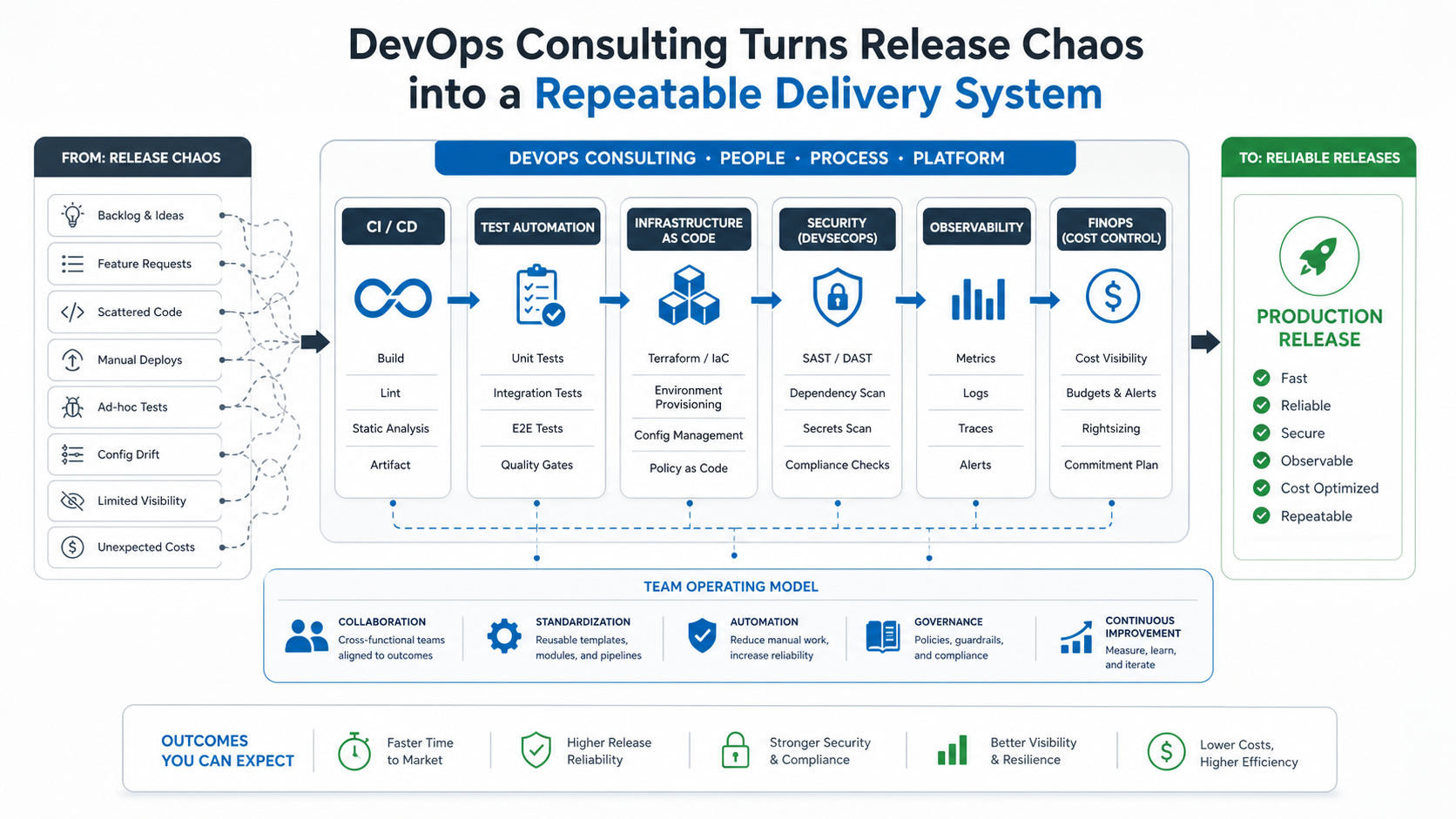
DevOps consulting for SaaS teams is the work of turning release, infrastructure, monitoring, security, and cloud-cost practices into a repeatable operating system. The best engagement does not start with a tool migration. It starts by finding the bottlenecks that slow product delivery: fragile CI/CD, drifting environments, unclear rollback, noisy alerts, manual access changes, hidden cloud waste, or release work that depends on one senior engineer.
For a SaaS company, the useful outcome is a delivery system engineers can trust. Code should move through predictable quality gates, infrastructure should be reviewed in version control, production should expose customer-impact signals, rollback should be rehearsed, and cost/security evidence should be visible. If the work includes landing zones, workload moves, or environment redesign, place the DevOps plan inside a broader cloud migration services roadmap. If the main need is hands-on pipeline, infrastructure, and reliability implementation, use a dedicated DevOps consulting services engagement.
When A SaaS Team Needs DevOps Consulting
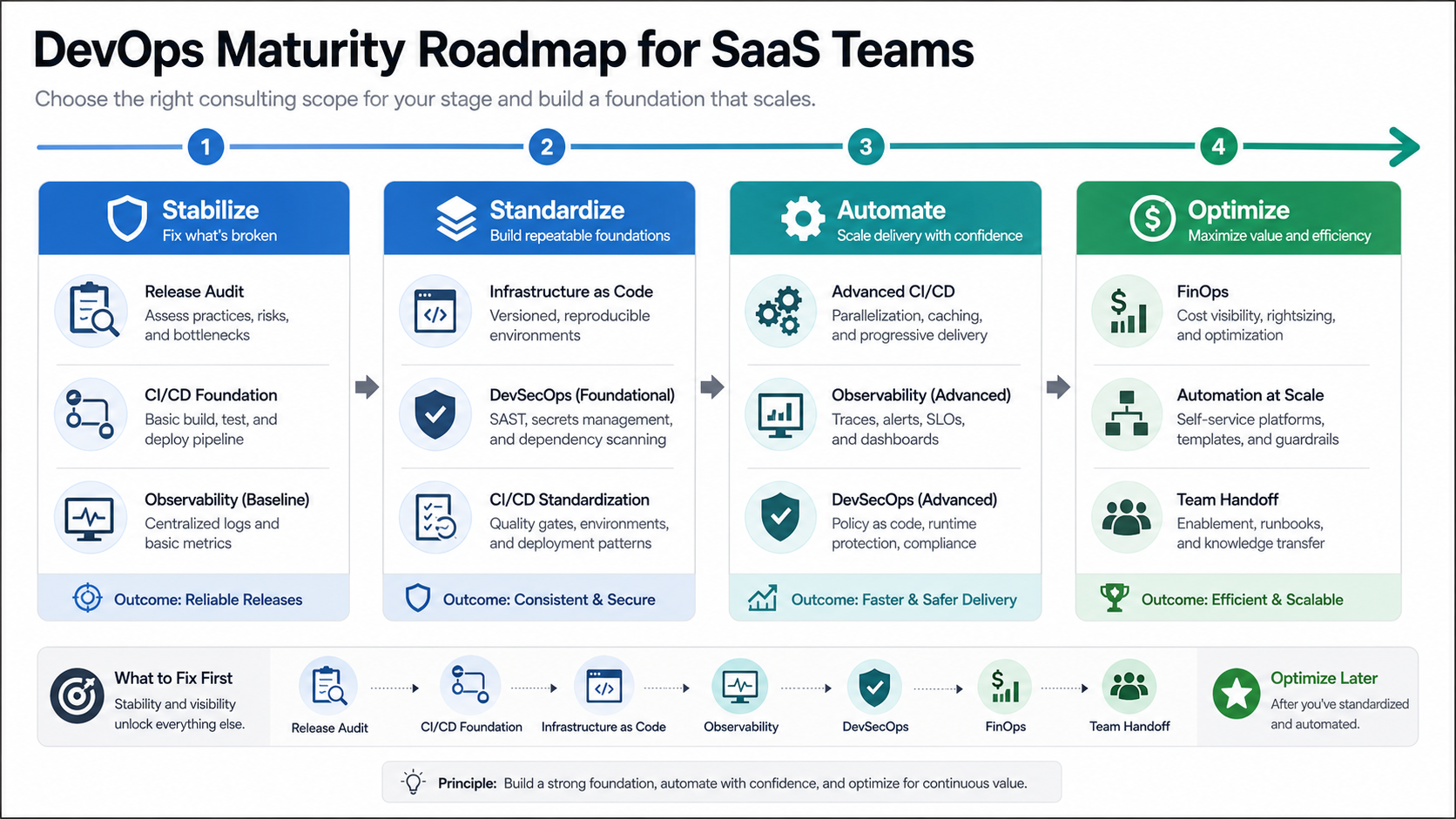
SaaS teams usually need DevOps help when delivery pressure exposes weak operating foundations. Releases take too long, hotfixes feel risky, staging does not match production, cloud bills rise without ownership, or incidents depend on a few people remembering manual steps. These are delivery-system problems, not just engineering effort problems.
The clearest signal is repeated friction. If every deployment needs a war room, if engineers avoid infrastructure changes, if monitoring creates noise but not decisions, or if the product roadmap is blocked by environment work, consulting can be cheaper than letting velocity leak every sprint. Teams building or scaling a SaaS product should connect this work to product architecture through SaaS development services, because tenant model, data design, release strategy, and operational controls affect each other.
Start With A DevOps Readiness Assessment
The first deliverable should be a readiness assessment, not a tool recommendation. The assessment should map the release path from code commit to production, then inspect environments, deployment scripts, infrastructure, secrets, access controls, logs, metrics, incident process, backup approach, and cloud-cost ownership around that path.
| Assessment Area | What To Inspect | Useful Output |
|---|---|---|
| CI/CD | Build time, test coverage, approvals, deployment frequency, rollback steps | Pipeline fixes and release guardrails |
| Infrastructure | Cloud accounts, environments, IaC coverage, networks, secrets, scaling rules | Environment parity and automation backlog |
| Observability | Logs, metrics, traces, alert quality, dashboard ownership, incident history | Monitoring plan tied to service reliability |
| Security | Access, secrets, dependency checks, image scans, audit logging, policy exceptions | DevSecOps controls inside delivery flow |
| Cost | Tagging, waste, reserved capacity, environment schedules, cost anomalies | FinOps ownership and budget guardrails |
For older SaaS products, the assessment may show that DevOps work cannot stand alone. Brittle architecture, unsupported dependencies, manual data flows, and fragile integrations may need legacy software modernization scoring before automation will be stable.
CI/CD Foundation: What Consultants Should Fix First
The CI/CD foundation should make the normal release path safe and boring. A SaaS pipeline usually needs fast pull-request feedback, deterministic builds, automated tests, environment-specific configuration, approval rules for sensitive changes, migration checks, artifact versioning, deployment logs, and a rollback path. The goal is not more ceremony. The goal is removing hidden manual judgment from routine releases.
Good consultants also separate pipeline problems from product problems. If tests are slow because module boundaries are unclear, the fix may involve application design. If deployments fail because database migrations are risky, the fix may involve backwards-compatible schema changes, feature flags, and staged rollout. If release windows are blocked by team capacity, compare a project-based engagement with a longer-running engineering pod using the Dedicated India Team Cost Calculator.
Cloud Infrastructure And IaC Decisions
Infrastructure as code is valuable when it reduces drift and makes recovery repeatable. It should cover the cloud resources that matter most: environments, networks, compute, databases, queues, storage, IAM roles, secrets references, scaling rules, and monitoring hooks. For many SaaS teams, the first practical win is not a perfect internal platform. It is a repeatable staging and production baseline that engineers can review in code.
Consultants should decide how much platform work fits the business stage. A seed-stage SaaS product may need a lean managed-services setup with clean deployment automation. A growth-stage product may need multi-environment IaC, observability, security gates, disaster recovery, cost controls, and clearer ownership. A mature product may need platform-engineering patterns, golden paths, service templates, and a phased cloud migration roadmap. When scope also includes product features and dashboards, connect infrastructure choices to a broader web app development cost plan.
Observability, Incident Response, And Reliability
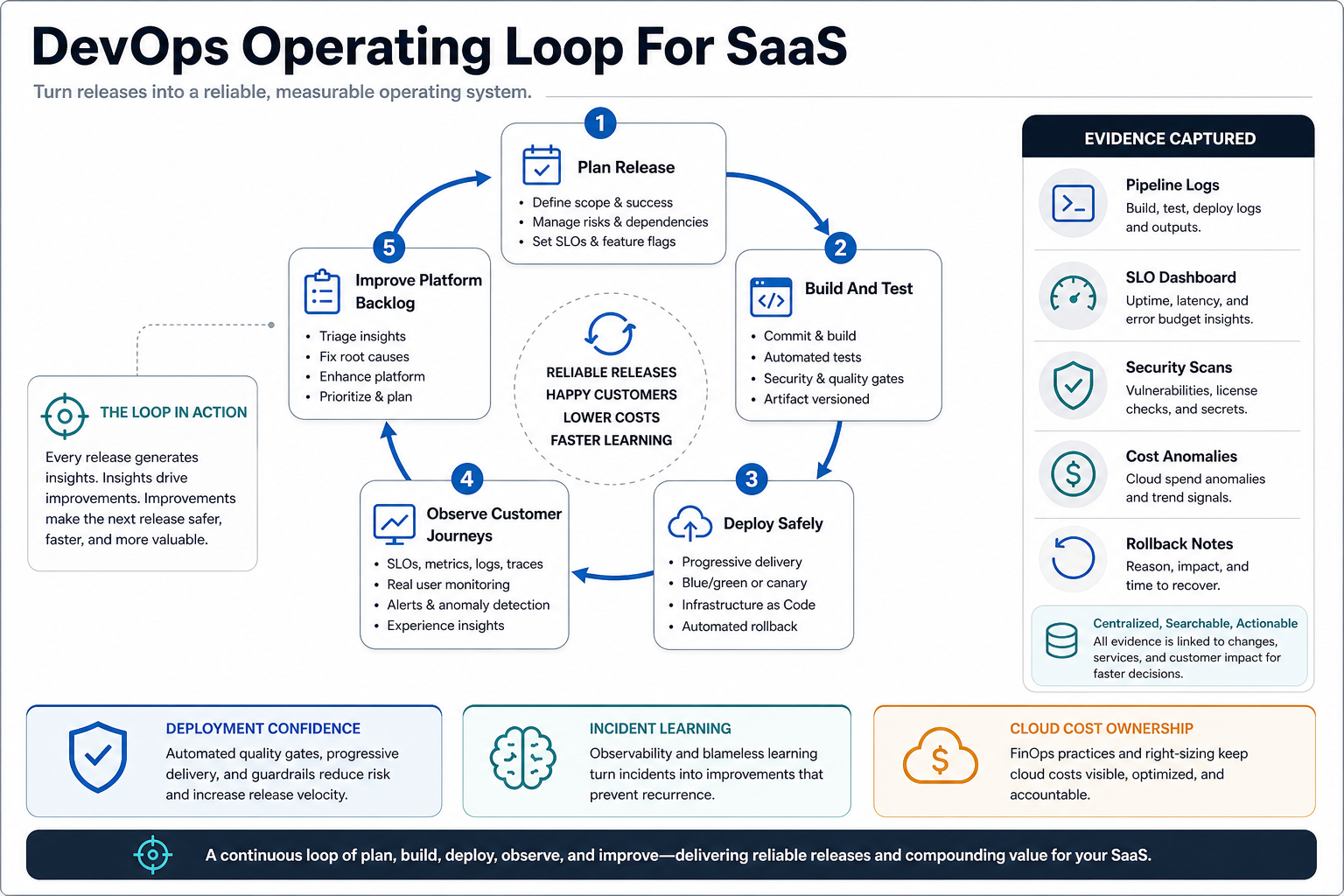
Observability is not the same as collecting logs. SaaS teams need enough signal to know whether customers can complete critical workflows, whether error rates changed after a release, whether latency affects conversion, and whether a dependency is failing. A consulting engagement should define service-level indicators, dashboards, alert routes, on-call rules, incident severity, post-incident review, and ownership for follow-up work.
DORA's 2025 research reinforces a useful point for AI-assisted and modern engineering teams: tools amplify the underlying system. If release ownership, feedback loops, and operating discipline are weak, new automation can make the bottlenecks more visible without fixing them. DevOps consulting should therefore improve the system around the tools: value-stream visibility, reliable feedback, and measurable product outcomes.
DevSecOps And Compliance Guardrails
Security checks should move into the delivery flow without turning every release into a manual review. That usually means dependency scanning, container image checks, secret detection, infrastructure policy checks, access reviews, audit logging, branch protection, environment separation, and documented exception handling. The consultant's job is to place controls where they catch real risk while keeping engineers productive.
For regulated SaaS products, define evidence early. Access changes, deployments, vulnerability responses, backups, incident records, and policy exceptions should be traceable. This is especially important when a SaaS product handles financial, healthcare, enterprise, or personal data. Use a baseline like the DevSecOps pipeline checklist to decide which controls belong in pull requests, CI, container registries, runtime monitoring, and release approvals.
Cost Plan: FinOps And Cloud Waste Control
Cloud cost control belongs in DevOps scope because delivery choices create cost patterns. Preview environments, over-provisioned databases, untagged resources, noisy logs, duplicate monitoring tools, and always-on test infrastructure can quietly raise monthly spend. Flexera's 2026 cloud reporting keeps cloud spend management and waste high on the operating agenda, so SaaS teams should treat cost ownership as part of platform design.
A practical cost plan includes tagging standards, environment schedules, budget alerts, anomaly detection, reserved-capacity review, right-sizing, storage lifecycle policies, and cost review cadence. It should also assign owners. If nobody owns a resource, nobody will optimize it.
How To Choose The Right DevOps Consulting Model
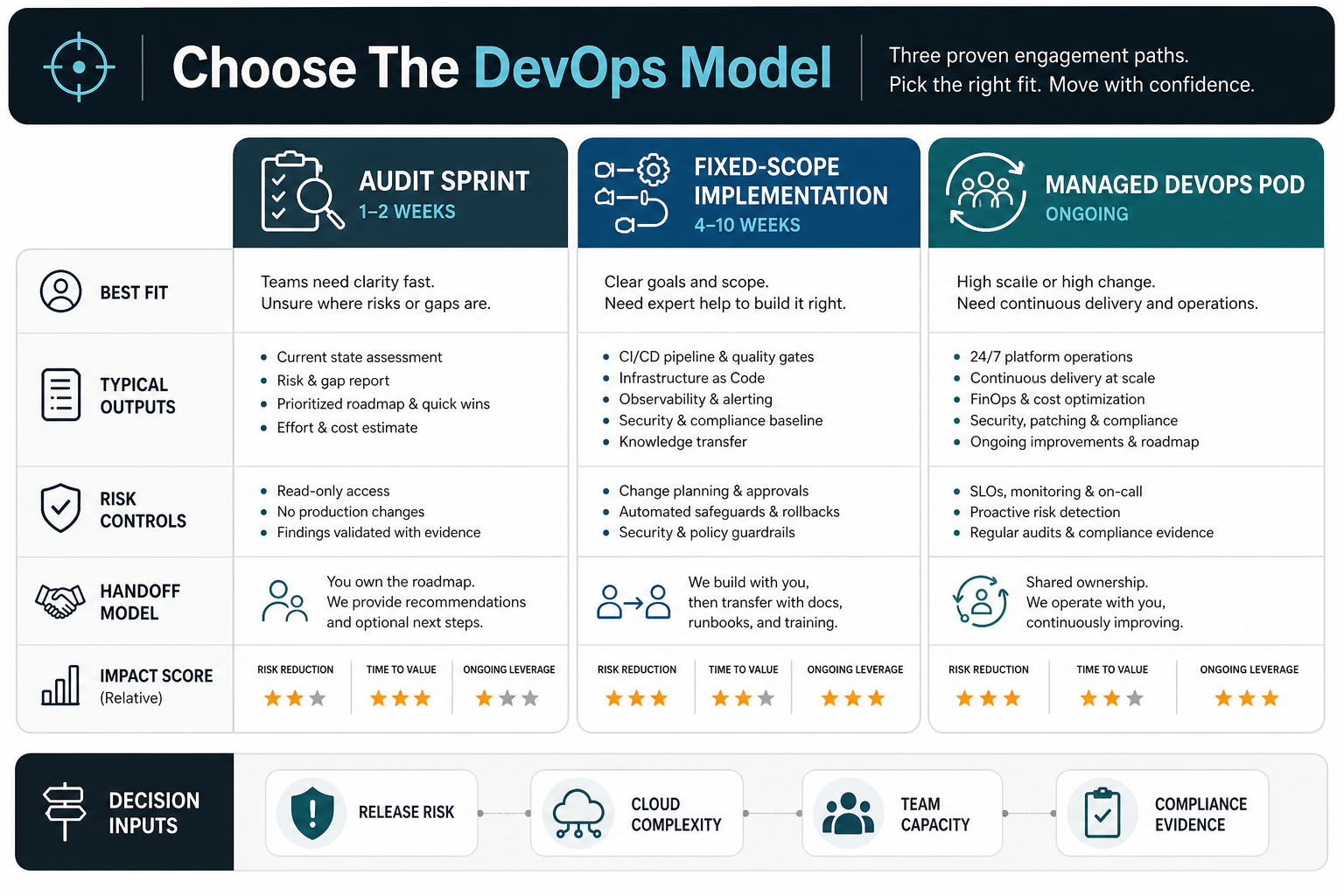
There are three common models. A short audit works when leaders need a prioritized roadmap before investing. A fixed-scope implementation works when the backlog is clear: build CI/CD, introduce IaC, configure observability, or prepare a cloud landing zone. A managed team model works when the SaaS product needs ongoing delivery, reliability, and maintenance capacity.
| Model | Best Fit | Typical Output | Risk To Watch |
|---|---|---|---|
| Audit sprint | Leadership needs a fact-based roadmap before committing budget. | Current-state map, risks, quick wins, cost and sequencing plan. | Findings stall if nobody owns implementation. |
| Fixed-scope implementation | The backlog is clear and the team needs specialist execution. | Pipeline, IaC, observability, DevSecOps, or migration deliverables. | Scope can drift if product architecture issues are hidden. |
| Managed DevOps pod | The product needs ongoing release, reliability, and cloud operations capacity. | Continuous delivery support, runbooks, dashboards, cost controls, and improvement backlog. | Weak handoff can create vendor dependency. |
If you are comparing a consulting sprint with an ongoing managed team, also read staff augmentation vs managed dedicated team. For some SaaS products, DevOps consulting solves the immediate platform problem, while a managed team keeps reliability, maintenance, and roadmap delivery moving afterward.
What A Strong DevOps Consulting Proposal Should Include
A useful proposal should make the operating change visible before the work starts. Ask for the current-state assumptions, delivery scope, access model, security boundaries, success metrics, evidence artifacts, handoff plan, and owner responsibilities. The proposal should also state what is out of scope: application refactoring, major cloud migration, test-suite rebuild, compliance certification, or 24/7 operations if those are not included.
- Named outcomes, such as faster release confidence, safer rollback, environment parity, or clearer cost ownership.
- Artifacts the team will keep: pipeline definitions, IaC modules, dashboards, runbooks, ADRs, access matrices, and cost reports.
- Operating metrics: deployment frequency, change failure rate, lead time, MTTR, alert quality, cloud cost anomalies, and security exceptions.
- Handoff expectations: documentation, walkthroughs, team training, repository ownership, and support window.
- Risk controls: read-only discovery first, least-privilege access, change approvals, rollback plans, and production freeze windows.
DevOps Consulting Checklist For SaaS Leaders
- Map the current path from commit to production before discussing tools.
- Identify release failures, incident patterns, and cloud cost issues that repeat.
- Define target environments, pipeline stages, approval rules, and rollback paths.
- Move critical infrastructure into version control where it improves safety.
- Add observability around customer workflows, not only server health.
- Place security checks inside CI/CD with clear exception rules.
- Create cost ownership, tagging, budgets, and anomaly alerts early.
- Document handoff, runbooks, dashboards, and owner responsibilities.
- Choose between audit, fixed-scope implementation, and ongoing team support.
How NextPage Helps SaaS Teams With DevOps
NextPage helps SaaS teams turn delivery bottlenecks into a practical improvement plan: DevOps readiness review, cloud foundation, CI/CD pipeline design, infrastructure automation, observability, security guardrails, cost controls, and team handoff. If the product also needs architecture or feature work, our web app development and custom software development teams can connect platform decisions to the product roadmap.
Start with DevOps consulting services when your priority is faster releases and safer operations, choose cloud migration services when the priority is a broader infrastructure move, or use the dedicated team calculator when you need to compare a one-time consulting project with an ongoing delivery pod.