
Quick Answer: EU AI Act Readiness for Software Teams
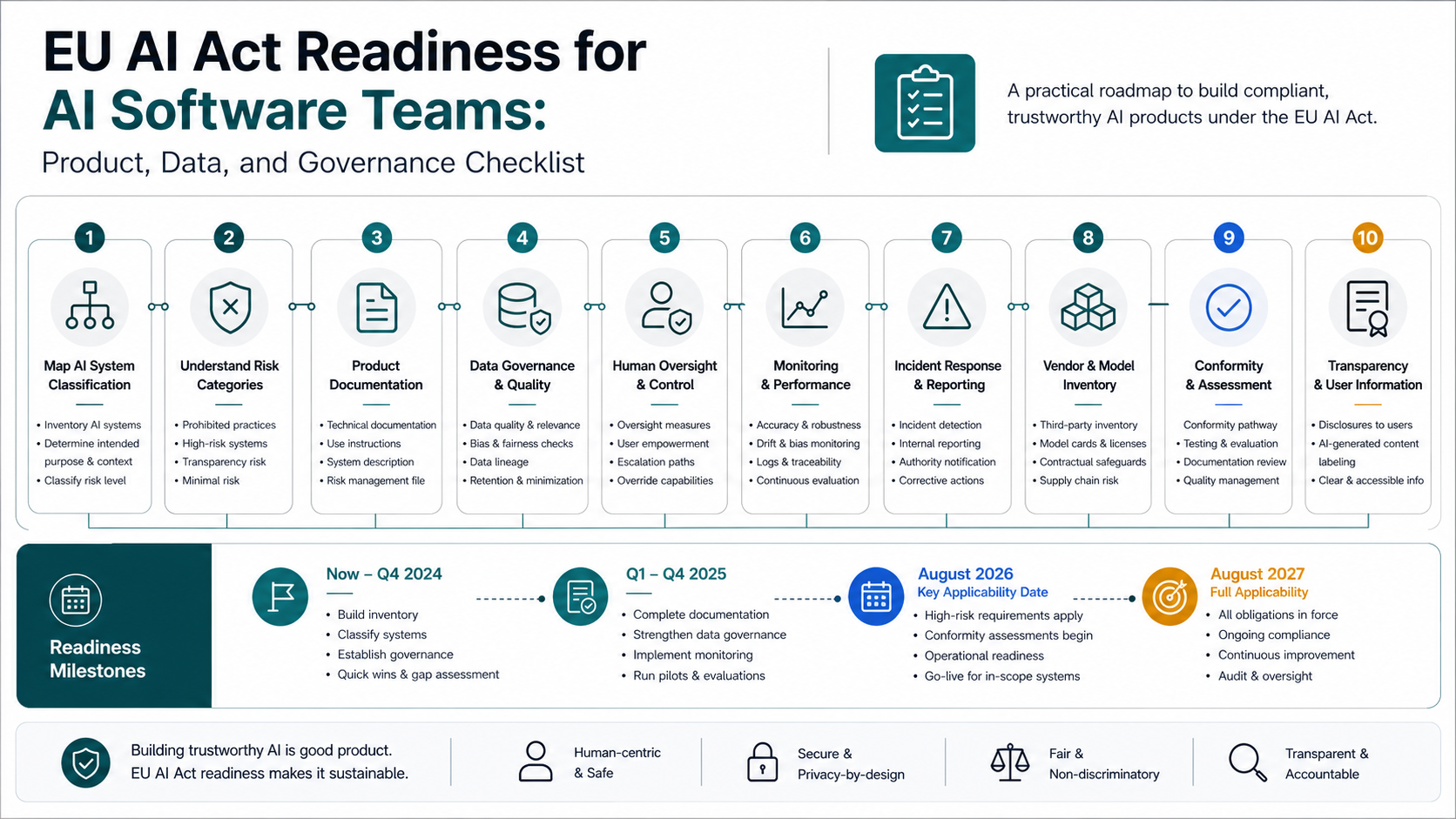
EU AI Act readiness for software teams means knowing which AI systems you build, buy, deploy, or expose to EU users; classifying each system by risk; documenting how data, models, prompts, human oversight, monitoring, security, and incident response work; and turning those controls into product release gates. This is not only a legal exercise. It is a product, data, engineering, and governance workflow that should live beside your normal software delivery process.
As of 25 June 2026, the AI Act is already applying in stages. The European Commission's AI Act page says prohibited practices and AI literacy obligations applied from 2 February 2025, GPAI governance and model-provider obligations applied from 2 August 2025, and the main AI Act application window remains 2 August 2026. The same Commission page, last updated 11 May 2026, also reflects the 7 May 2026 political agreement on simplification: rules for certain high-risk areas such as biometrics, critical infrastructure, education, employment, migration, asylum, and border control are now mapped to 2 December 2027, while high-risk AI embedded in regulated products is mapped to 2 August 2028. Teams should keep a dated assumption log because official implementation support, standards, and Service Desk materials continue to evolve.
If you are unsure where to start, run the workflow through the AI Agent Readiness Assessment. It helps score workflow clarity, data readiness, integration access, and human-review controls before you commit to a production AI build.
Why Software Teams Need a Readiness Checklist
Many AI compliance efforts start too late because the team treats the AI Act as a policy review after engineering has already shipped. That creates rework. A product team may discover that a feature needs stronger disclosure, a data team may lack dataset provenance, an engineering team may not log enough model behavior for traceability, and leadership may not know whether the company is a provider, deployer, importer, distributor, or downstream operator in the AI value chain.
A readiness checklist gives each function a concrete job. Product owns system inventory and user-facing behavior. Data owns dataset provenance, access, retention, quality, and bias checks. Engineering owns model integration, prompt and retrieval controls, logging, security, and rollback. Operations owns monitoring, incident handling, support scripts, and escalation. Leadership owns risk appetite, ownership, review cadence, and documentation standards.
The broader Enterprise AI Readiness Checklist is useful if your team still needs to align business workflows, data access, security, governance, and rollout priorities before mapping EU-specific obligations.
Step 1: Build an AI System Inventory
You cannot classify what you cannot see. Start with an inventory of AI systems across the product, internal tools, customer support, analytics, marketing automation, and third-party software. Include systems that are obvious, such as chatbots and recommendation engines, and systems that are easy to miss, such as AI-assisted moderation, scoring, matching, ranking, forecasting, code generation, document extraction, summarization, and employee productivity tools.
| Inventory field | What to capture | Why it matters |
|---|---|---|
| System name and owner | Product area, business owner, engineering owner, vendor owner | Creates accountability for classification and evidence |
| Use case and users | What the system does, who uses it, who is affected | Connects technical design to risk and user impact |
| Role in the product | Decision support, automation, recommendation, generation, moderation, ranking | Clarifies autonomy and human oversight needs |
| Inputs and outputs | Personal data, sensitive data, documents, prompts, model outputs, downstream actions | Supports data governance, privacy, logging, and monitoring |
| Model and vendor chain | Foundation model, fine-tune, RAG store, APIs, open-source models, third-party tools | Shows who supplies what and where obligations may sit |
| Market exposure | EU users, EU customers, regulated industry, internal-only use | Helps decide how much AI Act analysis is needed |
Do not wait for the inventory to be perfect. A first version that covers the highest-impact systems is better than a policy document that never reaches engineering.
Step 2: Classify Risk Before Roadmap Commitments
The AI Act uses a risk-based structure. The Commission describes categories including prohibited practices, high-risk systems, transparency-risk systems, and minimal or no-risk systems. For product teams, the key move is to classify the use case before committing to a launch date, customer promise, or model architecture.
| Risk layer | Software-team question | Readiness action |
|---|---|---|
| Prohibited practice | Could this feature manipulate, exploit vulnerability, social-score, scrape biometric databases, infer protected traits, or use restricted biometric/emotion recognition patterns? | Stop, escalate, and get legal/product governance review before build continues. |
| High-risk area | Does the system influence education, employment, essential services, critical infrastructure, law enforcement, migration, justice, biometrics, or regulated product safety? | Create a high-risk evidence package with risk management, data governance, logging, documentation, human oversight, robustness, cybersecurity, and monitoring. |
| Transparency obligation | Does a user need to know they are interacting with AI or viewing AI-generated content? | Design labels, disclosures, UI copy, audit logs, and support workflows as part of the product experience. |
| Minimal or no risk | Is the system low-impact and not in a regulated category? | Keep a lightweight record, monitor drift, and avoid overbuilding controls. |
Teams building agents, copilots, workflow automation, or RAG products should also clarify the product architecture. The distinction between generative AI, agents, and agentic AI changes autonomy, tool access, review points, and audit needs; the NextPage guide on Generative AI vs AI Agents vs Agentic AI is a practical starting point.
Step 3: Map AI Act Timing to Your Release Plan
AI Act timing should become part of roadmap planning. If your AI feature sells into Europe, supports EU users, or sits inside a regulated customer workflow, ask whether the launch window intersects with active or upcoming AI Act obligations. The official timeline is progressive, and the Commission's May 2026 simplification context means teams should maintain a dated compliance assumption log.
| Date | Official context to track | Product-team action |
|---|---|---|
| 2 February 2025 | Prohibited practices and AI literacy obligations applied. | Review feature concepts for banned patterns and make AI literacy part of role training. |
| 2 August 2025 | GPAI governance and model-provider obligations applied. | Inventory foundation-model providers, model cards, training-data summaries, copyright/transparency notes, and contract evidence. |
| 2 August 2026 | Most AI Act rules and transparency obligations are part of the main application window. | Design disclosure, labeling, monitoring, support, and documentation workflows before launch. |
| 2 December 2027 | Commission simplification context points to high-risk rules for certain areas such as education, employment, biometrics, migration, and critical infrastructure. | Build the high-risk evidence package early if your product enters those domains. |
| 2 August 2028 | Commission simplification context points to high-risk AI embedded in regulated products. | Coordinate AI compliance with product-safety, quality, and conformity workflows. |
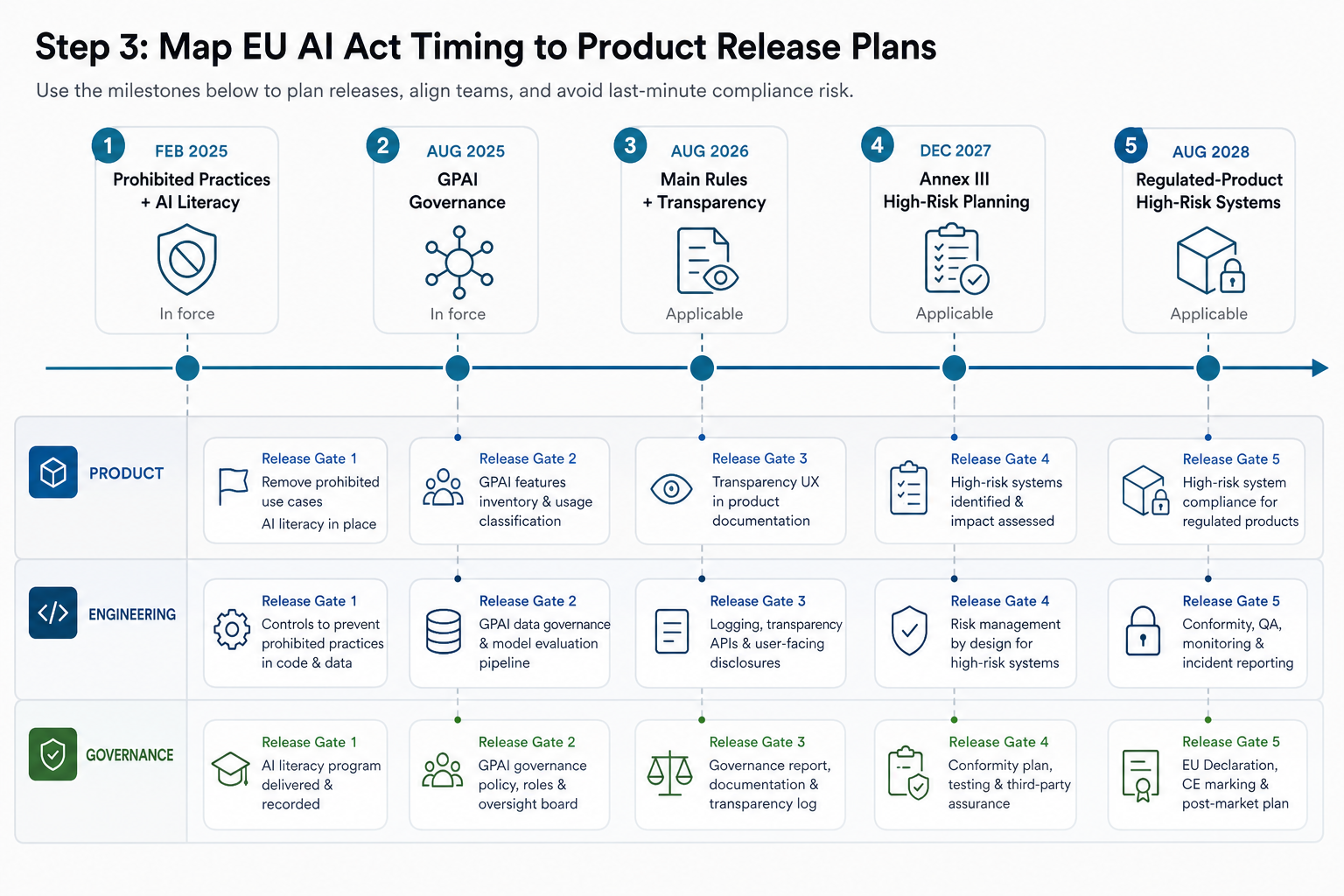
This article is not legal advice. The practical point is that engineering teams need a current assumption record: what official source was checked, when it was checked, which obligations were considered, and which release decisions depend on that interpretation.
Step 4: Design Data Governance for AI Products
AI readiness depends on data readiness. A team that cannot explain data sources, permissions, retention, labeling, evaluation data, prompt logs, embeddings, and downstream actions will struggle to defend product behavior. This is especially important when the AI system affects people, produces recommendations, or uses personal or sensitive data.
For an LLM, RAG, or agent product, map the data lifecycle from input to output: what the user provides, what context the system retrieves, what the model sees, what the system stores, what logs support troubleshooting, and what humans can review. Then define data quality checks, redaction rules, access control, retention periods, deletion workflows, and customer-facing explanations.
When a product needs retrieval, copilots, generated recommendations, or AI workflow automation, Generative AI Development should include evaluation datasets, retrieval testing, guardrail design, logging, cost controls, and monitoring rather than just model integration.
Step 5: Turn Documentation Into Product Evidence
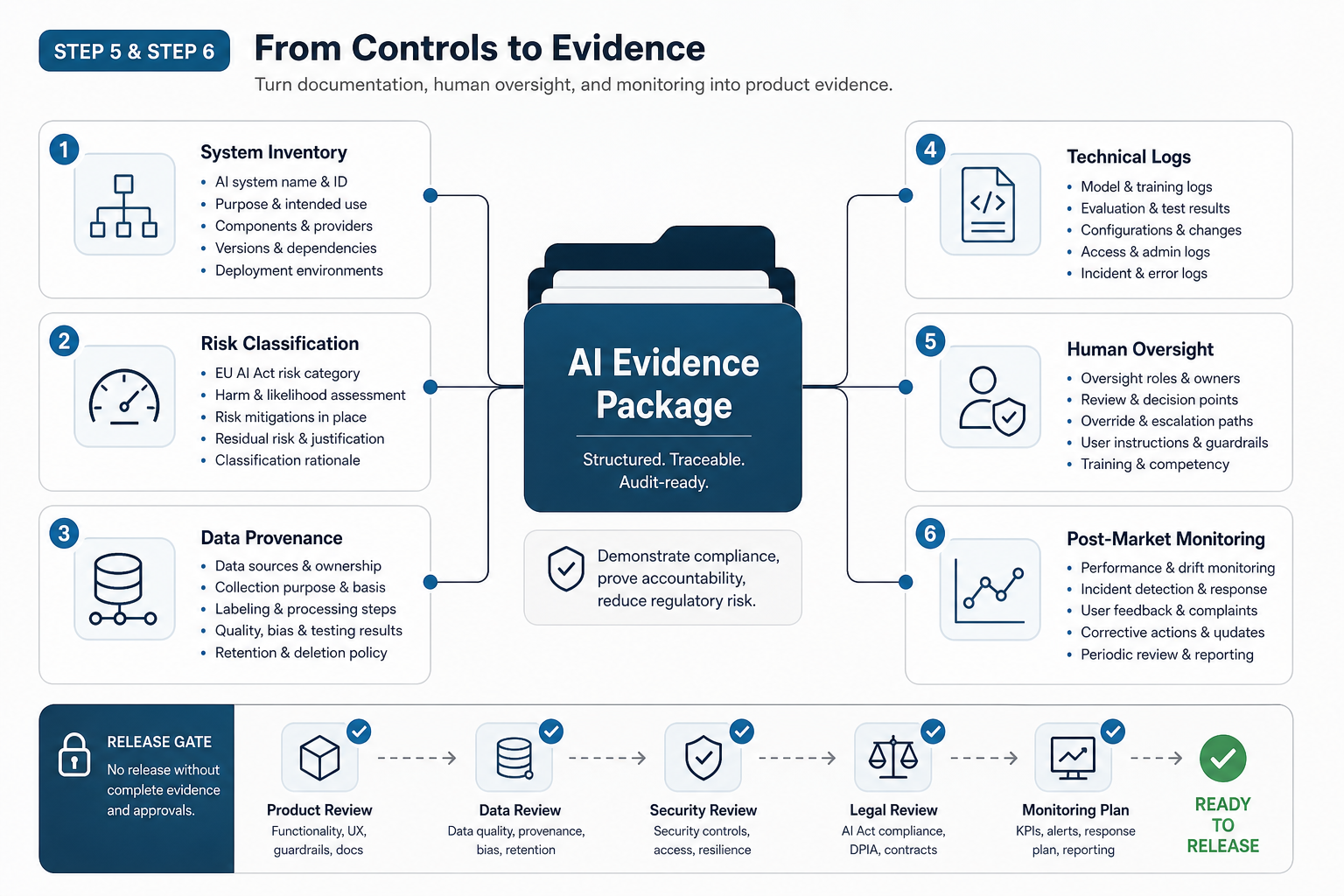
Compliance documentation fails when it is separate from how the product is built. Instead, treat documentation as evidence generated by normal delivery. Product requirements should include the AI purpose, affected users, risk classification, known limitations, and disclosure needs. Engineering design docs should include architecture, model and vendor dependencies, retrieval sources, logging, security controls, and fallback paths. QA should include evaluation cases, regression checks, red-team prompts when relevant, and acceptance thresholds.
- Product evidence: use-case description, intended users, affected persons, benefit/risk rationale, release assumptions, and disclosure copy.
- Data evidence: data source register, quality checks, consent/permission basis, retention, access control, and evaluation data.
- Technical evidence: architecture diagram, model versioning, prompt/retrieval configuration, logs, monitoring events, fallback logic, and security review.
- Operational evidence: human oversight procedures, support scripts, incident triage, customer communication, rollback, and post-market monitoring.
For teams moving from pilot to production, the AI Implementation Roadmap gives a delivery structure for use case discovery, data readiness, prototype evaluation, production rollout, and monitoring.
Step 6: Build Human Oversight and Release Gates
Human oversight is not a checkbox at the end of the build. It changes product design. A reviewer needs enough context to understand the AI output, intervene when needed, override or reject the result, report problems, and trigger follow-up. If the product automates a workflow, the team must decide which decisions stay human-reviewed, which can be automated, and which require escalation because the user impact is high.
Release gates should be explicit. Before launch, require classification review, data review, model and vendor review, security review, user disclosure review, evaluation review, monitoring plan, support readiness, and incident-response readiness. After launch, require monitoring of quality, drift, complaints, failure modes, abuse, costs, and changes in vendor behavior. If the system can take actions or touch business tools, use an enterprise AI agent governance model for permissions, human review, monitoring, and rollback.
Autonomy also affects budget and timeline. If you are choosing between a grounded assistant, human-reviewed workflow helper, or tool-using agent, the AI Agent Development Cost guide explains why tool access, evaluation, human review, and monitoring are often the real cost drivers.
Step 7: Check Vendors, Models, and Contracts
Most AI software teams use external models, APIs, vector databases, observability tools, labeling tools, and cloud services. EU AI Act readiness should therefore include a vendor and model evidence folder. Capture model provider, model version, service region, data-processing terms, training-data and copyright statements where applicable, uptime and fallback assumptions, security controls, data-retention options, and support commitments.
For GPAI-based products, identify whether your team is only using a model, modifying it, integrating it into a product, fine-tuning it, or offering a downstream AI system. The answer may change what evidence you need from the provider and what documentation your product team must maintain for customers. Regulated or sensitive deployments should also consider the operating controls in a private generative AI deployment plan before broadening data access or model authority.
If an AI workflow has unclear ROI or operational value, estimate the value before overbuilding governance around a weak use case. The AI Automation ROI Calculator can help decide whether the workflow is worth implementing, then the readiness checklist can decide how to build it responsibly.
EU AI Act Readiness Checklist for AI Software Teams
Use this checklist as a working backlog, not as a final legal opinion.
- Inventory: list every AI system, owner, user group, model/vendor dependency, input, output, and EU exposure.
- Classification: classify each system against prohibited, high-risk, transparency, GPAI, and low-risk categories using dated official assumptions.
- Product behavior: document intended purpose, affected users, autonomy level, user disclosures, limitations, and support paths.
- Data controls: record data sources, permissions, sensitive fields, quality checks, retention, access, deletion, and evaluation datasets.
- Technical controls: maintain architecture, model versions, prompts, retrieval sources, logging, guardrails, fallback, cybersecurity, and rollback.
- Human oversight: define who reviews outputs, when intervention is required, how overrides work, and how users can report problems.
- Monitoring: track quality, drift, bias signals, unsafe outputs, complaints, abuse, vendor changes, cost spikes, and incidents; an MLOps implementation checklist can help turn those controls into repeatable deployment evidence.
- Documentation: keep product, data, engineering, security, QA, and operational evidence in a single auditable package.
- Governance: assign owners, meeting cadence, release gates, escalation path, and update policy as official guidance changes.
How NextPage Helps With AI Act Readiness
NextPage AI Development Services help software teams turn AI readiness into buildable product work. We can inventory AI workflows, score readiness, map data and integration gaps, design RAG or agent architecture, define human-review controls, create evaluation and monitoring plans, and turn governance requirements into product and engineering tasks.
For teams still choosing a first AI workflow, start with readiness and ROI scoring. For teams already building, focus on classification, data evidence, documentation, oversight, monitoring, and release gates. For teams selling AI-enabled software into Europe, keep an official-source review cadence because the EU AI Act implementation timeline and support guidance continue to evolve.