
Quick Answer: Job Portal App Development Cost In 2026
Job portal app development cost in 2026 usually starts around $35,000 to $75,000 for a focused MVP, moves into the $75,000 to $180,000 range for a production-ready hiring marketplace, and can exceed $250,000 when the platform needs mobile apps, recruiter workflows, AI matching, ATS or HRIS integrations, subscriptions, analytics, moderation, security review, and enterprise reporting. Treat lower public estimates as narrow MVP assumptions unless they clearly include QA, integrations, admin workflows, launch support, and post-launch maintenance.
A useful estimate starts by deciding what kind of product you are building: a niche job board, a staffing-agency portal, an employer-candidate marketplace, a freelance marketplace, an internal recruitment portal, or an AI-assisted hiring platform. Each model changes user roles, data structure, moderation needs, payment rules, search quality, and integration scope. If the product is meant to become a serious hiring marketplace, review the service scope behind job portal app development services before comparing hourly quotes.
If you only need a directional range, use NextPage's custom software cost estimator. If you already have a feature list and need to trim it into a first release, the MVP Scope Builder is the better starting point.
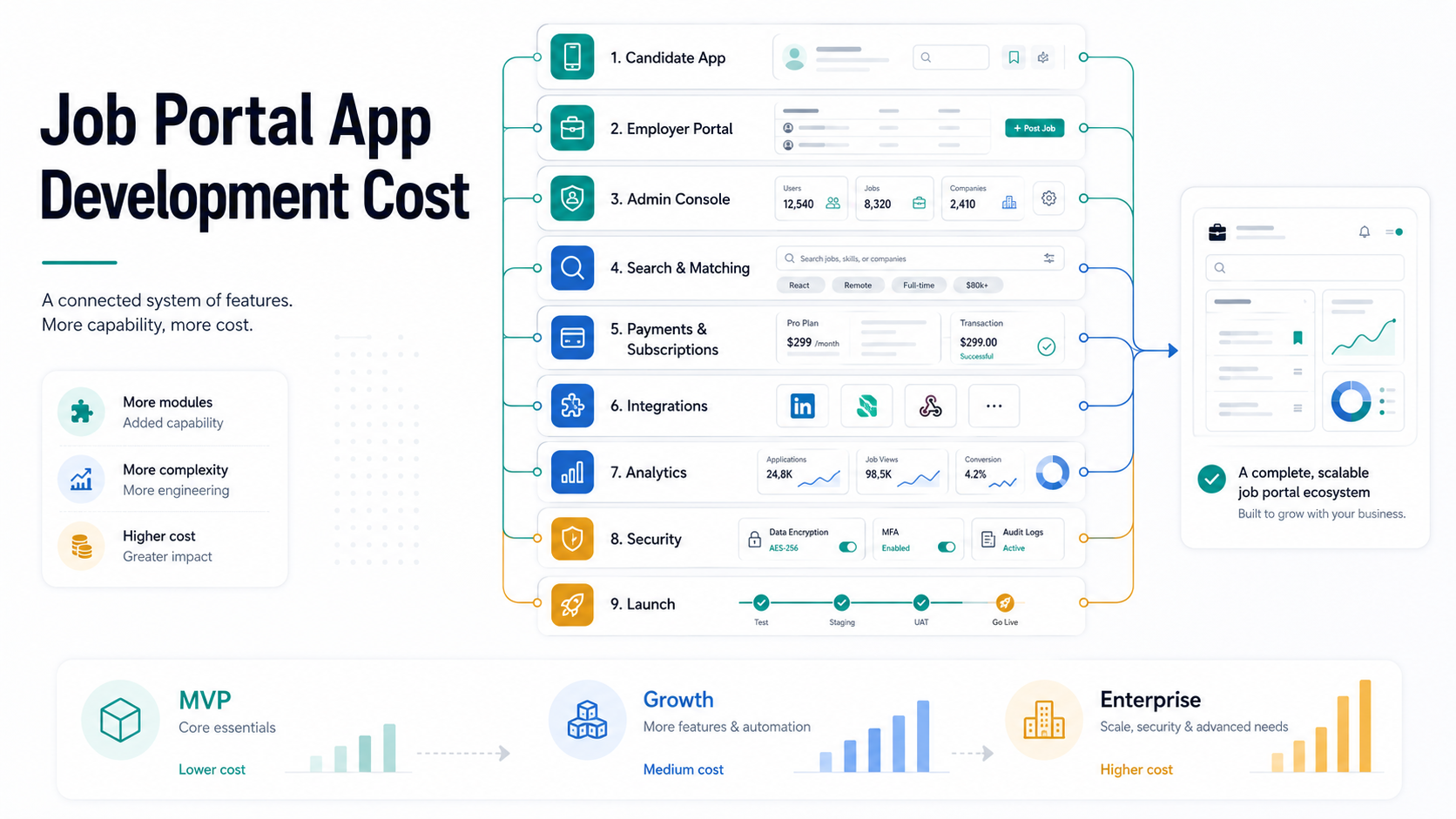
Why Job Portal Cost Varies So Much
Current competitor pages for job portal development cost usually do three things: list candidate, employer, and admin features; publish broad MVP-to-enterprise price bands; and mention AI matching, video interviews, subscriptions, or ATS integrations as advanced scope. That is useful, but it still compresses very different products into one number. The stronger planning question is what operating model the software must support after launch.
A job portal is not one workflow. It is a multi-sided product with at least three operating surfaces: job seekers, employers or recruiters, and administrators. Many platforms add staffing consultants, agencies, payment admins, content moderators, interviewers, or super-admin roles. Every extra role adds permission logic, dashboards, notifications, reporting, and support workflows.
Cost also shifts when the product moves from listings to matching. A simple job board can use keyword search, filters, saved jobs, and email alerts. A more advanced hiring marketplace may need resume parsing, profile scoring, semantic search, job recommendations, duplicate candidate detection, interview scheduling, employer analytics, and AI-assisted screening. NextPage's guide to AI agents for HR and recruiting explains where automation can help, but it also shows why these workflows need clear controls and escalation paths.
Job Portal Cost By Scope
Use these ranges as planning bands, not fixed quotes. Geography, team seniority, design quality, data migration, integrations, compliance, and launch expectations can move the budget in either direction.
| Scope | Best for | Typical build range | Typical timeline | What is included |
|---|---|---|---|---|
| Lean MVP | Niche job board or staffing portal validation | $35,000-$75,000 | 10-16 weeks | Responsive web app, candidate profiles, employer accounts, job posting, applications, basic search, email notifications, admin moderation, analytics basics |
| Growth platform | Funded marketplace or agency product with monetization | $75,000-$180,000 | 4-7 months | MVP plus mobile-ready UX, richer dashboards, saved searches, payment/subscription flows, resume upload, screening questions, reporting, integrations, QA automation, role-based permissions |
| Advanced marketplace | Multi-region or multi-role hiring platform | $180,000-$350,000+ | 7-12 months | Native or cross-platform apps, ATS/CRM integrations, advanced search, matching logic, interview scheduling, moderation queues, analytics warehouse, security review, performance engineering |
| Enterprise recruitment ecosystem | Large recruitment business or internal enterprise hiring system | $350,000+ | 9-18 months | Custom workflows, SSO, enterprise integrations, complex permissions, migration, high availability, audit trails, multi-language support, compliance controls, custom BI, support tooling |
If your product is mostly a web portal, compare these ranges with NextPage's web app development cost guide. If mobile apps are central to candidate engagement, review mobile app development cost in 2026 as well, because native iOS/Android scope, offline states, push notifications, and app-store launch work can materially change the estimate.
Marketplace Economics That Change The Cost
A job portal is a marketplace before it is a screen set. Cost rises when the product has to balance job supply, candidate demand, employer conversion, search relevance, trust, and monetization at the same time. A niche job board can launch with manual employer onboarding and simple categories. A recruitment marketplace needs better workflows because each side expects quality signals from the other.
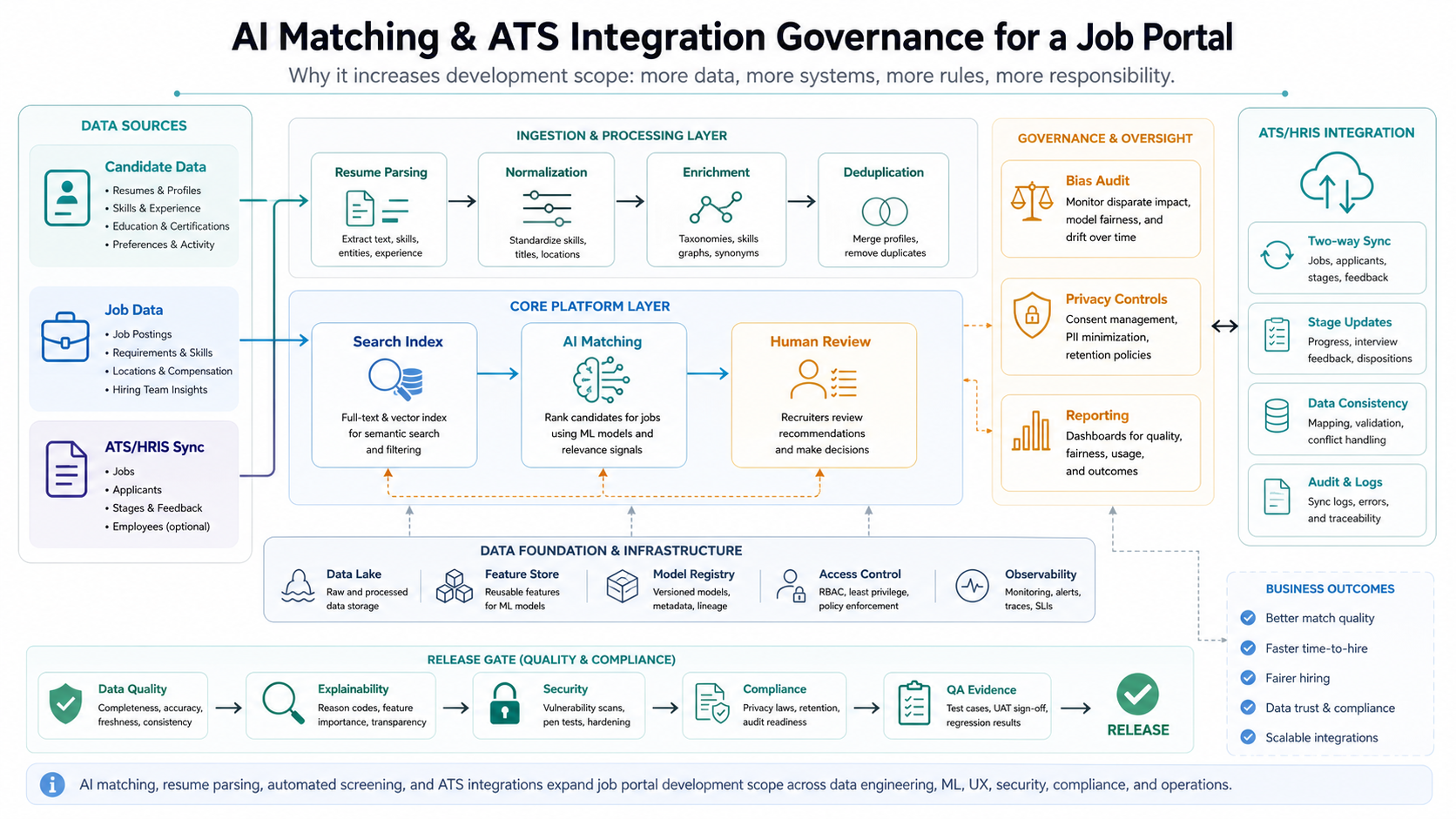
| Cost Driver | MVP Assumption | Growth Or Enterprise Assumption |
|---|---|---|
| Supply quality | Manual employer approval and basic job fields | Employer verification, paid plans, duplicate checks, job quality scoring, and reporting |
| Demand quality | Candidate profiles, resumes, saved jobs, and apply flow | Skills graph, parsed resumes, portfolio evidence, privacy controls, and candidate nurture |
| Search relevance | Keyword search, filters, and saved alerts | Semantic search, synonyms, ranking rules, zero-result monitoring, and personalization |
| Monetization | Manual invoicing or one paid listing plan | Subscriptions, promoted jobs, coupon logic, invoices, refunds, taxes, and revenue analytics |
| Trust and safety | Admin moderation and abuse reports | Fraud workflows, audit logs, employer reputation, candidate privacy, and support tooling |
This is why two job portals with the same feature names can have very different budgets. The expensive version usually needs more states, permissions, reporting, exception handling, and QA evidence behind each feature.
Features That Change The Budget
Feature count matters, but feature depth matters more. A job posting form is simple when it has title, description, location, salary, and category fields. It becomes more expensive when it includes approval workflows, multiple recruiters, job templates, remote/hybrid rules, compensation visibility by region, screening questions, paid promotion, expiry rules, and analytics by source.
| Feature area | Lean version | Higher-cost version | Why it affects cost |
|---|---|---|---|
| Candidate profiles | Basic profile, resume upload, saved jobs | Portfolio, skills graph, parsed resume, visibility controls, privacy settings | More data fields, search indexing, privacy logic, and user settings |
| Employer portal | Company profile, job posts, applications | Team seats, recruiter permissions, pipelines, scorecards, analytics | Role-based access and workflow state management |
| Search | Keyword and filters | Semantic search, synonyms, ranking, saved alerts, personalization | Search infrastructure, tuning, QA, and relevance testing |
| Matching | Rules-based recommendations | AI-assisted ranking, resume parsing, skill extraction, explainability | Data quality, model/vendor selection, evaluation, guardrails |
| Payments | Single paid listing plan | Subscriptions, featured jobs, coupons, invoices, refunds, tax rules | Billing state, edge cases, reporting, reconciliation |
| Admin tools | User and job moderation | Dispute handling, fraud checks, content review, audit logs, support notes | Operational workflows and accountability controls |
Do not estimate from a feature checklist alone. Estimate from a release model. A feature can be MVP-friendly if it is manual behind the scenes, and expensive if it needs automation, reporting, permissions, and edge-case coverage on day one.
Architecture And Integrations To Plan Early
The architecture decision that most affects cost is whether the portal is a simple listing system or a workflow platform. Listing systems store jobs and applications. Workflow platforms manage candidate pipelines, employer teams, recruiter tasks, search relevance, payment state, analytics, notifications, and external system handoffs.
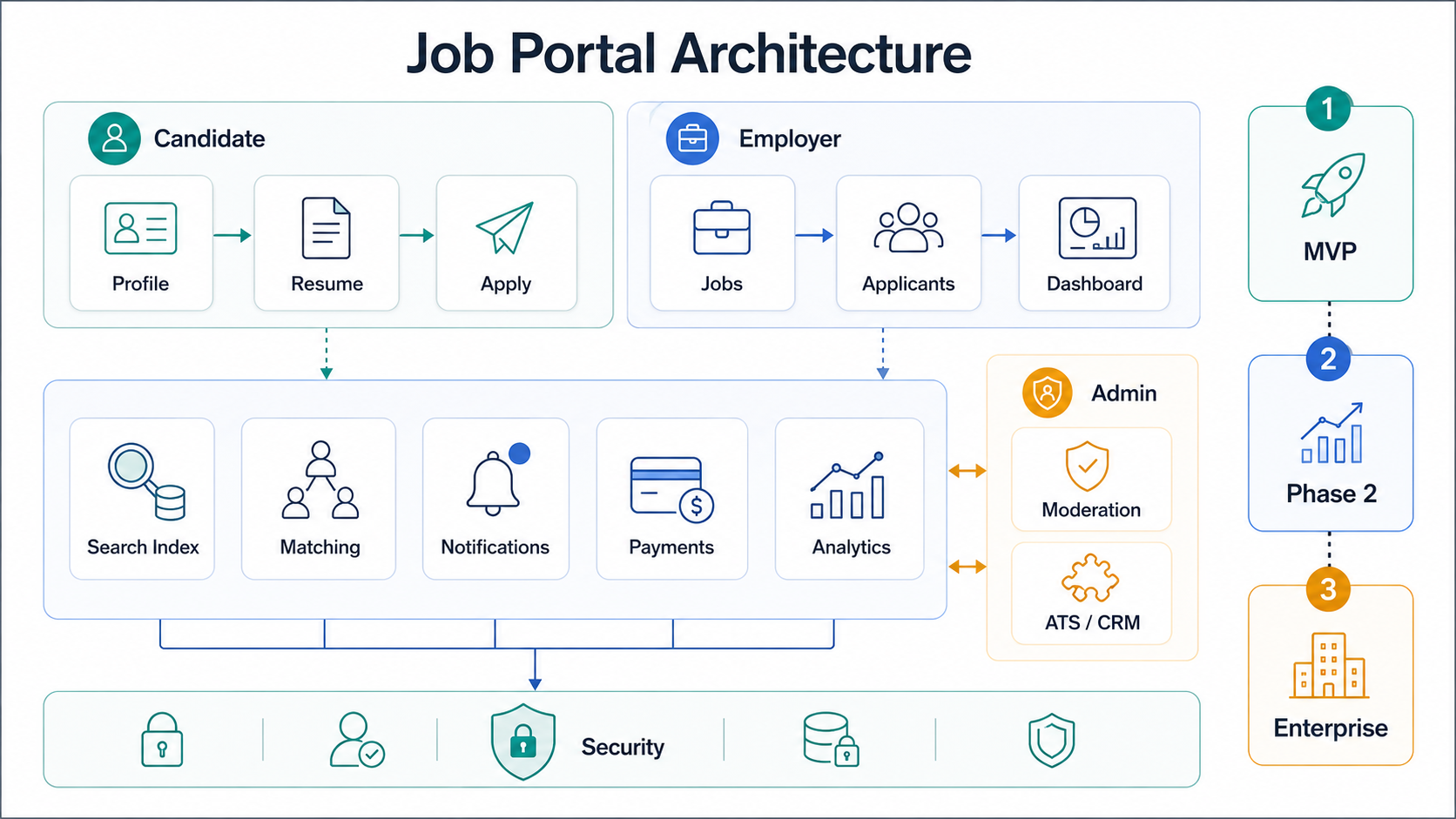
Plan these layers early:
- Data model: candidate profile, resume, job, employer, application, pipeline stage, message, payment, notification, and audit entities.
- Search index: filters, keyword relevance, location rules, remote work, salary, skills, seniority, and freshness ranking.
- Integration layer: ATS, CRM, email, SMS, calendar, payment gateway, analytics, identity provider, and job distribution feeds.
- Security: role-based permissions, employer team access, candidate privacy, admin audit trails, spam controls, and abuse reporting.
- Observability: application funnels, search zero-result rates, apply completion, employer conversion, payment failures, and moderation backlog.
If the first release includes several integrations, budget for discovery and test environments. ATS, HRIS, CRM, calendar, payroll, assessment, background-check, and email systems often have inconsistent APIs, rate limits, custom fields, webhook gaps, approval steps, and sandbox limitations. Even when an integration looks small, mapping employer-specific workflows can add weeks.
AI Matching And ATS Governance
AI matching, resume parsing, automated screening, and recruiter copilots can make a hiring platform more valuable, but they also create new product and compliance work. A responsible implementation needs data-quality checks, explainability, human review, bias monitoring, privacy controls, security review, and clear fallback behavior when the model is uncertain.
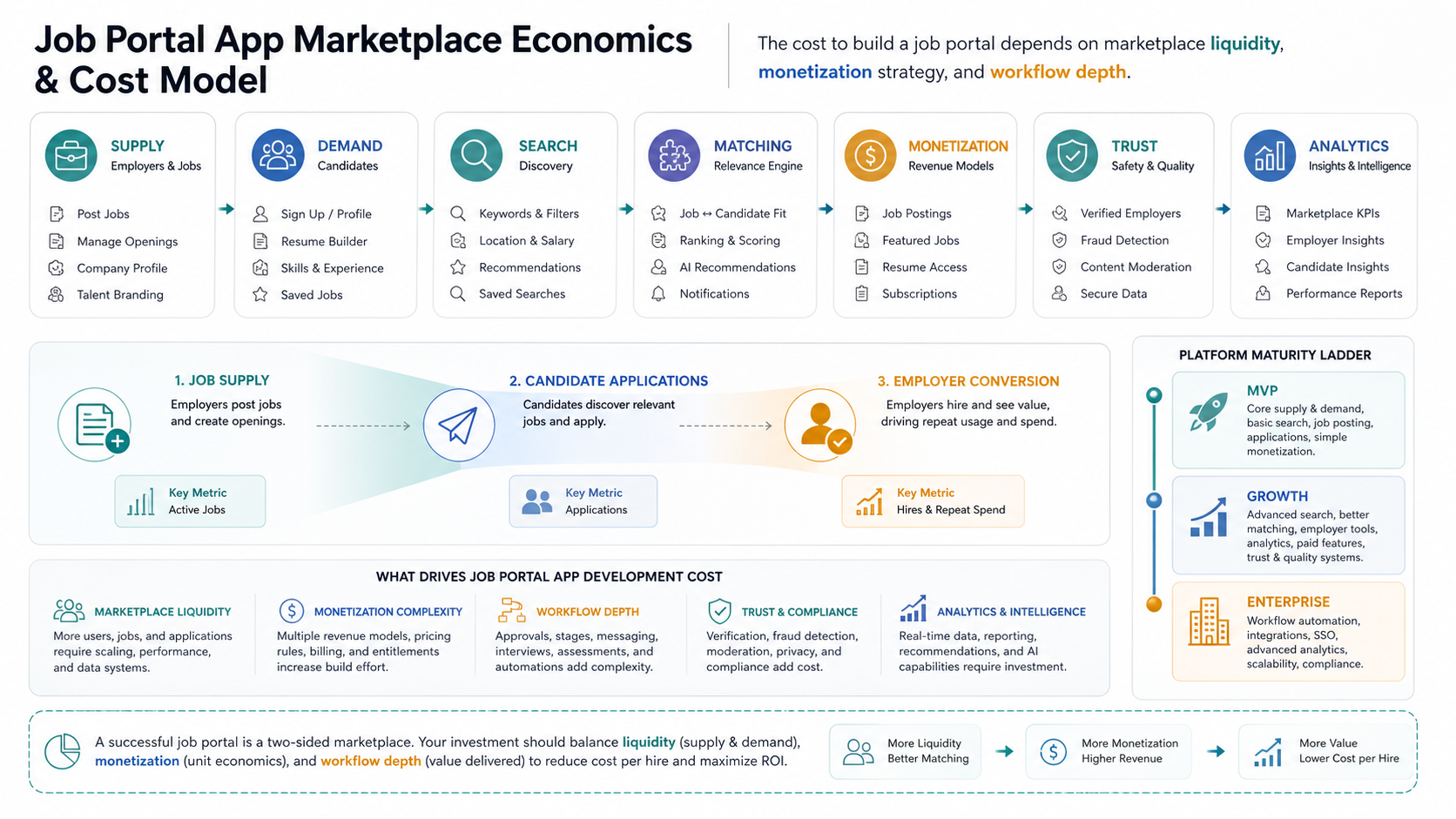
Use official AI governance references as planning inputs, not as decorative compliance language. NIST's AI Risk Management Framework emphasizes managing AI risks across the lifecycle, and New York City's automated employment decision tool rules show why some hiring automation workflows may need bias-audit and candidate-notice planning. The exact legal requirements depend on market and use case, but the engineering implication is straightforward: AI hiring features need reviewable evidence.
| AI Or Integration Feature | Extra Scope To Budget | Evidence Before Launch |
|---|---|---|
| Resume parsing | File handling, extraction quality, field mapping, privacy controls, correction flow | Parsing accuracy sample, rejected-file handling, data retention rules |
| AI job matching | Data quality, model/vendor choice, ranking logic, explainability, human override | Evaluation set, relevance review, bias-risk notes, fallback behavior |
| ATS/HRIS sync | Custom fields, status mapping, webhooks, retry logic, audit logs, error queues | Sandbox test report, sync failure handling, support ownership |
| Recruiter automation | Message templates, consent rules, escalation paths, activity logging | Human review policy, opt-out handling, audit trail |
If the business case depends on automation savings, estimate the repeated work with NextPage's AI Automation ROI Calculator before funding complex AI matching. For a deeper HR automation strategy, pair the roadmap with NextPage's guide to AI agents for HR and recruiting.
Timeline, Team, And Delivery Model
A lean job portal can often be designed, built, tested, and launched in 10 to 16 weeks when the first release is disciplined. A production marketplace typically needs 4 to 7 months. Enterprise recruitment systems can take 9 months or more because they involve integrations, migration, security review, stakeholder approvals, and custom reporting.
A practical delivery team usually includes a product lead, UX/UI designer, frontend engineer, backend engineer, QA engineer, and part-time DevOps or cloud support. Mobile-heavy builds add iOS/Android or cross-platform specialists. AI-assisted matching adds data engineering, model evaluation, prompt/workflow design, and human review rules.
Delivery model matters too. A fixed-scope build works when the MVP is tightly specified and buyer feedback cycles are fast. A dedicated team works better when the product roadmap is evolving, the platform will need continuous iteration, or the buyer has in-house product leadership. For staffing or marketplace founders, a hybrid model is often strongest: fixed first-release scope, then a retained product team for marketplace iteration.
MVP Scope Vs Phase Two
The safest way to control cost is to make the MVP prove the marketplace loop: employers can post quality jobs, candidates can find and apply, admins can moderate, and the business can measure whether supply and demand are forming. Anything that does not validate that loop should be challenged.
| Keep in MVP | Usually move to phase two |
|---|---|
| Candidate signup, profile, resume upload, search, saved jobs, apply flow | Full resume builder, advanced career coaching, complex portfolio formats |
| Employer signup, company profile, job post, applicant view, basic pipeline | Custom recruiter scorecards, multi-brand employer workspaces, advanced permissions |
| Admin moderation, user/job management, basic reporting | Automated fraud detection, complex audit workflows, support CRM replacement |
| Basic notifications and email alerts | Personalized multi-channel campaigns, SMS automation, candidate nurture journeys |
| Simple paid listing or manual invoicing | Subscriptions, coupons, usage-based billing, marketplace commissions, tax automation |
| Keyword/filter search | AI ranking, semantic matching, automated interview scheduling, deep ATS sync |
This is where many budgets slip. Teams add AI matching before they have enough structured candidate and job data. They add subscriptions before proving employers will pay. They build native apps before validating marketplace liquidity. A better first release gets the core loop into users' hands, then funds automation with real usage evidence.
Launch Evidence And QA Readiness
Before a job portal goes live, ask for evidence that the marketplace loop works under realistic conditions. Test employer signup, job posting, candidate search, resume upload, apply flow, recruiter review, notifications, payments, moderation, admin reporting, and analytics events. Also test negative states: duplicate jobs, spam accounts, incomplete resumes, payment failures, ATS sync errors, expired postings, and zero-result searches.
For mobile-heavy platforms, include device and release checks through mobile app testing services. For sensitive candidate data, add a security pass using mobile app security hardening services or equivalent web/API hardening work before public launch.
Hidden Costs After Launch
The launch budget is only part of the total cost. Job portals need ongoing work because marketplace quality changes every week. Spam jobs, stale postings, fake candidate profiles, duplicate resumes, poor search results, payment disputes, employer churn, and support tickets all affect trust.
Plan for post-launch costs in these areas:
- Cloud and search infrastructure: hosting, database, object storage, search index, email, SMS, monitoring, backups, and logs.
- Moderation and support tooling: review queues, abuse reporting, support notes, user blocking, and audit trails.
- Security and privacy: access reviews, dependency updates, vulnerability fixes, privacy requests, and data retention rules.
- Marketplace growth: SEO pages, job schema, landing pages, employer onboarding, analytics, and conversion experiments.
- Maintenance: bug fixes, browser/device updates, API changes, payment updates, and performance tuning.
For a serious production portal, reserve 15% to 25% of the initial build budget annually for maintenance, optimization, and roadmap iteration. High-growth marketplaces may spend more because product-market fit requires fast experiments across acquisition, employer conversion, candidate activation, and retention. If the roadmap includes native apps, use NextPage's mobile app development team for app-store, push, offline-state, and device QA planning; if the first release is portal-first, use web app development planning for admin, employer, candidate, and analytics workflows.
What To Prepare Before Asking For An Estimate
A better estimate starts with the operating model. Bring these inputs before asking a vendor for a fixed number:
- Marketplace model: niche job board, staffing portal, internal hiring product, freelance marketplace, or employer-candidate marketplace.
- User roles: candidates, employers, recruiters, agencies, admins, moderators, finance users, and support users.
- Revenue model: paid listings, subscriptions, promoted jobs, employer seats, commission, manual invoicing, or free launch.
- Integration list: ATS, HRIS, CRM, calendar, payments, email, SMS, analytics, identity, assessments, and background checks.
- AI assumptions: resume parsing, semantic search, recommendations, automated screening, recruiter assistant, and human-review rules.
- Launch evidence: QA scope, security review, analytics events, admin reports, migration needs, support workflow, and maintenance plan.
These inputs make cost discussions concrete and reduce the risk of comparing one vendor's MVP number with another vendor's production-marketplace number.
How NextPage Scopes Job Portal Projects
NextPage scopes job portal app development by starting with the operating model: who supplies jobs, who applies, who pays, who moderates, what data is trusted, what integrations are required, and what must be true for the first release to prove demand. We then split the roadmap into MVP, growth, and enterprise layers so cost discussions are tied to evidence, not wish lists.
For many buyers, the right starting point is not a long feature document. It is a scope workshop that defines user roles, critical workflows, launch geography, data model, integration assumptions, monetization rules, and the minimum analytics needed to make the next product decision. From there, we can recommend whether the build should be web-first, mobile-first, native, cross-platform, or phased.
If you are planning a job board, staffing platform, freelance marketplace, or hiring app, bring your feature list, launch goal, monetization idea, integration requirements, and target timeline. NextPage can help turn that into a practical estimate and MVP roadmap through mobile app development, web app development, or a custom product team.