
Quick Answer: What Should A Mobile App MVP Roadmap Include?
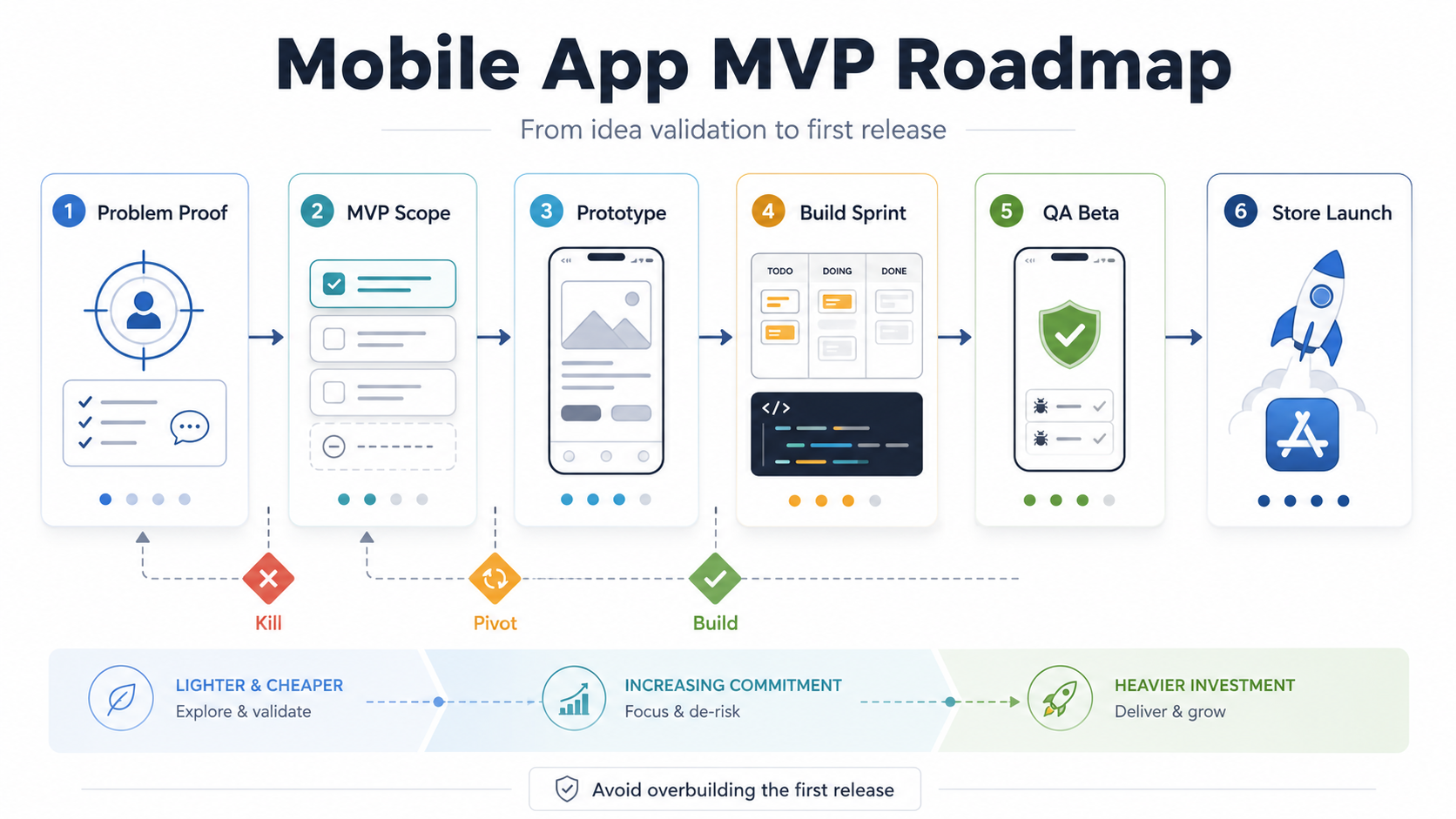
A mobile app MVP roadmap should take an idea through six decisions: prove the problem, define the smallest useful release, prototype the risky flows, build the first working version, test it with real users, and launch with store-ready evidence. The roadmap is not a feature wish list. It is a way to reduce risk before a founder or product team spends months building the wrong app.
For most teams, the right first release is the smallest version that lets a real user complete one valuable job and gives the business enough evidence to decide what to do next. That means the roadmap needs validation tasks, scope rules, UX decisions, platform choices, backend and integration assumptions, QA gates, App Store or Play Store preparation, launch metrics, and a post-launch feedback loop. If you already have a rough idea, start by shaping it in NextPage's MVP Scope Builder before asking engineers for a fixed quote. If the budget conversation is already active, pair the scope output with NextPage's mobile app cost and timeline planner so the roadmap connects release-one scope, platform choice, QA, and launch support.
Why Mobile App MVP Roadmaps Fail
Most failed MVP roadmaps fail before development starts. The team writes down every feature that might be useful, calls the list an MVP, and then treats launch as the finish line. That creates a first version that is too large to learn from quickly and too thin to feel polished. Mobile apps are especially unforgiving because users compare the first release with mature apps already on their phones.
The better roadmap starts with risk. What must be true for this app to deserve a build? Which audience has the pain now? Which workflow proves value? Which feature looks simple but may hide technical, legal, payment, content, or operations risk? Which launch channel can bring the first users? A roadmap that answers those questions is more useful than a timeline that simply says design, develop, test, and deploy.
Phase 1: Validate The Problem Before Designing Screens
Validation should prove that a real group of users has a frequent, painful, and valuable problem. Do not start with screen lists. Start with the user, situation, current workaround, cost of the problem, and desired outcome. A strong problem statement names the user and the moment clearly: for example, independent clinic managers struggle to confirm appointments because phone reminders are manual, missed, and hard to track.
Useful validation evidence includes interview notes, manual workflow data, support tickets, waitlist quality, paid pilots, letters of intent, failed workaround screenshots, or usage of a concierge test. A polite survey response is weak evidence. A user who spends time, data, money, or reputation to test the workflow is stronger evidence. This is also where the roadmap should decide whether a mobile app is really needed, or whether a responsive web app, internal tool, or manual service can prove the first hypothesis faster.
For product leaders who already know the audience but need delivery help, NextPage's mobile app development team can turn discovery findings into a practical first-release plan across iOS, Android, Flutter, React Native, backend, QA, and launch support. The mobile app development process page shows how discovery, design, engineering, QA, and launch gates should connect before the first sprint starts.
Phase 2: Define The Smallest Useful Release
The MVP should not be the smallest thing the team can build. It should be the smallest thing a real user can use to complete the target job. That distinction matters. A stripped-down app that cannot complete the job will not validate demand. A bloated app with every stakeholder request will burn budget before learning.
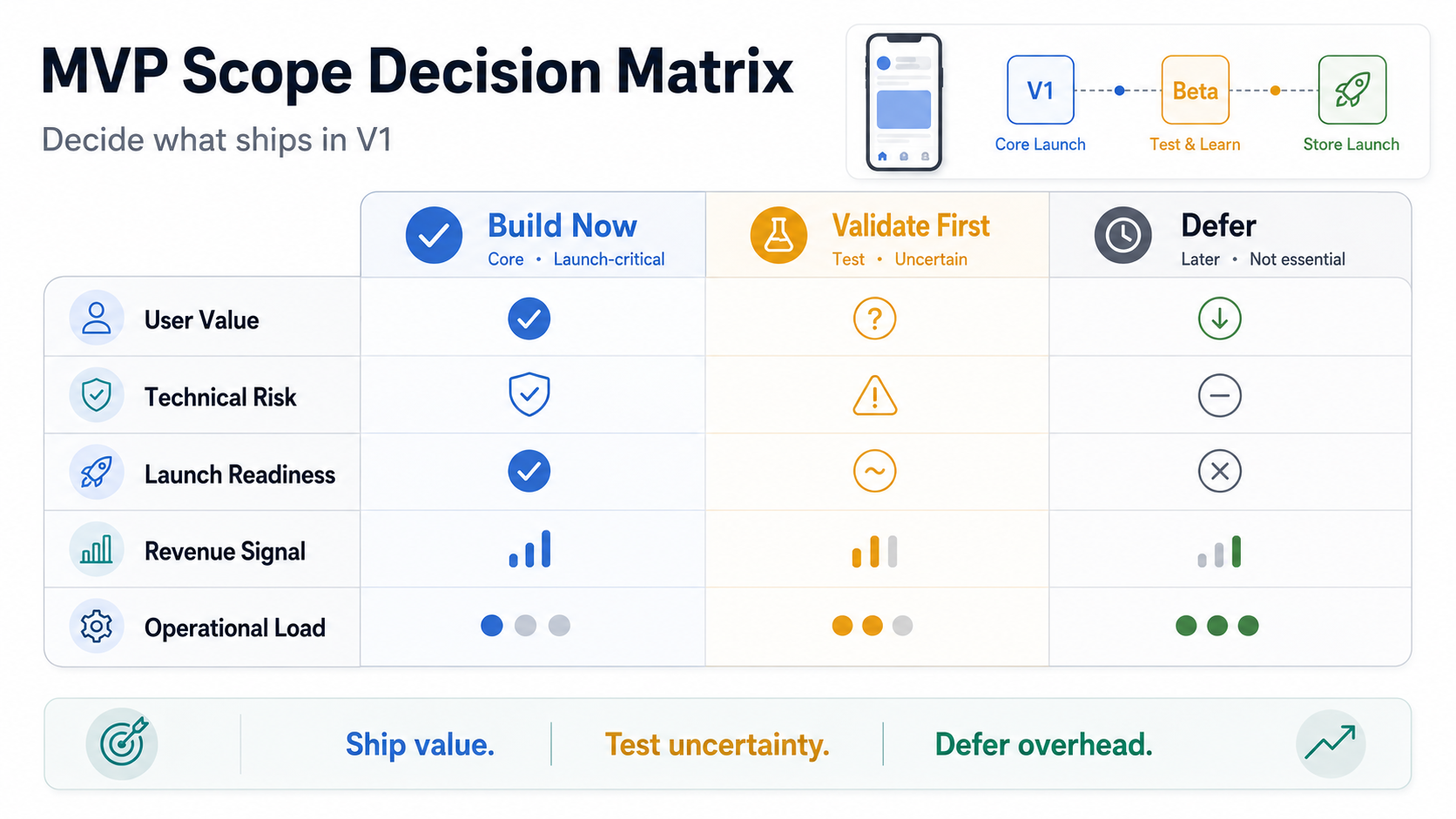
Use three buckets: build now, validate first, and defer. Build-now features are required for the main workflow to succeed. Validate-first items may be valuable, but need evidence before engineering. Defer items are useful later, but not required to test the first release. This decision should be explicit because scope creep usually enters through features that feel reasonable one by one.
The MVP Release-Gate Scorecard
A stronger MVP roadmap uses gates, not vague phase names. Each gate should answer whether the team is ready to spend the next block of money, invite more users, or submit to the app stores. If a gate fails, the roadmap should say whether to kill, pivot, narrow scope, or keep testing manually.
| Gate | Question | Evidence Before Moving On |
|---|---|---|
| Problem proof | Does a specific user have a painful, frequent, valuable problem? | Interview notes, workflow data, waitlist quality, paid pilot, or manual service usage. |
| Scope proof | Can one core job be completed without a phase-two feature? | Build-now, validate-first, and defer list with owner approval. |
| Prototype proof | Do users understand the risky flow before engineering starts? | Prototype test notes, acceptance criteria, removed assumptions, and revised flows. |
| Architecture proof | Can the platform, backend, data, integrations, and release process support the MVP? | API contracts, auth model, data model, environment plan, and integration readiness. |
| Launch proof | Can the app survive real users, store review, support, and first-week monitoring? | QA evidence, device matrix, privacy answers, test accounts, analytics, crash monitoring, and rollback plan. |
These gates make stakeholder tradeoffs visible. A feature may be exciting, but if it does not help pass a gate, it belongs in validate-first or defer. For a vendor-ready handoff, the mobile app development RFP checklist can turn these gates into questions for estimates, exclusions, QA coverage, and launch ownership.
Phase 3: Prototype The Risky Flows
A prototype is useful when it answers a question. It should test confusing onboarding, multi-step forms, payment trust, booking flow, location permissions, camera or upload behavior, AI review screens, marketplace matching, or any workflow where users may hesitate. A polished prototype can help investors and stakeholders, but the roadmap should still connect prototype work to decisions.
For a mobile app MVP, the most important prototype outputs are acceptance criteria and removed assumptions. If users do not understand the first action, change the flow before development. If they expect a trust signal, add it before launch. If the prototype reveals that a feature is only useful after data exists, defer it. The prototype is not a design milestone by itself; it is a scope filter.
Phase 4: Choose Platform And Architecture
Platform choice belongs in the MVP roadmap because it changes cost, timeline, QA, and maintenance. Native iOS or Android can be right when device APIs, performance, background behavior, payments, offline use, camera, Bluetooth, or platform-specific experience matter. Flutter or React Native can be right when the release needs both iOS and Android with shared product logic. A PWA can be enough when the first release is mostly content, forms, dashboard work, or internal workflows.
The key is to choose for the first learning goal, not for prestige. If the riskiest question is demand, a narrower first platform may be smarter than launching everywhere. If the riskiest question is operational adoption across field teams, Android support and device testing may matter more than iOS polish. NextPage's Native Vs Cross Platform Mobile App Development guide is useful when the roadmap depends on this tradeoff. If a shared codebase fits the MVP and the team needs iOS plus Android quickly, React Native app development services can be a practical option, but the roadmap should still price backend, QA, store readiness, analytics, and post-launch support.
Phase 5: Plan The Build Sprints Around Learning Gates
A first-release roadmap should break the build into learning gates, not just engineering tickets. A practical sequence is foundation, core workflow, integrations, admin and support tooling, analytics, QA hardening, beta release, and store submission. Each sprint should produce evidence: working flows, reviewed assumptions, tested devices, analytics events, support rules, and launch blockers.
| Roadmap stage | Primary question | Evidence to capture |
|---|---|---|
| Foundation | Can the app, backend, auth, environments, and analytics support the MVP? | Architecture notes, environments, event plan, release branch, access controls |
| Core workflow | Can the user complete the main job without manual help? | Acceptance tests, screen recordings, usability notes, drop-off points |
| Integrations | Do external services work under realistic data and error states? | Sandbox credentials, API limits, retry behavior, fallback rules |
| Admin and support | Can the team operate the MVP after launch? | Admin flows, support playbook, moderation rules, data export needs |
| Beta and launch | Is the app reliable enough for the first public audience? | QA report, crash threshold, test accounts, store assets, reviewer notes |
Budget planning belongs here too. The Mobile App Development Cost In 2026 guide can help map scope, team, platform, integrations, QA, and launch work into a more realistic estimate. For schedule planning, use the companion mobile app development timeline guide to pressure-test whether discovery, design, backend, QA, and app-store tasks can actually overlap.
Phase 6: Build QA And Beta Readiness Into The Roadmap
QA should not wait until the last week. Mobile MVPs fail when they work on the developer's device but break on older phones, slower networks, permission changes, push notification states, interrupted payments, login edge cases, or app updates. The roadmap should define a device matrix, critical workflows, regression checks, accessibility basics, analytics checks, crash monitoring, and test data before beta users arrive.
For launch readiness, use a checklist that proves the organization can release, monitor, and respond. NextPage's Mobile App QA and Launch Checklist covers the evidence a release should have before store submission, while the Mobile App Testing Checklist helps teams design practical coverage for real devices and workflows. If the internal team does not have enough device, workflow, or regression coverage, NextPage's mobile app testing services can add release-risk review before the final sprint becomes a blocker.
Phase 7: Prepare App Store And Play Store Launch
Store launch is not just uploading a binary. The roadmap should include app name, subtitle, description, screenshots, privacy policy, data safety or privacy answers, content rating, support URL, test credentials, review notes, subscription or payment compliance, account deletion flow when required, crash-free beta evidence, and a rollback plan. Apple and Google both use review and policy processes to protect users, so privacy, security, accurate metadata, demo access, data-safety answers, and compliant in-app purchase setup need to be ready before submission.
Google Play quality guidance emphasizes value, usability, device experience, and safety. Apple App Review guidance puts similar weight on privacy, security, safety, accurate metadata, and compliant business models. A team that treats these items as paperwork often loses days or weeks to avoidable review cycles. Add them to the MVP roadmap as real work.
Phase 8: Launch, Measure, And Iterate
The launch goal is learning with enough quality that users take the app seriously. Define the first 30 days before the app goes live. Track activation, task completion, retention, crash-free sessions, support requests, referral or invite signals, payment intent, and the specific behavior that proves the app solves the problem. App store downloads alone are not enough if users do not complete the core workflow.
Post-launch ownership should also be part of the roadmap. The first release creates maintenance obligations: OS updates, SDK changes, crash triage, analytics review, support response, security patches, and roadmap grooming. NextPage's Post-Launch Mobile App Maintenance Checklist is a useful operating plan once the MVP is in users' hands.
Timeline, Budget, And Team Model For A Mobile App MVP
A mobile app MVP roadmap is incomplete unless it connects scope to budget and team shape. A narrow MVP with one core workflow, basic backend, limited integrations, and clear acceptance criteria may fit an 8-14 week build window. A production MVP with payments, admin tools, analytics, device testing, store launch, and support workflows often needs more time because quality gates become real work.
| Roadmap Choice | Best When | Budget Control | Main Risk |
|---|---|---|---|
| Fixed-scope MVP | Users, workflows, integrations, and acceptance criteria are already clear. | Lock scope, exclusions, and change rules before sprint work starts. | Learning during development becomes change requests. |
| Discovery plus capped build | The problem is clear but workflow, platform, or integration risk remains. | Fund discovery first, then cap release-one implementation. | Stakeholders may try to keep discovery outputs vague. |
| Dedicated mobile team | The app will need multiple releases after launch. | Staff mobile, backend, QA, and product capacity around the roadmap. | Capacity is wasted if backlog ownership is weak. |
If the roadmap continues after launch, use NextPage's Dedicated India Team Cost Calculator to model monthly capacity before hiring. For evidence that mobile roadmaps can include role-aware workflows, backend systems, media handling, and AI support, review the FieldIQ portfolio case study and the broader mobile app case studies page.
What To Defer From Version One
Good MVP roadmaps are defined as much by what they exclude as what they include. Defer features that do not change the main learning decision, require a large data network before they are useful, add heavy moderation, create policy risk, or need custom automation that can be handled manually for the first users.
- Advanced personalization: useful after enough behavior data exists.
- Full social features: expensive to moderate and rarely essential for first proof.
- Complex admin analytics: start with the reports needed to operate the pilot.
- Multi-market localization: defer unless geography is the core hypothesis.
- Every payment method: support the payment path that validates willingness to pay first.
- AI automation without review: start with human-in-the-loop workflows when mistakes are costly.
A Practical Mobile App MVP Roadmap Template
Use this structure when turning a rough idea into a delivery plan:
- Problem proof: target user, painful moment, existing workaround, success metric, and validation evidence.
- Scope boundary: build-now, validate-first, and defer decisions for every major feature.
- Prototype plan: risky flows to test before engineering and decisions the prototype must answer.
- Platform decision: iOS, Android, cross-platform, or PWA rationale tied to the first learning goal.
- Build plan: sprints, acceptance criteria, backend assumptions, integration owners, admin/support needs.
- QA plan: device matrix, critical workflows, regression checks, analytics events, crash threshold, beta scope.
- Store plan: assets, privacy answers, test accounts, reviewer notes, release notes, support URL, rollback plan.
- Learning loop: first 30-day metrics, feedback channels, support process, and next-scope decision date.
If integrations are part of the first release, validate them early. Payment, maps, chat, CRM, ERP, push notification, identity, and analytics tools often create schedule risk through credentials, sandbox gaps, rate limits, policy checks, or missing support. Use the Mobile App Integrations Checklist before treating an integration as a fixed line item. If the first release depends on OS updates, SDK changes, crash triage, support workflows, or roadmap iteration after launch, also plan from the mobile app maintenance checklist before the MVP budget is approved.
How NextPage Helps Build A Better MVP Roadmap
NextPage helps teams turn app ideas into scoped mobile releases by combining product discovery, UX, mobile engineering, backend architecture, QA, launch planning, and post-launch support. The goal is not to build the largest possible version one. The goal is to build the smallest credible release that can prove the business case and survive real usage.
That means challenging weak assumptions, trimming scope, choosing the right platform, naming integration risks, planning launch evidence, and setting up the first learning loop. For founders and product owners, that kind of roadmap is easier to fund, easier to build, and easier to improve after launch.