
NFT marketplace development cost in 2026 usually starts around $45,000-$90,000 for a focused MVP, reaches $90,000-$220,000 for a custom multi-role marketplace, and can exceed $250,000-$500,000 when the product needs custom smart contracts, advanced wallet onboarding, custody flows, fiat payments, enterprise admin controls, audits, and high-volume operations. The real budget driver is not the phrase "NFT marketplace"; it is the operating model behind the marketplace.
A basic marketplace where creators mint fixed-price collectibles on one chain is a different product from a gaming asset exchange, a music royalty marketplace, a tokenized real-world asset platform, or an enterprise digital ownership portal. Each adds different contract logic, wallet UX, compliance review, moderation, dispute handling, analytics, and launch support.
This guide is for founders, product managers, creator platforms, gaming studios, and tokenized asset teams that need a practical estimate before they talk to vendors. Use the ranges as planning bands, then validate your own feature set with the Custom Software Cost Estimator, narrow the first release with the MVP Scope Builder, or compare the build path against NextPage's NFT marketplace development services when you need a custom roadmap for wallet onboarding, smart contracts, marketplace operations, and launch support.
Quick NFT Marketplace Cost Ranges
Most serious NFT marketplaces fall into one of three scope bands. A lean MVP should prove listing, discovery, wallet connection, minting or asset import, checkout, and admin review. A growth build adds richer seller tools, auctions, royalties, advanced search, moderation, analytics, notifications, and support workflows. An enterprise-grade platform adds deeper custody, compliance, custom contract logic, fiat rails, scalable infrastructure, and security review.
| Scope | Typical Budget Band | Best Fit | Common Timeline |
|---|---|---|---|
| Focused MVP | $45,000-$90,000 | Single-chain marketplace, limited roles, simple listing and checkout | 10-16 weeks |
| Custom Growth Marketplace | $90,000-$220,000 | Creator tools, auctions, royalties, search, analytics, moderation, support | 4-7 months |
| Enterprise Or Regulated Build | $250,000-$500,000+ | Custom contracts, custody, fiat/KYC, high-scale architecture, audits, compliance review | 7-12+ months |
If your marketplace behaves more like a general marketplace than a Web3 product, compare the non-blockchain workload against NextPage's marketplace app development cost guide. The NFT-specific premium usually comes from wallet onboarding, smart contract design, contract testing, security audit readiness, chain events, metadata storage, and launch monitoring.
What Drives NFT Marketplace Development Cost?
The largest cost drivers sit in five areas: marketplace workflow, smart contracts, wallet/payment layer, security, and operations. A vendor quote that prices only screens will miss the expensive work.
Marketplace Workflow
Buyer and seller screens are only the visible layer. Cost increases when you need creator onboarding, asset verification, category governance, listing approval, offer workflows, auctions, bid cancellation rules, collection pages, royalty display, dispute handling, admin actions, and support notes. These are the same workflow questions that shape any web app development cost, but marketplaces multiply the number of roles and edge cases.
Smart Contract Complexity
Smart contracts become expensive when they own meaningful business rules. Using well-tested token standards and marketplace patterns is cheaper than writing novel royalty splits, escrow, lazy minting, rental mechanics, fractional ownership, bridge logic, or upgradeable contracts. ERC-721 and ERC-1155 cover common NFT token models, while ERC-2981 gives a royalty information standard, but your product still has to define listing rules, settlement behavior, metadata policy, and admin powers.
Wallet And Payment Layer
Wallet UX is no longer just a "connect wallet" button. Buyers may expect email login, social login, embedded wallets, WalletConnect-style mobile wallet support, gas estimation, transaction status, failed-transaction recovery, and fiat checkout. Every simplification for mainstream users adds integration and testing work behind the scenes.
Security, Audit, And Abuse Controls
NFT marketplace risk includes contract bugs, admin-key misuse, spoofed collections, metadata tampering, phishing, fake volume, sanctions exposure, payment disputes, and content moderation. A real budget should include threat modeling, contract test coverage, external audit readiness, dependency review, monitoring, and launch-day incident response. Cutting this too aggressively can make a cheap build expensive after launch.
Launch Operations
Most NFT marketplace teams underestimate operational tooling: collection review, seller verification, support dashboards, analytics, refund or takedown workflows, chain event reconciliation, retry queues, notification logs, and role-based permissions. These admin systems rarely appear in clone-script demos, but they determine whether the marketplace can run after the first campaign.
Cost Bands By Scope
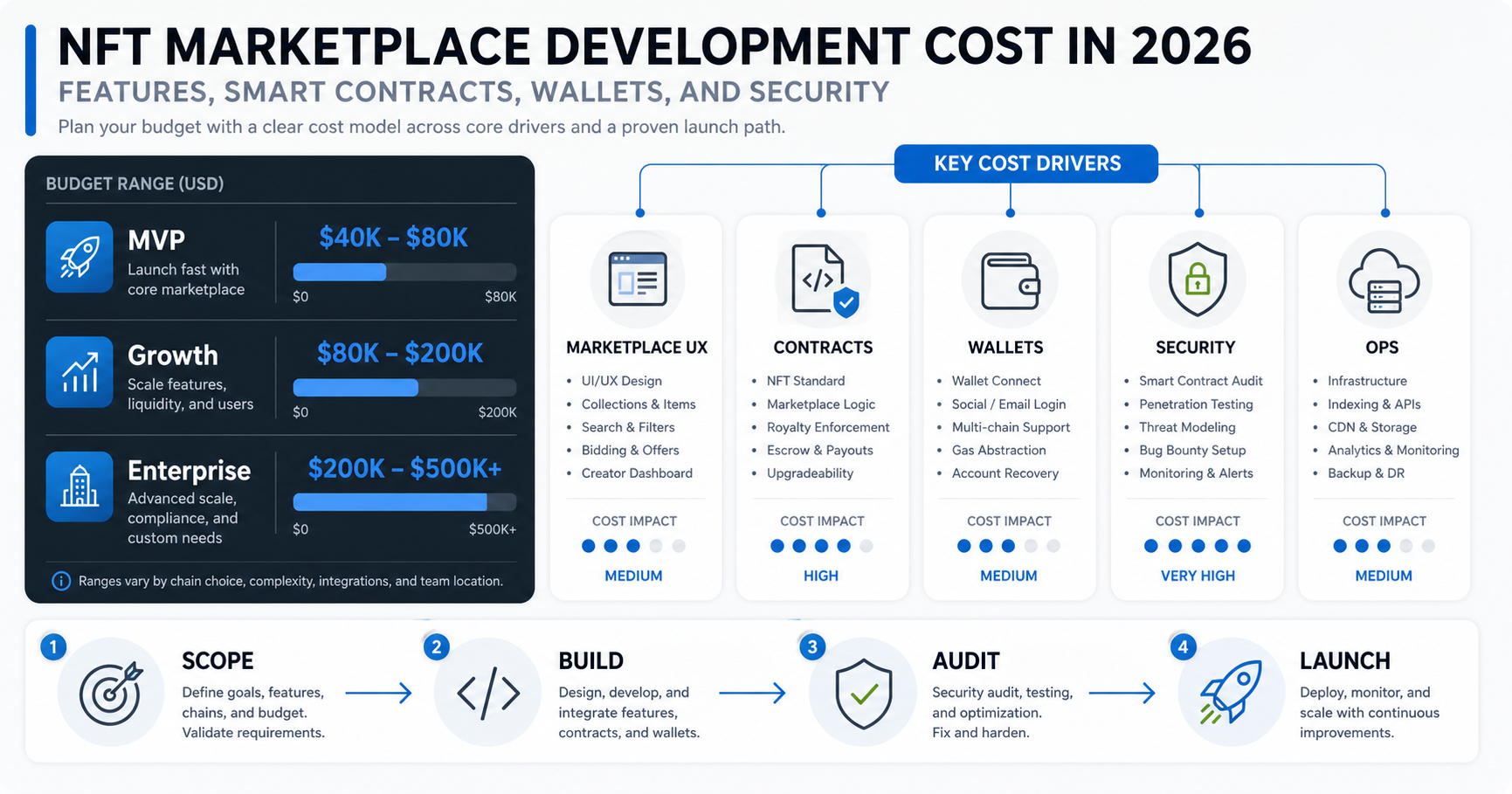
A useful estimate starts by separating what must launch now from what can wait. The MVP is not a weak product; it is a narrow product with fewer irreversible decisions.
| Capability Area | MVP | Growth Build | Enterprise Build |
|---|---|---|---|
| Marketplace UX | Listings, collection pages, simple checkout | Auctions, offers, saved items, richer seller tools | Multi-market operations, advanced moderation, enterprise admin |
| Contracts | Standard token and sale flows | Royalties, lazy minting, drops, allowlists | Custom settlement, custody, upgrade strategy, formal audit process |
| Wallets | Popular browser/mobile wallet support | Embedded wallet options, fiat gateway, transaction recovery | Custody choices, KYC flows, account abstraction, enterprise controls |
| Security | Internal review and test coverage | Audit readiness, monitoring, abuse controls | External audit, compliance review, incident response drills |
For a first release, NextPage usually recommends proving the marketplace loop first: one asset type, one or two chains, one sale model, a small creator cohort, and enough admin tooling to handle abuse. Teams can then add auctions, richer royalties, fiat checkout, analytics, and enterprise integrations after real demand is visible.
White-Label Vs Custom NFT Marketplace: Where Cost Changes
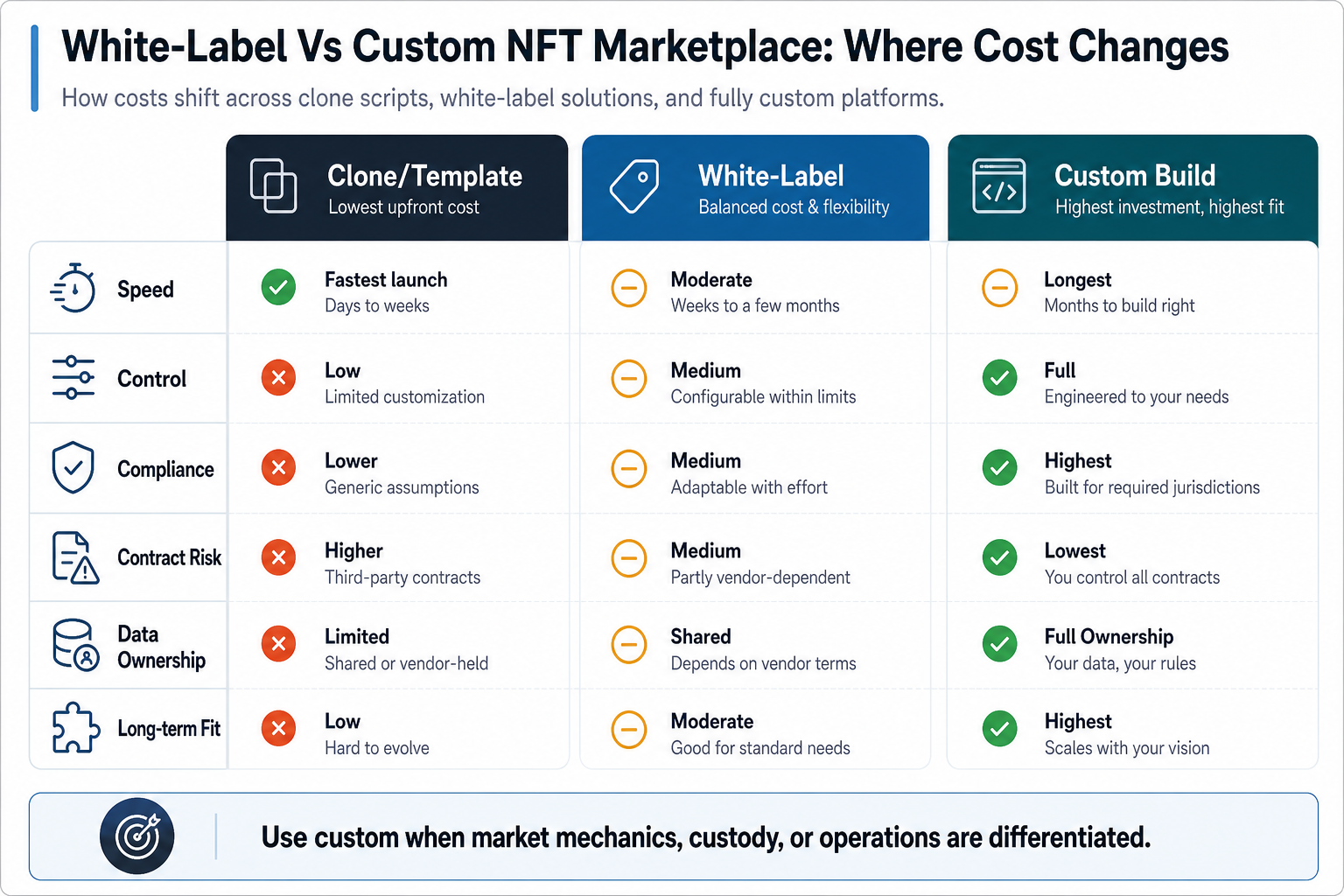
Not every NFT marketplace should start as a full custom build. A template or clone script can help test a low-risk idea when the asset model, sale mechanics, wallet paths, and admin workflow are close to the vendor default. A white-label platform can be useful when speed matters and the team accepts limits around architecture, roadmap control, and custom operations.
A custom NFT marketplace becomes easier to justify when the product competes on market mechanics, creator workflow, custody assumptions, gaming asset behavior, royalties, compliance boundaries, private communities, enterprise integrations, or ownership of the core data model. In those cases, the cheaper first quote can become expensive if it blocks contract changes, wallet analytics, seller operations, or audit evidence later.
If you are still deciding whether to configure, buy, or build, use the Build vs Buy Decision Tool before locking a vendor path. If the product needs differentiated workflows and source ownership, compare the roadmap against NextPage's custom software development process and NFT-specific service scope.
Feature-By-Feature Budget Drivers
Feature lists can be misleading because two teams can use the same words while building very different products. "Wallet integration" might mean MetaMask only, or it might mean WalletConnect, embedded wallets, email login, fiat on-ramp, gas sponsorship, and mobile deep-link recovery. "Royalties" might mean displaying royalty metadata, or it might mean enforcing complex splits across collections and secondary-market behavior.
- Buyer experience: search, filters, collection pages, checkout, wallet state, transaction feedback, watchlists, order history, and support messages.
- Creator tools: collection setup, metadata upload, minting, pricing, royalties, allowlists, drop scheduling, verification, analytics, and payout visibility.
- Admin system: user moderation, collection approval, takedowns, fee settings, category management, feature flags, logs, and support notes.
- Blockchain layer: token standards, marketplace contracts, event indexing, metadata storage, gas strategy, testnet flows, and deployment scripts.
- Integrations: wallet providers, fiat on-ramp, email/SMS, analytics, CRM, fraud tooling, tax exports, content storage, and customer support.
- Quality and launch: contract tests, end-to-end tests, load tests, audit preparation, launch monitoring, rollback planning, and documentation.
If your feature set is still fluid, estimate the non-Web3 software effort with the custom software development cost guide, then add the Web3-specific contract, wallet, audit, and operational work as separate line items.
How Smart Contracts Change The Budget
Smart contract cost depends on novelty and risk. A marketplace using standard contracts, one token standard, fixed-price sales, and simple marketplace fees is materially cheaper than a marketplace with rentals, revenue splits, fractional ownership, multi-chain settlement, or complex upgrade behavior.
Budget for smart-contract work in four layers. First, architecture: decide which contracts exist, what each owns, what can be upgraded, and what happens if an admin key is compromised. Second, implementation: write or configure contracts using reputable libraries where possible. Third, testing: unit tests, integration tests, fuzzing where valuable, and testnet rehearsal. Fourth, audit readiness: documentation, threat model, deployment plan, and bug-fix time after review.
The most expensive smart-contract mistake is treating audit as a final checkbox. Audit feedback often changes implementation, tests, deployment scripts, and product behavior. Put audit readiness before the launch deadline, not after marketing has announced a drop date.
Wallet Onboarding And Fiat Payments
Wallet onboarding can make or break mainstream adoption. Crypto-native buyers may tolerate browser extensions and manual gas choices. Consumer audiences often need email sign-in, embedded wallets, card payments, clear transaction status, and recovery flows when a transaction is rejected, pending, or replaced.
Every extra onboarding path adds QA. Browser wallets, mobile wallets, WalletConnect sessions, embedded wallets, and fiat checkout can behave differently across devices. If your marketplace needs mobile-first collectors, budget more time for deep links, session persistence, failed-payment recovery, and customer support tooling.
For teams choosing between a quick white-label path and a custom wallet experience, the question is control. White-label tools may launch faster, but custom product teams often need ownership over onboarding, analytics, retention, compliance review, and roadmap. Use the MVP Scope Builder to decide which onboarding paths are needed for the first buyer cohort.
Security, Compliance, And QA Budget
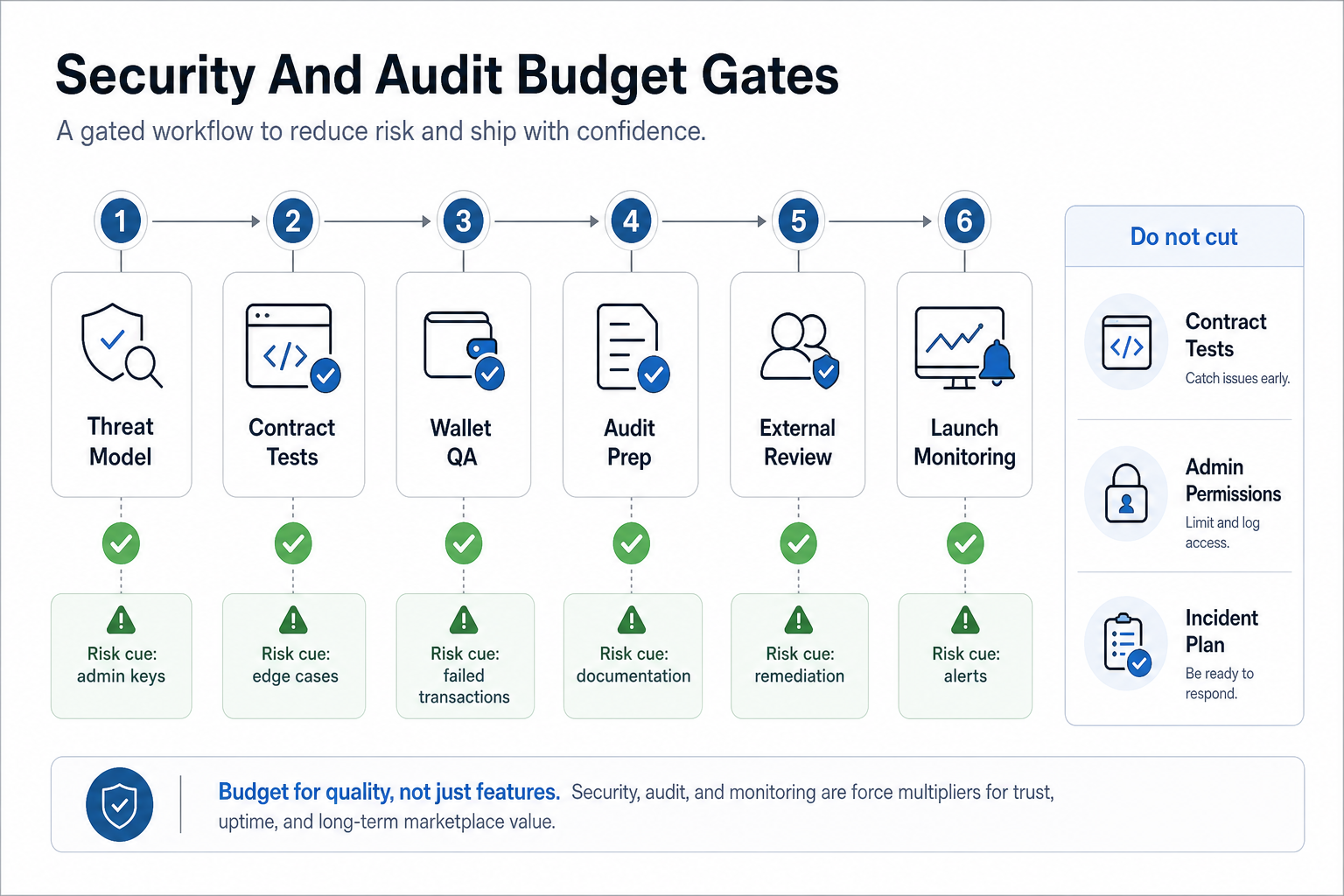
Security work should be visible in the estimate. At minimum, include secure development review, contract test coverage, dependency review, admin permission design, environment separation, rate limiting, abuse controls, and production monitoring. For higher-risk marketplaces, include external smart-contract audit, penetration testing, KYC/vendor review, sanctions-screening consultation, tax/reporting export needs, and incident response planning.
Compliance needs vary by jurisdiction, asset type, payment model, custody choices, and whether the product touches financial instruments, gaming assets, tickets, memberships, royalties, or tokenized real-world assets. A software vendor should not promise legal certainty, but the build plan should leave room for legal review and product changes.
QA also has Web3-specific scenarios: wallet disconnects, network switching, insufficient funds, rejected signatures, pending transactions, duplicate events, reorg-related indexing delays, failed metadata fetches, and marketplace fee changes. These are not rare edge cases; they are normal user support tickets waiting to happen.
Team Shape And Timeline
A focused NFT marketplace MVP usually needs a product lead, UX/UI designer, frontend engineer, backend engineer, smart contract engineer, QA engineer, and DevOps/cloud support. Growth builds add data/indexing expertise, security review, analytics, support tooling, and sometimes dedicated mobile or payments specialists.
For a 10-16 week MVP, keep the team small and decisions tight. For a 4-7 month custom marketplace, plan parallel tracks: UX and product rules, application backend, smart contracts, wallet/payment integrations, admin tools, QA, and launch operations. For an enterprise build, expect discovery, architecture, security review, compliance review, pilot launch, and staged rollout to be part of the budget.
If you are comparing engagement models, a fixed price can work when scope and risk are narrow. Time-and-materials or a dedicated team often fits better when contract behavior, wallet UX, and compliance questions are still changing. That is especially true when the marketplace is tied to a new creator economy model, game economy, or enterprise asset workflow.
How To Reduce NFT Marketplace Cost Without Creating Rework
The safest cost reduction is scope discipline, not security cuts. Start with one asset type, one primary buyer journey, one creator onboarding path, one chain, and one sale model. Avoid custom contract mechanics until the business case is proven. Delay advanced analytics, complex auctions, multi-chain support, and deep enterprise permissions unless they are critical to launch.
Do not cut admin tools entirely. A small but real admin dashboard for reviewing collections, suspending suspicious users, editing categories, and seeing transaction status will save support time and reduce launch risk. Do not cut contract tests or audit preparation when contracts hold funds, assets, or admin powers.
The best early estimate is a scope map: what is standard marketplace software, what is Web3-specific, what is legally sensitive, what is security-sensitive, and what is only a launch experiment. NextPage can turn that map into a budget range, timeline, and team plan through the software cost estimator or a short product discovery call.
How NextPage Scopes An NFT Marketplace
NextPage scopes NFT marketplace development by separating the buyer journey from the blockchain risk. We start with the marketplace loop: who lists assets, who buys, how discovery works, how transactions complete, how support handles exceptions, and what the admin team needs on day one. Then we define contract behavior, wallet choices, metadata storage, chain event indexing, and security requirements. That is why our custom NFT marketplace development planning starts with scope, launch operations, and risk gates before estimating screens.
That separation prevents the estimate from becoming either too generic or too speculative. It also helps founders decide what belongs in an MVP and what should wait until liquidity, creator demand, or enterprise adoption is proven. For teams still comparing Web2 marketplace features, the eCommerce app development cost and marketplace cost guides can help benchmark the software side before adding Web3 complexity.
If you already have a reference product or Rarible-like concept, bring the expected asset type, target chain, wallet audience, sale models, royalty rules, custody assumptions, and launch timeline. Those decisions will shape the estimate more than the number of screens.
Final Budget Checklist
- Have you limited the first release to one clear marketplace loop?
- Do you know whether minting, listing, and settlement use standard or custom contracts?
- Have you decided which wallet paths are required for launch users?
- Does the estimate include admin tools, support workflows, and chain event monitoring?
- Is audit readiness scheduled before launch commitments?
- Have you separated legal/compliance review from software engineering estimates?
- Do you have a post-launch budget for bug fixes, indexing issues, analytics, and user support?
A realistic NFT marketplace estimate should show assumptions, not just a total. If a quote does not explain contract scope, wallet onboarding, audit readiness, and admin operations, it is not ready to compare.