
Quick Answer: Offshore Software Development Checklist
An offshore software development partner is worth shortlisting only when it can prove six things before work starts: clear scope ownership, signed IP transfer, controlled access to code and data, visible delivery governance, real QA evidence, and continuity planning if people change. Cost savings and developer availability matter, but they are not enough to protect your product.
Use this offshore software development checklist to compare vendors before you sign. Ask for evidence, not promises: sample sprint reports, code review rules, testing approach, security controls, onboarding plan, documentation expectations, replacement terms, escalation paths, and a handoff plan for source code, credentials, environments, and deployment knowledge.
If you are already comparing India-based teams, NextPage's guide to software development outsourcing to India explains common models and cost ranges. To estimate a managed offshore pod before vendor calls, use the Dedicated India Team Cost Calculator. If the scope is still fluid, pressure-test it with the Custom Software Cost Estimator before comparing vendor rates.
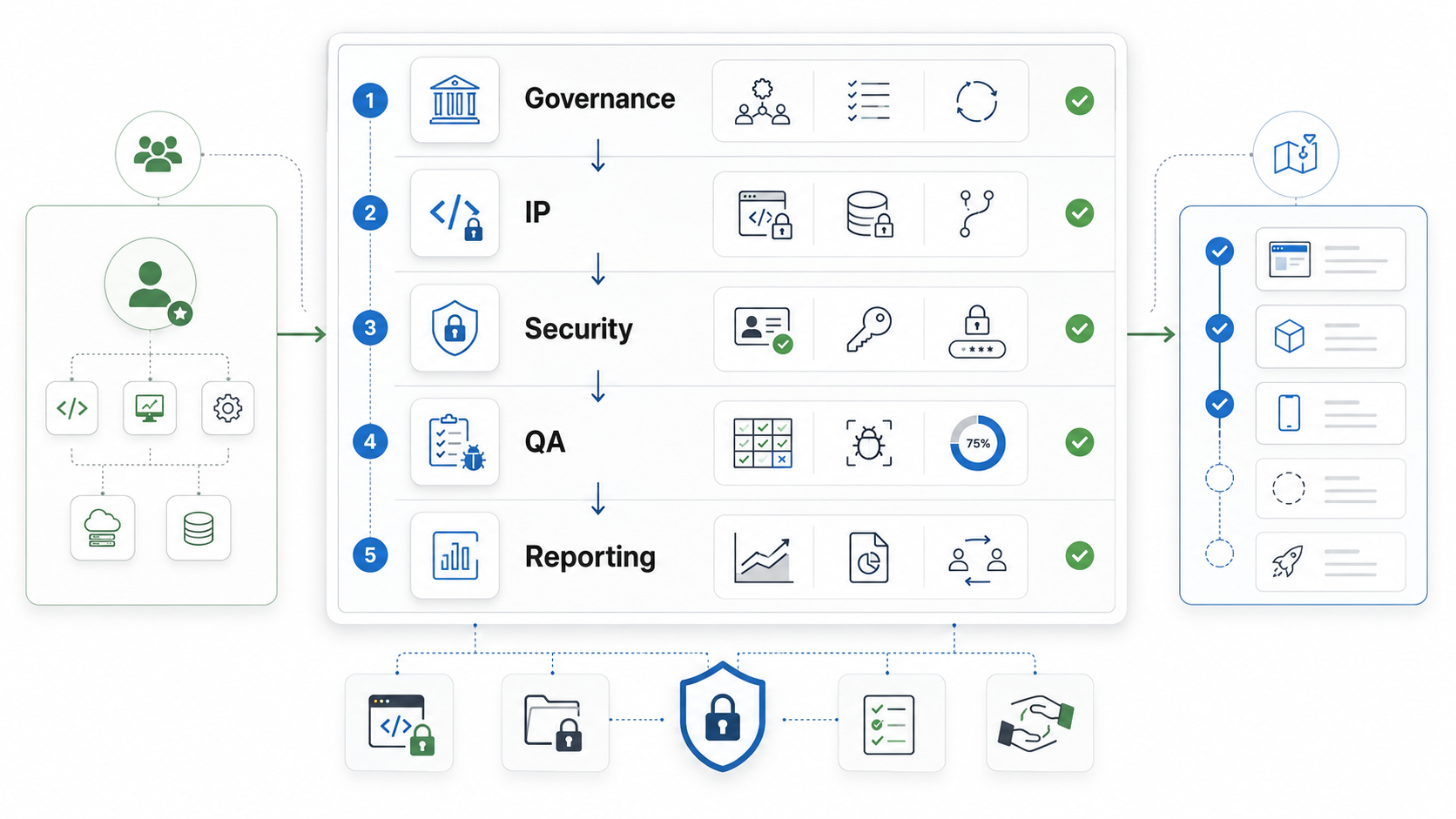
Why Offshore Vendor Selection Needs Governance
The CHL Softech reference page positions offshore development around cost savings, global talent access, scalability, time-zone coverage, communication, dedicated teams, and software services such as web development, mobile app development, migration, and digital product development. Those are useful buying signals, but they do not answer the harder question: how will the buyer keep control once work moves outside the building?
The strongest offshore relationships are not built on hourly rates alone. They are built on operating rules. Who approves scope changes? Where is source code hosted? Who owns credentials? How are pull requests reviewed? What happens if a developer leaves? Which test cases block a release? How will the vendor report progress when the buyer is asleep?
This is where many offshore evaluations become too soft. Buyers ask whether the vendor has developers, but they do not ask how delivery evidence is created. They ask about technology stack, but not secure SDLC. They ask about time-zone overlap, but not decision rights. NextPage's article on loss of control in IT outsourcing covers this risk in more depth.
The Offshore Software Development Checklist
Use this checklist during discovery, proposal review, contract negotiation, and onboarding. A vendor does not need a perfect answer for every item on the first call, but it should be able to explain how the gap will be resolved before the first sprint.
| Area | What to verify | Evidence to request | Risk if skipped |
|---|---|---|---|
| Scope governance | Who owns priorities, acceptance criteria, change requests, and sprint decisions? | Discovery plan, backlog format, decision log, scope-change process | The team builds features without business tradeoffs |
| IP ownership | Do you own source code, designs, documentation, generated assets, and deliverables? | Contract clauses, repository ownership plan, work-for-hire language, exit checklist | You pay for work but cannot safely move or maintain it |
| Security access | How are repositories, secrets, data, cloud accounts, and production environments protected? | Access-control process, least-privilege policy, secrets handling, offboarding checklist | Data, credentials, and production systems become exposed |
| QA and release gates | Which tests are run, who reviews defects, and what blocks release? | QA matrix, regression checklist, code review rules, release notes, bug triage workflow | Speed hides reliability problems until users find them |
| Delivery reporting | How often will you see working software, risks, blockers, velocity, and next decisions? | Demo cadence, sprint report sample, risk register, escalation channel | The project goes quiet until delay or rework is expensive |
| Continuity | What happens if team members rotate, holidays overlap, or the engagement ends? | Backup roles, documentation standard, handover plan, replacement terms | Knowledge stays with individuals instead of your product |
If you are also comparing broader software partners, pair this article with NextPage's custom software development company checklist. The offshore version adds more weight to access control, knowledge transfer, time-zone operating rhythm, and contract clarity.
Vendor Questions To Ask Before You Hire
Ask every shortlisted vendor the same questions so the comparison stays objective. A polished sales deck is not enough; you need operating evidence.
| Question | Strong answer | Weak answer |
|---|---|---|
| How will you turn our idea into a first sprint backlog? | Workflow discovery, user roles, acceptance criteria, assumptions, and phase-one scope | "Send requirements and we will start development" |
| Where will source code and project documentation live? | Buyer-owned repository or agreed organization, documented permissions, written handoff rule | Vendor-owned accounts with unclear export or ownership terms |
| How do you handle credentials and production access? | Least privilege, no shared passwords, environment separation, secrets manager, access review | Credentials shared in chat or stored by individual developers |
| What is your QA process before release? | Test plan, regression coverage, bug severity definitions, release checklist, demo environment | "Developers test their own work" |
| How will we know the project is on track? | Weekly demos, sprint report, visible backlog, blocker list, decision log, risk register | Informal updates only when asked |
| What happens if the assigned developer leaves? | Named backup, knowledge base, code review coverage, replacement SLA, transition period | No documented continuity plan |
Budget discussions should come after these answers, not before. A low monthly rate can become expensive if rework, missed QA, unclear ownership, or unmanaged access creates downstream risk. For a quick budget sanity check, use the custom software cost estimator and compare the result against the vendor's assumptions.
Governance And Communication Cadence
Offshore delivery needs a visible operating cadence. Time-zone differences can help by extending the workday, but only if decisions, blockers, and review windows are designed intentionally. Without that rhythm, the team may spend a full day moving in the wrong direction before the buyer sees the issue.
Define these rules before kickoff:
- Decision rights: who approves priorities, UX changes, technical tradeoffs, and release scope?
- Overlap hours: which hours are reserved for real-time discussion, demos, blocker removal, and sprint planning?
- Reporting format: what will the weekly update show: shipped work, demo links, risks, bugs, decisions needed, and next sprint plan?
- Escalation path: who gets involved when scope, quality, availability, or timeline risk appears?
- Documentation: where are API notes, architecture decisions, setup instructions, and release notes stored?
If the vendor offers a dedicated team model, ask how product leadership and QA support are included. NextPage's hire dedicated developers in India service is built around managed onboarding, sprint rituals, QA support, and flexible scaling rather than unmanaged staff augmentation.
IP Ownership, Security, And Access Control
IP ownership should be explicit, boring, and documented. The contract should state who owns source code, architecture documents, design files, configuration, test cases, content, and assets created during the engagement. It should also define when ownership transfers, what happens if invoices are disputed, and how handoff works if the relationship ends.
Security needs the same level of clarity. NIST's Secure Software Development Framework groups secure development work around preparation, protecting software, producing well-secured software, and responding to vulnerabilities. OWASP's secure coding checklist covers practical areas such as input validation, authentication, access control, data protection, error handling, logging, and communication security. You do not need every offshore vendor to recite the standards, but you do need evidence that their process covers the same risk areas.
At minimum, require:
- Buyer-owned or jointly controlled repositories with branch protection.
- Role-based access and named accounts, not shared credentials.
- Secrets stored outside source code and chat tools.
- Separate development, staging, and production environments.
- Pull request review rules for security-sensitive changes.
- Offboarding steps that remove repository, cloud, database, and tool access.
- Documentation for deployment, rollback, backups, and incident response.
QA, Code Review, And Release Readiness
Many offshore issues are blamed on distance when the real cause is weak QA. Distance only makes weak QA harder to catch. Your vendor should explain how quality is designed into the sprint, not bolted on at the end.
Ask for a QA plan that covers:
- Acceptance criteria for each user story.
- Code review before merge, with reviewer ownership and branch rules.
- Unit, integration, API, UI, and regression test expectations where relevant.
- Bug severity rules and who can approve release despite known defects.
- Environment parity between development, staging, and production.
- Release notes, rollback steps, and post-release monitoring.
For release-heavy products, adapt the structure in NextPage's regression testing checklist. Even a lean offshore team needs a small, repeatable release gate for the workflows that matter most to users and revenue. If the product handles sensitive workflows, pair QA with software QA testing services so regression coverage, defect triage, and release signoff are visible before scale.
Vendor Evidence Gates Before You Sign
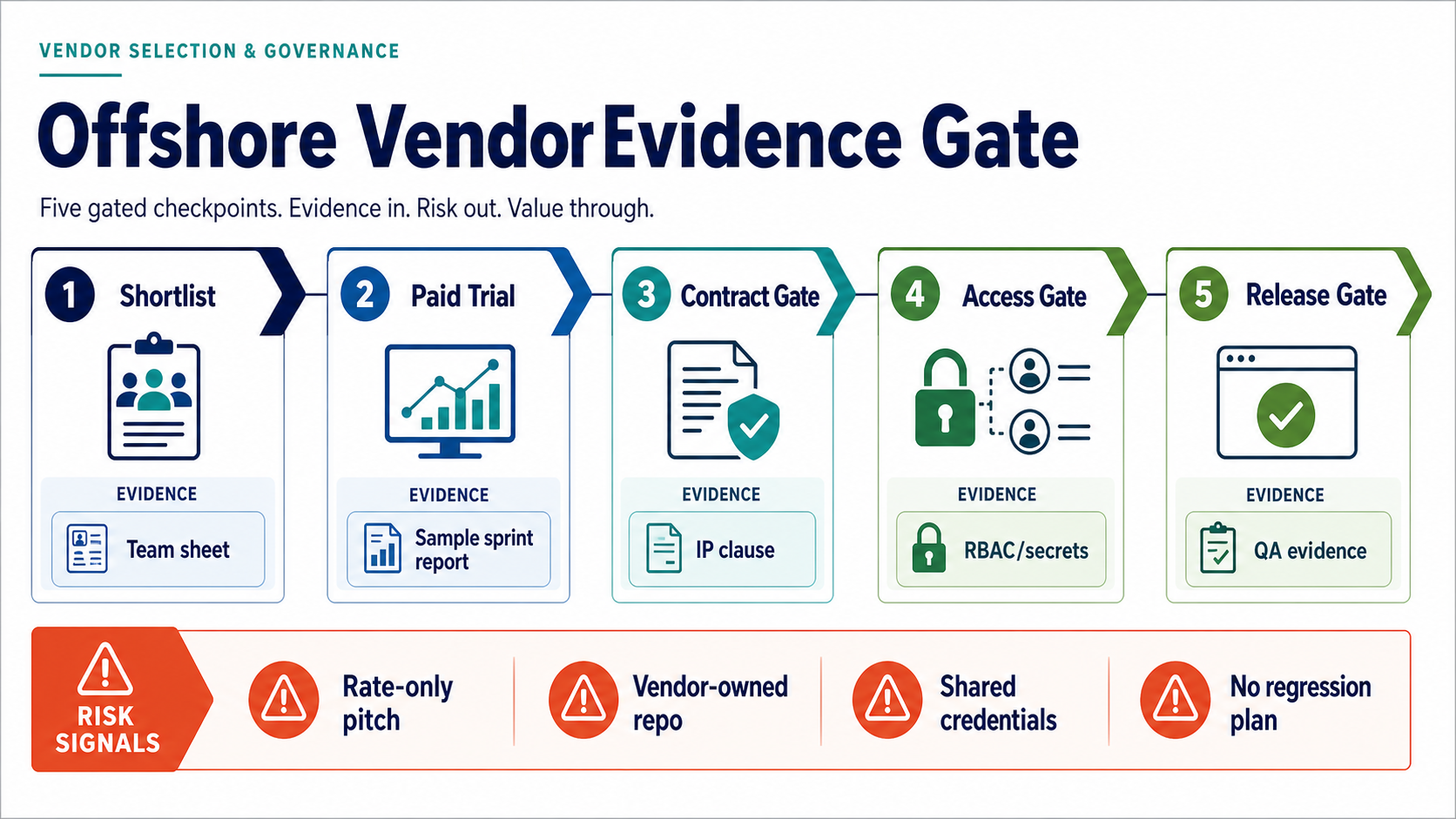
A stronger offshore evaluation uses evidence gates instead of one long sales conversation. Each gate should produce an artifact your team can inspect, compare, and reuse during onboarding.
| Gate | Evidence To Request | Pass Signal | Pause Signal |
|---|---|---|---|
| Shortlist | Relevant case examples, team shape, delivery model, sample sprint report | The vendor explains tradeoffs and shows how work is governed | The pitch is mostly hourly rates, resumes, and generic portfolio claims |
| Paid trial | Small backlog slice, code review output, demo, defect notes, release evidence | The team ships a narrow working increment with visible assumptions | The team hides process gaps behind speed or asks for full access too early |
| Contract gate | IP assignment, repository ownership, substitution rules, termination and handoff terms | Ownership, continuity, and exit conditions are explicit | Source code stays in vendor-owned accounts or handoff is vague |
| Access gate | Named accounts, role-based permissions, secrets process, offboarding checklist | Access follows least privilege and is reviewed on a schedule | Shared credentials, unmanaged production access, or chat-based secrets |
| Release gate | Regression scope, UAT notes, rollback steps, monitoring, release owner | Quality evidence blocks release when risk is high | QA is informal or release approval is only verbal |
This is also where commercial routes should become concrete. If the vendor is effectively selling individual developers, compare the model with hire dedicated developers in India. If the roadmap needs a stable pod with QA, lead review, and delivery coordination, compare it with NextPage's Your Team in India model before signing.
Paid Trial Sprint Checklist
A paid trial should not be free consulting, a vague prototype, or a beauty contest. It should test the parts of offshore delivery that create risk: requirements translation, technical judgment, code quality, communication cadence, QA discipline, and ownership behavior.
| Trial Area | What To Test | Evidence That Matters |
|---|---|---|
| Scope translation | Can the vendor turn a business goal into acceptance criteria and a small backlog? | User story, assumptions, dependencies, open decisions, test notes |
| Technical judgment | Does the team challenge risky requirements and explain architecture choices? | Design note, tradeoff log, code review discussion, integration plan |
| Delivery rhythm | Are blockers visible during overlap hours instead of at the end of the week? | Daily notes, demo link, risk register, decision log |
| Quality | Can the team show what was tested and what remains risky? | QA checklist, defect notes, release gate, rollback plan |
| Handoff | Can your team understand and maintain the work after the sprint? | README, environment notes, API notes, deployment steps |
For release-heavy products, compare the vendor's QA evidence with NextPage's UAT, functional testing, and regression testing guide. It helps separate user acceptance from engineering verification and recurring release safety.
Contract And Security Red Flags
Contract risk is often invisible until the relationship ends. Review ownership, substitution, confidentiality, data handling, liability, termination, and handoff language before the offshore team touches production systems or customer data.
- No named ownership language: source code, documentation, designs, test cases, generated assets, and deployment scripts must transfer clearly.
- Vendor-owned repository by default: the buyer should control or jointly govern the repository, CI/CD access, and deployment environments.
- Unapproved substitutions: replacement developers should require notice, overlap, knowledge transfer, and approval for critical roles.
- Security proof is only a certificate: SOC 2, ISO 27001, or policy claims are useful only when the scope covers your delivery environment and access model.
- Termination is vague: the exit plan should include code, documentation, credentials, environments, support window, and final knowledge transfer.
Security should map to practical controls, not buzzwords. NIST's SSDF gives buyers a common language for secure development expectations, and OWASP's secure coding checklist turns that into reviewable categories such as authentication, access control, cryptography, logging, data protection, communication security, configuration, and database security.
Offshore Operating Model For The First 30 Days
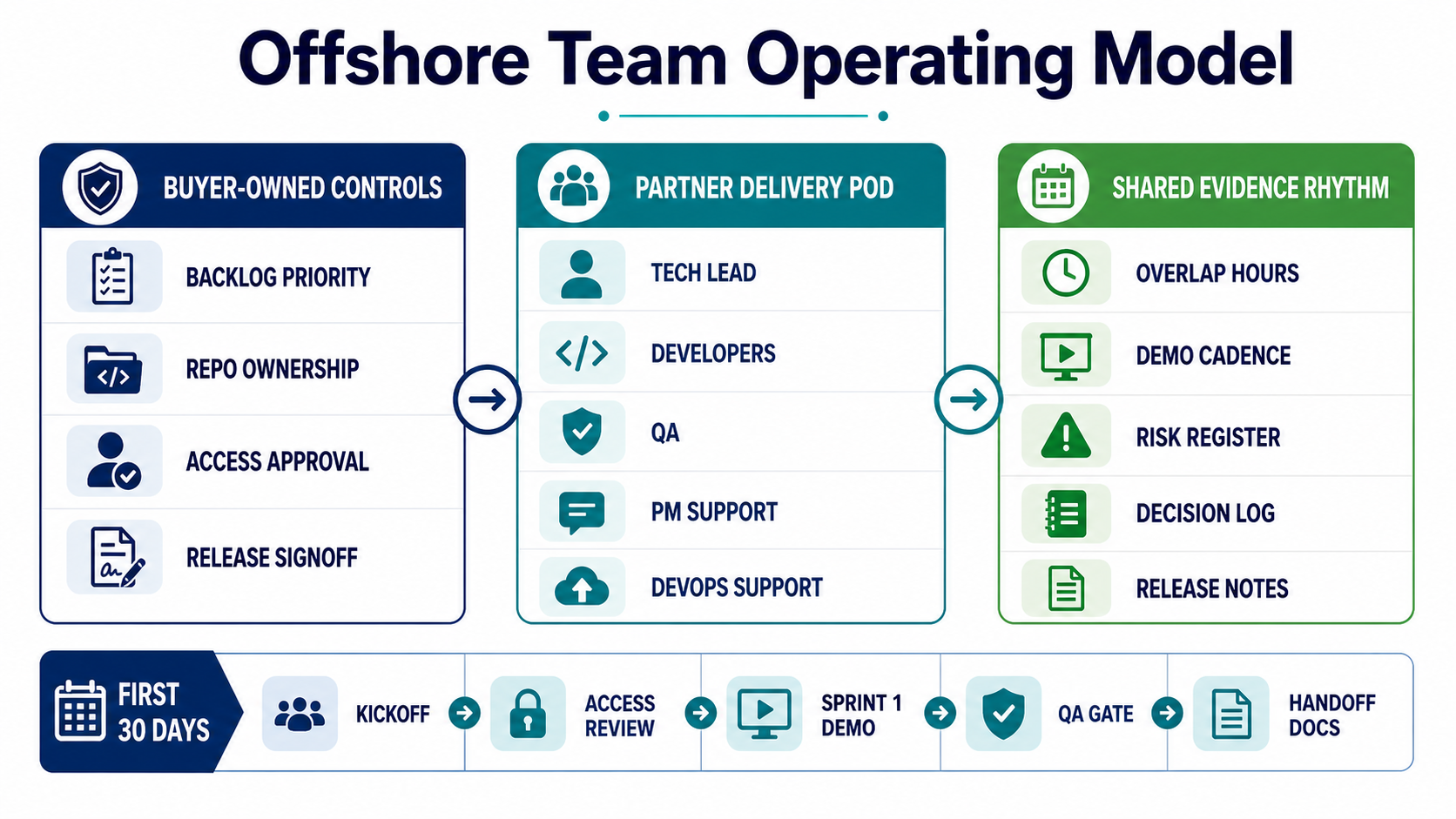
The first 30 days should prove that the engagement can operate without heroics. The vendor should not only write code; it should establish the operating system for decisions, access, quality, reporting, and continuity.
- Week 1: confirm product goals, roles, communication channels, overlap hours, repository ownership, environment access, and onboarding documents.
- Week 2: ship a narrow backlog slice, run code review, record assumptions, and demonstrate working software.
- Week 3: add QA evidence, regression notes, defect triage, and release-readiness criteria.
- Week 4: review team fit, velocity quality, communication gaps, handoff quality, and next-month scope before scaling.
For buyers who need a delivery system rather than only resumes, NextPage's software outsourcing in India path can combine discovery, team setup, QA support, and governance rituals. The QualityHub portfolio case study is a useful proof point for supplier-quality workflows, evidence capture, and review-heavy operational software.
AI-Assisted Offshore Delivery Controls
Many offshore teams now use AI coding assistants, test generation, documentation helpers, and code-review tools. That can improve speed, but it creates new review obligations. Ask how AI-generated code is reviewed, whether prompts or outputs can expose customer data, how dependencies are checked, and who is accountable when generated code introduces a defect.
Keep AI use inside the same delivery controls as human work: buyer-owned repositories, pull request review, secure coding checks, test evidence, dependency scanning, and release approval. If the roadmap includes AI features inside the product itself, route those decisions through AI development services planning rather than treating them as a developer productivity add-on.
Red Flags Before Signing An Offshore Contract
- Hourly rate is the main selling point: the vendor cannot explain governance, scope control, QA, or handoff quality.
- Repository ownership is unclear: source code will live in the vendor's private account with vague export terms.
- Security is reduced to an NDA: there is no access-control process, secrets policy, or offboarding checklist.
- No demo rhythm: progress is reported in written summaries instead of working software and visible backlog movement.
- QA is informal: developers test their own work without a regression plan, release checklist, or defect severity rules.
- Replacement terms are vague: the vendor cannot explain how knowledge is retained when a developer rotates out.
- Everything is yes: no one challenges scope, sequencing, technical risk, or budget assumptions.
A good offshore partner will surface uncomfortable risks early. That is not a negative signal. It means the vendor is willing to protect the product instead of rushing toward a signed contract.
Use This Governance Scorecard Before You Sign
Score each vendor from 1 to 5 across six categories. Write one evidence note beside every score. If the evidence is missing, the score should stay low even if the sales conversation felt strong.
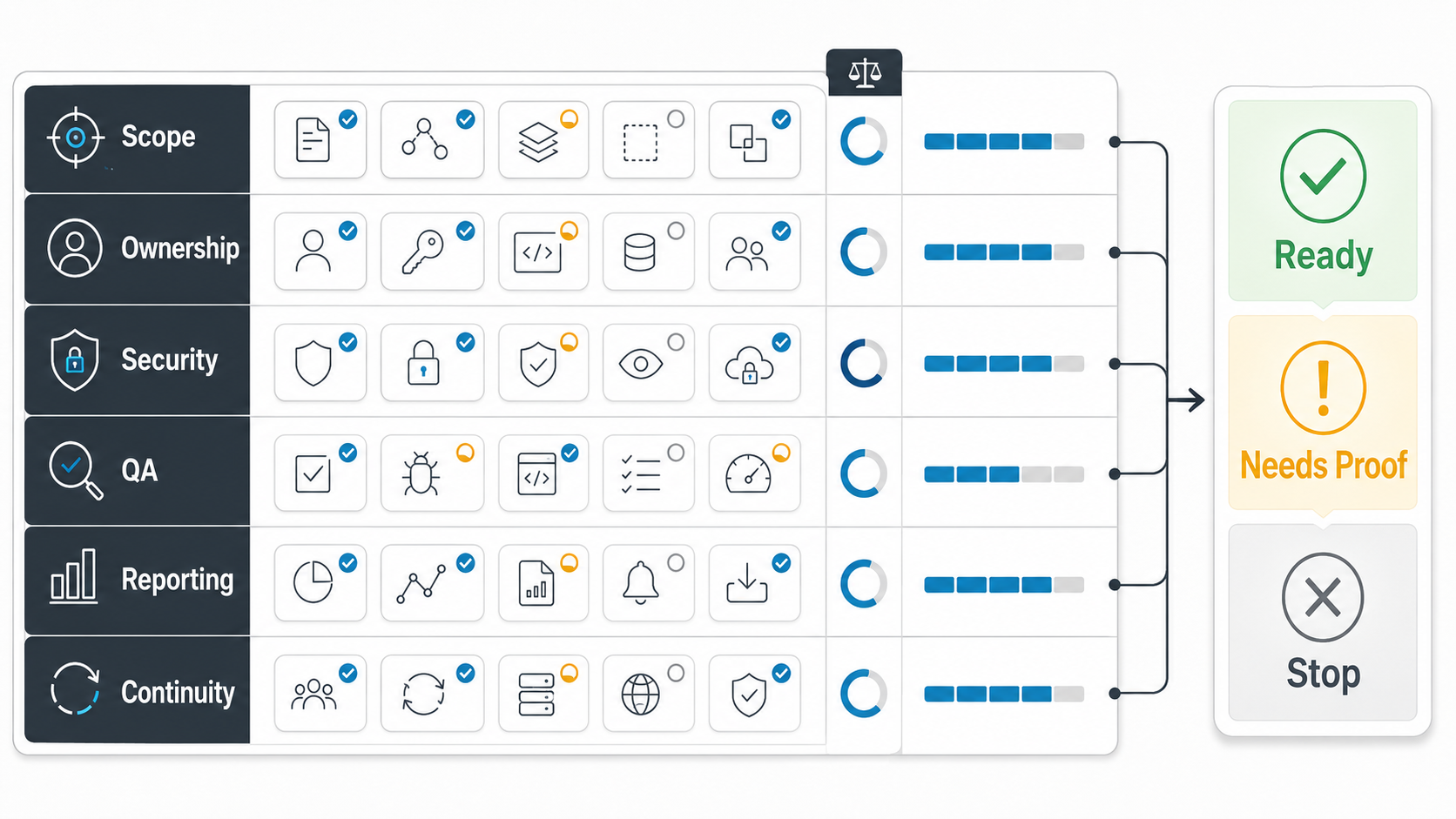
| Category | Suggested weight | Pass condition |
|---|---|---|
| Scope governance | 20% | Backlog ownership, acceptance criteria, change-control, and decision rights are clear |
| IP and handoff | 15% | Source code, documentation, environments, credentials, and assets have explicit ownership rules |
| Security access | 20% | Least privilege, branch protection, secrets handling, offboarding, and environment separation are documented |
| QA and release quality | 20% | Testing, review, severity rules, release gates, and rollback expectations are defined |
| Delivery reporting | 15% | Weekly demos, sprint reports, risk register, blockers, and decision log are visible |
| Continuity | 10% | Backup roles, replacement terms, documentation standards, and knowledge transfer are credible |
Any vendor with weak security access or unclear IP ownership should be paused, even if the price is attractive. Any vendor with weak reporting should be treated as high-risk until it demonstrates a working delivery cadence.
How NextPage Helps You Hire With Control
NextPage helps founders, CTOs, and product teams build offshore development capacity without losing product control. We can review your scope, define the first-release backlog, estimate the right team shape, set up governance rituals, and help you decide whether a dedicated team, managed project, or hybrid support model fits the product.
If you are evaluating offshore software development vendors, bring your feature list, target launch window, current technical stack, access constraints, and budget range. We will help identify the risks that should be resolved before signing, the roles your team actually needs, and the checkpoints that should appear in the first 30 days.
Start with the partner evaluation, not the contract. Score the vendor, run a paid trial, verify security and QA evidence, confirm ownership terms, and only then scale the team. If you need help turning a feature list into an offshore operating model, plan an offshore software development setup with NextPage.