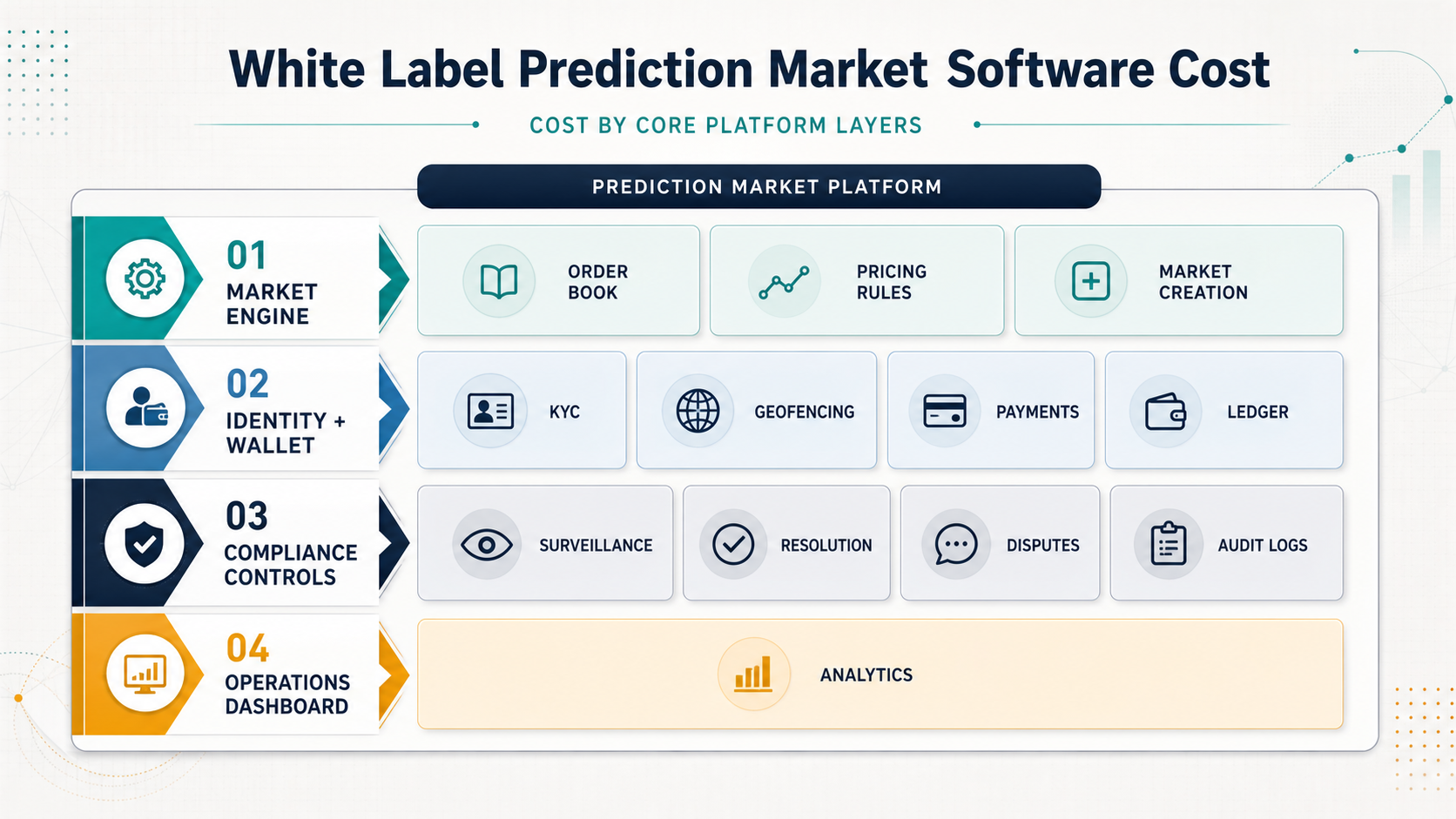

White label prediction market software cost depends on the launch path: a free-to-play forecasting MVP, a branded white-label platform, or a custom regulated event-contract product. The budget is shaped by trading mechanics, market creation tools, liquidity model, user identity, wallet or payment flows, KYC, geofencing, resolution workflows, audit logs, market surveillance, compliance review, integrations, and post-launch operations.
The safest way to estimate the project is to separate the reusable software platform from the launch work around regulation, risk controls, market operations, and customer trust. A white-label demo can look complete in days, but a platform that handles money, event contracts, sensitive user data, or regulated markets needs a much wider checklist before launch.
This guide is for founders, product leaders, and venture teams comparing white-label vendors with a custom MVP. It is product-planning guidance, not legal advice. Prediction markets are an active regulatory area in 2026. The CFTC sports event-contract proposal reported on June 10, 2026 and the recent market-integrity focus around insider-risk controls make one point clear: any real-money launch should include counsel-led review, market restrictions, surveillance, and audit evidence before development scope is locked.
Quick Answer: White Label Prediction Market Software Cost
White label prediction market software cost usually has four layers: platform license or source-code access, customization and integrations, compliance and operational controls, and ongoing support. A lightweight forecasting MVP may focus on user accounts, markets, points, leaderboards, admin creation, and resolution. A real-money or regulated platform adds identity checks, payments, wallets, transaction monitoring, geofencing, reporting, market-integrity controls, dispute workflows, and legal review.
| Cost Layer | What It Includes | Why It Changes Scope |
|---|---|---|
| Core platform | Market listing, outcomes, pricing model, trading or voting, charts, profiles, admin panel. | Determines whether the product is a simple engagement tool or an exchange-like system. |
| Customization | Branding, UX, mobile web or apps, market categories, permissions, notifications, analytics. | White-label software often covers defaults, not your actual operating model. |
| Money and identity | KYC, age checks, geofencing, wallets, payments, withdrawals, ledger, reconciliation. | Moves the project from product UI into financial and operational reliability. |
| Compliance operations | Audit logs, market surveillance, risk limits, contract restrictions, dispute process, reporting. | Creates launch gates that cannot be solved by front-end development alone. |
If your team is still comparing broad software budgets, start with the Custom Software Cost Estimator and then use this article to refine prediction-market-specific risk and scope. If the product is already moving toward event trading, market operations, or regulated real-money workflows, compare the estimate against NextPage's prediction market software development service page so engineering scope and operating controls are planned together.
Cost Bands By Launch Path
Use cost bands as planning language, not quotes. The same feature label can mean very different work. A “wallet” may be a points balance for a community game, an internal credit ledger, or a real-money transaction system with KYC, reconciliation, withdrawals, chargebacks, tax reporting, sanctions screening, and audit requirements.
| Launch Path | Good Fit | Typical Scope | Budget Risk |
|---|---|---|---|
| Free-to-play MVP | Media, sports, education, research, internal forecasting, community engagement. | Accounts, points, market creation, leaderboards, admin moderation, resolution, analytics. | Low to moderate if no cash, prizes, or regulated markets are involved. |
| White-label platform | Teams that need speed and can adapt operations to an existing platform. | Vendor setup, branding, categories, admin workflows, integrations, reporting, support. | Moderate; customization, data ownership, and compliance gaps often appear late. |
| Custom MVP | Teams with differentiated UX, market rules, data feeds, risk model, or integration needs. | Custom web app, trading or forecasting engine, admin console, APIs, analytics, QA. | Moderate to high; architecture choices shape long-term scalability. |
| Regulated real-money platform | Teams pursuing event-contract, gaming, financial, or jurisdiction-specific approval paths. | Identity, payments, wallet/ledger, surveillance, audit logs, legal workflows, reporting. | High; legal, compliance, liquidity, and operations work can exceed UI build effort. |
For general web-product assumptions, compare the prediction-market estimate against web app development cost. Prediction markets usually sit above a standard web app because they combine marketplace dynamics, financial-style operations, and live event resolution.
Prediction Market MVP Scope Matrix
A useful MVP plan separates what must exist on day one from what belongs in a regulated launch or growth phase. Trying to ship every market type, every payment option, every data feed, and every admin report in the first release usually increases risk without proving demand faster.
| Area | MVP Core | Regulated Launch | Growth Platform |
|---|---|---|---|
| Markets | Yes/no or limited multi-outcome markets with clear resolution rules. | Product restrictions, legal review, surveillance rules, jurisdiction controls. | Automated market lifecycle, templates, partner APIs, data-feed-driven creation. |
| Trading | Simple price display, points, capped exposure, or limited order model. | Order book or pricing controls, risk limits, audit trails, manipulation monitoring. | Liquidity tools, advanced charts, notifications, API access, segmentation. |
| Identity | Email/social login, roles, basic abuse controls. | KYC, age gates, sanctions, geofencing, account restrictions. | SSO, enterprise roles, support tooling, CRM sync. |
| Money | Points or internal credits where legally appropriate. | Payments, wallets, withdrawals, reconciliation, reporting. | Multi-currency, tax docs, partner settlement, loyalty/rewards integrations. |
| Operations | Admin market creation, close, resolve, moderate, and export. | Disputes, approvals, incident logs, compliance reports, escalation workflows. | Automation, dashboards, BI exports, support macros, partner reporting. |
Use the MVP Scope Builder to trim the first release to the smallest product that proves user demand and operational feasibility before real-money complexity is added.
1. Market Engine, Pricing, And Trading Rules
The market engine is the center of the estimate. A community forecasting product can use points, fixed odds, simple shares, or scoring rules. A trading-style platform may need order-book matching, automated market makers, price charts, liquidity controls, tick sizes, exposure limits, cancellations, settlement rules, and abuse detection.
Cost rises when the platform must handle real-time updates, many simultaneous markets, changing odds, market-maker logic, API access, mobile responsiveness, and detailed trade history. It rises again when the product needs deterministic ledgers, reconciliation, dispute evidence, and rollback procedures.
This is why a prediction-market estimate should borrow from marketplace app development cost thinking, but go further: instead of buyer-seller matching, the product must manage market lifecycle, price discovery, exposure, resolution, and participant trust.
2. Identity, Wallets, Payments, And Geography
Identity and payments determine whether the platform is a game, a research tool, a loyalty product, or a regulated financial/gaming-adjacent system. Basic accounts are straightforward. KYC, age checks, geofencing, sanctions screening, device/IP risk, wallets, deposits, withdrawals, refunds, chargebacks, and transaction monitoring add serious scope.
For planning, separate three balances: prediction points, promotional credits, and real money. Each has different legal, UX, accounting, and support implications. A vendor may advertise wallet integration, but the operating questions still remain: who owns customer funds, who reconciles balances, what happens during disputes, what audit evidence exists, and which jurisdictions are blocked?
Prediction markets that touch money should be scoped with similar caution to fintech app development cost: identity, security, compliance, support, and monitoring are not optional polish.
3. Market Operations, Resolution, And Disputes
The admin side is often underestimated. Operators need to create markets, define outcomes, select resolution sources, set trading windows, approve wording, pause risky markets, close trading, resolve results, handle disputes, issue corrections, and export evidence. If market resolution is vague, the product becomes a support and trust problem.
Good market operations require role-based permissions, approval chains, audit logs, data-source records, dispute notes, override rules, and communication templates. Regulated or high-stakes categories may need separation of duties between market creators, reviewers, and resolvers.
Before building, create a market policy file: allowed categories, banned categories, resolution source hierarchy, review owner, manipulation risks, dispute SLA, and escalation path. This document shapes product scope as much as the UI wireframes.
4. Compliance, Surveillance, And Product Restrictions
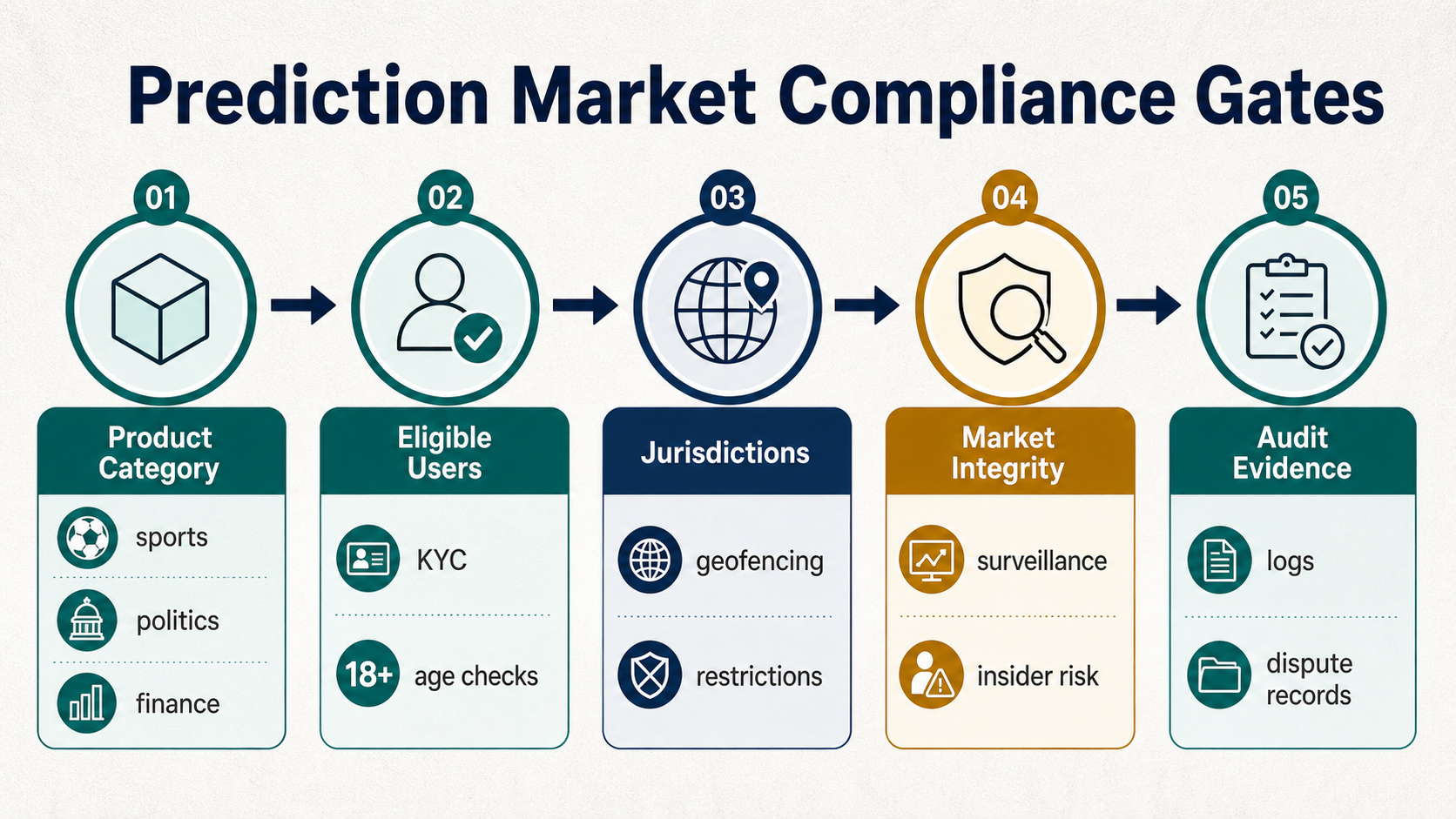
Prediction-market compliance is not a checkbox after development. In 2026, CFTC and legal commentary continue to focus on event-contract classification, Designated Contract Market obligations, market surveillance, anti-fraud and anti-manipulation controls, customer protection, state gambling challenges, and especially product design for sports and politically sensitive contracts.
That does not mean every forecasting product is the same risk. An internal employee forecasting tool with no money, no prizes, and no public markets has a different profile from a public real-money exchange. But the product team should still decide the risk perimeter before writing code: eligible users, jurisdictions, market categories, exposure limits, source-of-truth rules, insider restrictions, moderation, recordkeeping, and reporting.
Build the budget around counsel-led answers. If a vendor says compliance is “included,” ask what that means in practice: KYC provider, AML checks, sanctions screening, market surveillance, data retention, restricted markets, audit exports, incident response, and ongoing updates when law or policy changes.
5. Data Feeds, APIs, Analytics, And Admin Workflows
Prediction markets become more expensive when they depend on external data. Sports stats, economic releases, election data, weather feeds, crypto prices, financial indicators, and custom partner data all require source selection, reliability checks, licensing review, fallback rules, latency expectations, and resolution governance.
Integrations can include payment providers, KYC vendors, notification systems, CRM, BI dashboards, CMS content, support tools, data warehouses, affiliate systems, or partner APIs. Each integration needs test credentials, error handling, monitoring, retries, and support ownership.
Analytics should cover more than signups and page views. Operators need market volume, active traders, exposure, liquidity, settlement accuracy, disputed markets, suspicious behavior, user cohorts, retention, and support load. These reports help decide whether to add features or narrow the market catalog.
White Label Vs Custom Build: What Changes The Budget?
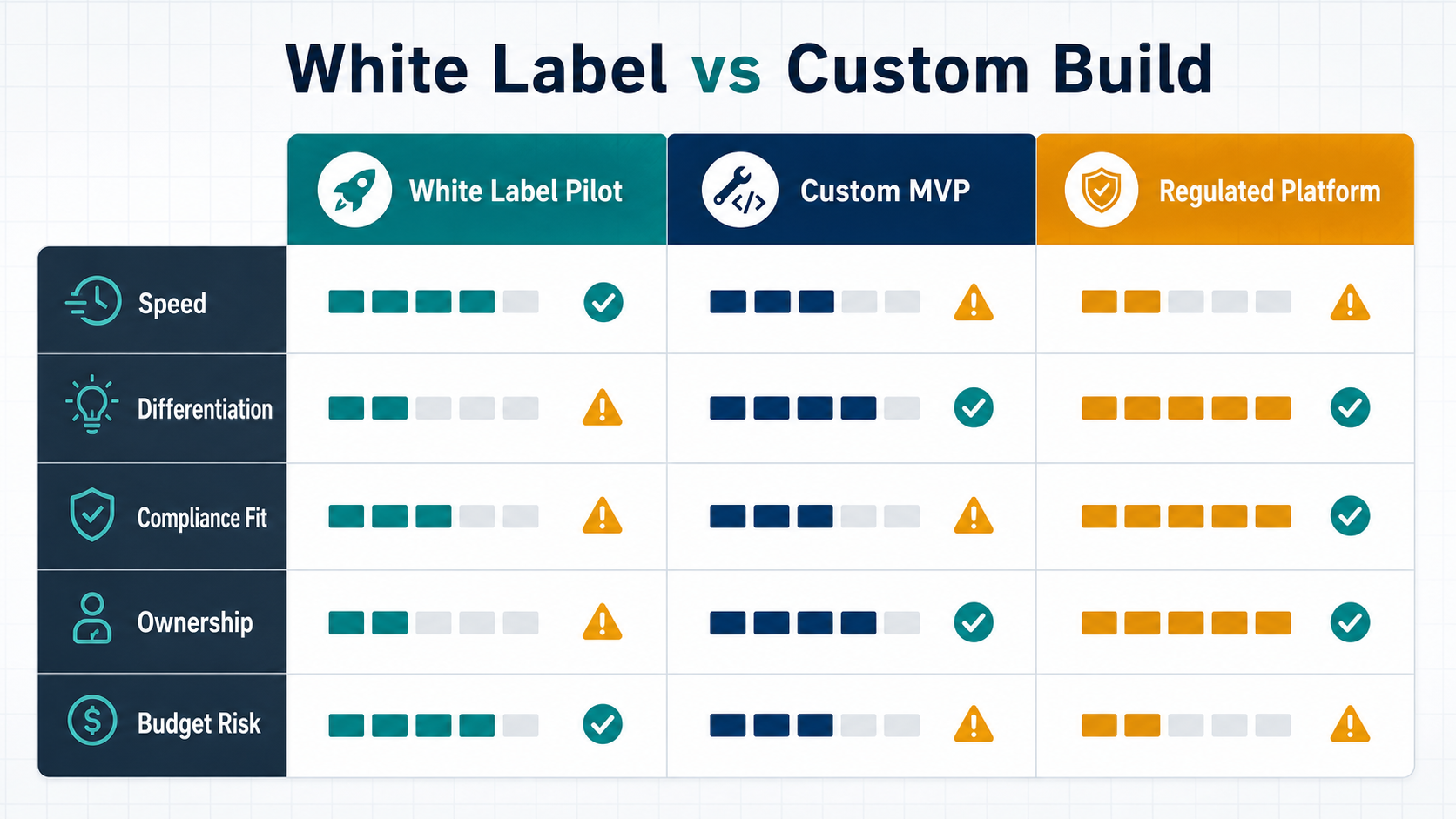
White-label software is useful when speed matters and the product can fit the vendor model. It can reduce initial engineering time for market listings, admin screens, pricing mechanics, dashboards, and common user workflows. The tradeoff is less control over architecture, data model, risk controls, roadmap priority, and compliance-specific customization.
Custom software development is more expensive upfront but can be better when the business model is differentiated: unique market formats, proprietary data feeds, private communities, enterprise SSO, unusual resolution workflows, strict jurisdiction controls, partner dashboards, or a long-term plan to own the core IP. For teams deciding between SaaS configuration and owned software, the Build Vs Buy Decision Tool can turn these tradeoffs into a first-pass decision before vendor demos start.
| Question | White Label Is Stronger When... | Custom Build Is Stronger When... |
|---|---|---|
| Speed | You need a pilot quickly and can accept vendor defaults. | You need a tailored launch sequence or complex approvals. |
| Differentiation | The product competes on audience, content, or distribution. | The product competes on market mechanics, data, UX, or operations. |
| Compliance | The vendor has a proven fit for your exact jurisdiction and use case. | You need custom restrictions, surveillance, audit, or reporting workflows. |
| Ownership | You are comfortable with vendor dependencies and roadmap limits. | You need source ownership, custom architecture, and deeper data control. |
If you are evaluating vendors, use the questions from the custom software development company checklist and add prediction-market-specific proof: live market load, resolution tooling, audit logs, KYC integrations, risk limits, dispute evidence, and support process.
Implementation Timeline By Phase
A practical timeline starts with product and legal discovery, not UI design. The first phase should define target users, market categories, payment model, jurisdiction strategy, launch constraints, and MVP metrics. Only then should the team decide whether white-label setup, custom MVP, or hybrid development is the right path.
| Phase | Work | Output |
|---|---|---|
| Discovery | Use case, market categories, user roles, money flow, legal/risk review, success metrics. | Launch path, risk register, MVP scope, budget assumptions. |
| Product design | Market lifecycle, trading rules, user journey, admin workflow, resolution process. | Wireframes, workflow maps, acceptance criteria. |
| Platform build/setup | White-label configuration or custom engineering for markets, accounts, admin, analytics. | Working MVP in test environment. |
| Controls and integrations | KYC/payments, data feeds, geofencing, notifications, audit logs, reporting, monitoring. | Operationally testable release candidate. |
| Validation and launch | QA, load testing, security review, market policy review, UAT, support runbooks. | Launch decision, backlog, support plan. |
How NextPage Scopes Prediction Market MVPs
NextPage scopes prediction market software by separating the product concept from the operating model. We clarify whether the first release is a free-to-play engagement product, an internal forecasting platform, a white-label deployment, or a custom regulated product. Then we map market lifecycle, user roles, trading mechanics, wallet model, compliance gates, admin workflows, data feeds, analytics, and support requirements.
The outcome is a practical MVP plan: what to launch now, what to defer, what legal or compliance answers are required, what integrations are risky, and what budget range is realistic for the chosen launch path. If you are deciding between white label and custom development, use the estimator, build an MVP scope, and then book a product review before committing to a vendor contract.
For adjacent cost planning, the NFT marketplace development cost guide is useful when wallet, ownership, security, and marketplace operations are part of the discussion, even though prediction-market rules and compliance risks are different.