Portfolio case study

AquaBalance: Pool water chemistry and service operations platform

A pool care and water chemistry platform that brings LSI calculation, multi-pool profiles, reading history, operator visibility, and downloadable service reports into one connected mobile and admin workflow.

Name changed to respect NDA.

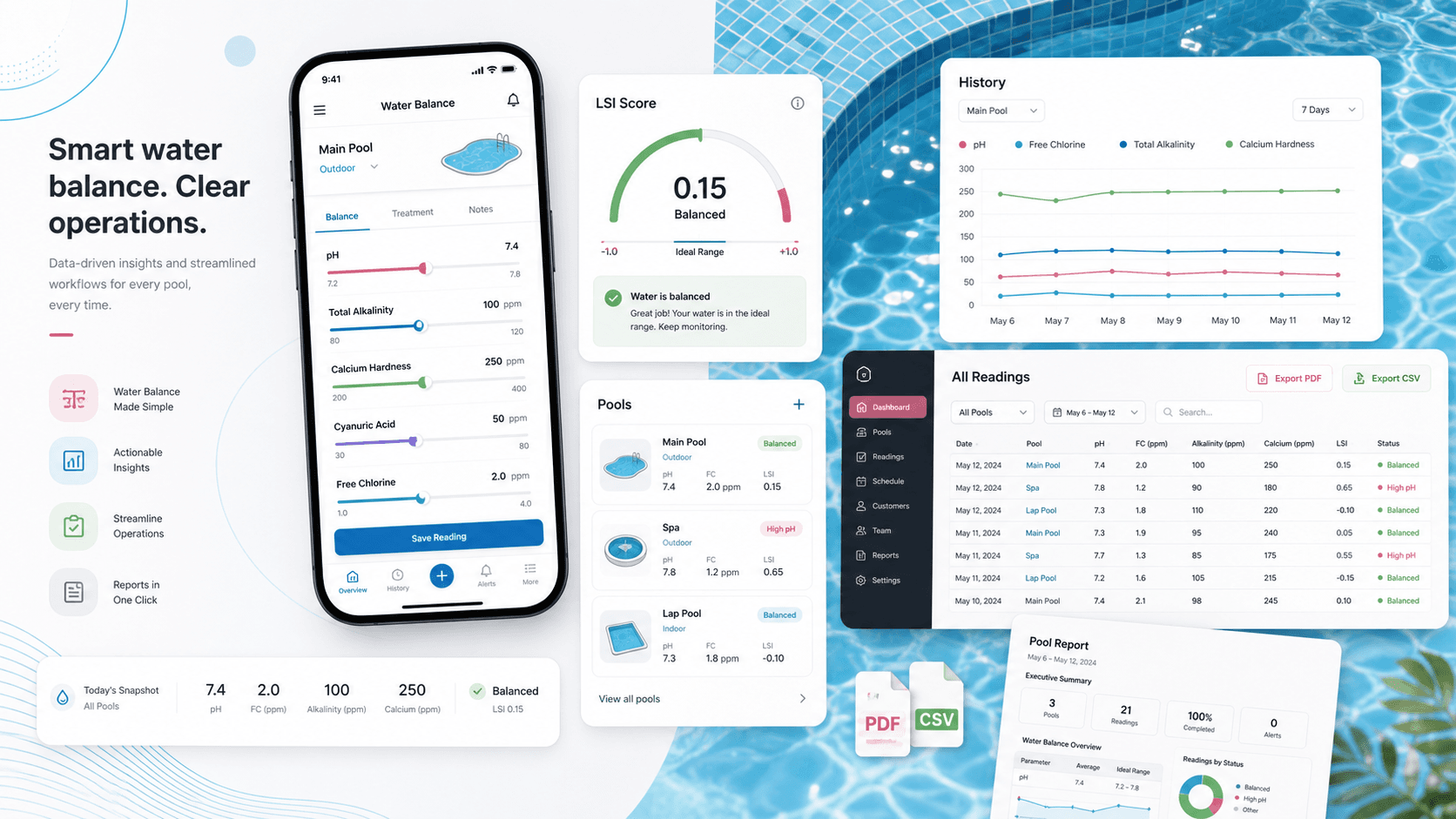
Pool water chemistry platform visual with mobile LSI sliders, pool cards, reading history chart, admin table, and report export elements
Project scope

Product engineering across Ionic mobile app, React admin console, report export API, pool profile workflows, readings history, and service operations support

3
connected product surfaces
8
tracked water readings
4
pool shape models
PDF
and CSV report exports

Timeline

Multi-surface product build for mobile pool care and operator oversight

Pool care data was hard to turn into repeatable action

Pool owners and service teams needed a practical way to capture water chemistry readings, understand LSI balance, manage multiple pool profiles, and review historical changes without relying on loose notes or disconnected spreadsheets.

  • Chemical readings needed guided capture across pH, chlorine, calcium, alkalinity, stabilizer, salt, phosphates, and temperature
  • Residential and commercial pools required different profile context, including shape, dimensions, sanitization method, indoor or outdoor location, and volume
  • Service teams needed history, charts, and downloadable outputs that could support recurring maintenance conversations
  • Operators needed a lightweight admin view for users, pool profiles, and recent pool activity

A mobile-first chemistry workflow with an admin and export layer

AquaBalance combines an Ionic mobile app, a React operations console, and a Node/Express report service so users can calculate LSI, save pool profiles, track readings over time, and generate shareable reports.

  • LSI calculator with paired current and desired reading controls for the core water-balance factors
  • Pool profile setup for common pool shapes, dimension units, sanitization methods, location, category, address, and calculated volume
  • Reading history screens with charted chemical trends and saved current-versus-desired values
  • Admin user and pool views plus PDF and CSV generation endpoints for service reporting

Product surfaces

What the platform brought together

The work spanned core product operations, daily user workflows, data-heavy coordination, and resilient platform management.

LSI calculator and recommendations

The main mobile flow turns water test readings into an immediate saturation-index signal and a recommendation moment.

  • Slider-style controls for temperature, chlorine, pH, calcium, alkalinity, stabilizer/CYA, salt/TDS, and phosphates
  • LSI calculation compares current and desired states with visual status feedback
  • Recommendation prompts connect the calculator to saved reading workflows and account conversion moments

Pool profile management

Users can maintain multiple pool records instead of recalculating context each time they test water.

  • Pool forms capture name, address, pool shape, dimension unit, sanitization method, indoor/outdoor location, and residential/commercial category
  • Volume calculation supports square/rectangular, round, elliptical, and irregular pool models
  • Search, edit, delete, and default-pool flows make recurring pool maintenance faster

Reading history and trends

Saved readings become chartable history that helps users understand whether pool chemistry is improving or drifting.

  • History screens plot reading values over time for the tracked chemistry factors
  • Current and desired readings are saved together so service decisions have context
  • Default and signed-in states let the product support trial use while preserving deeper account value

Operations console and report exports

The admin and API layer turns consumer pool records into an operator-ready service workspace.

  • React admin tables show users, latest pool details, pool type, dates, and drill-down pool records
  • Node/Express export endpoints generate PDF and CSV outputs from submitted reading data
  • Downloadable reports help translate chemistry sessions into client-facing service artifacts

Buyer priorities

What mattered most to the people evaluating the platform

Prospective buyers want to know whether the work solved real workflow, adoption, reliability, data, and operations problems. These priorities shaped the product decisions.

Field usability

The mobile app needed to be fast enough for pool-side testing while still collecting enough context for reliable recommendations.

  • Touch-friendly sliders reduce manual typing during water testing
  • Saved pool profiles avoid repeated shape, dimension, location, and sanitization setup
  • Default-pool behavior lets new users experience value before committing to an account

Service continuity

A pool care platform becomes more valuable when every visit leaves useful history instead of isolated readings.

  • Reading history keeps current and desired chemistry values attached to pool records
  • Charts make trend conversations easier for owners and technicians
  • Exports create shareable evidence for maintenance recommendations

Operator visibility

The admin console gives the business side enough visibility to support users and understand pool activity without overbuilding a heavy back office.

  • User tables surface account, pool name, pool type, and recent activity signals
  • User detail views list associated pool records with category, type, sanitization, and date
  • Report services keep export generation separate from the mobile interface

System model

How the platform connects roles, workflows, and product surfaces

The product architecture brings every role into the same operating model, with shared data moving cleanly between web, mobile, media, and notification layers.

Reading to recommendation workflow

Pool-side measurements move through guided capture, LSI calculation, recommendation prompts, saved readings, and reports.

Three-surface product architecture

Mobile app, admin console, report API, and pool data services work together around one water chemistry model.

Pool care roles

Owners, technicians, service managers, and support operators each see a practical part of the same maintenance loop.

Technology

The Stack We Used And Why

The stack section is written for buyers who need to understand the product architecture, operational trade-offs, and long-term maintainability of the system.

Mobile app

Used for pool-side chemistry capture, LSI calculation, account flows, pool profile setup, reading history, and service prompts.

IonicAngularTypeScriptCordovaChart.jsApexCharts

Admin web

Used for operator dashboards, user tables, pool detail views, searchable records, and support visibility.

ReactCoreUIBootstrapDataTablesAxiosMoment.js

Report API

Used to convert submitted water chemistry data into downloadable PDF and CSV service artifacts.

Node.jsExpresshtml-pdfjson2csvMoment.js

Data layer

Used for user accounts, pool profiles, saved readings, profile filtering, and mobile/admin API access.

Headless CMS APIREST endpointsJSON recordsLocal storageToken-based API access

Why Ionic And Angular

The core experience needed mobile-friendly controls, native packaging, and quick iteration around form-heavy pool-side workflows.

  • Ionic components supported touch-first sliders, selects, menus, modals, alerts, and mobile navigation
  • Angular services kept API calls, local storage, and utility behavior reusable across screens
  • Cordova packaging gave the product a path to iOS and Android from one codebase

Why A Separate Admin Console

Pool care support teams needed a browser workspace for account and pool visibility without forcing mobile users through operational screens.

  • React tables made user and pool records searchable and easy to scan
  • Detail views connected users to their associated pools and service context
  • The admin stayed focused on oversight instead of duplicating every mobile feature

Why Export Services

Chemistry recommendations become easier to trust when users and operators can produce portable reports.

  • PDF exports package the chemistry factors into a shareable service document
  • CSV exports support downstream analysis and operational records
  • A small Express service kept report generation isolated from mobile app complexity

Delivery

How the product came together

The work moved from domain modeling to core platform delivery, mobile adoption, and operational hardening.

1

Shape the chemistry model

Define the water readings, pool profile fields, LSI inputs, and service context needed to make calculations useful.

2

Build the mobile workflow

Turn testing, profile setup, reading capture, history, account prompts, and settings into a mobile-first Ionic experience.

3

Add operator visibility

Create a lightweight React admin console for viewing users, associated pools, and profile-level activity.

4

Connect reporting outputs

Add API endpoints that transform submitted chemistry data into PDF and CSV outputs for service workflows.

Operational depth

What made the platform usable after launch

The strongest case studies are not only feature lists. They show how the system is operated, monitored, governed, and improved when real users depend on it.

Chemistry inputs match real pool-care conversations

The calculator covers the readings technicians and owners commonly discuss when evaluating water balance.

  • Tracked values include temperature, chlorine, pH, calcium, alkalinity, stabilizer/CYA, salt/TDS, and phosphates
  • Current and desired values sit side by side so recommendations are framed around a target state
  • LSI output gives immediate status feedback instead of burying the user in raw numbers

Pool profiles preserve operating context

The product stores the pool details that change how maintenance advice should be interpreted.

  • Profiles include shape, dimensions, volume, sanitization, location, category, and address
  • Multiple pool management supports owners, managers, and technicians who maintain more than one pool
  • Search and edit flows keep repeated service visits manageable

Reports make the workflow client-ready

The export layer turns each chemistry session into an artifact that can be shared, reviewed, or filed.

  • PDF generation uses a structured template for the core chemistry factors
  • CSV generation makes readings portable for spreadsheet or operational review
  • Admin screens give operators a way to connect reports back to users and pools

Results

The measurable and observable lift from the work

The strongest improvements are the ones a buyer can connect to daily work: fewer disconnected tools, safer operations, clearer workflows, and more reliable product behavior.

Mobile-first

Testing Workflow

Users can calculate LSI, compare current and desired values, and save pool context from the mobile app.

Multi-pool

Profile Management

The platform supports multiple pool records with shape, dimensions, sanitization, location, and volume details.

Charted

Reading History

Saved readings feed historical charts that show chemistry movement across service visits.

Exportable

Service Reports

PDF and CSV outputs help turn readings into shareable documentation.

Outcome

A stronger operating system for pool care and water chemistry operations platform

The platform reduced tool fragmentation and gave each role a clearer path from live activity to day-to-day action.

A mobile pool chemistry workflow for LSI calculation, profile selection, reading capture, recommendations, account prompts, and history review

A pool profile system covering multiple shapes, dimension units, sanitization methods, residential/commercial categories, indoor/outdoor location, and volume calculation

A lightweight operations console for user and pool visibility, plus a report service for PDF and CSV downloads

A public-safe portfolio page that positions the work as a complete pool care platform without exposing real project names, production domains, hard-coded tokens, source screenshots, or private identifiers

FAQ

Frequently Asked Questions About AquaBalance

Answers about the pool care and water chemistry operations platform scope, platform model, technology choices, operational workflows, and related build patterns.

What Kind Of Platform Does AquaBalance Represent?

AquaBalance represents a pool care and water chemistry platform for LSI calculation, pool profile management, reading history, admin visibility, and report exports.

Why Does Pool Care Need Custom Software?

Pool care workflows combine chemistry formulas, pool-specific context, historical readings, service recommendations, and client-facing documentation in ways generic note or spreadsheet tools do not handle well.

Can This Pattern Support A Pool Service Business?

Yes. The same product pattern can support pool owners, route technicians, service managers, and support teams by connecting mobile readings to profiles, history, and reports.

What Should A Buyer Prepare Before Building A Similar Product?

Useful inputs include the chemistry factors to track, recommendation rules, pool profile fields, technician workflows, report formats, account requirements, and any existing customer or pool data model.

Related services

Build a similarly ambitious product without starting from a blank page.

We can help scope the web, mobile, AI, media, and operating layers needed for your own platform.

Start a project inquiry