Portfolio case study

BranchWise: Financial institution discovery and branch intelligence platform

A financial institution discovery platform that helps consumers search banks and credit unions by location, branch details, services, ratings, and nearby options while giving the business a content-rich search surface for lead generation.

Name changed to respect NDA.

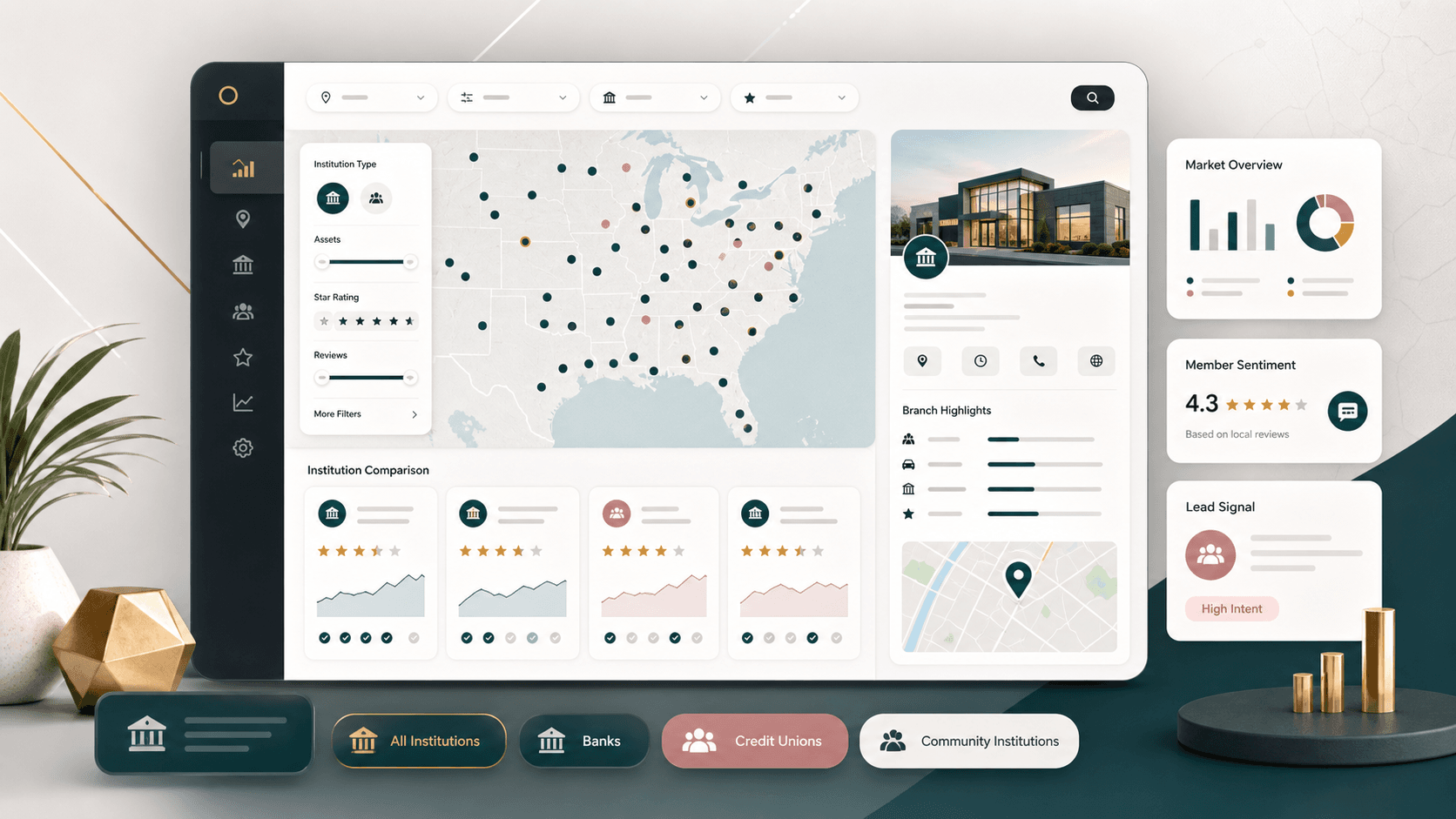
Financial institution discovery platform visual with branch locator map, search filters, comparison cards, ratings, and lead capture panels
Project scope

Server-rendered React web app, Express API, financial data search, location discovery, content surfaces, and lead-generation workflow delivery

SSR
search-friendly React web
2
institution data domains
Geo
radius and location search
Lead
newsletter and inquiry capture

Timeline

Financial directory platform build across public discovery, search APIs, data pages, and conversion forms

Financial discovery needed more structure than a static directory

Consumers needed a practical way to find banks, credit unions, branches, locations, opening context, ratings, and related financial information without browsing disconnected lists or generic search results.

  • Branch and institution data needed to be searchable by state, city, name, zip code, service type, and location radius
  • Public pages needed SEO-friendly rendering for directory, state, city, branch, credit union, and informational routes
  • Visitors needed comparison and detail views before sharing contact information or returning later
  • The business needed lead capture, newsletter collection, reviews, favorites, and content surfaces around the discovery journey

A server-rendered financial directory with location-aware search

BranchWise combines a React server-rendered public site with an Express API that exposes bank, credit union, state, city, branch, ranking, radius search, review, and lead-capture workflows.

  • Server-rendered React routes for home, search, bank lists, credit unions, state pages, city pages, branch details, and financial content pages
  • Express and SQL-backed APIs for branch search, state and city counts, top-ranked banks, credit union lookup, reviews, and similar institutions
  • Location-aware search paths that combine query filters with latitude, longitude, and mile-radius matching
  • Conversion workflows for newsletters, contact leads, favorites, sign-up, login, ratings, and review submission

Product surfaces

What the platform brought together

The work spanned core product operations, daily user workflows, data-heavy coordination, and resilient platform management.

Bank and credit union search

Consumers can move from broad discovery to focused institution results using search, pagination, location, and category filters.

  • Search routes for banks, credit unions, states, cities, and branch-level result pages
  • Query handling for zip code, address, state, city, institution name, branch name, service type, and institution type
  • Pagination and result-state handling for large financial institution datasets

Branch detail and comparison journeys

Institution pages turn raw directory records into useful decision surfaces with details, related options, and user signals.

  • Single branch and single credit union detail routes with SEO metadata support
  • Similar institution, review, favorite, average-rating, and ranking workflows
  • Comparison and credit-card oriented content areas that keep financial research inside the platform

Location intelligence

Geospatial lookups help users search nearby branches instead of relying only on exact text matches.

  • Radius search using latitude, longitude, mile distance, and branch coordinates
  • State and city count APIs for browsable geographic landing pages
  • Map-ready client components for markers, info windows, and branch discovery context

Content and conversion layer

The directory supports customer acquisition through forms, newsletter capture, contact flows, and finance education content.

  • Newsletter and lead-capture flows tied to public search and listing pages
  • Login, sign-up, forgot-password, favorite, and review workflows for returning visitors
  • RSS-backed article surfacing and static informational pages for about, contact, disclaimer, and credit-card research

Module depth

Dedicated product blocks for the highest-value workflows

For large platforms, the conversion story depends on showing how each major module solves a specific operating problem, not only listing features.

Discovery

Searchable Financial Institution Directory

The core module turns large bank and credit union datasets into a navigable public product where users can search from multiple angles.

Supported by public search routes, bank pagination, credit union search, state and city pages, branch detail routes, and API filters for names, locations, services, and institution attributes.

  • Bank and credit union browse paths
  • State, city, and branch landing pages
  • Search filters across zip, address, city, state, branch, service type, and institution type
  • Pagination for large result sets

Local intent

Radius-Based Branch Finder

A location layer helps users move from general research to practical nearby branch options.

Supported by latitude and longitude search endpoints, distance calculations, map components, state/city count endpoints, and branch coordinate fields.

  • Near-me style branch discovery
  • Distance-sorted search results
  • Map-ready branch markers
  • State and city navigation for regional browsing

Retention

Reviews, Favorites, And Lead Capture

The platform adds lightweight account and conversion workflows around the directory so visitors can return, rate institutions, and request follow-up.

Supported by sign-up, login, forgot-password, favorite, average rating, review, newsletter, and contact lead flows in the public app.

  • Favorite institution actions
  • Branch rating and review collection
  • Newsletter and contact lead forms
  • Returning visitor flows for saved research

Buyer priorities

What mattered most to the people evaluating the platform

Prospective buyers want to know whether the work solved real workflow, adoption, reliability, data, and operations problems. These priorities shaped the product decisions.

Search visibility

A directory product only works when search engines and users can reach deep pages without fighting a client-only app.

  • Server-side rendering supported search-friendly public pages
  • State, city, bank, credit union, and branch routes created multiple entry points
  • Metadata handling helped pages carry the right title and description context

Decision support

Financial institution discovery needs enough detail to help users compare local options before contacting anyone.

  • Branch details, similar banks, ratings, and review flows support comparison
  • Location radius search helps users find nearby practical choices
  • Credit union and bank domains are separated while staying in one product experience

Monetizable traffic

The business needed visitor paths that could convert directory traffic into subscribers, leads, and repeat visits.

  • Newsletter and contact forms turn research traffic into owned follow-up
  • Favorite and account flows support repeat sessions
  • Finance content pages keep users engaged beyond a single branch lookup

System model

How the platform connects roles, workflows, and product surfaces

The product architecture brings every role into the same operating model, with shared data moving cleanly between web, mobile, media, and notification layers.

Discovery roles around one directory

Visitors, returning users, content readers, reviewers, and operators all interact with the same financial institution data layer.

Search to branch decision flow

Users move from search intent to filtered results, map context, detail pages, reviews, and contact or saved-research actions.

Public site and API working together

The server-rendered web app sits on directory APIs, SQL data, location logic, account flows, and content feeds.

Technology

The Stack We Used And Why

The stack section is written for buyers who need to understand the product architecture, operational trade-offs, and long-term maintainability of the system.

Public web app

Used to render SEO-sensitive directory and content pages while keeping the app interactive for search, forms, ratings, maps, and account flows.

ReactServer-side renderingReact RouterReduxRedux FormMaterial UI

Search API

Used to expose financial directory data, location filters, ranking views, detail records, reviews, and browse counts to the public app.

Node.jsExpressSequelizeSQLREST APIs

Location and maps

Used to support local branch discovery, radius search, coordinates, map markers, and regional browse experiences.

Google MapsGeocodingLatitude/longitude searchDistance queries

Growth workflows

Used to capture leads, newsletter subscriptions, reviews, saved institutions, and content engagement around high-intent financial search traffic.

Lead formsNewsletter captureReviewsFavoritesRSS content

Why Server-rendered React

A financial directory depends on search traffic and deep routes, so the public site needed renderable pages for institution and location discovery.

  • SSR made bank, credit union, state, city, and branch pages more discoverable
  • React kept search, map, form, and rating interactions in one app model
  • Route-level data loading supported detail pages and paginated result pages

Why A Dedicated Search API

Directory products need repeated filtered access to large datasets rather than one-off static pages.

  • Express endpoints separated query construction from the UI layer
  • SQL filters handled broad search across branch, location, and institution attributes
  • Dedicated count and ranking endpoints powered browse pages and home-page summaries

Why Location Was Central

Banking discovery becomes more useful when users can move from national or state-level data to nearby branches.

  • Radius search connected coordinates to practical branch results
  • State and city pages supported regional discovery paths
  • Map components gave local search a visual decision surface

Delivery

How the product came together

The work moved from domain modeling to core platform delivery, mobile adoption, and operational hardening.

1

Map directory taxonomy

Define the financial institution data shape, browse routes, public categories, and user actions around bank and credit union discovery.

2

Build searchable pages

Create server-rendered React pages for home, search, listings, states, cities, branch details, credit unions, and content routes.

3

Expose financial data APIs

Add Express endpoints for branch search, counts, ranking, radius search, detail lookup, reviews, and similar institutions.

4

Layer conversion workflows

Add newsletter, lead forms, favorites, reviews, ratings, login, sign-up, and content feeds so the directory can support repeat engagement.

Operational depth

What made the platform usable after launch

The strongest case studies are not only feature lists. They show how the system is operated, monitored, governed, and improved when real users depend on it.

Large dataset navigation

The product turned bank and credit union records into browsable pages, search results, and detail views instead of leaving data trapped in a static import.

  • State and city count endpoints support regional navigation
  • Paginated listing pages keep large datasets usable
  • Branch and credit union detail pages create durable discovery destinations

Local intent handling

Search behavior accounts for users who know a bank name, users who know a location, and users who only know they want nearby options.

  • Radius search combines user coordinates with branch coordinates
  • Multi-field search covers zip, address, city, state, service, branch, and bank fields
  • Map components support branch-level browsing and comparison

Traffic-to-lead pathways

Directory visitors can move into subscription, inquiry, account, saved institution, and review workflows without leaving the product context.

  • Newsletter capture appears around public discovery pages
  • Contact lead forms collect high-intent user requests
  • Favorites and reviews create reasons to return after the first search

Results

The measurable and observable lift from the work

The strongest improvements are the ones a buyer can connect to daily work: fewer disconnected tools, safer operations, clearer workflows, and more reliable product behavior.

Deep routes

SEO-ready Directory

Home, search, bank listing, credit union, state, city, and branch detail pages create multiple public discovery paths.

Geo search

Local Branch Discovery

Radius and coordinate-aware endpoints help users find practical nearby financial institution options.

2 domains

Banks And Credit Unions

The platform handles bank and credit union data separately while keeping them in one consumer discovery experience.

Conversion

Lead And Retention Layer

Newsletter, contact, favorites, sign-up, review, and rating flows turn directory traffic into business value.

Outcome

A stronger operating system for financial institution discovery and branch intelligence platform

The platform reduced tool fragmentation and gave each role a clearer path from live activity to day-to-day action.

A public server-rendered financial directory with pages for home, search, bank listings, credit union listings, states, cities, branch details, contact, account, and finance content

A Node and Express API layer for bank search, credit union search, branch detail lookup, state and city counts, radius search, rankings, reviews, favorites, and similar institution data

Location-aware discovery that supports city, state, zip, branch name, institution name, service type, and nearby branch searches

A public-safe portfolio page that positions the work as a financial institution discovery product without exposing the real repository name, private domains, credentials, SQL dumps, logs, certificates, source screenshots, or implementation-only identifiers

FAQ

Frequently Asked Questions About BranchWise

Answers about the financial institution discovery and branch intelligence platform scope, platform model, technology choices, operational workflows, and related build patterns.

What Kind Of Finance Platform Does BranchWise Represent?

BranchWise represents a financial institution discovery platform for searching banks, credit unions, branch locations, regional pages, reviews, ratings, nearby options, and lead-generation workflows.

Why Use Server-side Rendering For A Directory Product?

Financial directories rely on search traffic and deep public routes. Server-side rendering helps location, listing, branch, and informational pages present useful content before client-side interactions start.

How Does The Platform Support Local Search?

The product combines state, city, zip, branch, service, and institution filters with latitude, longitude, and mile-radius search so users can narrow results to practical nearby options.

Can This Pattern Support Other Directory Or Comparison Products?

Yes. The same architecture can support insurance directories, lender comparison tools, healthcare provider directories, local service marketplaces, dealership finders, franchise locators, and other data-rich discovery platforms.

Related services

Build a similarly ambitious product without starting from a blank page.

We can help scope the web, mobile, AI, media, and operating layers needed for your own platform.

Start a project inquiry