Portfolio case study

LinePilot: Online sports betting mobile app and sportsbook platform

A mobile-first online sports betting platform built around fast match discovery, clear odds comparison, bet-slip checkout, wallet movement, account security, responsible play controls, and the admin/API systems needed to operate it safely.

Name changed to respect NDA.

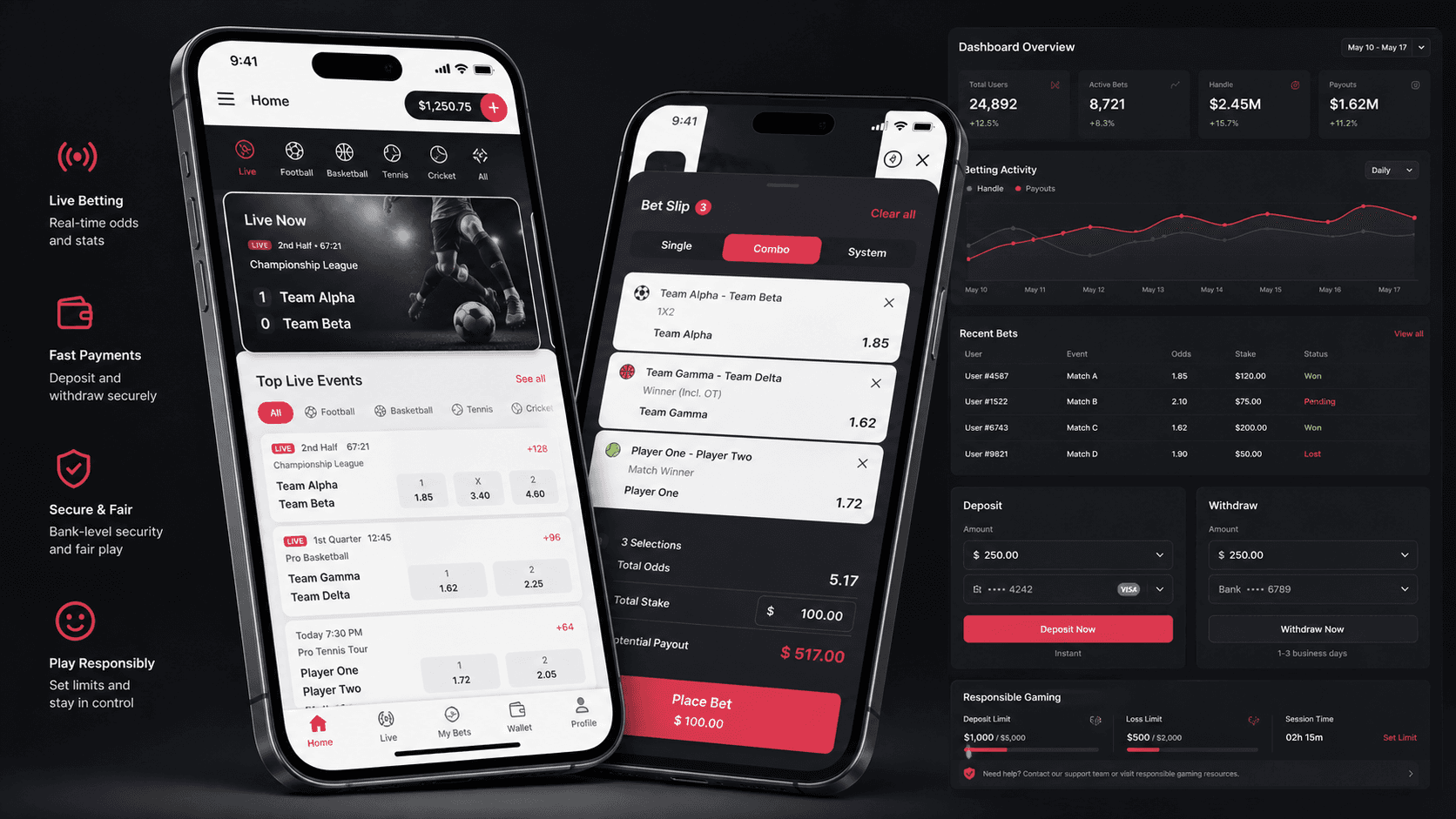
Mobile sports betting app visual with match cards, odds tiles, bet slip, wallet panel, responsible play controls, and supporting admin layers
Project scope

Mobile-first betting product strategy, sportsbook UX architecture, backend API, wallet and account flows, admin console, and operational control layer

Mobile
primary betting experience
Live odds
match and market discovery
Wallet
deposit, balance, and payout flows
Admin/API
operating layer behind the app

Timeline

Mobile sportsbook product build with API and admin-console support systems

The product needed to feel fast on mobile without losing operational control

Online sports betting users expect instant access to matches, odds, bet slips, wallet balances, and account actions from a phone. The platform also needed the account controls, activity review, and administrative systems that let an operator run the betting product responsibly.

  • The mobile app needed quick sport and match discovery, readable odds, and a low-friction bet slip
  • Users needed wallet balance, deposit, withdrawal, identity, password, and account-status flows in one trusted experience
  • Operators needed user review, bet-history visibility, account status controls, and team access behind the scenes
  • The backend needed authentication, validation, response handling, wallet fields, role flags, and betting activity context

A mobile sportsbook experience backed by a protected operating layer

LinePilot is framed as a complete online sports betting platform: the phone is the primary product surface for players, while the ASP.NET API and React admin console form the account, wallet, support, and risk-control layer behind it.

  • Mobile-first sportsbook UX for live and upcoming matches, odds markets, bet-slip review, and account actions
  • Wallet-led flows for balance visibility, deposits, withdrawals, transaction review, and payout confidence
  • JWT-backed signup, login, password, profile, account status, and user lookup APIs
  • React admin console for user management, bet-history review, snippets, team members, and protected operator navigation

Product surfaces

What the platform brought together

The work spanned core product operations, daily user workflows, data-heavy coordination, and resilient platform management.

Mobile sportsbook lobby

The mobile app leads with the moments bettors care about: live fixtures, upcoming matches, odds markets, favorites, and quick movement into the bet slip.

  • Sport and competition browsing with mobile-friendly match cards
  • Odds tiles designed for quick comparison, selection, and state changes
  • Personalized shortcuts for recent sports, saved markets, and high-intent betting moments

Bet slip and wager checkout

The bet slip keeps selection, stake, balance, potential return, confirmation, and result feedback clear on a small screen.

  • Single and multi-selection bet-slip patterns for common sportsbook journeys
  • Stake entry, balance checks, acceptance states, and confirmation feedback
  • Bet-history review for date, bet type, reference, stake, balance, result, and status context

Wallet and account trust

The platform treats payments, identity, and responsible play as central mobile workflows instead of hidden account settings.

  • Balance visibility, wallet fields, account profile, and login history tied to the user model
  • Deposit, withdrawal, payout, and transaction patterns designed for fast account confidence
  • Responsible play controls such as limits, cooling-off states, and account status messaging

Admin, support, and risk operations

Behind the mobile product, operators get the controls needed to review accounts, resolve support issues, and manage platform content.

  • Searchable user tables, account detail screens, status controls, and protected navigation
  • Team-member flows for controlled staff access and role-aware operations
  • Snippet management for reusable notices, help content, promotion text, or operational templates

Module depth

Dedicated product blocks for the highest-value workflows

For large platforms, the conversion story depends on showing how each major module solves a specific operating problem, not only listing features.

Primary surface

Mobile Betting Experience

The public product story starts with the mobile app: fast sports discovery, odds selection, bet-slip confidence, wallet visibility, and account control.

The source establishes sportsbook account, wallet, bet-history, sport, status, auth, and operator capabilities. The public page presents those foundations as the complete mobile sportsbook experience expected by users.

  • Live and upcoming match browsing built for one-handed mobile use
  • Readable odds cards, selections, stake entry, and confirmation feedback
  • Wallet, profile, responsible play, and bet history close to the core betting loop

Product backbone

Sportsbook Account And Wallet API

The API supports the sensitive pieces of the mobile journey: identity, authentication, wallet context, account state, and betting activity review.

The ASP.NET source includes controllers, services, repositories, request models, response models, token service, password hashing, and NPoco-backed database access.

  • Signup, login, profile retrieval, password reset, and password change flows
  • Wallet address, balance, country, date of birth, signup, and last-login fields
  • Repository-backed account persistence with paging, lookup, save, login, status, and delete paths

Operating layer

Admin And Risk Control Console

Sports betting platforms need operational safety behind the mobile app, so the browser console remains a key support and control surface.

Source review found React routes for users, user details, bet history, snippets, and protected admin layout flows, paired with API endpoints for login, signup, get, delete, team members, and account status.

  • Searchable user tables with pagination-ready API parameters
  • Detail pages for identity, contact, status, balance, login, and bet-history context
  • Status and team-member endpoints for support, risk, and internal operations

Buyer priorities

What mattered most to the people evaluating the platform

Prospective buyers want to know whether the work solved real workflow, adoption, reliability, data, and operations problems. These priorities shaped the product decisions.

Mobile conversion

A sportsbook app wins or loses on how quickly users can understand a match, compare odds, add selections, fund the wallet, and place a bet with confidence.

  • Match cards and odds tiles make scanning fast on small screens
  • Bet-slip flow keeps stake, balance, acceptance, and confirmation visible
  • Wallet and account actions stay close to the betting journey

Player trust and responsibility

Sports betting products need to earn trust through account clarity, money movement, status messaging, and visible responsible-play controls.

  • Identity, age, country, mobile number, and profile fields support account readiness
  • Wallet and balance fields keep financial context tied to the player account
  • Blocked, pending, and approved-style account states support safer platform behavior

Operator control

The mobile app is only sustainable when the business can review users, inspect betting context, update status, and control internal staff access.

  • User tables, account details, and bet-history screens reduce support context switching
  • Team-member and role workflows separate public players from internal operators
  • Snippet and status modules give operators reusable control surfaces

System model

How the platform connects roles, workflows, and product surfaces

The product architecture brings every role into the same operating model, with shared data moving cleanly between web, mobile, media, and notification layers.

Mobile betting app journey

A mobile product visual shows match discovery, odds selection, bet slip, wallet context, and responsible play controls.

Bet placement to account review

A workflow diagram connects player signup, match browsing, bet placement, wallet movement, bet history, and operator review.

Player and operator access model

A role matrix separates player, manager, support, and admin responsibilities across the mobile app, API, and console.

Technology

The Stack We Used And Why

The stack section is written for buyers who need to understand the product architecture, operational trade-offs, and long-term maintainability of the system.

Mobile app experience

Used for the primary betting surface where players discover matches, compare odds, manage the bet slip, view wallet status, and control their account.

Mobile-first UXSportsbook product designBet-slip workflowsWallet UXResponsible play controls

Sportsbook API

Used for authenticated account, wallet, profile, status, validation, user lookup, and betting activity workflows behind the mobile app.

ASP.NET CoreC#JWT authenticationFluentValidationNPoco

Admin web

Used for protected browser workflows where operators review users, account details, bet histories, snippets, and team activity.

ReactTypeScriptMaterial UIReact RouterReact TableAxios

Data and operations

Used to support account records, wallet fields, sports catalogs, role flags, status changes, paging, and admin reporting paths.

Relational databaseRepository patternPagination modelsRole-based access control

Why Mobile Was The Lead Surface

Sports betting is a repeated, time-sensitive consumer behavior, so the strongest public story is the phone experience rather than the internal console.

  • Users need live match access, odds comparison, bet slips, wallet actions, and confirmations in seconds
  • A mobile-first structure keeps account, wallet, history, and responsible-play controls close to betting activity
  • The admin console becomes a support layer instead of the center of the product narrative

Why ASP.NET Core And React Support It

The backend and admin console give the mobile sportsbook the operating backbone it needs for trust, support, and account control.

  • Controllers, services, repositories, and request models separate web concerns from business logic
  • JWT tokens and validation rules support protected account workflows
  • React Router, Material UI, and table components help operators scan users and betting history quickly

Delivery

How the product came together

The work moved from domain modeling to core platform delivery, mobile adoption, and operational hardening.

1

Product and evidence review

The API and admin repositories were reviewed as source evidence for a broader online betting product, with private names, source paths, credentials, and screenshots excluded from public copy.

2

Public-safe product framing

The public page positions the work as a mobile-first online sports betting platform, not as a literal code inspection of two private repositories.

3

Implementation and QA

The case study was added to the existing data-driven portfolio system with generated imagery, metadata, schema, and sitemap inclusion through the published portfolio helper.

Operational depth

What made the platform usable after launch

The strongest case studies are not only feature lists. They show how the system is operated, monitored, governed, and improved when real users depend on it.

Mobile-first betting loop

The platform is designed around the repeat player loop: open the app, find a match, compare odds, build a slip, fund the wallet, place the bet, and track the result.

  • Match and market screens prioritize fast scanning and low-friction selection
  • Bet-slip and wallet context reduce uncertainty before confirmation
  • Bet-history states help users understand open, settled, and historical activity

Responsible account controls

Sports betting products need visible account and status controls so users and operators can handle risky or restricted states clearly.

  • Signup and profile flows capture age, country, mobile, zip code, and identity-adjacent fields
  • Account status logic supports blocked, pending, and approved-style platform states
  • Wallet and balance visibility keep money movement grounded in account context

Reusable operating layer

The admin console and API make it possible to operate the mobile sportsbook with support, risk, content, and team workflows.

  • Protected and public layouts separate login from internal work
  • Shared table, pagination, search, and notification components reduce repeated admin code
  • Route metadata controls side navigation, cards, icons, and logout behavior

Results

The measurable and observable lift from the work

The strongest improvements are the ones a buyer can connect to daily work: fewer disconnected tools, safer operations, clearer workflows, and more reliable product behavior.

Mobile

Primary Betting Surface

The case study now leads with the phone experience users expect from an online sportsbook: match browsing, odds, bet slip, wallet, and history.

Wallet

Money Movement Context

Balance and wallet fields anchor deposit, withdrawal, stake, payout, and account-review journeys.

Secure

Account Foundation

Password hashing, JWT generation, validation, role flags, and account statuses establish the base for protected betting workflows.

Admin/API

Operating Backbone

React admin workflows and ASP.NET API services support user review, bet-history inspection, snippets, team members, and status control.

Outcome

A stronger operating system for online sports betting mobile app

The platform reduced tool fragmentation and gave each role a clearer path from live activity to day-to-day action.

A mobile-first online sports betting product story with match discovery, odds browsing, bet-slip checkout, wallet visibility, responsible play controls, and bet-history review

A sportsbook API foundation with signup, login, token generation, profile lookup, password workflows, team-member management, deletion, and account status handling

A React admin console with protected routing for users, account details, bet-history review, snippets, side navigation, breadcrumbs, filters, tables, and logout flows

A role-aware account model covering player, manager, admin, status, wallet, balance, country, contact, signup, last-login, and modification fields

FAQ

Frequently Asked Questions About LinePilot

Answers about the online sports betting mobile app scope, platform model, technology choices, operational workflows, and related build patterns.

What Kind Of Sports Betting Platform Does LinePilot Represent?

LinePilot represents a mobile-first online sports betting platform with match discovery, odds browsing, bet-slip checkout, wallet visibility, account management, bet-history review, responsible play controls, and the backend/admin systems needed to operate it.

Why Is The Mobile App The Primary Surface?

Sports betting is a repeated, time-sensitive behavior. Users want to check live matches, compare odds, place bets, manage wallet balance, and review results from their phone, so the mobile app has to carry the main product experience.

What Role Do The API And Admin Console Play?

The API and admin console support the mobile app with authentication, profile access, account status, wallet context, bet-history review, team-member controls, snippets, and operator workflows for support and risk teams.

What Should A Buyer Plan For In A Similar Sportsbook App?

A similar product should plan for mobile sportsbook UX, odds and market data integration, KYC and age checks, responsible gaming controls, wallet and payment flows, bet placement states, settlement logic, support tooling, and risk operations from the start.

Related services

Build a similarly ambitious product without starting from a blank page.

We can help scope the web, mobile, AI, media, and operating layers needed for your own platform.

Start a project inquiry