Portfolio case study

PressGrid: Newspaper advertisement layout automation platform

A newspaper advertisement layout automation platform that turns Excel ad lists, artwork files, physical page rules, and deterministic packing algorithms into visual page plans for production teams.

Name changed to respect NDA.

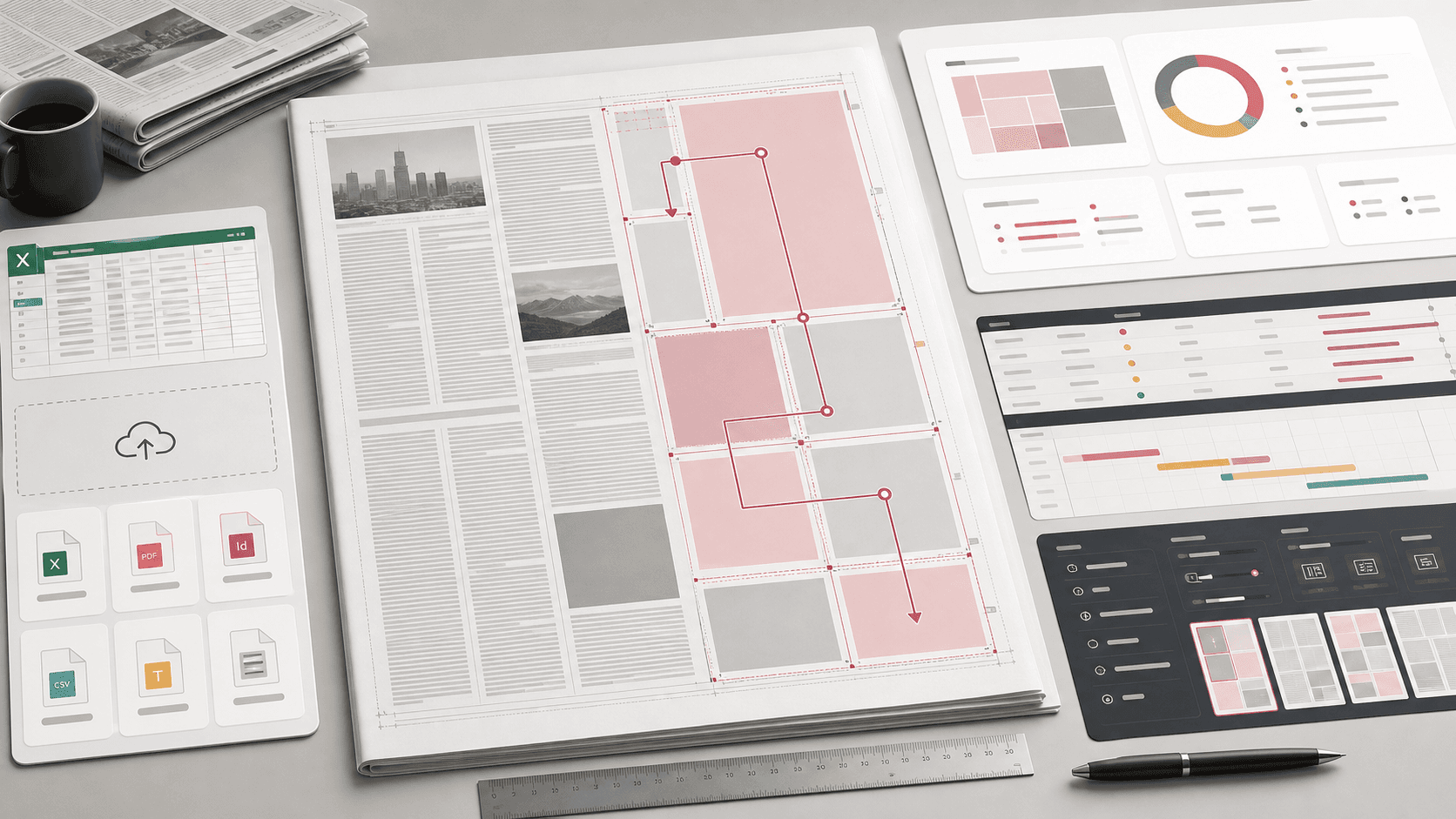
Abstract newspaper advertisement layout automation visual with page grids, ad blocks, import panels, utilization cards, and production workflow surfaces
Project scope

Product engineering across Next.js application workflows, React visualization, deterministic placement algorithms, Excel processing, file matching, S3-backed media handling, MySQL persistence, and production deployment support

33 x 50 cm
production page planning model
4
placement priority groups
0 overlap
core layout constraint
Excel
ad list intake workflow

Timeline

Prototype-to-production newspaper operations platform build and optimization workflow expansion

Manual ad placement made newspaper production slower and riskier

Production teams needed to arrange many paid advertisement blocks on fixed newspaper pages while respecting page size, margins, preferred gaps, fixed-page requests, top-placement rules, and artwork files.

  • Ad dimensions, clients, agencies, RO numbers, page requests, color metadata, and file names arrived through spreadsheets
  • Layout teams needed a visual page plan that could expose overlaps, empty space, and page utilization quickly
  • Fixed-page and top-placement requirements had to be honored before regular ads were packed into remaining space
  • Artwork files needed to be discovered, matched to ad records, uploaded, and previewed without losing production context

A deterministic layout workspace for ad operations

PressGrid brings spreadsheet intake, publication records, ad/file matching, configurable packing rules, page previews, statistics, and production asset handling into one browser-based workflow.

  • Excel parsing normalizes real-world column variations for ad number, dimensions, page, remarks, client, agency, hue, area, and file metadata
  • Bottom-left and column-aware packing routines place ads with boundary checks, overlap prevention, and utilization metrics
  • Interactive page visualization shows ad blocks, color-coded sizes, page navigation, hover details, measurement tools, and empty-space inspection
  • File discovery, S3 upload, CDN URL handling, and database records keep artwork files connected to the ads they represent

Product surfaces

What the platform brought together

The work spanned core product operations, daily user workflows, data-heavy coordination, and resilient platform management.

Excel and publication intake

Daily ad lists become structured publication records that downstream placement and file workflows can trust.

  • Header normalization for common spreadsheet naming variations such as ad number, RO number, width, height, hue, page, remarks, and file name
  • Publication date extraction from file names and folder-ready date formatting
  • MySQL-backed repositories for publications, ads, files, source records, trends, and app settings

Placement algorithm engine

The layout engine models the newspaper page as physical geometry, then places ads according to production rules.

  • Page dimensions, content area, margins, preferred gaps, minimum gaps, and controlled margin overflow modeled explicitly
  • Fixed-page top ads, fixed-page regular ads, free top ads, and regular ads handled as separate priority groups
  • Grid-aware overlap checks and candidate position scoring reduce floating-point placement risk

Page visualization and review

Production users can inspect page plans visually before artwork moves deeper into the publishing workflow.

  • Scaled page preview with ad blocks sized from centimeter-based placement coordinates
  • Page navigation, utilization statistics, tooltips, selection state, size-color grouping, and measurement overlays
  • Alternative layout variation hooks for comparing placement options when utilization leaves room for improvement

Files, storage, and editorial helpers

The platform connects layout planning to production assets and supporting editorial workflows.

  • Ad artwork discovery and matching by ad number, with primary-file selection and association updates
  • S3 upload support for Excel and ad files with generated CDN URLs and file records
  • Editorial assistant surfaces for headline, body copy, refinement, provider selection, and AI-assisted newspaper operations

Buyer priorities

What mattered most to the people evaluating the platform

Prospective buyers want to know whether the work solved real workflow, adoption, reliability, data, and operations problems. These priorities shaped the product decisions.

Layout accuracy

Paid ad placement has little tolerance for overlap or missed constraints, so the platform centered the product around deterministic geometry and validation.

  • Every proposed placement checks page bounds before it is accepted
  • Rectangle overlap logic treats touching blocks as valid while rejecting physical overlap
  • Top-placement and fixed-page requirements are handled before general packing begins

Production speed

The workflow needed to reduce repetitive spreadsheet and visual checking work without asking operators to abandon familiar ad-list inputs.

  • Excel import keeps the daily operating source familiar
  • Automatic ad/file matching reduces manual lookup between records and artwork folders
  • Page utilization, placed/unplaced counts, and page navigation help operators review large runs faster

Operational continuity

A newspaper layout tool has to fit existing production habits, file storage, and deployment realities rather than live as a fragile prototype.

  • MySQL persistence keeps publications, ads, files, settings, and source records queryable
  • S3-backed upload paths move large ad assets outside the application runtime
  • Docker, PM2, and CI/CD notes supported repeatable deployment and maintenance

System model

How the platform connects roles, workflows, and product surfaces

The product architecture brings every role into the same operating model, with shared data moving cleanly between web, mobile, media, and notification layers.

Ad list to page plan

Spreadsheet rows, artwork files, page rules, placement algorithms, and visual review come together in one production workflow.

Production roles and controls

Operators, layout reviewers, editors, administrators, and file managers share one source of truth with scoped workflows.

Shared newspaper operations layer

The React workspace, placement engine, database, file storage, and AI-assisted editorial tools sit on one operating foundation.

Technology

The Stack We Used And Why

The stack section is written for buyers who need to understand the product architecture, operational trade-offs, and long-term maintainability of the system.

Application frontend

Used for the browser workspace where production users select publications, compare algorithms, inspect page plans, and review ad files.

Next.js 16React 19TypeScriptTailwind CSSReact Routerlucide-react

Layout algorithms

Used to convert ad dimensions and page rules into deterministic page placements with zero-overlap validation.

2D bin packingBottom-left fillColumn-aware sortingGrid-based geometryFree-rectangle analysis

Data and files

Used to import spreadsheets, preserve ad records, associate artwork, and serve production files reliably.

ExcelJSPrismaMySQLAWS S3CDN URLsFile discovery

Editorial and extraction tools

Used for adjacent newsroom and ad-operations support where content generation or source extraction can assist production teams.

OpenAI APIGoogle Geminicheerio@mozilla/readabilityProvider fallback controls

Deployment and operations

Used to move the prototype into a maintainable production setup with database setup, asset storage, and service supervision.

DockerPM2Woodpecker CIPrisma migrationsNginx-ready deployment notes

Why Deterministic Algorithms

Advertisement layout is a physical optimization problem where explainable placement rules matter more than vague automation.

  • Bottom-left placement gives operators a predictable packing strategy
  • Grid-based coordinate conversion reduces floating-point errors in centimeter layouts
  • Explicit overlap and boundary checks make failure states easier to inspect and fix

Why Excel And MySQL

The platform needed to respect the way newspaper production data already entered the organization.

  • Excel import supported existing ad-list operations instead of forcing a new intake format
  • Column normalization handled messy spreadsheet variations from real workflows
  • MySQL preserved publication, ad, file, source, and settings records for review and reuse

Why Visual Review Stayed Central

Automation was not enough on its own; operators still needed a fast way to trust and inspect page plans.

  • Scaled previews made centimeter-based coordinates understandable at a glance
  • Hover, selection, measurement, and utilization tools helped catch layout issues before production handoff
  • Variation hooks kept room for future algorithm comparison without redesigning the review surface

Delivery

How the product came together

The work moved from domain modeling to core platform delivery, mobile adoption, and operational hardening.

1

Model the newspaper page

Define physical dimensions, usable area, margins, gaps, coordinate rules, overflow allowances, and placement priorities.

2

Build the placement core

Implement packing strategies, overlap checks, candidate scoring, page metrics, and unplaced-ad reporting.

3

Connect intake and assets

Parse spreadsheets, persist publications and ad records, discover artwork files, and upload production assets to object storage.

4

Ship the operator review surface

Create the visualization, controls, page navigation, statistics, algorithm selector, and editorial helper surfaces.

Operational depth

What made the platform usable after launch

The strongest case studies are not only feature lists. They show how the system is operated, monitored, governed, and improved when real users depend on it.

Production geometry safeguards

The layout system treats geometry as a first-class product concern because small placement errors can break real newspaper pages.

  • Explicit page, content, margin, gap, and overflow dimensions
  • Rectangle separation checks for every proposed placement
  • Placed, unplaced, pages-used, and utilization metrics after packing

File association workflow

Artwork files stay connected to ad records so layout review can move from abstract blocks toward production-ready assets.

  • Ad-number based file discovery
  • Primary file selection and association updates
  • CDN URL handling after S3 upload

Prototype-to-production path

The project carried a working TypeScript prototype while leaving a path for heavier optimization services if production volume required it.

  • Multiple algorithm strategy points in the UI
  • Documented path toward Python or OR-Tools for advanced optimization
  • Docker, PM2, and CI/CD deployment guidance

Results

The measurable and observable lift from the work

The strongest improvements are the ones a buyer can connect to daily work: fewer disconnected tools, safer operations, clearer workflows, and more reliable product behavior.

0 overlap

Placement Constraint

The layout engine was designed around physical non-overlap checks so every accepted ad block remains distinct on the page.

4 groups

Priority-Aware Packing

Fixed-page top ads, fixed-page regular ads, free top ads, and free regular ads are handled in separate placement priority groups.

Excel to visual

Faster Review Loop

Spreadsheet data can move into publication records, algorithmic placement, visual page review, and file-aware production checks.

33 x 50 cm

Real Page Geometry

The system models newspaper page dimensions, content bounds, margins, gaps, and overflow rules directly in the placement workflow.

Outcome

A stronger operating system for newspaper ad layout automation platform

The platform reduced tool fragmentation and gave each role a clearer path from live activity to day-to-day action.

A browser-based production workspace for converting daily ad lists into inspectable newspaper page plans

A deterministic placement foundation with boundary checks, overlap prevention, utilization reporting, and unplaced-ad visibility

A file-aware workflow that connects ad records with discovered artwork, uploads, CDN URLs, and preview-ready production assets

A maintainable product direction for evolving from a TypeScript placement prototype toward higher-scale optimization services when needed

FAQ

Frequently Asked Questions About PressGrid

Answers about the newspaper ad layout automation platform scope, platform model, technology choices, operational workflows, and related build patterns.

What Kind Of Platform Does PressGrid Represent?

PressGrid represents a newspaper advertisement layout automation platform with Excel intake, publication records, deterministic 2D packing, visual page review, ad/file matching, storage workflows, and editorial support tools.

Why Was Custom Software Useful For Newspaper Ad Placement?

The workflow needed to combine physical page constraints, messy spreadsheet intake, ad artwork files, placement priorities, utilization review, and production storage in a way generic design tools do not automate end to end.

How Does The System Reduce Placement Risk?

It models page bounds and margins directly, checks overlap before accepting placements, separates priority groups, reports unplaced ads, and gives operators a visual page preview for review.

Can This Pattern Support Other Print Or Layout Operations?

Yes. The same architecture can support magazine ad planning, catalog layout, print inserts, signage batches, packaging sheets, or any workflow that turns rectangular items into constrained production layouts.

Related services

Build a similarly ambitious product without starting from a blank page.

We can help scope the web, mobile, AI, media, and operating layers needed for your own platform.

Start a project inquiry