Portfolio case study

RewardPulse: Survey rewards and audience insights platform

A survey rewards and audience insights platform that connects participant onboarding, verified profiles, paid survey campaigns, question builders, response analytics, points, payments, and admin review in one operating system.

Name changed to respect NDA.

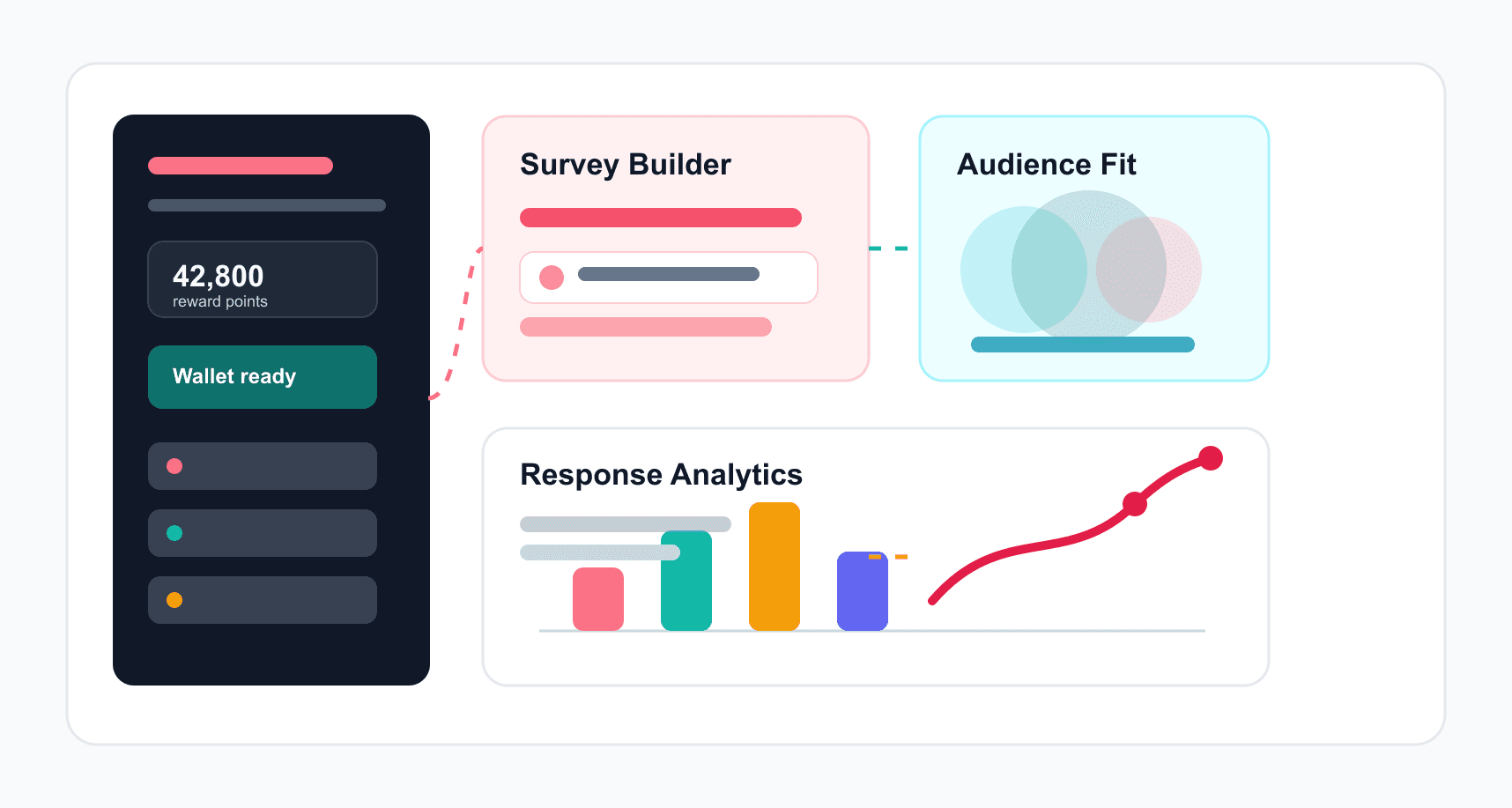
Survey rewards platform visual with campaign builder, audience targeting, wallet balance, and response analytics panels
Project scope

Product engineering, React web app, ASP.NET Core API, survey workflow, rewards logic, analytics, and admin operations

3
role-aware workspaces
7-step
participant onboarding
Points
reward ledger
Charts
survey response analytics

Timeline

Multi-role rewards survey platform build

Survey campaigns needed trust, rewards, and usable analytics

The product needed to serve participants, research clients, and administrators without turning paid survey operations into a spreadsheet-heavy process. Each survey had to be targeted, approved, answered, measured, rewarded, and reconciled.

  • Participants needed guided onboarding, profile verification, and a clear path to eligible surveys
  • Clients needed survey creation, question management, response review, and payment readiness
  • Administrators needed user, survey, approval, status, and quality controls
  • Reward points, payment history, cards, referrals, and response data had to stay connected to the same account model

A connected survey rewards workflow from signup to insight

RewardPulse brings profile intake, campaign setup, survey questions, submission tracking, response charts, wallet-style points, and admin supervision into a React web app backed by an ASP.NET Core API.

  • Multi-step participant signup captured profile, location, demographic, referral, and verification details
  • Client dashboards summarized surveys, approvals, weekly and monthly activity, submissions, popular surveys, and payments
  • Survey builders supported campaign details, demographic targeting, question ordering, answer choices, and file uploads
  • Admin screens reviewed users and surveys while the API enforced roles, verification state, blocked accounts, and survey approval paths

Product surfaces

What the platform brought together

The work spanned core product operations, daily user workflows, data-heavy coordination, and resilient platform management.

Participant onboarding and verification

The signup flow collected the profile data needed to match participants with relevant survey opportunities.

  • Seven-step registration structure for account, demographic, location, household, and profile details
  • Email and phone verification hooks before sensitive survey and client actions
  • Referral code and profile fields that support acquisition loops and targeting logic

Survey campaign builder

Research clients could create campaigns, define targeting rules, add questions, and manage the survey lifecycle.

  • Survey title, description, age range, gender, point value, status, and featured/popular controls
  • Question list management with add, edit, delete, pagination, and drag-sort ordering
  • Question response views for totals, completion rate, typical time spent, answer distribution, and comments

Rewards and payment operations

Survey completion fed into a reward ledger so users and operators could understand earning, spending, and payment activity.

  • Points history tracked earned and spent balances by user and survey
  • Card and payment-history workflows supported client payment readiness
  • Recent payments and payment method screens connected commercial readiness to campaign creation

Admin and reporting console

Administrators could supervise users, surveys, approvals, and health of the survey marketplace.

  • Admin routes for user lists, user details, survey lists, and survey detail review
  • Survey approval and blocked-account handling kept marketplace quality under control
  • Dashboard charts showed survey counts by gender, survey activity over time, submissions, and popular campaigns

Module depth

Dedicated product blocks for the highest-value workflows

For large platforms, the conversion story depends on showing how each major module solves a specific operating problem, not only listing features.

Acquisition

Profile-Led Participant Intake

The onboarding system turns anonymous visitors into usable audience profiles before survey matching begins.

Source evidence includes the multi-step signup components, user model fields, verification endpoints, and role-aware account data.

  • Collects account, contact, demographic, education, occupation, location, family, and referral context
  • Uses verification status to protect campaign creation, account trust, and participant eligibility
  • Supports future segmentation without forcing clients to manually screen every respondent

Operations

Campaign Creation With Approval Control

Clients can assemble surveys while administrators retain the review path needed for quality and compliance.

Source evidence includes the survey controller, survey item controller, client survey pages, and admin survey routes.

  • Survey save rules validate title, description, age range, gender, and point value
  • Question screens support ordered survey items, answer choices, pagination, and response drilldowns
  • Approval endpoints and admin survey routes create a managed publishing workflow

Monetization

Rewards, Cards, And Payment Readiness

The product connects survey participation to points and connects client campaign activity to payment method checks.

Source evidence includes card, payment, and points-history controllers, repositories, tests, and dashboard payment calls.

  • Points history calculates earned, spent, and balance state for survey participation
  • Card screens capture payment method details before client survey creation
  • Payment history and dashboard summaries help operators reconcile commercial activity

Buyer priorities

What mattered most to the people evaluating the platform

Prospective buyers want to know whether the work solved real workflow, adoption, reliability, data, and operations problems. These priorities shaped the product decisions.

Audience trust

Paid survey products depend on profile quality, verification, and clear participant expectations.

  • Profile fields created a stronger basis for survey eligibility
  • Verification checks reduced low-trust account activity before sensitive actions
  • Reward points made survey value visible to participants

Campaign speed

Research clients needed to launch and review campaigns without asking developers to configure every survey.

  • Self-serve campaign and question management kept survey setup inside the product
  • Sortable questions helped clients refine the respondent experience
  • Response analytics turned raw answers into shareable decision support

Marketplace control

Administrators needed enough oversight to protect both participants and research buyers.

  • Role-aware routes separated participant, client, and admin actions
  • Survey approval and blocked-user workflows supported quality control
  • Dashboards surfaced activity, submissions, and payments for operational review

System model

How the platform connects roles, workflows, and product surfaces

The product architecture brings every role into the same operating model, with shared data moving cleanly between web, mobile, media, and notification layers.

Participant to reward loop

A workflow view connects profile intake, survey matching, completion, points, and payment history.

Three operating roles

Participants, research clients, and administrators share one platform with different controls.

Survey platform architecture

The React web app, ASP.NET Core API, database repositories, verification services, file uploads, and analytics endpoints support one operating layer.

Technology

The Stack We Used And Why

The stack section is written for buyers who need to understand the product architecture, operational trade-offs, and long-term maintainability of the system.

Web application

Used for participant signup, client survey management, admin review, dashboards, tables, charts, and account settings.

ReactTypeScriptReact RouterReduxAnt DesignCoreUI

API platform

Used for role-aware survey, user, payment, point, file, dashboard, and verification workflows.

ASP.NET CoreC#NPocoFluentValidationSwaggerNLog

Analytics and reporting

Used to turn submissions, respondent segments, survey activity, and answer distributions into useful dashboards.

ApexChartsRechartsMiniProfilerDashboard APIs

Communications and files

Used for verification, notifications, uploaded survey assets, and account-support workflows.

TwilioRestSharpMultipart uploadsFile APIs

Why React For The Console

The product needed dense client and admin workflows with tables, charts, forms, route guards, and reusable controls.

  • React and TypeScript supported survey builders, response pages, account forms, and dashboard cards
  • Ant Design and chart libraries helped the interface expose operational data quickly
  • React Router made participant, client, and admin surfaces fit into one browser application

Why ASP.NET Core For The API

Survey rewards require clear server-side rules for roles, verification, approvals, rewards, and payments.

  • ASP.NET Core controllers created explicit endpoints for each operational domain
  • NPoco repositories kept survey, user, card, payment, points, and response data accessible
  • Validation, logging, profiling, and Swagger support made the API easier to operate and debug

Why Rewards Needed A Ledger

Paid surveys work only when the product can explain what was earned, what was spent, and why.

  • Points history tied earned rewards to survey completion
  • Balance calculation made wallet state visible for users and operators
  • Payment history gave the client side a commercial audit trail

Delivery

How the product came together

The work moved from domain modeling to core platform delivery, mobile adoption, and operational hardening.

1

Map The Marketplace Roles

Define how participants, clients, and administrators move through the product without exposing the same controls.

2

Build The Survey Core

Create the campaign, question, answer, submission, and survey-taken workflows that make the product useful.

3

Connect Rewards And Payments

Tie survey completion, point balances, cards, and payment history into the account model.

4

Add Reporting And Oversight

Give clients and administrators dashboards for activity, submissions, audience segments, and campaign performance.

Operational depth

What made the platform usable after launch

The strongest case studies are not only feature lists. They show how the system is operated, monitored, governed, and improved when real users depend on it.

Verification-aware actions

Survey creation and sensitive actions can be blocked until email, phone, and payment prerequisites are complete.

  • Client survey creation checks email verification, phone verification, and payment method state
  • API rules return explicit unauthorized, blocked, and verification messages
  • Admin controls can mark accounts verified or blocked based on review needs

Survey response intelligence

Response pages translate survey submissions into answer percentages, totals, completion rate, and time-spent signals.

  • Question-level response charts reveal distribution patterns
  • Survey detail pages show total responses and completion rate
  • Dashboard APIs summarize popular surveys and recent submissions

Reward accounting foundation

Points, payments, cards, and histories create the financial backbone for a paid participation product.

  • Survey completion can write earned point history
  • Balance queries subtract spent points from earned points
  • Payment and card modules prepare the product for paid campaign operations

Results

The measurable and observable lift from the work

The strongest improvements are the ones a buyer can connect to daily work: fewer disconnected tools, safer operations, clearer workflows, and more reliable product behavior.

Self-serve

Survey Setup

Clients could create campaigns and questions from the product instead of relying on manual setup.

Verified

Audience Accounts

Participant profiles and verification state supported more trustworthy survey participation.

Rewarded

Participation Loop

Points and payment history connected user activity to a visible incentive system.

Outcome

A stronger operating system for survey rewards and audience insights platform

The platform reduced tool fragmentation and gave each role a clearer path from live activity to day-to-day action.

A React and TypeScript web app for participant signup, client dashboards, survey management, question ordering, response analytics, admin review, account settings, and payment methods

An ASP.NET Core API covering users, roles, surveys, survey items, submissions, survey completion, files, cards, payments, points history, referrals, and dashboard reporting

A managed survey lifecycle with validation, demographic targeting, approval, featured/popular controls, verification checks, and role-aware access

A public-safe portfolio page that positions the work around survey rewards, audience insight operations, response analytics, and marketplace trust without exposing private repository names or source screenshots

FAQ

Frequently Asked Questions About RewardPulse

Answers about the survey rewards and audience insights platform scope, platform model, technology choices, operational workflows, and related build patterns.

What Kind Of Product Does This Case Study Represent?

It represents a paid survey and audience insights platform where participants complete profile-led surveys, clients manage research campaigns, and administrators supervise quality, rewards, and accounts.

Why Does A Paid Survey Platform Need Verification?

Verification protects campaign quality, reduces duplicate or low-trust accounts, and gives clients more confidence that responses come from eligible participants.

How Do Rewards Fit Into The Product?

Survey completion feeds a points-history model so participants can see earned value while operators keep an audit trail of incentives and payment activity.

Can This Pattern Support Other Research Products?

Yes. The same architecture can support customer panels, product testing communities, brand research, employee surveys, healthcare screeners, academic research panels, and incentive-backed feedback programs.

Related services

Build a similarly ambitious product without starting from a blank page.

We can help scope the web, mobile, AI, media, and operating layers needed for your own platform.

Start a project inquiry