Portfolio case study

StayHaven: Vacation rental marketplace web platform

A vacation rental marketplace platform that connects destination search, property discovery, traveler booking requests, host listing management, owner approvals, amenities, media, and admin controls in one web product.

Name changed to respect NDA.

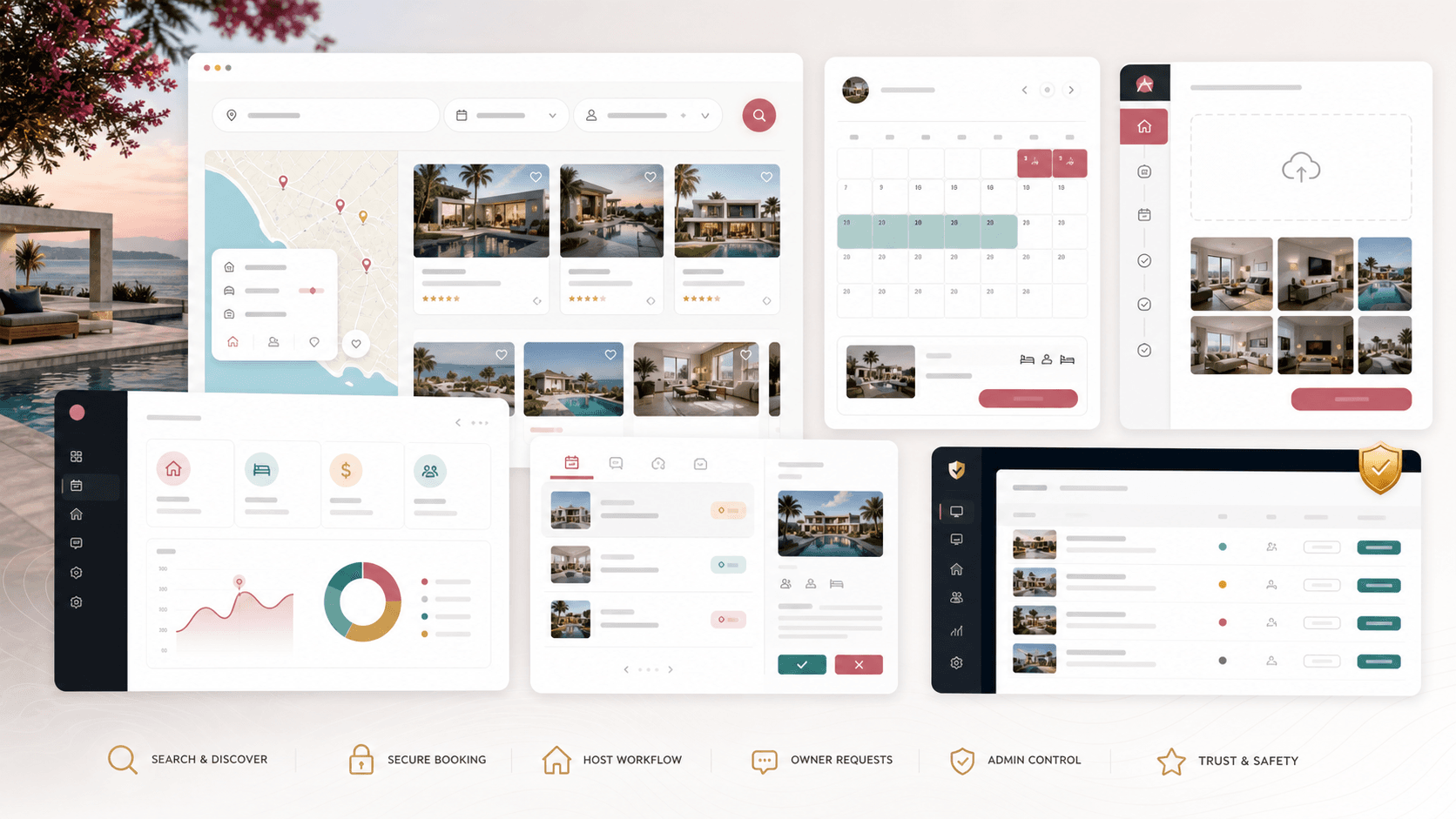
Vacation rental marketplace platform visual with property cards, search filters, booking calendar, host listing workflow, and admin approval controls
Project scope

Marketplace web product engineering, Blazor application development, traveler booking workflows, host listing tools, admin operations, and relational data modeling

3
primary user roles
7+
marketplace workflow areas
Blazor
interactive web app foundation
NPoco
relational data access layer

Timeline

Vacation rental marketplace build with traveler, host, owner, and admin workflows

Travelers, hosts, and operators needed one booking workflow

The marketplace needed to bring property discovery, date-based booking intent, host inventory management, owner approvals, amenities, file handling, and account access into a single hospitality product instead of disconnected forms.

  • Travelers needed destination, date, guest, property-detail, amenity, price, and booking-request flows
  • Hosts needed a structured way to create listings, add media, set location and rules, and manage inventory
  • Owners needed booking-request review with accept and reject actions tied to each property
  • Admins needed user, listing, amenity, and approval controls to keep marketplace supply organized

A role-aware rental marketplace from search to stay operations

StayHaven connects traveler-facing search and property detail pages with host listing workflows, booking management, admin dashboards, email/file services, and a relational marketplace data model.

  • Destination search combines city typeahead, date ranges, adult and child guest counts, and property list navigation
  • Property detail pages expose media galleries, location hierarchy, bedroom and bathroom counts, amenities, prices, rules, reviews, and booking actions
  • Host workflows support listing creation, image uploads, amenities, country/state/city selection, address, price, rules, and deletion
  • Owner and admin views separate booking requests, booking details, user management, listing review, and amenity management

Product surfaces

What the platform brought together

The work spanned core product operations, daily user workflows, data-heavy coordination, and resilient platform management.

Traveler search and discovery

The public marketplace path helps travelers move from intent to a specific property with enough context to request a booking.

  • Home search supports destination typeahead, date-range selection, adult count, child count, and search navigation
  • Property results show image previews, location context, sleeping capacity, price per night, estimated total, and detail links
  • Property pages show media, location, rental description, amenities, rates, availability, reviews, contact-host prompts, and booking actions

Host listing operations

Hosts can create and maintain marketplace supply with structured data instead of sending property details through manual back office channels.

  • Listing forms capture name, bedroom count, bathroom count, amenities, price, images, country, state, city, address, phone, description, and rules
  • File upload handling supports multiple property images and connected listing records
  • My-listings views keep owner inventory, booking counts, edit actions, and listing deletion reachable from the host workspace

Booking request lifecycle

Booking intent is modeled as a request that can be reviewed, accepted, rejected, and tracked across traveler and owner workspaces.

  • Booking pages capture guest details, check-in, checkout, adult and child counts, total amount, and request metadata
  • Owner booking request screens filter bookings by status and route into booking detail review
  • Accept and reject actions update booking status while preserving request and update timestamps

Marketplace admin controls

Operators get the internal controls needed to manage users, amenities, listings, and platform quality as supply grows.

  • Admin routes include user lists, user details, listing review, amenity lists, and amenity editing
  • Role-aware navigation separates traveler, owner, and admin menus after sign-in
  • Email, file, error logging, local storage, and database helpers support the operational web app foundation

Module depth

Dedicated product blocks for the highest-value workflows

For large platforms, the conversion story depends on showing how each major module solves a specific operating problem, not only listing features.

Demand

Search-To-Booking Traveler Journey

The traveler flow turns a broad trip idea into a property-specific booking request with dates, guests, amenities, rates, and stay details attached.

Source evidence showed home destination typeahead, date range selection, guest counts, property results, property-detail booking actions, and booking request persistence.

  • Destination and date filters begin the marketplace funnel
  • Property cards provide price, capacity, and media previews
  • Detail pages combine description, amenities, rates, availability, and booking prompts
  • Booking requests capture traveler identity and stay details for owner review

Supply

Host Listing Management

The host workflow gives property owners a repeatable path for publishing and maintaining supply, which is the core liquidity problem in a rental marketplace.

Source evidence showed owner listing forms, amenity multi-select, file uploads, location dropdowns, rules, descriptions, pricing, my-listings, booking counts, and delete confirmations.

  • Hosts can create listing records with structured location and inventory data
  • Multiple property files can be attached to support media-rich discovery
  • Amenities and rules help travelers compare fit before sending a request
  • Owner inventory views keep listings and booking interest visible

Operations

Admin And Approval Layer

A marketplace needs operator control for users, amenities, listings, and quality review so the public catalog can stay trustworthy.

Source evidence showed admin layouts, user routes, listing routes, amenity CRUD screens, approved-by fields, booking counts, role checks, and shared repository methods.

  • Admin user management supports marketplace access and support work
  • Amenity management keeps property attributes consistent
  • Listing review data includes approval, submitter, city, state, and country context
  • Role-aware menus keep admin, owner, and traveler actions separate

Buyer priorities

What mattered most to the people evaluating the platform

Prospective buyers want to know whether the work solved real workflow, adoption, reliability, data, and operations problems. These priorities shaped the product decisions.

Marketplace liquidity

Vacation rental products need both demand and supply workflows to work, so the platform supports travelers searching and hosts adding inventory.

  • Search, results, and property details help travelers evaluate stays
  • Listing creation and owner inventory tools help hosts add supply
  • Booking request counts give owners a fast signal of property demand

Operational control

Hospitality marketplaces need internal controls for quality, user support, amenity consistency, and listing review.

  • Admin dashboards separate internal work from traveler-facing pages
  • Role-aware navigation routes users to the right workspace after sign-in
  • Approval and status fields create a foundation for quality-control workflows

Booking confidence

Travelers need enough detail before requesting a stay, while owners need enough request data to act on it.

  • Property pages combine location, media, amenities, rates, rules, and availability prompts
  • Booking requests capture contact, guest, date, and total amount context
  • Owner review screens make accept and reject decisions explicit

System model

How the platform connects roles, workflows, and product surfaces

The product architecture brings every role into the same operating model, with shared data moving cleanly between web, mobile, media, and notification layers.

Traveler to booking workflow

A marketplace workflow maps destination search, property comparison, property detail review, booking request, and owner decision.

Three role operating model

Travelers, hosts, and admins share one platform while seeing different controls and marketplace responsibilities.

Marketplace web platform

The Blazor web app connects search pages, host tools, admin operations, database repositories, file services, and email workflows.

Technology

The Stack We Used And Why

The stack section is written for buyers who need to understand the product architecture, operational trade-offs, and long-term maintainability of the system.

Web application

Used for an interactive marketplace experience with traveler search, property details, account flows, owner tools, and admin views.

ASP.NET CoreBlazorC#Razor ComponentsBootstrap

Marketplace data

Used to model listings, bookings, users, roles, amenities, files, locations, booking status, approval context, and marketplace queries.

Relational databaseNPocoRepository patternSQL joinsPagination

User and role workflows

Used to separate traveler, owner, and admin experiences while keeping account, navigation, and booking flows connected.

Blazored LocalStorageRole checksAccount pagesProtected layouts

Operations and services

Used for file uploads, image-backed listings, notifications, email delivery, error tracking, and deployable app operations.

InputFile uploadsEmail serviceElmahCoreAnt Design BlazorPublish scripts

Why Blazor For The Marketplace

The product needed dynamic forms, role-aware navigation, interactive booking screens, and admin workflows while staying inside the .NET ecosystem.

  • Blazor kept traveler pages, owner tools, and admin screens in one C# web application
  • Razor components supported form-heavy workflows such as booking, signup, listing creation, and admin edits
  • ASP.NET hosting gave the app a straightforward deployable web foundation

Why A Relational Marketplace Model

Rental marketplaces depend on strongly connected records across users, listings, cities, amenities, files, and bookings.

  • Listing queries join users, city, state, country, approval, and booking-count context
  • Booking records connect traveler requests to properties, dates, status, and total amount
  • Repository methods kept read, save, paging, and delete workflows consistent across modules

Why Separate Roles Early

The platform needed different navigation and workflows for travelers, property owners, and administrators from the first usable version.

  • Travelers see property discovery and trip history
  • Owners see listings and booking requests
  • Admins see users, listings, amenities, and dashboard controls

Delivery

How the product came together

The work moved from domain modeling to core platform delivery, mobile adoption, and operational hardening.

1

Map marketplace roles

Define traveler, host, owner, and admin workflows so search, listings, bookings, and controls could share one product model.

2

Build traveler flows

Implement destination search, property results, property detail pages, availability inputs, amenities, and booking request submission.

3

Add host operations

Create listing management, media uploads, amenities, location selectors, rules, pricing, my-listings, and booking request review.

4

Harden admin controls

Layer in user management, amenity management, listing review, role-aware navigation, email/file helpers, and operational support paths.

Operational depth

What made the platform usable after launch

The strongest case studies are not only feature lists. They show how the system is operated, monitored, governed, and improved when real users depend on it.

Role-aware navigation

The app changes available actions after sign-in so admins, owners, and travelers each land in a workflow that matches their job.

  • Admins can access property listings and dashboard/user controls
  • Owners can manage listings and create new properties
  • Travelers can view properties and track trips without seeing owner tools

Listing quality controls

The listing model includes the operational fields needed to review, approve, locate, and support property inventory.

  • Approval fields capture reviewer and timestamp context
  • Location joins attach city, state, and country labels to listing records
  • Amenity and file relationships keep property attributes and media organized

Booking review loop

Owners can review incoming requests and update status, giving the marketplace a practical booking workflow before deeper payment automation.

  • Booking requests store traveler contact and stay details
  • Owner views filter request lists by status
  • Booking detail actions update accepted or rejected status with update metadata

Results

The measurable and observable lift from the work

The strongest improvements are the ones a buyer can connect to daily work: fewer disconnected tools, safer operations, clearer workflows, and more reliable product behavior.

End-to-end

Booking Path

Search, property detail, date and guest selection, booking request submission, and owner status updates are represented in one web app.

Role-aware

Marketplace Workspaces

Traveler, owner, and admin navigation creates separate product surfaces for demand, supply, and operations.

Structured

Listing Inventory

Properties include location, media, amenities, capacity, price, description, rules, approval, and booking-count context.

Operational

Admin Foundation

User management, listing review, amenities, files, email, and error handling give the product a maintainable operating layer.

Outcome

A stronger operating system for vacation rental marketplace platform

The platform reduced tool fragmentation and gave each role a clearer path from live activity to day-to-day action.

A Blazor vacation rental marketplace with destination search, date ranges, guest counts, property results, property details, and booking request flows

Host and owner workflows for listing creation, media uploads, amenities, location selection, rules, pricing, my listings, booking requests, and accept or reject decisions

Admin workflows for users, listings, amenities, approval context, role-aware navigation, and platform operations

A relational marketplace foundation that connects users, roles, listings, bookings, files, amenities, countries, states, cities, and operational metadata

FAQ

Frequently Asked Questions About StayHaven

Answers about the vacation rental marketplace platform scope, platform model, technology choices, operational workflows, and related build patterns.

What Kind Of Marketplace Does StayHaven Represent?

StayHaven represents a vacation rental marketplace web platform with traveler search, property discovery, booking requests, host listing management, owner booking review, amenities, files, account access, and admin controls.

Why Do Vacation Rental Platforms Need Separate Traveler, Host, And Admin Workflows?

Travelers need search and booking confidence, hosts need inventory and request management, and admins need quality controls. Separating those workflows keeps the marketplace usable as both demand and supply grow.

How Were Booking Requests Supported?

The booking flow captures property, traveler, check-in, checkout, guest counts, total amount, request owner, request time, update owner, update time, and status so owners can review and accept or reject requests.

Can This Pattern Support Larger Hospitality Products?

Yes. The same architecture can extend into payments, channel management, calendar sync, messaging, cleaning operations, tax rules, trust and safety checks, loyalty programs, and hospitality analytics.

Related services

Build a similarly ambitious product without starting from a blank page.

We can help scope the web, mobile, AI, media, and operating layers needed for your own platform.

Start a project inquiry