
Quick Answer: Restaurant Management Software Development Cost
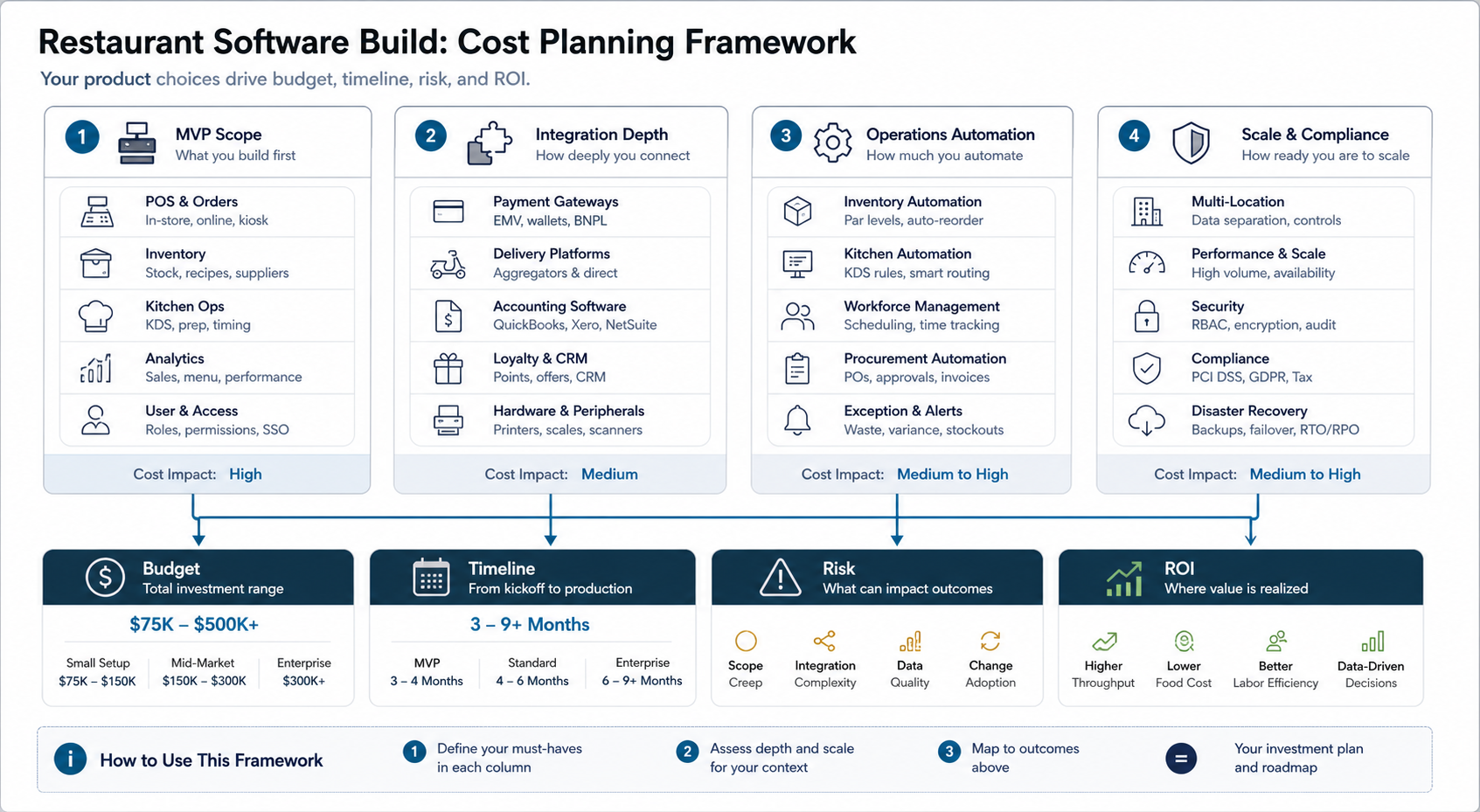
Restaurant management software development cost usually starts around $35,000 to $70,000 for a focused single-location MVP, $80,000 to $180,000 for a multi-location restaurant operating system, and $180,000 to $450,000+ for a restaurant SaaS platform with advanced analytics, third-party integrations, and role-based administration. The budget depends less on the phrase "restaurant management software" and more on what the system must control: POS workflows, kitchen display screens, inventory, recipes, suppliers, staff scheduling, CRM, loyalty, delivery channels, accounting, reporting, and compliance.
If you already have a POS and only need an operations layer around inventory, ordering, and analytics, the build can stay lean. If the software must replace or deeply integrate with POS, payments, delivery marketplaces, kitchen hardware, accounting, and multi-brand reporting, the cost rises quickly. Before you ask for a quote, separate must-have operating workflows from future automation ideas and run the scope through a custom software cost estimator so the first conversation is about assumptions, not a generic hourly rate.
This guide is written for restaurant groups, ghost kitchen operators, QSR brands, and founders comparing restaurant app development services or building restaurant operations SaaS. It uses the queued reference topic as context, but the recommendations are original and focused on practical scope decisions.
Why Restaurant Software Cost Varies So Much
Restaurant software is expensive when it has to be operationally correct during service. A marketing dashboard can tolerate a delayed sync; a kitchen display, stock deduction, or payment workflow cannot. The system also touches several teams at once: front-of-house staff, kitchen teams, managers, procurement, finance, marketing, and owners. Every role adds permissions, workflows, training needs, and edge cases.
Recent restaurant technology research explains why scope keeps expanding. TouchBistro's January 2026 restaurant report says 81% of independent operators saw takeout and delivery sales increase compared with 2024, while 74% planned to spend more on technology in the next six months. It also lists order-ahead platforms, QR menus and payments, AI voice ordering, labor tools, reservations, menu optimization, and inventory management among active investment areas. The National Restaurant Association's technology research similarly highlights back-office systems, inventory control, POS, mobile payments, app ordering, and digital ordering as operator priorities.
That does not mean every restaurant needs a giant custom platform. It means the build needs a clear boundary. A single-location restaurant may need a lightweight web app that connects ordering, stock, and daily reports. A 40-location QSR group may need permissioned regional dashboards, menu versioning, kitchen display coordination, vendor purchasing, forecasting, and audit logs. The second product is not just "more screens"; it is a different operating model.
Cost by Product Type
The fastest way to estimate restaurant software is to classify the product model before counting features.
| Product model | Typical scope | Planning budget | Timeline |
|---|---|---|---|
| Single-location MVP | Admin dashboard, menu/item setup, simple inventory, basic reporting, limited POS or ordering integration | $35,000-$70,000 | 10-16 weeks |
| Multi-location operating system | Location hierarchy, role permissions, KDS support, supplier workflows, staff scheduling, CRM/loyalty, analytics, integration syncs | $80,000-$180,000 | 4-7 months |
| Restaurant SaaS platform | Multi-tenant architecture, billing, onboarding, integrations marketplace, advanced analytics, AI forecasting, audit logs, support tooling | $180,000-$450,000+ | 7-12+ months |
These ranges are planning ranges, not fixed quotes. A simple MVP can exceed the upper band if it needs real-time POS sync, offline tablet mode, payment flows, or certified hardware integrations. A larger platform can stay under control if it starts with a narrow operating wedge such as inventory and menu profitability instead of trying to replace every system on day one. For comparison, see how broader custom software development cost changes with workflow complexity, integration count, and team shape.
Module Scope: What You Are Actually Paying For
A restaurant management platform is a bundle of operating modules. The budget changes according to how many modules must be production-ready at launch and how tightly they interact.
POS and Order Management
POS scope can mean anything from reading finalized orders through an API to building a complete checkout, discounts, refunds, taxes, tips, and split-payment workflow. If you are not replacing the POS, keep the custom layer focused on menu sync, order status, sales reporting, and exception handling. If you are building POS-like workflows, budget for device testing, payment edge cases, tax logic, cash drawer rules, permissions, and staff training.
Kitchen Display and Fulfillment
Kitchen display systems are deceptively complex because speed and reliability matter during peak hours. Cost drivers include station routing, modifiers, prep timing, bump-screen behavior, offline handling, printer fallback, order throttling, and delivery pickup coordination.
Inventory, Recipes, and Suppliers
Inventory modules become valuable when they connect sales to ingredient depletion and purchasing. The MVP version tracks stock items and low-stock alerts. A mature version connects recipes, prep batches, vendor catalogs, purchase orders, waste logs, substitutions, and variance reports; teams with broad back-office workflows can also compare this scope with custom ERP development services. This is where restaurant software starts affecting margin, not just convenience.
CRM, Loyalty, and Marketing
CRM and loyalty features add customer profiles, order history, rewards, coupons, segments, campaigns, and consent rules. They are worthwhile when the restaurant already has repeat-order behavior or a multi-location brand, but they can distract an early MVP if operational data is still messy.
Analytics and Forecasting
Analytics cost depends on data quality. A clean dashboard that combines POS, inventory, labor, and delivery data can expose margin leaks. Forecasting adds another layer: historical demand, weather, events, seasonality, menu changes, waste, and supplier lead times. AI forecasting should be scoped after the reporting foundation is trusted.
Integration Costs That Change the Budget
Integrations are usually the largest hidden cost. They introduce authentication, API limits, mapping rules, failed sync retries, webhooks, duplicate records, and support ownership. A restaurant platform may need to integrate with Toast, Square, Clover, Oracle MICROS, DoorDash, Uber Eats, Swiggy, Zomato, QuickBooks, Xero, payroll tools, SMS/email providers, loyalty tools, and payment processors.
Each integration should have a business reason. A delivery marketplace sync can reduce menu mistakes and manual order entry. Accounting integration can save finance time. Inventory-to-POS sync can improve menu profitability. But integrating everything at launch creates a fragile MVP. Start with the system of record, the revenue channel that matters most, and the reporting outputs managers actually review.
If your roadmap includes customer ordering, delivery, or direct restaurant commerce, compare your scope with the decisions in our food delivery app development cost guide. If the platform is mainly a web dashboard with complex roles and reporting, the assumptions in our web app development cost guide will be closer.
Restaurant Software Cost Driver Framework
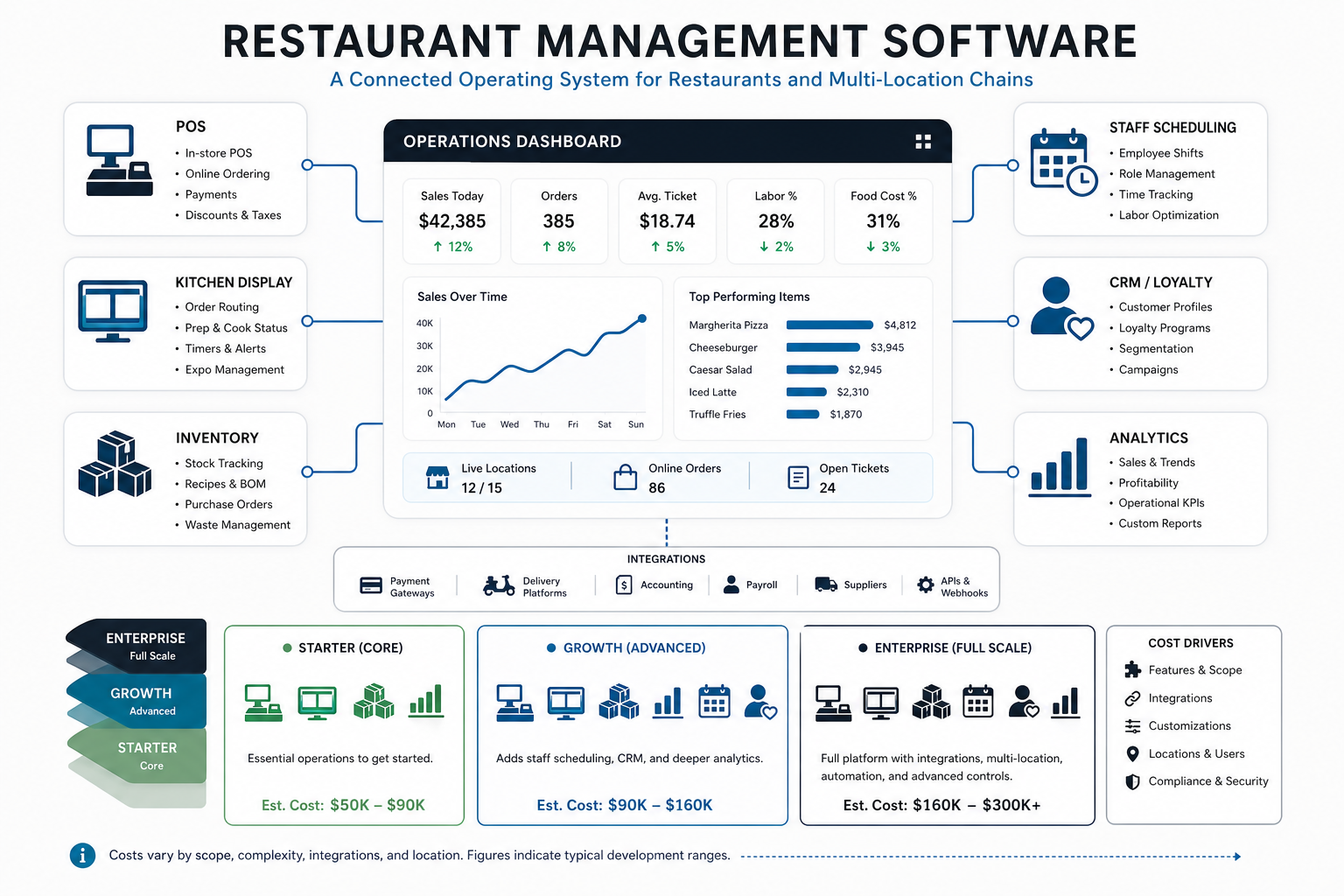
Use four questions to keep the estimate grounded:
- What is the first operating problem? Examples: inventory leakage, kitchen delays, manual reporting, menu inconsistency, delivery errors, or poor labor visibility.
- Which system owns the source data? POS, accounting, ordering marketplace, inventory tool, or the new platform itself.
- Who acts on the output? Store managers, kitchen staff, procurement, finance, marketers, franchise owners, or customers.
- What must work during service? Anything used live by staff needs stricter performance, offline, and support planning than a weekly reporting feature.
These answers decide whether you need a focused MVP, a full operating layer, or a SaaS-grade product. They also decide the team: product manager, UX designer, full-stack engineers, mobile/tablet engineers, QA, DevOps, data engineer, and integration specialist.
Timeline and Team Shape
A focused MVP usually needs 10 to 16 weeks if the team has clear workflows, API access, and a narrow integration set. Multi-location platforms usually need four to seven months because permissions, reporting, rollout training, and integration reliability need more cycles. SaaS products can take seven to twelve months or more because they need tenant isolation, onboarding, billing, admin tooling, support workflows, and deeper QA.
The team shape should match risk. For an MVP, a product lead, UX designer, two full-stack engineers, QA, and part-time DevOps support may be enough. For a multi-location rollout, add integration engineering, data/reporting expertise, and stronger QA automation. For a SaaS platform, add product analytics, security review, customer onboarding workflows, and infrastructure monitoring from the start.
Many buyers choose a blended delivery team to control cost while keeping senior architecture close. If you are comparing hiring models, the cost assumptions in our software development outsourcing to India guide can help you compare in-house, agency, and dedicated-team options.
Build vs. Buy: When Custom Software Makes Sense
Do not build custom restaurant software just because off-the-shelf tools feel crowded. Buy or configure existing platforms when your workflows are standard, your team needs quick deployment, and your differentiation comes from food, service, or brand rather than operational software. Custom development makes sense when your restaurant model has unusual workflows, multiple brands, franchise controls, custom reporting, internal operating IP, or a SaaS product opportunity.
| Choose off-the-shelf | Choose custom |
|---|---|
| You need POS, payments, reservations, or loyalty quickly. | You need one workflow across POS, inventory, kitchen, delivery, and finance. |
| Your locations can adapt to standard processes. | Your operating model is the differentiator. |
| You do not want to own technical support. | You need ownership of data, roadmap, integrations, and analytics. |
| Monthly SaaS fees are acceptable. | Per-location fees, marketplace commissions, or manual work are limiting growth. |
A hybrid approach is often best: keep proven POS and payment systems, then build the custom operations, reporting, integration, and decision layer around them.
How to Build an ROI Plan Before Development
Restaurant software ROI should be measured against operating outcomes, not just engineering output. Useful ROI signals include fewer stockouts, lower waste, faster payment time, fewer delivery mistakes, reduced manual reporting, better labor planning, improved menu profitability, higher repeat orders, and faster new-location onboarding.
Before development, define baseline metrics for three to five workflows. For example: inventory variance, daily manager reporting time, delivery refund rate, menu update time across channels, labor schedule change time, and average kitchen ticket time. Then define what improvement would justify the build. A $120,000 system has a different ROI story if it saves 20 manager-hours per week across 10 locations, reduces waste by 2%, and improves menu margin visibility than if it only replaces a spreadsheet.
Use the estimator CTA after you know the first workflow, user roles, integrations, and reporting outputs. That produces a better planning range and a cleaner build-vs-buy discussion.
Implementation Roadmap
A practical restaurant software roadmap should avoid "big bang" replacement. Start with discovery and workflow mapping, then launch a controlled pilot before scaling across locations.
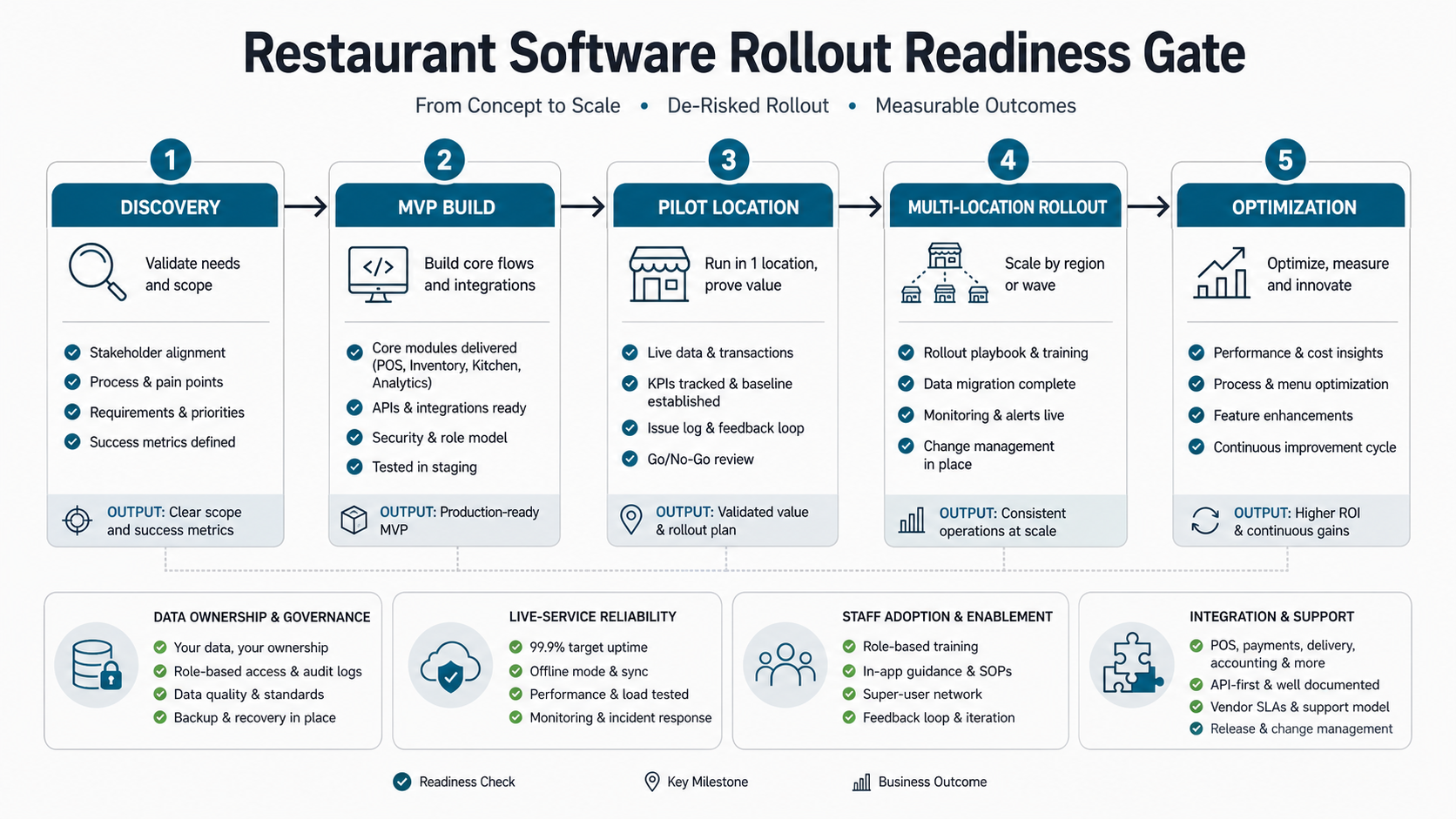
Phase 1: Discovery and Architecture
Map user roles, service workflows, POS/data sources, reporting needs, and integration constraints. Decide which system owns menus, orders, inventory, labor, and customer data.
Phase 2: MVP Build
Build the narrowest workflow that proves value. For many teams, that is inventory plus dashboard reporting, menu sync plus delivery operations, or kitchen display coordination for a specific format. A structured MVP scope builder can keep the first release from absorbing every future feature request.
Phase 3: Pilot Location
Run the system in one or two controlled locations. Measure speed, staff adoption, sync failures, edge cases, and manager decisions. Fix operational friction before adding more features.
Phase 4: Multi-Location Rollout
Add location hierarchy, permissions, training, support processes, dashboards, and rollout automation. This is where analytics, supplier workflows, and loyalty integrations become more valuable.
Phase 5: Optimization and Automation
After trusted data exists, add forecasting, AI menu optimization, automated purchasing suggestions, and deeper performance analytics. AI belongs after the data model is stable, not before.
For a scoped estimate, start with the custom software cost estimator, then use the result to decide whether the first release should be an MVP, an operating dashboard, or a full restaurant SaaS platform.