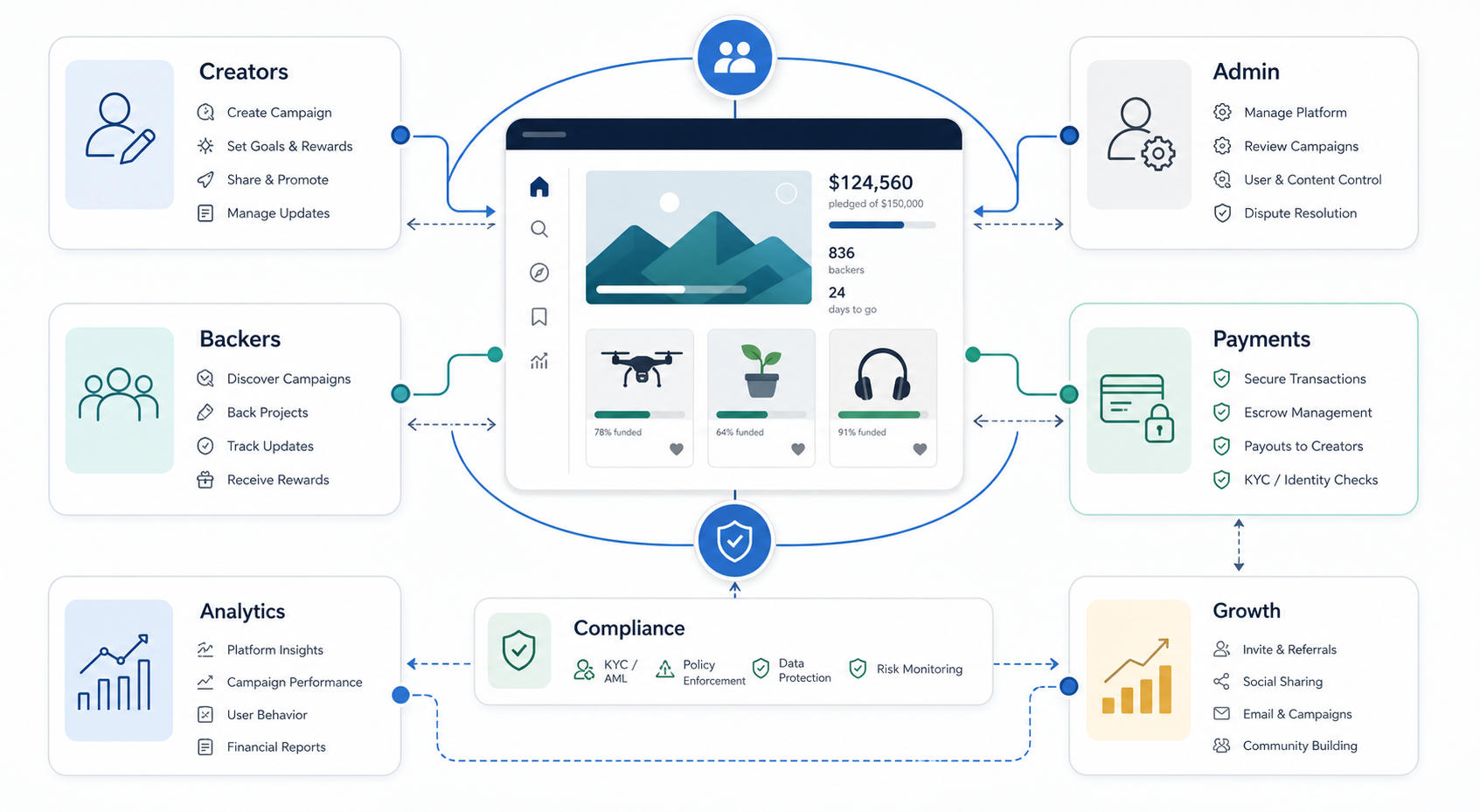

Creating a crowdfunding platform is not just a website project. It is a marketplace product that must balance campaign creators, backers, payments, compliance, trust, communication, analytics, and long-term platform operations.
The practical answer: start by choosing the crowdfunding model, validate the first user journey, launch a focused MVP, and treat payments, fraud controls, KYC, campaign review, and reporting as core architecture decisions. If the product will handle complex rules, regulated fundraising, multiple roles, or custom workflows, plan it as custom software development instead of stretching a generic template.
Quick Answer: How Do You Create A Crowdfunding Platform?
To create a crowdfunding platform, define the fundraising model, map the creator and backer journeys, decide how money moves, build an MVP with campaign pages and payment flows, add trust and compliance controls, test the product with a narrow audience, then expand features based on real campaign behavior.
- For donation platforms: prioritize trust signals, simple giving, donor receipts, campaign updates, and transparent use of funds.
- For reward platforms: prioritize pledge tiers, shipping data, creator updates, refund logic, and launch-day traffic readiness.
- For equity or lending platforms: prioritize legal review, investor onboarding, KYC, disclosures, document workflows, and audit trails.
- For niche marketplaces: prioritize category rules, campaign vetting, community features, analytics, and repeatable operating processes.
What Is A Crowdfunding Platform?
A crowdfunding platform helps people or organizations raise money from many contributors through online campaigns. The platform gives campaign owners tools to explain the idea, set a goal, collect funds, communicate progress, and report outcomes. Backers use the platform to discover campaigns, evaluate trust, contribute money, and receive updates, rewards, repayment, or ownership depending on the model.
The platform owner operates the marketplace. That means managing onboarding, campaign quality, payment rules, moderation, disputes, reporting, and growth. The product succeeds only when all three sides, creators, backers, and operators, can trust the system.
Choose The Right Crowdfunding Model First
The model determines the platform architecture. A donation platform can be relatively simple. An equity, lending, or real-estate platform needs deeper compliance, document management, identity checks, payment controls, and reporting.
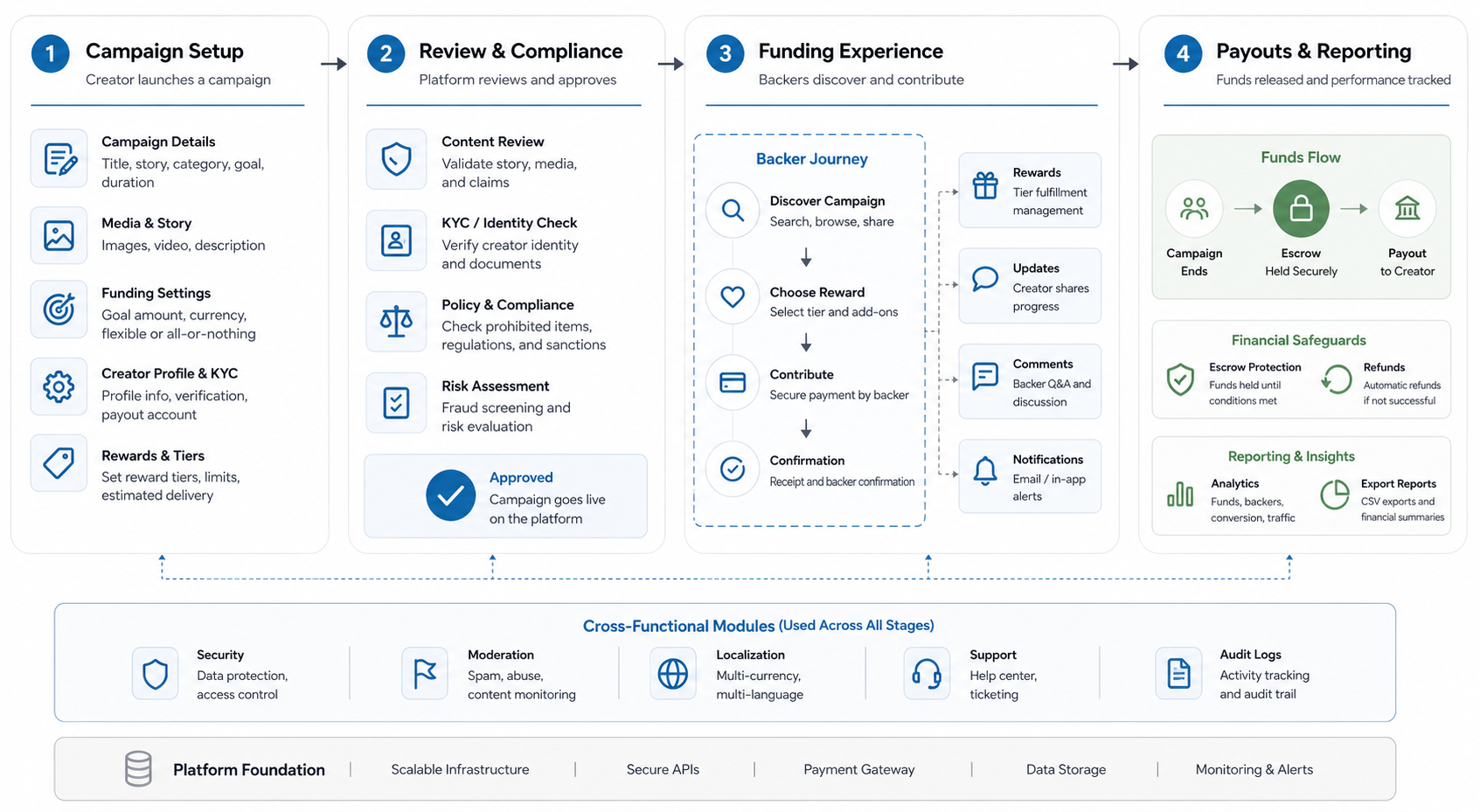
| Model | Best Fit | What To Watch |
|---|---|---|
| Donation crowdfunding | Charities, social causes, medical support, community funds, emergency help | Trust, campaign verification, donor receipts, transparency, and fraud reporting |
| Reward crowdfunding | Products, creative projects, games, hardware, creator communities | Pledge tiers, inventory promises, delivery risk, refunds, shipping data, and creator communication |
| Equity crowdfunding | Startups and private companies raising investment | Securities regulation, investor eligibility, disclosures, KYC, documents, and audit trails |
| Peer-to-peer lending | Borrowers and lenders using loan-based funding | Credit risk, repayment schedules, loan servicing, identity checks, collections, and regulatory review |
| Real-estate crowdfunding | Property investment and development projects | Deal documents, investor reporting, due diligence, distributions, and jurisdiction-specific rules |
Define The Core User Roles
A crowdfunding product normally needs at least three role groups: campaign creators, backers, and platform operators. More advanced models may add investors, borrowers, legal reviewers, verification agents, finance admins, moderators, fulfillment teams, and support users.
Creator Features
- Creator onboarding and profile verification
- Campaign setup with goal, deadline, story, media, risks, documents, and updates
- Reward tiers, investor documents, repayment terms, or project milestones depending on the model
- Campaign preview, submission, approval status, analytics, and backer communication
Backer Features
- Account registration, saved payment methods, and profile settings
- Campaign search, filtering, discovery, and category browsing
- Secure contribution flow with receipts and confirmation emails
- Saved campaigns, updates, comments, refunds, rewards, or investment documents
Admin Features
- Campaign review, approval, moderation, and takedown workflows
- User management, role permissions, support tools, and dispute tracking
- Payment monitoring, payout controls, refunds, fees, and revenue reports
- Compliance queues, document review, fraud alerts, and audit logs
Plan A Crowdfunding MVP Before Building Everything
The best first release should prove that campaign creators can launch credible campaigns and backers are willing to contribute through your platform. Avoid building every advanced feature before validating the operating model.
A useful MVP usually includes campaign creation, campaign review, public campaign pages, contribution checkout, basic updates, email notifications, admin review, payment tracking, and reporting. Add complex rewards, investor dashboards, escrow logic, community feeds, mobile apps, or advanced analytics only when the model needs them for launch. The MVP Scope Builder can help separate first-release features from later roadmap items.
Crowdfunding Platform Workflow
A crowdfunding platform should move users through a controlled workflow, not a loose set of pages. The workflow keeps campaign quality high, protects backers, and gives the platform owner enough visibility to manage risk.
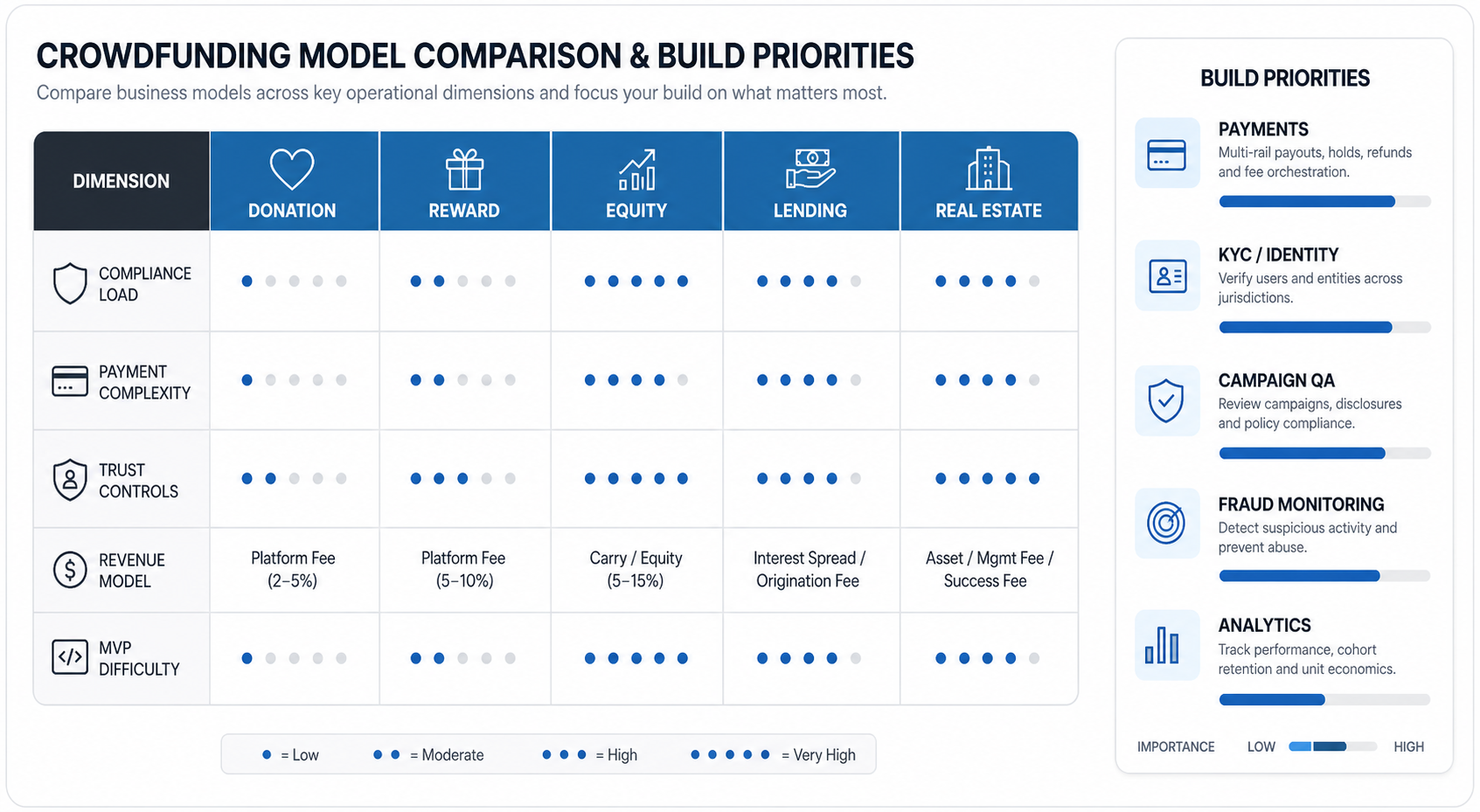
- Campaign setup: the creator adds the story, funding goal, deadline, media, rewards or terms, risks, and supporting documents.
- Review and compliance: the platform checks campaign quality, ownership, restricted content, identity, payment eligibility, and legal requirements.
- Funding experience: backers discover campaigns, review credibility signals, contribute money, receive confirmations, and follow updates.
- Payout and fulfillment: the platform releases funds, handles refunds or failed payments, supports reward delivery, and records revenue.
- Reporting and growth: admins monitor conversion, campaign success rates, fraud signals, creator performance, and category-level demand.
Must-Have Crowdfunding Platform Features
Feature planning should start with trust and transaction flow. A beautiful campaign page is not enough if the platform cannot verify users, move money safely, answer disputes, or explain what happens after a contribution.
- Campaign builder: structured fields for story, media, goals, timelines, risks, categories, documents, and updates.
- Discovery: search, filters, featured campaigns, categories, recommendations, and social sharing.
- Payments: contribution checkout, wallet or card handling, platform fees, refunds, payout rules, failed-payment recovery, and receipts.
- Trust controls: identity checks, campaign review, risk disclosures, moderation, reporting tools, and fraud monitoring.
- Communication: campaign updates, comments, questions, direct notifications, and email workflows.
- Admin console: dashboards for campaigns, users, payments, revenue, disputes, support tickets, and compliance queues.
- Analytics: creator analytics, platform KPIs, backer conversion, campaign success rates, and cohort reporting.
Advanced Features To Add After Validation
Advanced features are useful when they match the business model. Build them after the MVP proves demand, unless the model cannot legally or operationally launch without them.
- Escrow or milestone releases: useful when funds should be released only after conditions are met.
- KYC and KYB workflows: important for regulated fundraising, lending, investment, and high-risk categories.
- Creator CRM: helps the platform onboard, coach, and retain campaign creators.
- Reward and fulfillment management: needed for product launches and creator campaigns with physical or digital rewards.
- Community features: comments, updates, endorsements, group campaigns, and supporter badges can improve engagement.
- Risk scoring: combines campaign data, payment signals, reports, and moderation history to flag risk earlier.
- Mobile apps: useful when discovery, updates, or repeat giving must happen frequently on mobile devices.
How Crowdfunding Platforms Make Money
The revenue model should be clear before product design because it affects checkout, reporting, pricing pages, creator onboarding, and payout accounting.
- Platform fee: a percentage of funds raised, often charged only when campaigns receive money.
- Payment processing spread: a transparent markup or negotiated processing arrangement, if allowed by the payment setup.
- Subscription plans: monthly or annual creator plans for advanced tools, analytics, support, or recurring campaigns.
- Listing or application fees: useful for curated platforms where campaign review takes material effort.
- Promotion fees: paid placement, campaign boosts, newsletter promotion, or category sponsorship.
- Success services: optional campaign strategy, landing page design, video production, fulfillment support, or compliance assistance.
Crowdfunding Platform Development Cost Factors
Crowdfunding platform cost depends on the model, payment complexity, compliance requirements, user roles, campaign workflows, reporting needs, and whether you need mobile apps. A donation MVP can be much smaller than an equity or lending platform with investor onboarding, document review, audit trails, and regulated reporting.
Use marketplace app development cost planning as the closest comparison because crowdfunding products share the same buyer-seller-admin marketplace dynamics. For a directional budget, the custom software cost estimator can help frame complexity, team shape, and timeline before detailed scoping.
| Cost Driver | Why It Matters |
|---|---|
| Fundraising model | Donation, reward, lending, equity, and real-estate models carry different product and compliance requirements. |
| Payment architecture | Contribution checkout, refunds, payout timing, fees, escrow, and reconciliation can become major build areas. |
| Compliance depth | KYC, KYB, disclosures, document review, audit logs, and reporting add scope and testing effort. |
| Campaign tooling | Rich campaign builders, media, milestones, rewards, updates, and creator analytics increase product depth. |
| Admin operations | Review queues, moderation, support, disputes, revenue reporting, and risk monitoring are essential for platform control. |
| Mobile experience | Native apps or advanced mobile workflows add design, engineering, QA, and release-management effort. |
Build Strategy: Template, SaaS, Or Custom Platform?
Templates can work for a small proof of concept, and SaaS fundraising tools can be useful when your business does not need a differentiated platform. Choose a custom build when the product needs unique campaign rules, private workflows, marketplace operations, specialized compliance, custom payments, data ownership, or integration with an existing business system.
A practical build path is to start with a discovery and scope phase, define the model and compliance assumptions, prototype the campaign and checkout journey, build the MVP, test with real users, and then expand the roadmap based on campaign success rates and operating data.
Common Mistakes To Avoid
- Starting with a feature list instead of a model: model choice changes compliance, checkout, payout, and reporting requirements.
- Underestimating trust: backers need campaign quality, transparent terms, updates, and clear refund or payout rules.
- Ignoring admin tools: operators need review queues, reports, support views, disputes, and risk controls from the start.
- Overbuilding before validation: advanced community, mobile, and analytics features should follow validated demand.
- Treating compliance as a late add-on: regulated fundraising models need legal and compliance input before architecture decisions are locked.
- Leaving payments vague: payment provider constraints, payout timing, refunds, fees, and reconciliation shape the backend.
Final Recommendation
Create a crowdfunding platform when you have a clear niche, a credible supply of campaign creators, a backer audience, and a reason your platform can build more trust or focus than generic fundraising tools. Start with the model, compliance assumptions, payment flow, MVP scope, and operator dashboard before investing in advanced features.
The strongest platforms are not just campaign pages. They are operating systems for fundraising: they help creators launch better campaigns, help backers make confident decisions, and help platform owners manage money, risk, communication, and growth with discipline.