
Quick Answer: When Does Agent-To-Agent Architecture Make Sense?
Agent-to-agent architecture makes sense when a business workflow needs multiple autonomous or semi-autonomous agents to discover each other, delegate work, exchange task state, request approvals, and return auditable results across different systems or ownership boundaries. It is useful for cross-functional workflows such as support-to-billing escalation, procurement review, field-service scheduling, fraud triage, claims processing, internal operations, and developer-platform workflows where one assistant should not own every system, credential, and decision.
It is not the default answer for every AI workflow. If the job is a single chat assistant, a deterministic automation, a simple tool-calling agent, or a workflow that can be modeled cleanly in a queue and rules engine, agent-to-agent architecture may add latency, governance overhead, and debugging complexity without enough benefit.
For business software, the right question is not "Should we use A2A because it is new?" The better question is: do we need independent agents with clear capabilities, permissions, task state, observability, and handoff contracts? If yes, A2A patterns can reduce brittle custom integrations. If no, start with a smaller architecture and keep the option open.
What Agent-To-Agent Architecture Means In Business Software
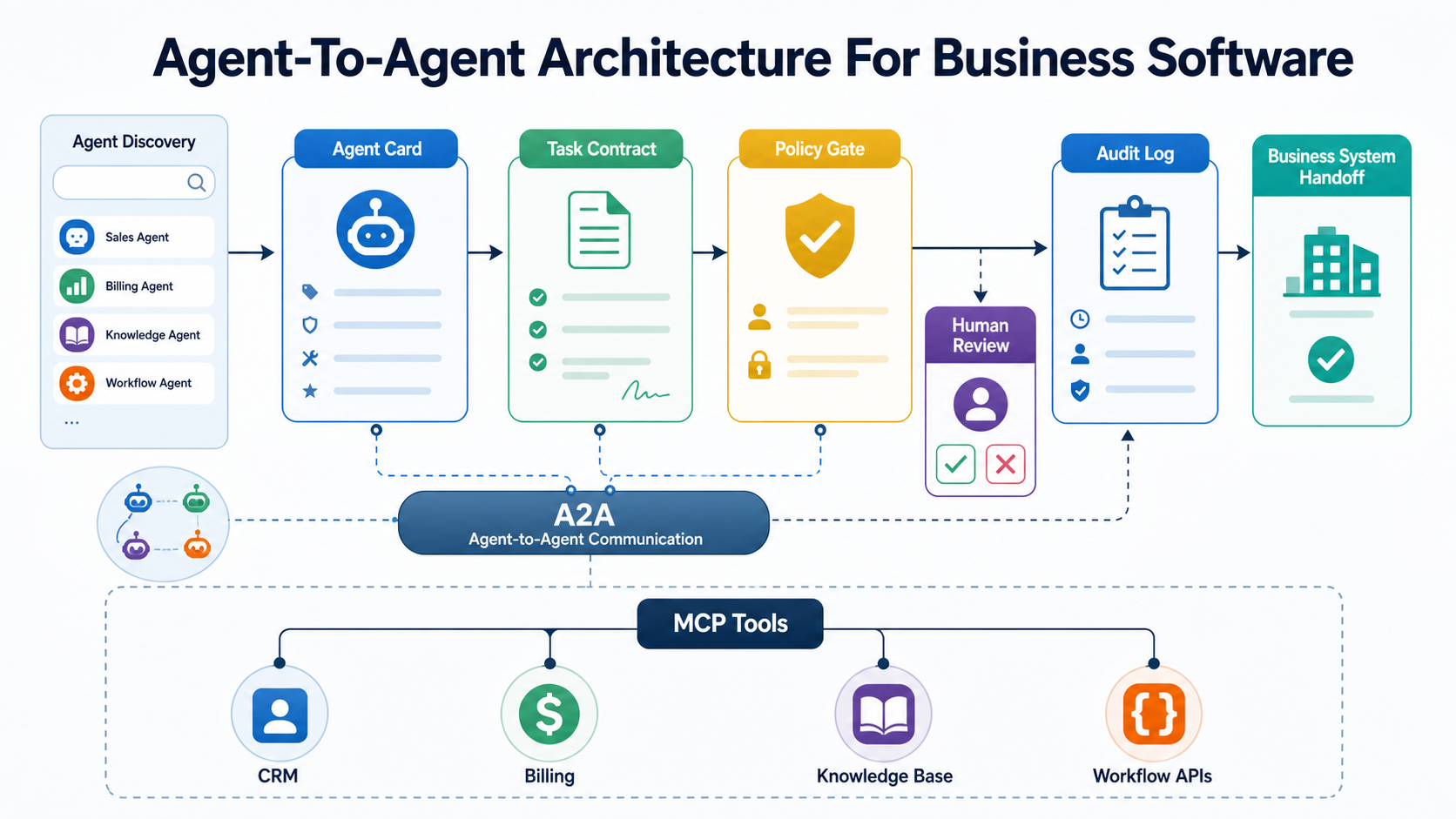
Agent-to-agent architecture is a communication and coordination pattern for AI agents that can act as peers. Instead of one central assistant calling every tool directly, specialized agents expose what they can do, accept delegated tasks, maintain task state, and return results or artifacts. A support agent might hand a billing question to a billing agent. A field-service agent might ask an inventory agent for part availability, then ask an approval agent to confirm an exception.
The open Agent2Agent protocol gives this idea a common language. The A2A specification covers operations such as message sending, task retrieval, task cancellation, push notification configuration, streaming updates, resubscription, and authenticated Agent Card access. The official A2A documentation also distinguishes A2A from the Model Context Protocol: MCP connects agents to tools and resources, while A2A helps independent agents collaborate with each other.
That distinction matters. In production software, you often need both. MCP-like tool access can let an agent query a CRM, call a pricing API, or create a ticket. A2A-like collaboration can let one agent delegate a bounded task to another agent that has different domain knowledge, tool permissions, data access, or business ownership.
A2A Decision Matrix: Use It, Avoid It, Or Start Smaller
Use this matrix before selecting a multi-agent framework, protocol, or vendor. It keeps architecture decisions tied to workflow evidence instead of hype.
| Workflow condition | Best fit | Why |
|---|---|---|
| One assistant answers questions from a governed knowledge base. | Single RAG assistant | Agent-to-agent handoffs add little value if retrieval and answer generation are the only responsibilities. |
| One agent uses several APIs or databases in a known sequence. | Tool-calling agent or workflow engine | MCP-style tool access, queues, and deterministic state are usually simpler than peer agent negotiation. |
| Different domains own different data, permissions, and decisions. | Agent-to-agent architecture | Separate agents can preserve ownership boundaries while collaborating through task contracts. |
| External vendors, platforms, or departments must expose agent capabilities independently. | A2A-compatible pattern | Agent Cards and standard task semantics reduce one-off integrations and make discovery more explicit. |
| Every action needs strict human approval and audit evidence. | A2A with policy gates, or deterministic workflow first | Peer agents can work, but only if approvals, logs, permissions, and rollback are designed before autonomy. |
| Low-latency transaction path with millisecond response needs. | Classic service/API design | Multi-agent negotiation, model calls, and task streaming can introduce unacceptable latency. |
A good first step is to score the candidate workflow with the AI Agent Readiness Assessment. If the workflow is unclear, data is fragmented, approvals are undefined, or tool permissions are risky, A2A will amplify those weaknesses rather than fix them.
A2A Vs MCP: Do Not Treat Them As Substitutes
A common planning mistake is to ask whether a team should choose A2A or MCP. They solve different interaction problems. MCP is about how an agent interacts with tools, APIs, files, databases, and resources. A2A is about how one agent collaborates with another agent that may be opaque, independently hosted, or owned by another team.
In a customer support workflow, for example, the support agent may use MCP-style tools to read the ticket, retrieve account history, and summarize a policy. It may use A2A-style delegation when it asks a billing agent to investigate disputed charges or asks a shipping agent to confirm delivery exceptions. The delegated agent may then use its own tools and return an artifact, status update, or escalation request.
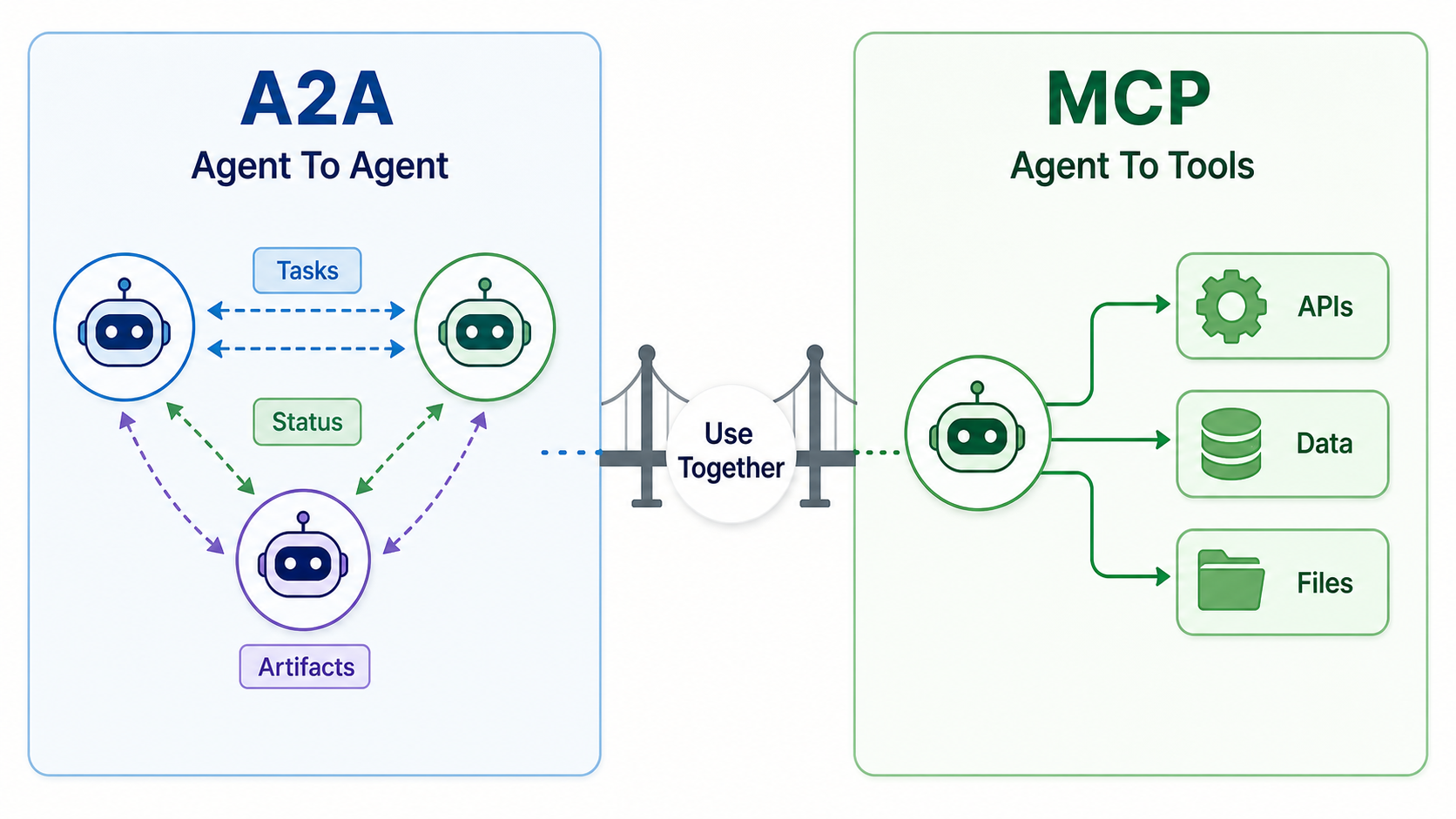
This separation creates a useful architecture boundary. Tool access stays close to the agent that is authorized to use the tool. Agent collaboration happens through messages, tasks, and results rather than by sharing every internal prompt, memory item, or credential. For enterprise software, that boundary can be the difference between a maintainable agent system and an over-permissioned assistant with too much hidden power.
Core Components Of A Practical A2A Architecture
A production-ready A2A design is more than a diagram with agent boxes and arrows. It needs contracts, policy controls, state management, monitoring, and failure handling. Treat each agent handoff like a product API: it needs an owner, version, schema, authentication model, timeout policy, acceptance examples, and a failure path that humans can understand.
| Component | What it does | Implementation evidence |
|---|---|---|
| Agent Card | Describes an agent's identity, endpoint, capabilities, supported modes, skills, and authentication requirements. | Versioned JSON, owner, capability list, auth scheme, cache policy, and signing or registry plan. |
| Task contract | Defines what can be delegated, required inputs, expected outputs, allowed states, timeout, and cancellation behavior. | Schema, examples, validation tests, timeout policy, retry policy, and fallback owner. |
| Policy gate | Controls whether a requesting agent may delegate a task or receive a result. | Authorization matrix, scopes, tenant rules, sensitive-data filters, and approval thresholds. |
| Memory boundary | Prevents agents from leaking unnecessary conversation history, private data, or internal reasoning. | Context-minimization rules, redaction, retention policy, and audit sampling. |
| Observability layer | Tracks task state, model calls, tool calls, handoffs, approvals, errors, cost, and latency. | Trace IDs, structured logs, dashboards, evaluation metrics, and incident runbooks. |
| Human review | Routes sensitive, expensive, irreversible, or low-confidence decisions to a person. | Approval UI, escalation rules, SLA, evidence packet, and rollback procedure. |
The A2A documentation's Agent Discovery guidance is especially important here. An Agent Card is not just a convenience file. It is the machine-readable source a client agent uses to determine what a remote agent can do, how to reach it, what authentication is required, and which skills or input modes are supported. Treat it like an API contract with ownership and lifecycle management.
For buyer teams, the practical acceptance test is simple: can an architect inspect the Agent Card, task schema, authentication rules, sample payloads, error states, and observability output without reading hidden prompts? If not, the system is still a demo surface rather than a maintainable business-software architecture.
For buyer teams, the practical acceptance test is simple: can an architect inspect the Agent Card, task schema, authentication rules, sample payloads, error states, and observability output without reading hidden prompts? If not, the system is still a demo surface rather than a maintainable business-software architecture.
Business Workflows Where A2A Can Add Real Value
A2A is most useful when the workflow crosses domain boundaries and each domain has its own context, tools, risk model, or approval path.
- Customer support escalation: A support agent gathers the issue, then delegates billing, logistics, warranty, or account-specific work to specialized agents without exposing every system credential to one assistant.
- Finance operations: A procurement agent can ask a vendor-risk agent for evidence, a budget agent for availability, and an approval agent for policy exceptions before creating a purchase order.
- Insurance claims: Intake, document review, fraud signal review, policy lookup, adjuster scheduling, and customer communication can be handled by specialized agents with human approval at high-risk steps.
- SaaS operations: A customer success agent can coordinate with usage analytics, billing, support, and product feedback agents to prepare renewal-risk recommendations.
- Field service: Scheduling, inventory, technician skills, route optimization, customer communication, and invoice review can stay modular while sharing task status.
- Internal developer platforms: A planning agent can delegate code search, dependency analysis, security review, documentation, and release note preparation to agents with distinct capabilities and audit trails.
These scenarios often overlap with broader Generative AI Development work. The architecture should start with one high-value workflow, not a platform-wide agent mesh. Prove the handoff, control, and monitoring model before expanding.
Security, Identity, And Permission Controls Come First
Agent-to-agent systems fail dangerously when teams design autonomy before permissions. Every agent should have a narrow purpose, least-privilege tool access, bounded context, and explicit authorization rules for delegation. A requesting agent should not be allowed to ask any other agent for any task simply because both exist inside the same platform.
The A2A specification includes security scheme concepts such as API keys, HTTP bearer auth, OAuth 2.0, OpenID Connect, and mutual TLS. It also emphasizes authorization boundaries and production transport security. In practice, those are only the start. Business software teams still need tenant isolation, data classification, approval thresholds, secret handling, prompt-injection defenses, logging policies, and incident response. NextPage's enterprise AI agent governance guide is a useful companion when the architecture needs permissions, review, monitoring, and rollback planning beyond protocol-level authentication.
Use the Secure AI Agent Development checklist before any agent can read sensitive records, modify systems, send customer messages, create financial transactions, or trigger operational workflows. A2A does not remove security work. It makes security contracts more visible.
Observability Is The Difference Between A Demo And A System
Multi-agent workflows are harder to debug than single-service workflows because failures can hide inside delegation chains. A user may see one response, but the system may have performed several model calls, retrieval calls, tool calls, agent handoffs, policy checks, retries, and human-review waits.
Track each workflow with a stable trace ID. Log the requesting agent, receiving agent, task type, input summary, data classification, authorization decision, tool calls, model versions, latency, cost, confidence signals, human approvals, final result, and any redactions. For high-risk processes, store an evidence packet that a reviewer can inspect later.
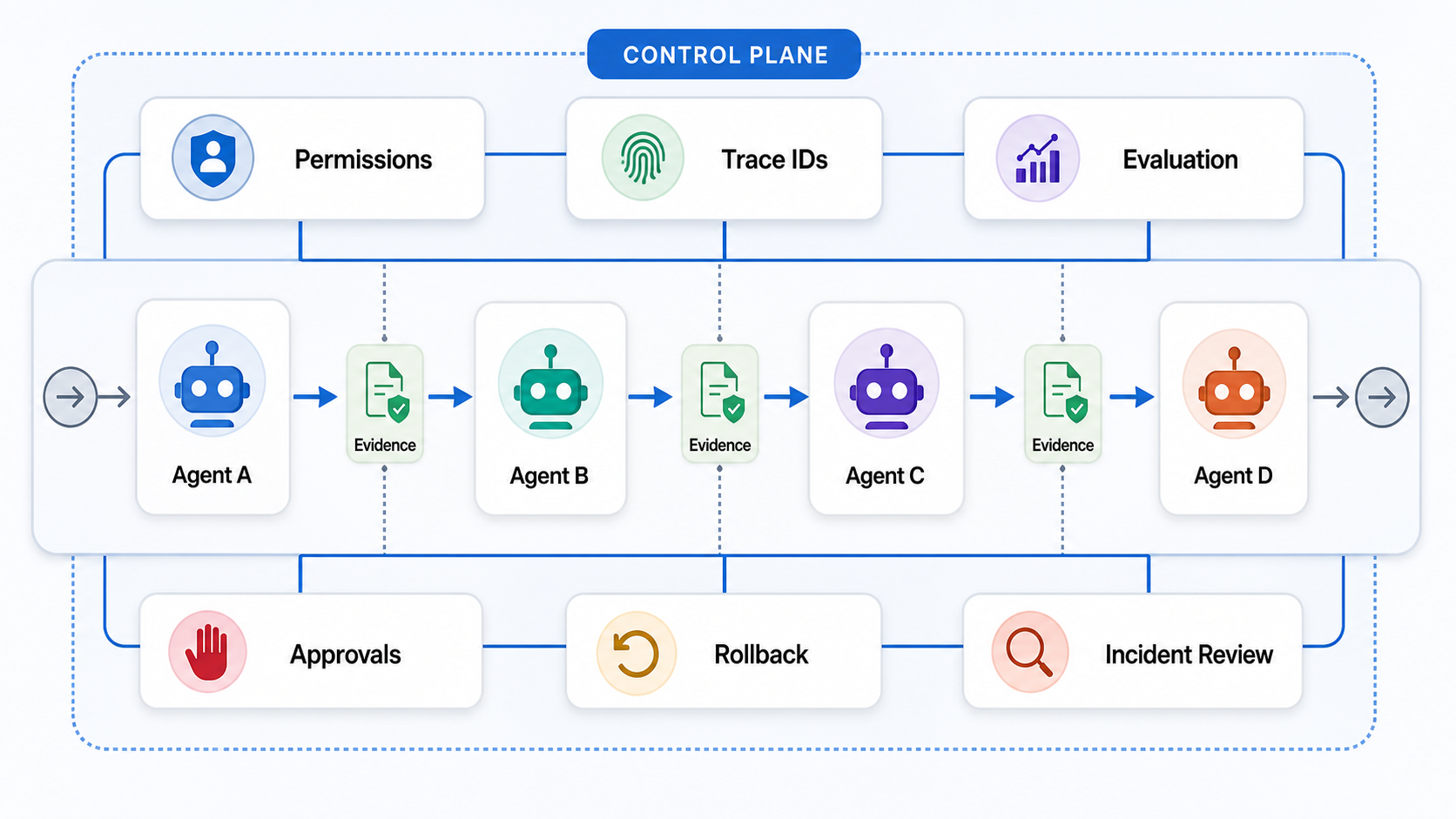
Evaluation should also be task-specific. A billing handoff needs different success criteria than a research summary or field-service schedule. Use an AI agent observability checklist to define the traces, evaluations, guardrails, and rollback evidence each agent workflow must produce before rollout. Use an AI agent observability checklist to define the traces, evaluations, guardrails, and rollback evidence each agent workflow must produce before rollout. Measure task completion, handoff accuracy, policy violations, escalation rate, time saved, error recovery, human override rate, and downstream business outcome. The Enterprise AI Readiness Checklist can help teams decide whether governance and measurement are mature enough for this level of automation.
Implementation Roadmap For A2A Business Software
A practical roadmap starts narrow and makes every handoff testable.
- Choose one workflow: Pick a process with enough value to justify architecture work and enough operational clarity to test safely.
- Map domain boundaries: Identify which teams, systems, and policies own each part of the workflow.
- Define agent responsibilities: Write each agent's purpose, allowed tasks, required data, tool access, and forbidden actions.
- Create Agent Cards and task contracts: Make capabilities, endpoints, inputs, outputs, states, and authentication explicit.
- Build policy gates: Enforce who can delegate which task, under which tenant, with which data and approval requirements.
- Instrument the workflow: Add trace IDs, structured logs, dashboards, cost tracking, and error states before production rollout.
- Run shadow mode: Let agents recommend handoffs and outputs while humans remain responsible for final action.
- Promote bounded autonomy: Automate only low-risk, high-confidence steps first, then expand with evidence.
Budget and timeline depend on tool access, data quality, number of agents, permission complexity, evaluation needs, and integration depth. If the A2A workflow includes new product features, admin panels, approval screens, or custom integration services, use the Custom Software Cost Estimator to pressure-test the scope before committing to delivery dates.
Protocol Evidence Buyers Should Ask For
Before approving an A2A build, ask the implementation team to show the evidence that will survive beyond the prototype. Useful artifacts include versioned Agent Cards, task contract examples, authentication and authorization maps, sandbox transcripts, failed-task examples, cancellation behavior, streaming update samples, human-review screens, trace exports, and rollback runbooks.
| Evidence artifact | What it proves | Why it matters |
|---|---|---|
| Agent Card registry | Capabilities, owners, endpoints, auth requirements, and supported modes are discoverable. | Prevents hidden one-off integrations and stale agent assumptions. |
| Task contract tests | Inputs, outputs, state transitions, timeouts, and cancellation paths are explicit. | Makes handoffs testable before agents touch production workflows. |
| Permission matrix | Each agent has scoped read, recommend, draft, approve, or execute authority. | Stops over-permissioned agents from becoming broad operational risk. |
| Trace and eval packet | Every handoff can be reviewed for policy, quality, latency, cost, and outcome. | Turns incidents and quality reviews into evidence rather than guesswork. |
If the team cannot produce these artifacts, start with a narrower supervised agent or deterministic workflow. The vocabulary in Generative AI vs AI Agents vs Agentic AI can help stakeholders separate content generation, tool-using agents, and broader autonomous systems before architecture scope expands.
Protocol Evidence Buyers Should Ask For
Before approving an A2A build, ask the implementation team to show the evidence that will survive beyond the prototype. Useful artifacts include versioned Agent Cards, task contract examples, authentication and authorization maps, sandbox transcripts, failed-task examples, cancellation behavior, streaming update samples, human-review screens, trace exports, and rollback runbooks.
| Evidence artifact | What it proves | Why it matters |
|---|---|---|
| Agent Card registry | Capabilities, owners, endpoints, auth requirements, and supported modes are discoverable. | Prevents hidden one-off integrations and stale agent assumptions. |
| Task contract tests | Inputs, outputs, state transitions, timeouts, and cancellation paths are explicit. | Makes handoffs testable before agents touch production workflows. |
| Permission matrix | Each agent has scoped read, recommend, draft, approve, or execute authority. | Stops over-permissioned agents from becoming broad operational risk. |
| Trace and eval packet | Every handoff can be reviewed for policy, quality, latency, cost, and outcome. | Turns incidents and quality reviews into evidence rather than guesswork. |
If the team cannot produce these artifacts, start with a narrower supervised agent or deterministic workflow. The vocabulary in Generative AI vs AI Agents vs Agentic AI can help stakeholders separate content generation, tool-using agents, and broader autonomous systems before architecture scope expands.
Cost And Timeline Drivers
Agent-to-agent architecture usually costs more than a single assistant because it adds contracts, coordination, testing, and governance. The main cost drivers are the number of agents, the number of delegated task types, enterprise authentication requirements, tool integrations, data classification rules, human approval workflows, observability depth, and evaluation coverage.
A focused proof of concept can validate the handoff model in a few weeks when the workflow is narrow and systems are accessible. A production rollout can take longer when the workflow touches regulated data, multiple departments, existing SaaS platforms, custom APIs, and customer-facing actions. The AI Agent Development Cost guide is useful for estimating how autonomy, integrations, and governance affect budget.
Do not start by building a generic internal agent marketplace. Start with a workflow that has a measurable baseline, a clear business owner, and a specific handoff pain. If that workflow succeeds, standardize the contracts and controls so the next agent is easier to add.
NextPage's Point Of View
A2A is valuable when it creates cleaner boundaries between specialized agents. It is risky when it becomes a way to avoid product thinking, process design, or security engineering. In most business software projects, the right path is incremental: readiness assessment, workflow map, single-agent or orchestrated prototype, then A2A-style delegation only where domain separation and scale justify it.
NextPage helps teams design AI agent workflows with the software engineering pieces included: data access, integrations, permission models, human review, evaluation, observability, and production support. For broader model selection, product engineering, governance, and integration work, connect the A2A plan to AI development services rather than treating agent coordination as a standalone experiment. If you are evaluating agent-to-agent architecture, start with an AI agent architecture review that identifies which workflow should be autonomous, which should remain deterministic, and which handoffs need A2A-style contracts.