
Quick Answer: What Is Agentic Commerce Readiness?
Agentic commerce readiness means your owned eCommerce website, app, catalog, checkout, payments, inventory, and support workflows are structured enough for AI agents to help buyers safely. Readiness is not just adding a chatbot. It requires accurate product data, reliable availability, clear permissions, governed actions, measurable outcomes, and a rollout plan that starts with low-risk workflows.
Forrester's 2026 emerging technology coverage places agentic commerce among short-term technologies with business cases first in owned environments such as websites and apps. That is the practical place to start: help customers compare products, recover carts, answer fit questions, prepare orders, and escalate exceptions before allowing agents to make high-impact decisions.
If you are unsure whether a workflow is ready for an agent, use NextPage's AI Agent Readiness Assessment to score workflow clarity, data readiness, integration access, and human-review controls.
Why Commerce Teams Should Prepare Now
Commerce teams are already feeling the shift from browse-and-click shopping toward assisted buying. AI search, conversational product discovery, personalized recommendations, and shopping assistants all depend on the same foundation: trustworthy product, pricing, availability, payment, delivery, and policy data. If that foundation is weak, agents produce confident but unreliable experiences.
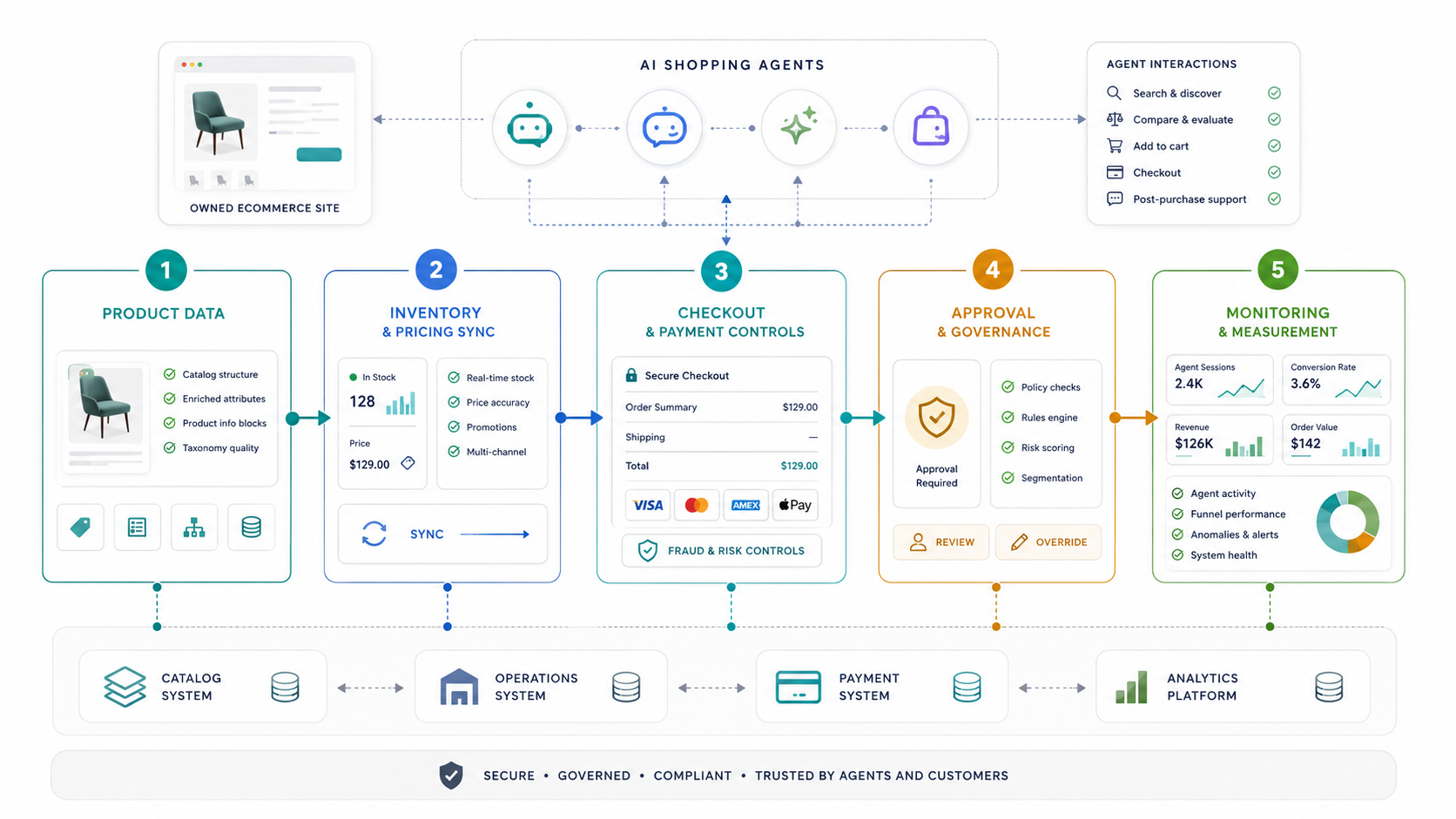
The mistake is to treat agentic commerce as a front-end feature. The visible assistant is only the surface. Underneath it are product feeds, inventory systems, pricing rules, payment permissions, customer identity, fraud controls, return policies, order management, support handoffs, analytics, and compliance requirements. A useful agent cannot compensate for broken operations.
NextPage's AI workflow automation guide is relevant because commerce agents should be designed as workflows: intake, context retrieval, decision, action, review, monitoring, and fallback.
Start In Owned Environments Before Open-Agent Commerce
Owned environments are safer because you control the interface, data access, payment boundaries, policy copy, analytics, and support handoff. Start with agent assistance inside your website, app, or customer portal before depending on external ecosystems to mediate the full purchase journey.
| Workflow | Good First Agent Use | Human Or System Guardrail |
|---|---|---|
| Product discovery | Ask fit questions and suggest categories | Show source products and filters used |
| Comparison | Summarize differences across products | Use structured attributes, not free-form guesses |
| Cart recovery | Explain blockers and suggest alternatives | Require user confirmation before cart changes |
| B2B ordering | Prepare reorder suggestions | Respect account pricing, approvals, and credit limits |
| Support | Answer delivery, return, and warranty questions | Escalate policy exceptions to staff |
For social-led buying journeys, NextPage's social commerce app development services show why the storefront, campaign flow, fulfillment, and analytics layer need to connect before automation can be trusted.
Product Data Quality Is The First Readiness Layer
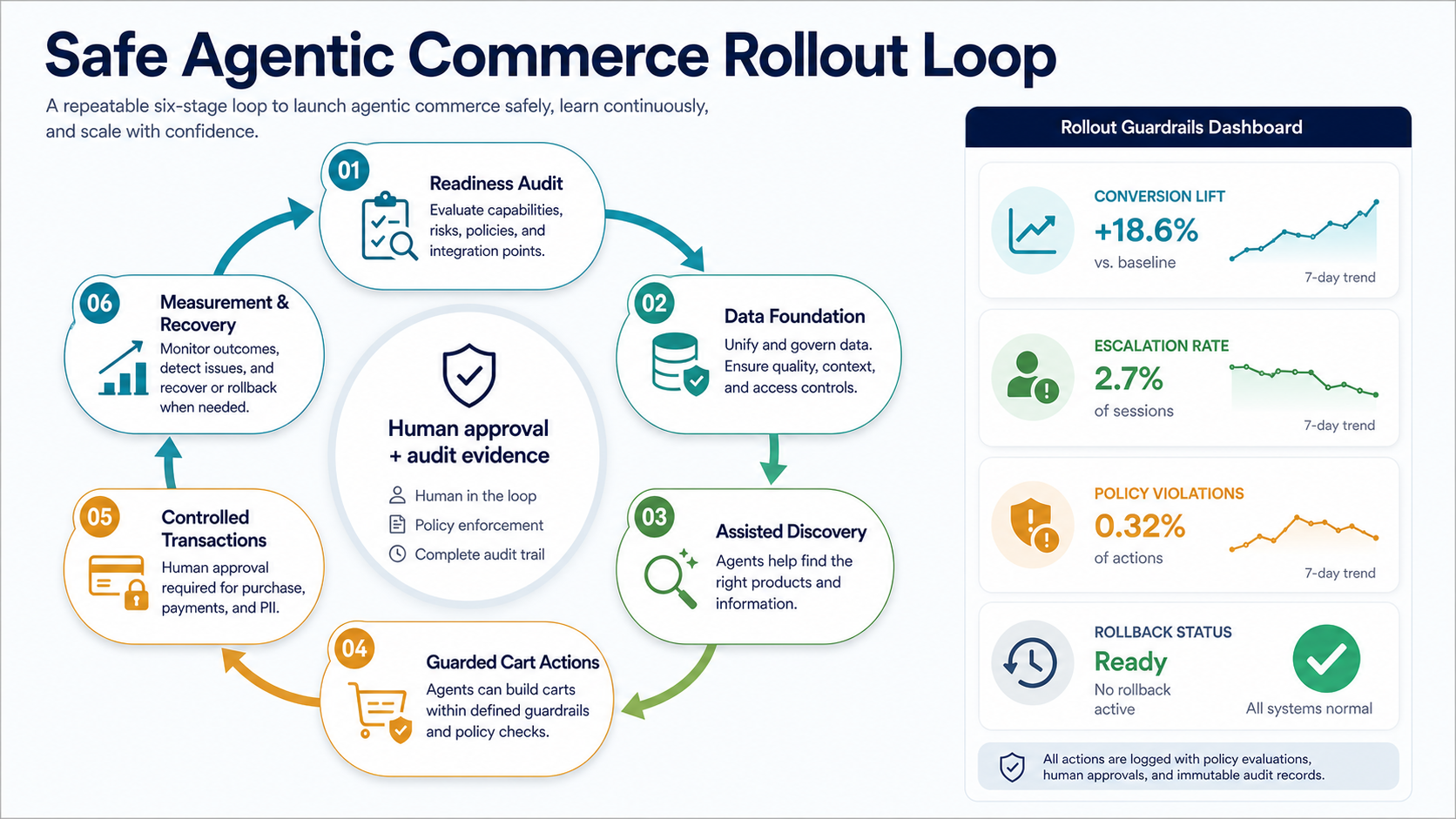
Agentic commerce depends on product data that is complete, current, and machine-readable. Agents need titles, attributes, variants, compatibility, images, shipping rules, inventory, price, returns, warranties, category taxonomy, and buyer-facing answers. If the agent cannot tell whether a product fits a buyer's need, it should not recommend or add it to cart.
Start with a product-data audit. Identify missing required attributes by category. Normalize variant names. Remove duplicate SKUs. Define canonical product IDs. Add compatibility fields where relevant. Separate marketing copy from factual specifications. Keep policy data and delivery promises updated. Add structured answers for common buyer questions.
This is also where AI search readiness matters. Agents and answer engines prefer clear, structured, source-backed information. NextPage's eCommerce development company checklist covers partner-selection questions for product data, platform fit, integrations, and conversion systems.
Checkout, Payments, Identity, And Authorization
Agents can assist checkout, but payment authority must be explicit. A readiness roadmap should define which actions an agent can suggest, prepare, or execute. Adding an item to a cart is lower risk than submitting payment, changing a delivery address, applying stored credit, or placing a recurring order.
| Action | Risk Level | Recommended Control |
|---|---|---|
| Suggest product | Low | Show evidence and alternatives |
| Add to cart | Medium | User confirmation and cart preview |
| Apply coupon | Medium | Policy validation and audit log |
| Change address | High | Identity check and confirmation |
| Submit payment | High | Strong authentication, spending limit, and explicit approval |
For custom commerce products, scope these controls early. NextPage's eCommerce app development cost guide explains why user roles, integrations, payment rules, admin tools, and operational workflows drive cost more than screen count.
Human Approval, Guardrails, And Audit Trails
Agentic commerce needs governance because agents can affect revenue, customer trust, and compliance. Define the agent's authority, data access, allowed actions, spending limits, escalation rules, rollback paths, and audit logs. If the agent can trigger a refund, reserve inventory, update customer data, or send an offer, that action needs permission boundaries.
Borrow from enterprise AI governance. Maintain a workflow inventory, document systems touched, classify data sensitivity, define human review points, capture prompt/action logs, and monitor outcomes. NextPage's enterprise AI agent governance guide provides a reusable structure for permissions, human review, monitoring, and rollback.
A commerce-specific governance model should answer: who approves new agent capabilities, who reviews failed recommendations, who owns product data quality, who signs off payment-related flows, and how support teams see the agent's decision trail.
Measurement, Monitoring, And Failure Recovery
Do not launch agentic commerce without measurement. Track assisted conversion rate, recommendation acceptance, cart changes, checkout completion, payment failures, escalation rate, refund rate, support contacts, latency, hallucination reports, policy violations, and revenue by assisted workflow. Also track negative outcomes: wrong recommendations, unavailable products, mismatched delivery promises, or customer confusion.
Monitoring should cover both software reliability and business quality. API failures, stale feeds, inventory lag, model errors, prompt drift, policy mismatches, and payment declines need alerts and owners. If the agent takes action, the system needs replay, rollback, and audit evidence.
For broader AI delivery planning, NextPage's agentic AI development services focus on workflow design, data access, evaluation, integration boundaries, monitoring, and human oversight.
A Practical Agentic Commerce Roadmap
| Phase | Scope | Exit Criteria |
|---|---|---|
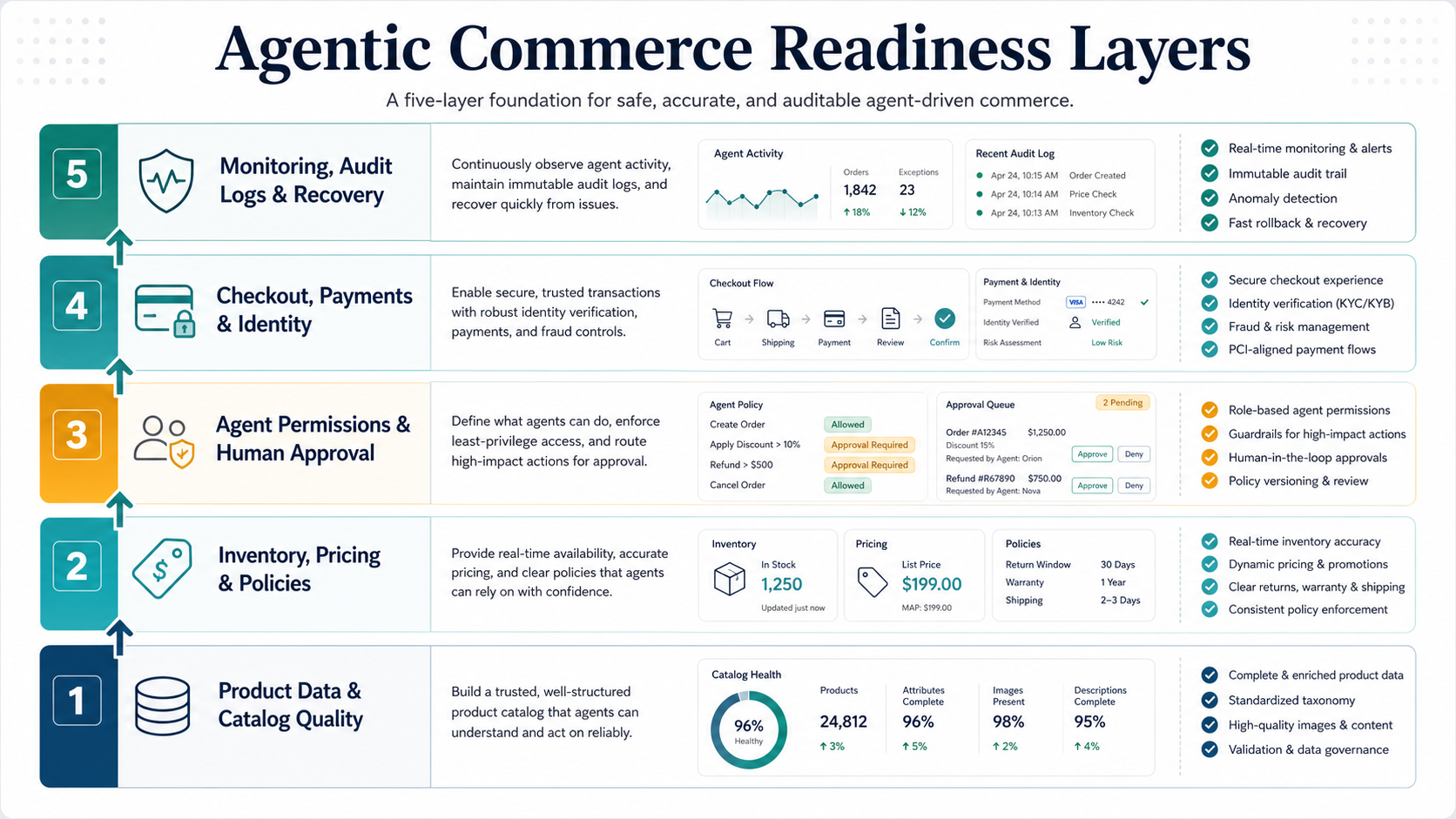
| Phase 1: readiness audit | Product data, systems, policies, checkout, analytics, risks | Approved gap list and workflow shortlist |
| Phase 2: data foundation | Attributes, inventory sync, pricing, policies, structured answers | Validated product-data and availability quality |
| Phase 3: assisted discovery | Q&A, comparison, fit guidance, category routing | Accurate answers with source evidence and low escalation |
| Phase 4: guarded cart actions | Add-to-cart, coupon help, reorder prep, cart recovery | User confirmation, audit logs, and conversion lift evidence |
| Phase 5: controlled transactions | Payment-adjacent flows with limits and authentication | Security signoff, monitoring, support runbook, rollback path |
Use NextPage's MVP Scope Builder to keep the first agentic commerce release narrow. For budget planning, the custom software cost estimator can help model integration count, AI complexity, and team shape.
Agentic Commerce Readiness Checklist
- Are product attributes complete enough for an agent to compare options reliably?
- Are inventory, pricing, and delivery promises fresh enough for checkout decisions?
- Do payment and account actions have explicit user confirmation rules?
- Can the agent show why it recommended a product or action?
- Are human approval points defined for high-impact actions?
- Are prompt, retrieval, recommendation, and action logs stored for review?
- Can support teams see what the agent told the customer?
- Are failed recommendations and policy exceptions monitored?
- Does the rollout start with a low-risk owned-site workflow?
- Is there a rollback plan if an agent capability harms conversion or trust?
How NextPage Helps Commerce Teams Build Safely
NextPage helps commerce teams design agentic commerce workflows that are useful, measurable, and controlled. We start with a readiness audit, product-data review, workflow shortlist, integration map, permission model, evaluation plan, and rollout backlog. Then we build the smallest safe agent workflow that can prove value without putting checkout trust at risk.
For commerce teams preparing for AI-mediated discovery and checkout, start with the AI Agent Readiness Assessment or talk to NextPage about a focused agentic commerce readiness sprint.