
AI agents for supply chain operations are most useful when they are designed around exceptions, approvals, and system handoffs, not around vague automation promises. A useful agent can notice that demand shifted, inventory is below a threshold, a supplier missed an update, or a shipment is at risk. A risky agent changes purchase orders, reallocates stock, or reroutes freight without enough context, controls, or human review.
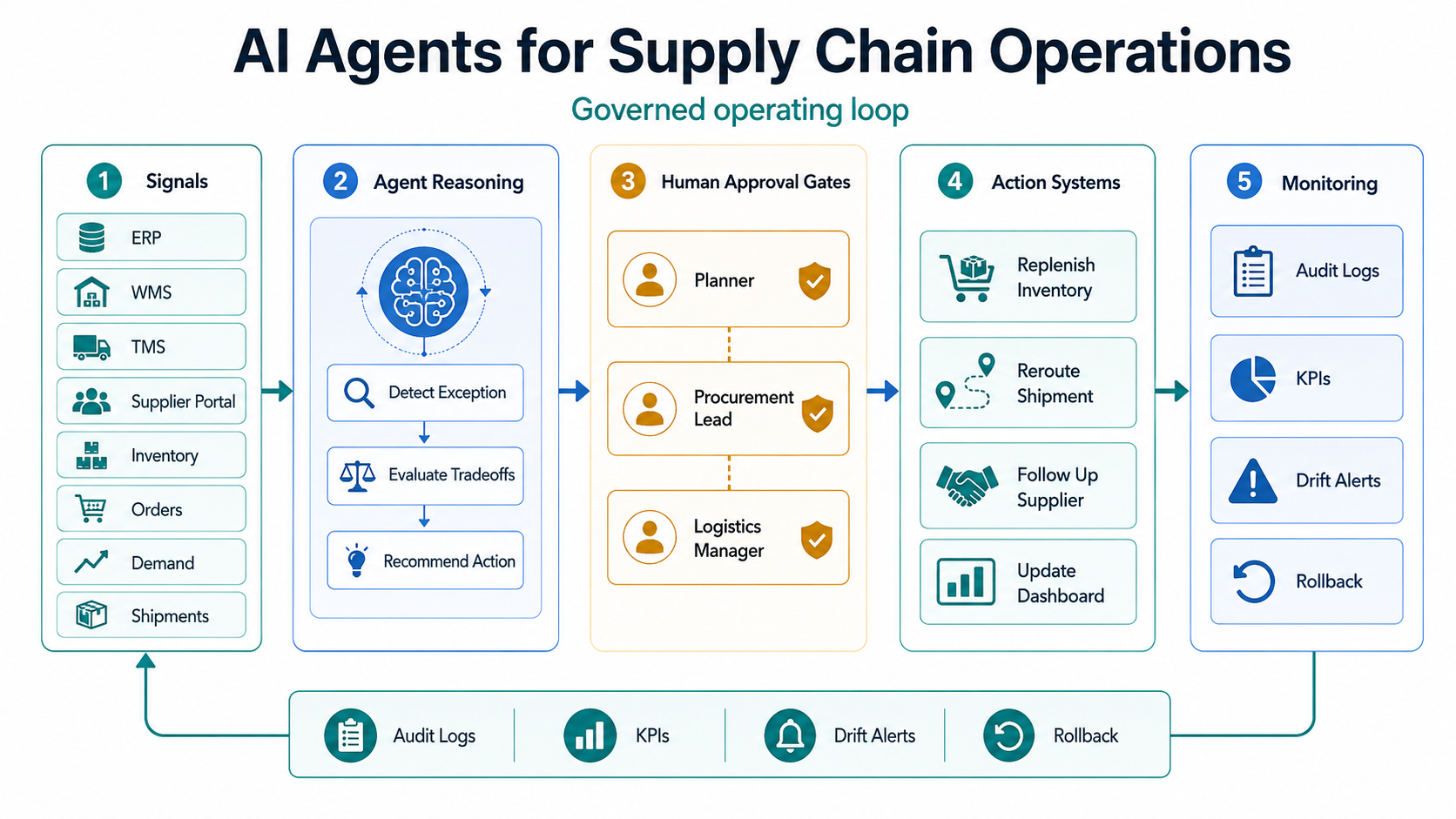
The practical starting point is a governed operating loop: collect signals from ERP, WMS, TMS, supplier portals, order systems, inventory feeds, and demand data; evaluate tradeoffs; recommend an action; route high-impact decisions to a planner or manager; then record the outcome for monitoring. That makes AI agents different from dashboards and chatbots. They need tool access, workflow ownership, audit logs, rollback paths, and clear limits on what they can do alone.
NextPage plans these systems as production software, not as disconnected demos. If you are deciding whether a workflow is ready for agentic automation, start with the AI Agent Readiness Assessment before granting an agent access to operational systems.
Quick Answer: Where AI Agents Fit In Supply Chain Operations
AI agents fit best where supply-chain teams already have repeatable decisions, fragmented signals, and expensive delays. Good first candidates include inventory exceptions, supplier follow-ups, shipment risk triage, procurement intake, order promise-date checks, demand-planning variance review, and control-tower summaries. The agent should not start by replacing planners. It should prepare evidence, recommend the next action, trigger low-risk updates, and escalate decisions that affect cost, customers, compliance, or supplier commitments.
| Workflow | Agent Role | Human Gate |
|---|---|---|
| Inventory exception | Detect low stock, compare demand, suggest replenishment or transfer. | Approve PO, transfer, substitution, or customer allocation. |
| Supplier follow-up | Find late confirmations, draft reminders, summarize risk. | Approve escalation, alternative supplier, or revised promise date. |
| Shipment risk | Monitor ETA, carrier status, weather, customs, and customer priority. | Approve reroute, expedite, customer notice, or cost exception. |
| Demand variance | Explain forecast change and affected SKUs, lanes, or sites. | Approve forecast override, safety stock change, or S&OP escalation. |
| Operations dashboard | Generate daily exception brief and recommended owner actions. | Confirm ownership, SLA, and action priority. |
Why Agents Are Different From Supply Chain Analytics
Traditional supply-chain analytics explains what happened or what might happen. An AI agent goes further: it can gather context, choose a tool, draft an update, create a task, call an API, or recommend a decision path. That extra agency is valuable only when the workflow has strong boundaries.
A planning dashboard may show delayed inbound shipments. An agent can check which customer orders are exposed, compare alternative stock locations, draft supplier follow-up, create a planner task, and recommend whether to expedite. This is useful because the agent reduces coordination work. It is risky if the same agent can silently change order priorities, promise dates, or purchase quantities without review.
For logistics-heavy teams, the closest commercial foundation is AI solutions for logistics and supply chain operations. That work usually combines forecasting, routing, warehouse signals, exception handling, dashboards, and ERP/WMS/TMS integrations into one operating model.
Use-Case Tiers: Start With The Safest Agent Work
The best pilot is usually not the most autonomous workflow. It is the workflow where the agent can save time while the business still controls the decision. Use three tiers to decide how much action the agent should have.
| Tier | What The Agent Can Do | Good First Use Cases | Risk Level |
|---|---|---|---|
| Assist | Summarize, classify, retrieve evidence, draft notes. | Daily exception brief, supplier-risk summary, demand-change explanation. | Low |
| Recommend | Rank options and propose next actions with reasons. | Inventory transfer suggestion, shipment recovery option, supplier escalation priority. | Medium |
| Act With Approval | Prepare system updates and execute after human approval. | Create PO draft, open carrier claim, update planner task, send supplier message. | Medium to high |
| Autonomous Action | Execute narrow low-risk actions within strict thresholds. | Request missing ASN, send status reminder, tag exception owner. | High unless tightly constrained |
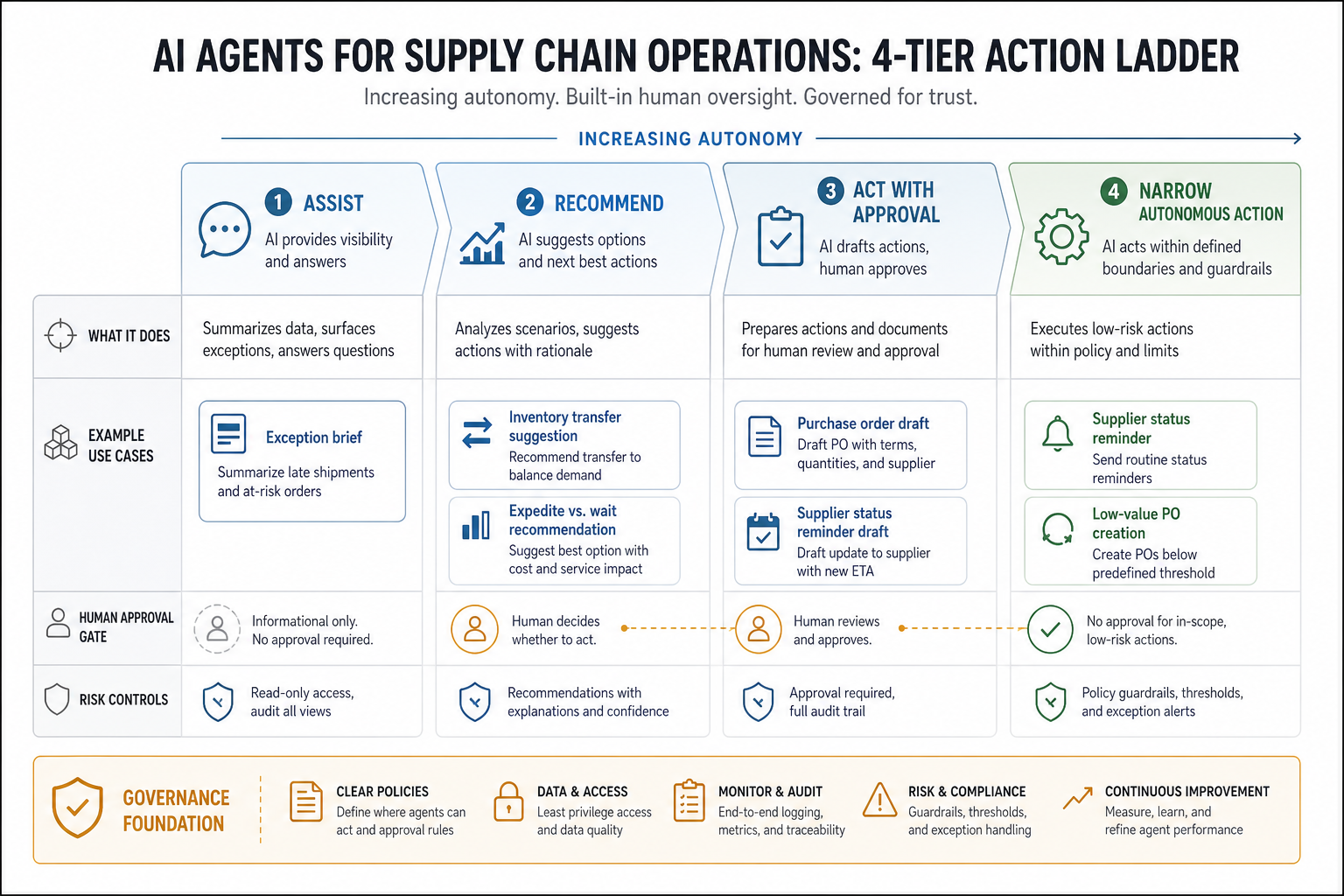
Start in assist or recommend mode. Move toward approved actions only after the team has evidence that recommendations are useful, explanations are understandable, and escalation rules are respected. Fully autonomous action should be limited to reversible, low-cost, well-scoped tasks.
Data And Integration Scope Before The Pilot
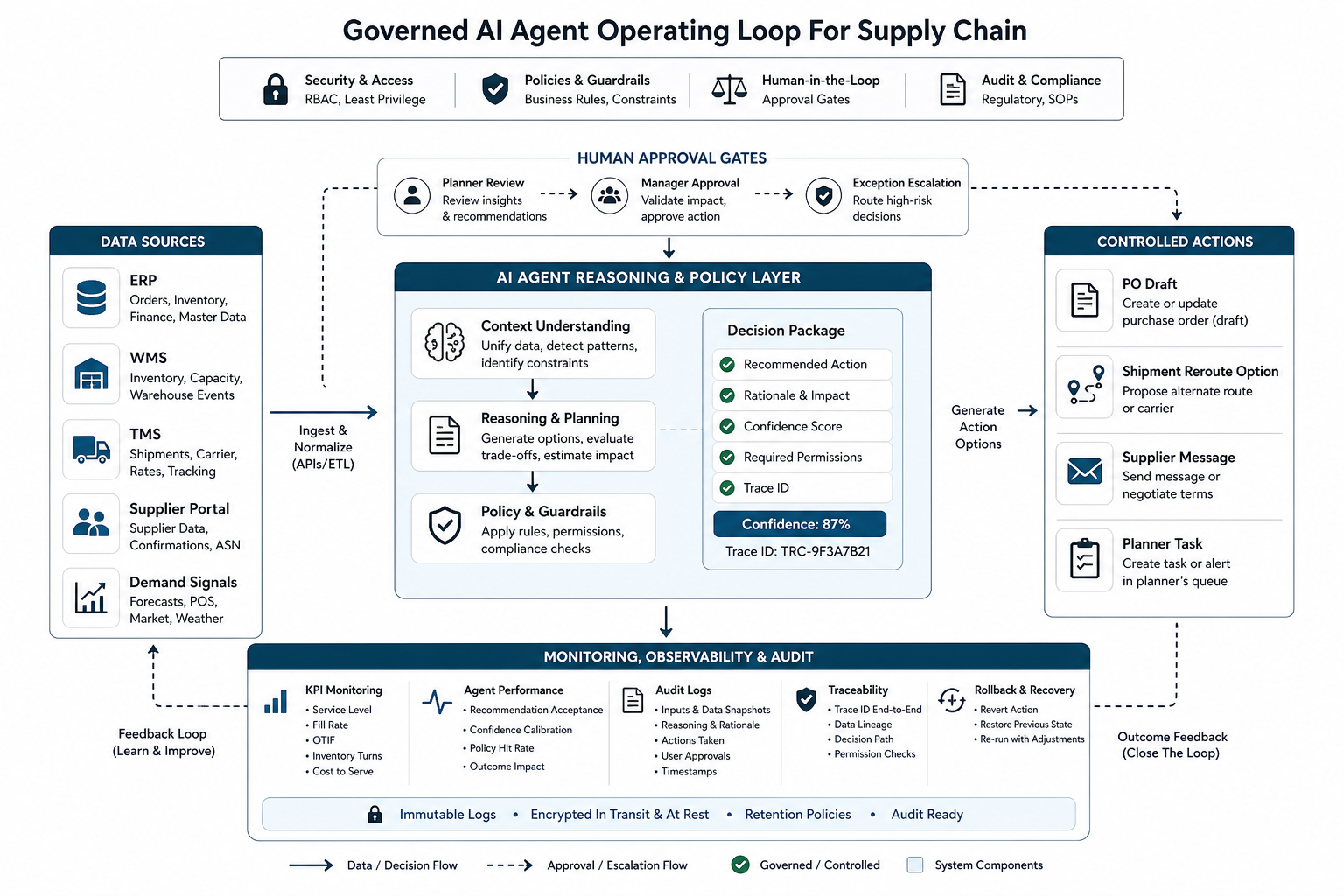
Supply-chain agents need current operational context. That usually means ERP records for orders and purchasing, WMS data for inventory and locations, TMS or carrier feeds for shipments, supplier portals for confirmations, demand-planning data, master data, customer priority rules, and workflow history. The project should define which fields are read-only, which actions are allowed, and which events must create an audit record.
Data freshness matters. A recommendation based on stale stock or old ETA data can create real operating damage. The pilot should document source latency, ownership, field definitions, failure behavior, and confidence levels. If the agent cannot access a reliable signal, it should say so instead of inventing certainty.
This is why agent work often becomes custom product engineering. NextPage's custom software development team designs the workflow layer, permissions, APIs, dashboards, and operational states that make AI useful inside real systems.
Human Approval Gates For Supply Chain Agents
A human approval gate is not a sign that the agent failed. It is how supply-chain teams keep accountability attached to decisions that affect cost, customer commitments, inventory allocation, compliance, or supplier relationships.
Define gates by impact. A reminder email to a supplier may only need policy-based approval or no approval after testing. A purchase order change, expedited freight decision, customer promise-date update, or inventory allocation should require a named approver until the operating risk is proven low. The interface should show the evidence, recommendation, confidence level, affected records, and rollback path before approval.
- Planner gate: approve forecast overrides, replenishment suggestions, and transfer recommendations.
- Procurement gate: approve supplier escalations, alternate sourcing, and PO changes.
- Logistics gate: approve carrier reroutes, expedite decisions, and customer-facing delay notices.
- Finance gate: approve cost exceptions, premium freight, and budget-impacting actions.
- Compliance gate: approve actions involving regulated goods, restricted countries, or audit-sensitive records.
Governance Checklist Before An Agent Touches Systems
Agent governance should be designed before integration credentials are issued. A pilot that starts with broad access is hard to contain later. The governance model should cover identity, permissions, data handling, tool access, evaluation, monitoring, incident response, and owner accountability.
| Control | Question To Answer | Evidence To Keep |
|---|---|---|
| Permission manifest | Which systems can the agent read or write? | Tool list, scopes, approval owner, expiry date. |
| Action thresholds | Which actions need approval, and what can be automated? | Policy rules, risk tiers, exception list. |
| Audit logs | Can the team reconstruct input, recommendation, approver, and action? | Trace ID, input snapshot, output, user action, timestamp. |
| Evaluation set | Does the agent handle normal cases, edge cases, and unsafe actions? | Test cases, expected actions, failure categories. |
| Monitoring | How will drift, bad recommendations, and integration failures be detected? | KPI dashboard, alerts, review cadence. |
| Rollback | What happens when the agent makes or recommends a wrong action? | Undo process, support owner, incident runbook. |
For broader enterprise AI programs, this governance work connects naturally to AI development services and AI automation services. The goal is not to slow the pilot. The goal is to make the pilot safe enough to learn from real work.
Pilot Roadmap For AI Agents In Supply Chain
A practical pilot should run for one workflow, one operating team, and one measurable decision. Avoid trying to cover forecasting, purchasing, warehousing, logistics, and customer communication in the first release. That creates too many integration and governance variables at once.
- Select one decision: choose a workflow with clear volume, pain, owner, and measurable delay or cost.
- Map the current process: document systems, handoffs, exception reasons, approvals, and existing reports.
- Define the agent boundary: decide read access, write access, approvals, confidence thresholds, and forbidden actions.
- Build an evaluation set: include normal cases, urgent cases, missing-data cases, false positives, and unacceptable actions.
- Ship assist mode first: summarize exceptions and recommended actions without system writes.
- Add approved actions: create drafts, tasks, messages, or updates that humans can approve.
- Monitor business value: track cycle time, backlog, expedite cost, inventory availability, SLA impact, override rate, and user trust; use the AI Automation ROI Calculator to frame savings and payback before scaling the workflow.
If the workflow needs model scoring, forecasting, or classification beyond an LLM interface, include machine learning development services in the architecture discussion. Some supply-chain agents should use deterministic rules, forecasting models, optimization logic, and LLM reasoning together rather than forcing every decision through a chat model.
Common Mistakes To Avoid
- Giving the agent write access before the team has proven recommendation quality.
- Using stale ERP, WMS, or TMS data without exposing freshness and confidence.
- Optimizing one metric, such as freight cost, while ignoring service level or inventory impact.
- Skipping supplier, customer, finance, and compliance approval boundaries.
- Letting agents create messages or tasks without clear ownership and SLA rules.
- Failing to log the evidence behind recommendations and approved actions.
- Launching a generic agent instead of one workflow-specific operating loop.
How NextPage Can Help
NextPage helps teams design, build, and govern AI agents that work inside real supply-chain systems. A first engagement usually maps the workflow, scores agent readiness, defines permissions, designs the pilot architecture, integrates trusted data sources, builds the approval interface, and creates monitoring for the operating team.
For supply-chain teams, the best first agent is usually narrow, measurable, and reviewable. It should reduce coordination work before it starts changing business records. If the pilot proves useful, the roadmap can expand into additional workflows such as demand exceptions, inventory allocation, supplier risk, warehouse prioritization, logistics recovery, and control-tower reporting.
Start with the AI Agent Readiness Assessment when you need to know which workflow is ready, which systems must connect, and which governance controls must exist before the agent touches operations.