
Quick Answer: AI Should Plan CVE Remediation, Not Silently Patch Production
AI CVE remediation works best as a supervised engineering workflow: it enriches scanner findings, ranks what matters, recommends safe upgrade paths, drafts remediation tickets, prepares patch notes, maps regression scope, and keeps the release evidence organized. It should not quietly merge code, suppress vulnerabilities, change production configuration, or decide that a risky dependency upgrade is safe without human approval.
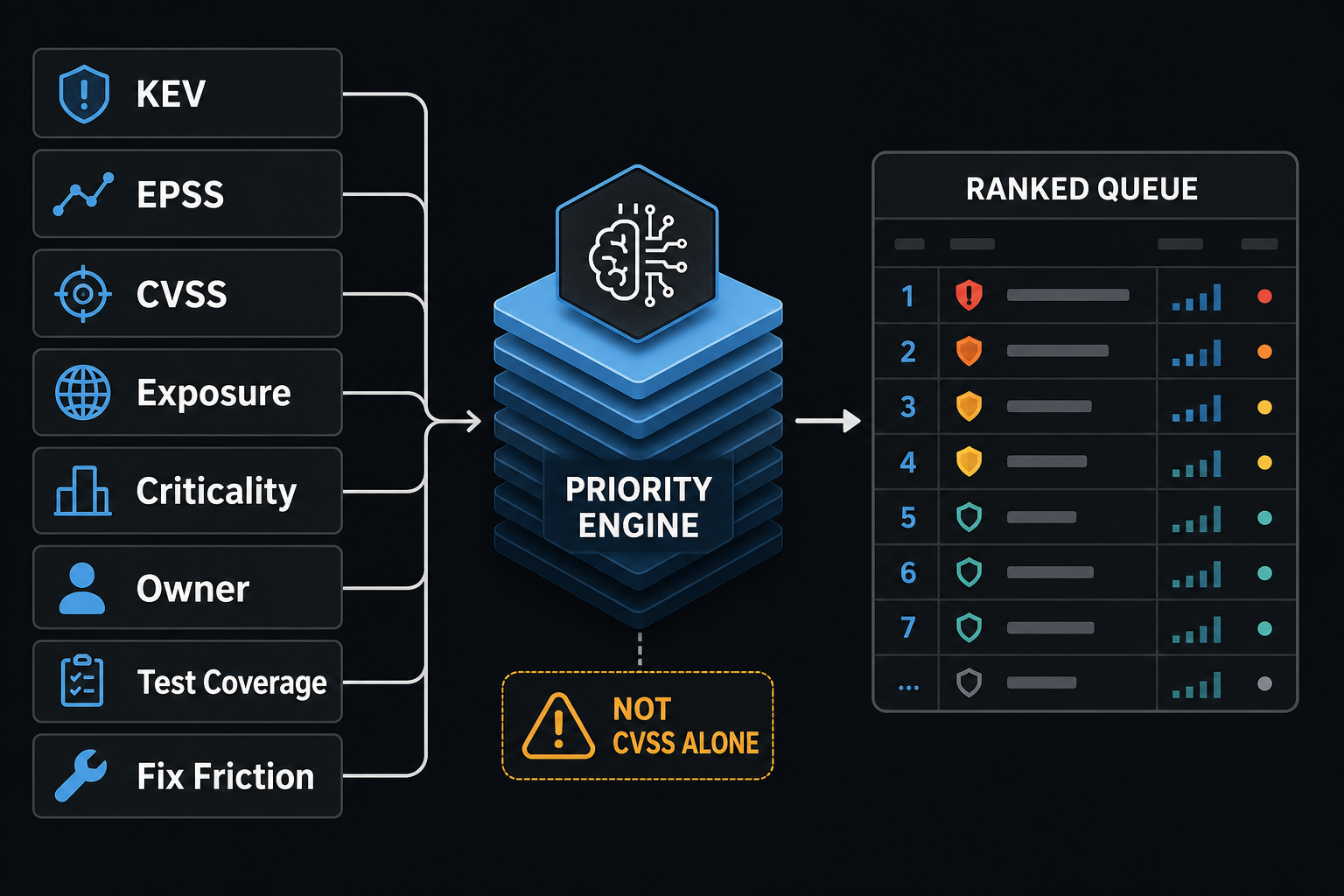
The practical goal is faster, better decision-making. A strong workflow combines CISA Known Exploited Vulnerabilities, EPSS exploit probability, CVSS severity, internet exposure, business criticality, dependency blast radius, owner data, test coverage, rollback confidence, and release windows. AI can compress the analysis. Security and engineering still own the risk decision.
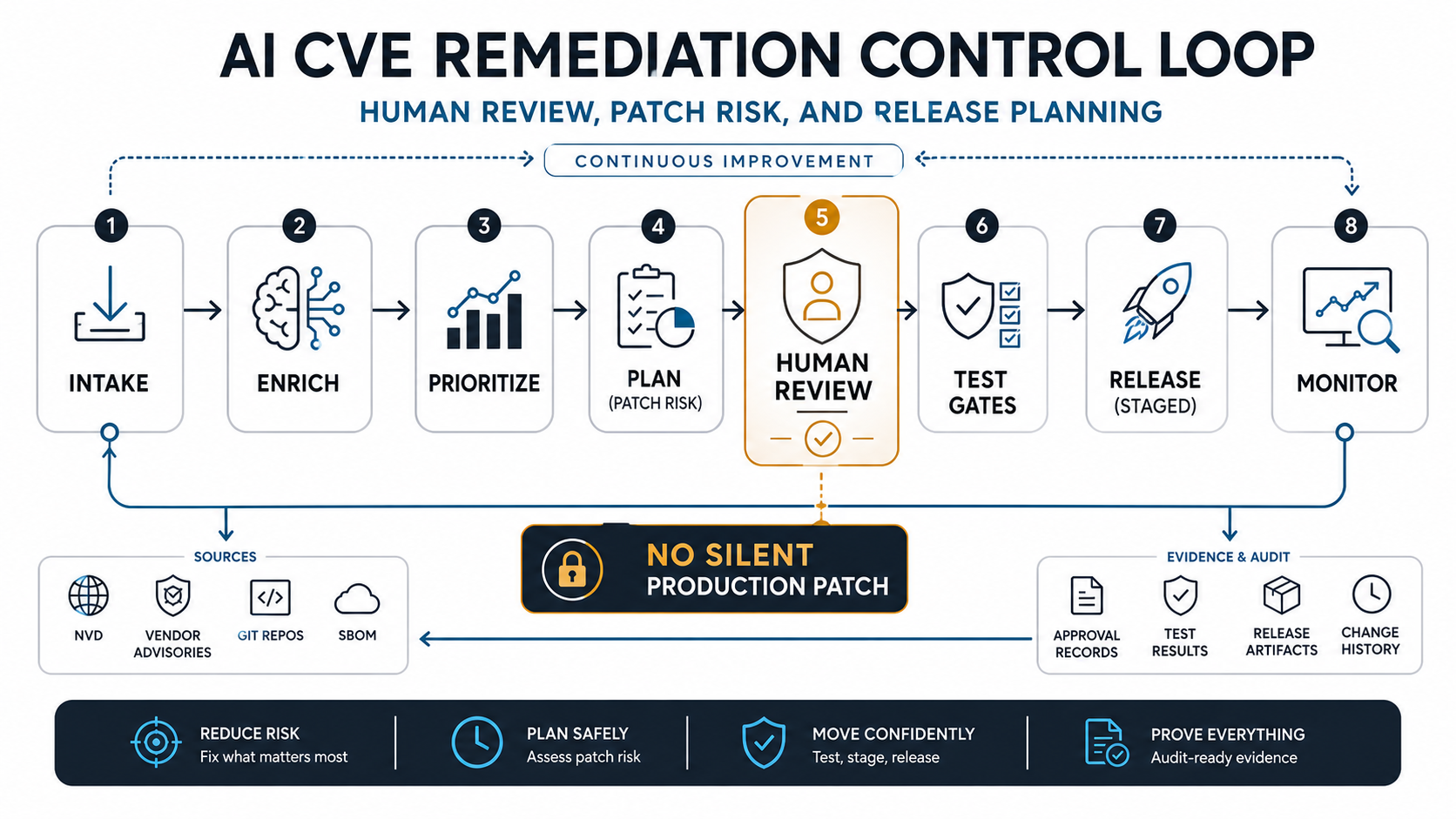
If your team is exploring this, start with a narrow workflow: one product area, one scanner source, a clear owner map, and a reviewed set of remediation actions. NextPage builds governed AI development services for workflows where automation must connect to real systems without losing control.
Why CVE Remediation Stalls After Detection
Most organizations do not lack vulnerability data. They have too much of it. SCA tools, container scans, SBOMs, code scanners, cloud posture checks, penetration tests, package advisories, and vendor bulletins all generate findings. The hard part starts after detection: which CVEs matter now, which library version should be targeted, which services will break, who owns the change, what tests are needed, and when the patch can safely ship.
Traditional remediation often becomes a manual loop. Developers open the scanner report, search advisories, compare fixed versions, try a dependency upgrade, fix build errors, rerun tests, investigate regressions, and repeat. Security teams then chase status across tickets and spreadsheets. AI can help by converting scattered evidence into a structured remediation plan, but only if the workflow includes reliable context and review gates.
| Remediation Bottleneck | Why It Slows Teams | AI-Assisted Response |
|---|---|---|
| Too many findings | Severity labels do not reflect real exposure or exploit activity | Rank CVEs using threat, asset, exposure, and business context |
| Unclear fix path | Scanner output lists versions but not migration impact | Summarize fixed versions, breaking changes, and known upgrade notes |
| No owner | Assets, repos, services, and teams are disconnected | Map CVEs to repositories, services, teams, and on-call groups |
| Patch risk | Dependency upgrades can break APIs, builds, data flows, and integrations | Attach risk notes, test scope, rollback plan, and approval needs |
| Weak closure evidence | Teams close tickets without consistent proof | Require fixed version, rescan, test results, release record, or exception |
The difference between vulnerability management and CVE remediation is execution. A related AI vulnerability management workflow can prioritize the backlog, but remediation needs engineering-grade release planning.
The Signal Stack AI Should Use Before Recommending A Fix
A useful CVE remediation assistant should not rank work from CVSS alone. FIRST describes EPSS as a model that estimates the probability that a published CVE will be exploited in the wild in the next 30 days. CISA KEV adds known exploitation. NVD and vendor advisories provide vulnerability and product data. Your own environment adds the most important context: asset exposure, data sensitivity, customer impact, compensating controls, and release friction.
The AI layer should explain which signals moved a CVE up or down. A medium-severity CVE in a public authentication flow with high EPSS, weak monitoring, and active exploitation can outrank a critical vulnerability in an isolated development environment. The reverse can also be true when a critical finding affects regulated data or shared identity infrastructure.
| Signal | Question | Workflow Use |
|---|---|---|
| CISA KEV | Is this known to be exploited? | Emergency review, incident check, compressed SLA |
| EPSS | How likely is exploitation soon? | Prioritize high-probability CVEs over severity-only queues |
| CVSS and vendor severity | How severe is the vulnerability in general? | Baseline impact and exploitability context |
| Asset exposure | Can attackers reach the affected system? | Escalate internet-facing and partner-facing assets |
| Business criticality | What is the impact if this service is compromised? | Connect patch priority to revenue, data, and operational risk |
| Fix friction | How hard is the change to ship safely? | Plan sprint, emergency, batch, mitigation, or exception path |
For aging products, add modernization risk. If repeated CVE work is blocked by unsupported frameworks, brittle integrations, or untestable code, use the Legacy Software Modernization Scorecard to decide whether patching is now a modernization problem.
What AI Can Do And What Still Needs Human Review
The first boundary is simple: AI may recommend, draft, and prepare. Humans approve risky actions. AI can group duplicate findings, summarize CVE context, identify likely owners, recommend fixed versions, draft migration notes, open tickets, suggest test scope, prepare pull-request descriptions, and monitor closure evidence. Those actions save time without giving the model final authority over production.
Human review should be required before suppressing a finding, extending an SLA, changing a critical dependency, merging a patch, modifying production configuration, disabling a control, accepting compensating controls, or closing a KEV item. The workflow should make these boundaries visible in the product, not buried in prompt text.
The same principle applies to secure AI agent development: tool permissions, approval gates, audit logs, and rollback paths have to be designed before an agent touches real systems. For remediation workflows, also treat service accounts and non-human identities as first-class risk. The AI agent identity governance checklist is directly relevant when an assistant reads scanners, repositories, CI results, tickets, and deployment systems.
Patch-Risk Matrix For Dependency And Code Changes
AI can recommend the target version, but the release decision depends on patch risk. A minor transitive dependency upgrade in a batch job is different from a major framework upgrade in a payment path. The workflow should score patch risk separately from vulnerability risk so security urgency does not hide delivery risk.
| Patch-Risk Factor | Low Risk | High Risk | Required Evidence |
|---|---|---|---|
| Dependency depth | Direct library with narrow use | Shared framework, runtime, ORM, auth, or crypto library | Impact map and affected service list |
| Version jump | Patch or minor upgrade | Major upgrade, removed APIs, EOL migration | Migration notes and compatibility checks |
| Business path | Internal admin or low-volume task | Login, checkout, payments, data sync, or customer workflow | Journey-specific regression plan |
| Data impact | No schema or data migration | Schema, serialization, encryption, or storage behavior changes | Backup, migration, rollback, and validation proof |
| Test confidence | Good automated coverage | Manual-only or fragile legacy coverage | Manual test script, smoke scope, and owner signoff |
| Rollback confidence | Feature flag or reversible deployment | Irreversible migration or vendor lockstep change | Rollback decision tree and monitoring plan |
This matrix prevents a common failure: treating every urgent CVE as an identical patch. Some fixes should be emergency changes. Some should be batched into a sprint. Some need a mitigation first and a deeper refactor later.
Testing And Release Gates For AI-Assisted CVE Fixes
AI-assisted remediation must end in release evidence, not just a patched package file. The required gate depends on the affected service and patch risk. A low-risk library update might need build, unit, smoke, dependency scan, and rescan evidence. A high-risk framework upgrade might require integration tests, end-to-end regression, performance checks, database validation, canary release, monitoring, and explicit product owner acceptance.
Use a stage-by-stage plan across UAT, functional testing, and regression testing. AI can draft the scope, but humans should review whether the selected journeys actually cover the blast radius. If your team does not have enough coverage, software QA testing services can help turn patch risk into a repeatable release gate.
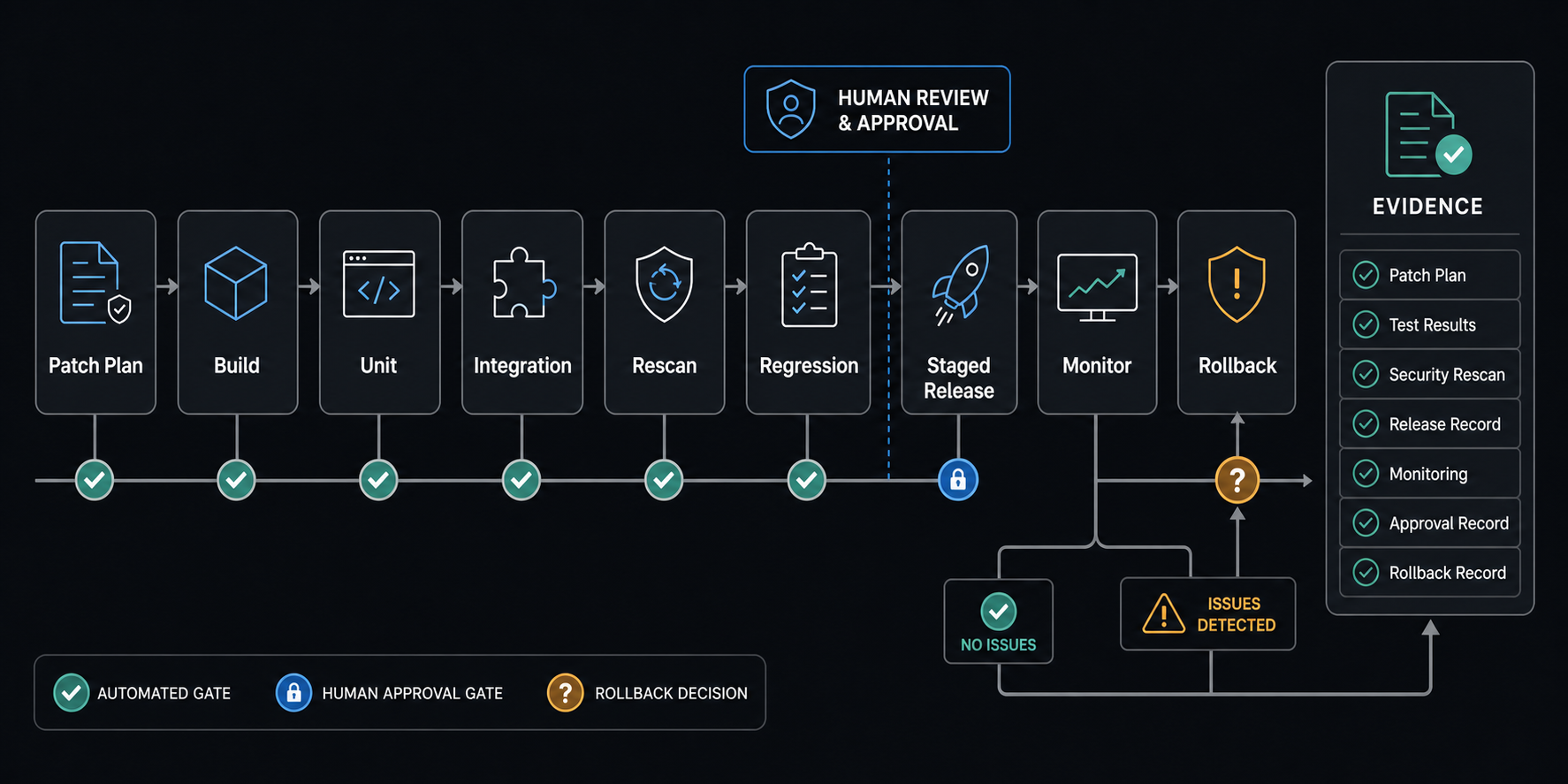
- Build gate: install fixed versions, compile, run type checks, and fail on incompatible dependency changes.
- Unit and component gate: test changed modules, wrappers, validation paths, and error handling.
- Integration gate: verify API contracts, queues, databases, identity, file handling, and third-party systems.
- Security gate: rescan the package, image, or application and confirm the CVE no longer appears or has a documented exception.
- Regression gate: run critical business journeys affected by the library, service, or framework.
- Release gate: record approvals, rollout plan, feature flags, canary scope, rollback steps, and monitoring alerts.
- Closure gate: attach fixed version, commit or release reference, scanner evidence, and residual risk notes.
Reference Architecture For A Governed CVE Remediation Workflow
The architecture should be controlled and auditable. Connect scanners, SBOM data, package registries, repository metadata, service catalogs, asset inventory, CI/CD, ticketing, and observability through narrow APIs. Put policy and permissions between the AI layer and any system that changes state. Avoid a broad agent that can read and write everywhere.
- Intake layer: SCA, SAST, DAST, container scans, SBOMs, cloud findings, vendor advisories, and penetration-test output.
- Context layer: EPSS, KEV, CVSS, NVD/vendor data, package metadata, repo ownership, service catalog, exposure, and data classification.
- Policy layer: SLA rules, exception policy, approval matrix, prohibited actions, and audit requirements.
- AI layer: deduplication, summarization, prioritization explanation, fixed-version recommendation, test-scope drafting, and ticket preparation.
- Action layer: Jira, GitHub, GitLab, CI/CD, Slack, email, change-management tools, and scanner rescan workflows.
- Evidence layer: retrieved context, prompts, outputs, human approvals, tickets, commits, test results, releases, rescans, and exceptions.
This resembles broader AI workflow automation, but with tighter permission boundaries and stronger closure evidence. For teams building internal security automation, NextPage's AI automation services can help connect the workflow without handing unrestricted access to a model.
Rollout Plan And Success Metrics
Do not start with autonomous patching. Start read-only, then add reviewed recommendations, then controlled ticket creation, then guarded patch suggestions. Only automate low-risk actions after the workflow has reliable data, stable policies, and measured accuracy.
| Phase | Scope | Success Metric |
|---|---|---|
| Phase 1: visibility | Normalize findings, owners, affected services, and context | Owner coverage, duplicate reduction, missing context rate |
| Phase 2: triage assistant | Rank CVEs and explain the priority | Priority agreement rate and time-to-triage |
| Phase 3: remediation planner | Draft fixed-version, risk, test, and rollback notes | Engineer edit rate and ticket completeness |
| Phase 4: workflow routing | Create reviewed tickets and route approvals | SLA adherence and stale critical findings |
| Phase 5: guarded automation | Suggest low-risk patches or pull requests with required checks | Test pass rate, rollback rate, and approval rate |
Useful metrics include mean time to triage, mean time to remediate, high-risk backlog age, percentage of KEV items inside SLA, duplicate ticket rate, reopen rate, emergency change failure rate, exception age, and percentage of closures with complete evidence.
AI CVE Remediation Checklist
- Do scanner findings map to services, repositories, packages, owners, and environments?
- Does prioritization combine KEV, EPSS, CVSS, exposure, asset criticality, and remediation friction?
- Can the assistant explain why each CVE is urgent, deferred, mitigated, or excepted?
- Are AI permissions limited to approved data sources and reviewed actions?
- Do high-risk actions require security and engineering approval?
- Does every patch recommendation include target version, migration notes, blast radius, and rollback risk?
- Are test gates based on release risk rather than one generic checklist?
- Can the workflow collect rescan evidence, test evidence, release references, and exception expiry?
- Are service accounts, tokens, and tool permissions logged and reviewed?
- Is success measured by risk reduction and safer releases, not only ticket volume?
Before you build, use the AI Agent Readiness Assessment to check workflow clarity, data readiness, integration access, and human-review controls.
How NextPage Helps Build Governed Remediation Workflows
NextPage helps product, SaaS, and enterprise teams design AI-assisted remediation workflows that connect real engineering systems without weakening governance. We start with data readiness, scanner and SBOM inputs, owner mapping, approval boundaries, testing strategy, CI/CD integration, and evidence requirements. Then we build the smallest useful workflow: triage assistant, remediation-ticket generator, patch-risk planner, exception review queue, or controlled AI agent.
The result is not a generic chatbot for security. It is a governed workflow that helps security and engineering decide what to fix first, how to fix it safely, how to prove it shipped, and when repeated patch friction means the product needs modernization. The same evidence-first delivery pattern appears in the QualityHub portfolio case study, where operational workflows needed traceable proof instead of loose status updates.