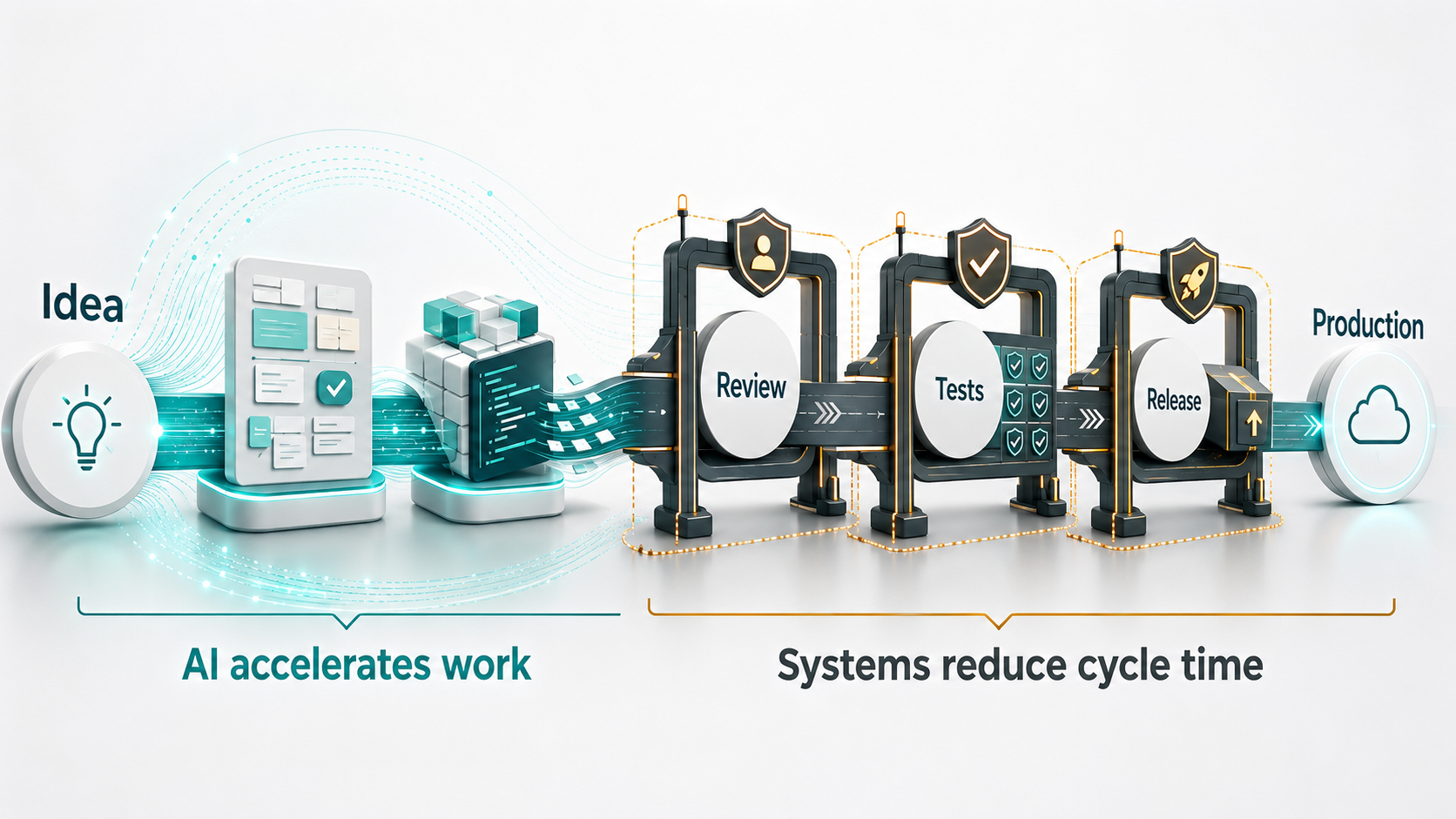

Quick Answer: How AI Reduces Engineering Cycle Time
AI reduces engineering cycle time when it removes delays across the whole delivery system, not only when it writes code faster. The biggest gains usually come from clearer requirements, faster impact analysis, smaller pull requests, automated review checks, stronger test generation, better CI triage, and safer release operations.
If your team already has disciplined product intake, modular architecture, reliable test automation, and a clean release path, AI can compress repetitive engineering work. If those basics are weak, AI-generated code reaches the next bottleneck faster and can even increase review, QA, and production support load.
For CTOs and delivery leaders, the practical question is not "Which coding assistant should we buy?" It is "Where does work wait, rework, or fail between idea and production?" That is where AI should be applied first. NextPage helps teams answer that through AI workflow review, delivery diagnostics, and India-based engineering pods that combine software outsourcing in India with senior delivery ownership.
Cycle Time Is Not The Same As Coding Speed
Engineering cycle time is the elapsed time from a committed decision or started work item to useful software running in production. Coding speed is only one part of that path. A developer may finish a function in half the time, but the business sees no improvement if the ticket waits for clarification, review, test fixes, security approval, deployment coordination, or release rollback planning.
This is why AI adoption can look impressive in demos and disappointing in delivery metrics. The source article makes a useful point: many teams optimize the most visible activity, coding, while their actual constraints sit in unclear requirements, review bottlenecks, fragmented tooling, and context switching. Google's DORA research also warns that AI can improve individual productivity while hurting delivery stability and throughput if teams neglect fundamentals such as small batch sizes and robust testing.
The operating principle is simple: use AI to reduce wait time, rework, and uncertainty at each gate. Do not measure success only by generated lines of code, accepted completions, or tool adoption. Measure whether lead time, change failure rate, review latency, escaped defects, deployment frequency, and recovery time improve together.
Where Engineering Cycle Time Actually Goes
Before adding more AI tools, map one real feature from idea to production. Capture each handoff, queue, rework loop, and decision delay. Most teams find the same pattern: coding is visible, but it is not the only drag.
| Bottleneck | Typical symptom | AI can help by | Human or system guardrail |
|---|---|---|---|
| Requirements clarity | Tickets bounce between product and engineering | Summarizing discovery notes, drafting acceptance criteria, finding contradictions | Product owner approves scope and edge cases |
| Architecture impact | Small change touches unknown services | Scanning repositories, dependency maps, docs, and prior incidents | Tech lead validates boundaries and migration risk |
| Coding | Boilerplate and repetitive edits consume focus | Generating scaffolds, tests, migrations, adapters, and refactors | Rules, approved libraries, and code ownership |
| Pull request review | PRs wait days or return with avoidable comments | Running first-pass checks for secrets, style, test gaps, risky diffs, and release readiness | Human reviewers focus on architecture, product risk, and maintainability |
| Testing | Regression cycles stretch or flaky tests hide real failures | Generating unit tests, edge cases, test data, and failure explanations | Coverage strategy and deterministic CI gates |
| Release operations | Deployments require manual coordination | Summarizing change risk, drafting runbooks, triaging failed pipelines, and suggesting rollback checks | Feature flags, observability, owners, and rollback authority |
This table is the editorial difference between AI theater and cycle-time improvement. If a tool only accelerates coding while the longest queues sit in review or release, the tool may be useful but it is not solving the real constraint.
Best AI Use Cases For Reducing Software Delivery Lead Time
The best use cases are repeatable, evidence-rich, and easy to review. They give developers a faster starting point without removing judgment. They also produce artifacts the next person in the chain can trust.
- Ticket refinement: convert messy notes into acceptance criteria, out-of-scope items, API assumptions, and test scenarios.
- Codebase orientation: explain relevant modules, ownership, known constraints, and similar prior changes before implementation starts.
- Change impact analysis: list affected services, database tables, feature flags, tests, and deployment risks for a proposed change.
- Small PR generation: produce focused diffs that follow local rules instead of large mixed changes that reviewers cannot reason about.
- PR pre-review: identify missing tests, unsafe migrations, secret exposure, inconsistent patterns, accessibility issues, and observability gaps before human review.
- Test creation and maintenance: generate unit tests, contract tests, fixtures, and realistic edge cases from acceptance criteria and production failures.
- CI/CD triage: summarize failed pipeline logs, detect flaky-test patterns, identify owner teams, and suggest next actions.
- Release notes and runbooks: summarize change intent, rollout plan, validation steps, rollback criteria, and customer-facing impact.
For a budget lens, pair the operating map with the AI Automation ROI Calculator. Estimate hours saved only after you know which bottleneck is being automated and who validates the output.
The Operating Model That Makes AI Useful
AI cycle-time gains need an operating model. Without one, every developer invents their own prompts, tools, rules, and review habits. That creates inconsistent output and makes teams slower at scale.
Start with five operating rules:
- Define approved AI surfaces: decide which tools are allowed in the IDE, repository, ticketing system, CI/CD, documentation, and production support workflows.
- Write team rules: document architecture patterns, naming rules, dependency policy, security constraints, testing standards, and explicit prohibitions.
- Keep work small: AI works better when tasks are scoped tightly. Small tickets and small PRs also reduce review queue time.
- Make AI output reviewable: require tests, citations to source files, assumptions, risk notes, and rollback notes where relevant.
- Measure system outcomes: track lead time, review latency, deployment stability, rework, and incident recovery, not only usage metrics.
This is where team structure matters. A managed pod can accelerate the work if it brings delivery ownership, QA discipline, DevOps habits, and AI workflow governance. If you are comparing local hiring, freelancers, outsourcing, or a managed pod, use the Dedicated India Team Cost Calculator to model the staffing side.
AI-Assisted PR Review Without Lowering The Bar
Pull request review is often the most visible cycle-time bottleneck. AI can help, but the goal is not to replace senior reviewers. The goal is to remove the repetitive checks that waste senior attention.
A useful AI pre-review should check for:
- Scope drift between ticket, branch, and diff.
- Missing or weak tests for changed behavior.
- Security issues such as exposed keys, unsafe input handling, missing authorization, or logging sensitive data.
- Database migration risk, rollback concerns, and backward compatibility issues.
- Performance risks such as N+1 queries, heavy client bundles, or unbounded loops.
- Observability gaps, including missing logs, metrics, tracing, alerts, or release notes.
The human reviewer should then focus on product behavior, architecture fit, domain assumptions, maintainability, and whether the change should exist at all. That division of labor reduces queue time without turning the review process into blind approval.
Testing And Quality Gates Matter More After AI
AI increases the volume and speed of proposed changes. That makes test strategy more important, not less. If generated code is accepted faster than the team can validate it, cycle time may appear to improve while change failure rate rises.
Use AI to strengthen the test system around the code:
| Gate | AI contribution | Quality rule |
|---|---|---|
| Unit tests | Generate edge cases from acceptance criteria and changed functions | Developer owns assertions and failure meaning |
| Integration tests | Draft API, database, and third-party interaction scenarios | Use realistic fixtures and known contract boundaries |
| Regression tests | Convert bug reports and incidents into repeatable tests | Prioritize high-risk flows over vanity coverage |
| CI triage | Summarize failure logs and likely owners | Do not auto-ignore flaky failures without evidence |
| Release validation | Draft smoke tests, rollback checks, and observability queries | Release owner signs off on risk and fallback |
For teams with inconsistent QA coverage, AI coding assistants should be paired with QA automation, CI reliability work, and release monitoring. Otherwise, speed moves downstream into manual testing and incident response.
Metrics To Track Before And After AI Adoption
Do not introduce AI and then search for a success story. Establish a baseline first. Track both delivery speed and reliability so the team cannot hide instability behind throughput.
| Metric | Why it matters | Watch out for |
|---|---|---|
| Lead time for changes | Shows elapsed time from started work to production | Segment by work type and team |
| PR review latency | Reveals queue time and reviewer bottlenecks | Do not reward superficial approvals |
| Change failure rate | Shows whether speed is damaging stability | Define failure consistently |
| MTTR | Measures recovery discipline | Include detection and rollback time |
| Rework rate | Shows whether AI output causes downstream churn | Separate requirement churn from code quality rework |
| Developer focus time | Shows whether AI removes or adds context switching | Survey data should supplement workflow telemetry |
Atlassian's DevEx findings are useful here because they frame the paradox many leaders see: AI can save time, while organizational inefficiencies consume the same gains. If developers still lose hours finding information, waiting on direction, or coordinating across teams, AI code generation alone will not fix the system.
A 30/60/90 Day Roadmap For AI Engineering Cycle Time
A practical rollout should start with the bottleneck map, not a tool migration. Use the first 90 days to prove one or two constraints can move without hurting quality.
| Timeframe | Focus | Output |
|---|---|---|
| Days 1-30 | Baseline and rules | Cycle-time map, approved tools, team rule file, measurement dashboard, first PR pre-review pilot |
| Days 31-60 | Workflow pilots | Ticket refinement assistant, codebase orientation prompts, test-generation workflow, CI failure summarizer |
| Days 61-90 | Scale and governance | Reusable templates, adoption playbook, release-readiness checks, team training, leadership review of speed and stability |
The roadmap should be narrow enough to measure. Pick one product area, one repository group, and one release stream. Compare before and after across the same work type. If the result is faster coding but slower review, more rework, or more failed deployments, the operating model needs adjustment before scaling.
Where Team Extension Fits
AI does not remove the need for experienced engineers. It changes where experience is most valuable. Senior people spend more time shaping requirements, splitting work, reviewing AI-assisted diffs, designing tests, improving pipelines, and deciding which risks are acceptable.
This is why team extension can be useful when cycle time is constrained by both capacity and operating discipline. A good pod should not just add hands. It should improve the flow of work: clearer intake, smaller releases, better QA coverage, stronger DevOps habits, and measurable AI usage patterns.
NextPage's team-extension model is designed for that kind of delivery ownership. If you are deciding between fixed price, time and material, and a dedicated pod, compare tradeoffs in Fixed Price Vs Time And Material Vs Dedicated Team For Software Development. For cost planning, the guide on dedicated development team cost in India gives realistic pod-size and ramp-up context.
Common Failure Modes
Most AI engineering cycle-time programs fail in predictable ways:
- Tool-first rollout: leadership buys licenses before identifying bottlenecks.
- No rule file: AI output drifts across frameworks, patterns, dependencies, and security expectations.
- Large PRs get larger: faster generation produces bigger diffs that wait longer for review.
- Testing stays manual: QA absorbs the extra output instead of automation improving.
- Metrics are vanity-driven: teams report acceptance rates and prompt counts while lead time and stability stay flat.
- Senior review load increases: experienced engineers spend more time correcting AI-generated rework.
- Release controls lag behind: deployment frequency rises without feature flags, observability, rollback, or incident readiness.
The fix is to treat AI as a system intervention. Every AI workflow should have an owner, inputs, review criteria, failure modes, and a measurement plan.
AI Engineering Cycle Time Checklist
- Map one real feature from idea to production before adding new AI tools.
- Find the longest queues: requirements, architecture review, PR review, tests, CI, release, or support.
- Write a team rule file covering stack, architecture, approved dependencies, security, testing, and prohibitions.
- Start with AI use cases that produce reviewable artifacts: acceptance criteria, impact analysis, pre-review notes, tests, and release runbooks.
- Keep PRs small enough for humans and AI tools to review with context.
- Measure lead time, review latency, change failure rate, MTTR, rework, and developer focus time together.
- Scale only when faster throughput does not increase defects, incidents, or senior review burden.
Next Steps
If your team is adopting AI coding tools, start with a delivery diagnostic. Identify where work waits today, what can be automated safely, which controls must stay human-owned, and which team gaps are slowing the release path.
NextPage can help with an engineering velocity and AI workflow review, then support implementation through Your Team In India, software outsourcing, AI development, QA automation, and DevOps support. The goal is not more generated code. The goal is a delivery system where better requirements, smaller changes, faster review, stronger tests, and safer releases compound into shorter cycle time.