
An AI legacy system discovery sprint is a focused two-to-four-week engagement that uses AI-assisted code analysis, workflow interviews, dependency mapping, and risk scoring to turn an opaque legacy system into a modernization scope leaders can actually approve. AI can accelerate code understanding and documentation, but it cannot decide which workflows matter, which integrations are fragile, which controls cannot be skipped, or which modernization path is safest for the business.
This guide is for CTOs, CIOs, engineering leaders, operations owners, and product teams that know a legacy platform is slowing delivery but do not yet trust the available documentation, estimates, or migration plan. The goal is to reduce uncertainty before a rewrite, replatforming effort, API wrapper, cloud migration, automation project, or phased rebuild.
If you need a fast starting point before budget conversations, use NextPage's Legacy Software Modernization Scorecard. Then use the sprint model below to collect the evidence needed for a confident modernization decision.
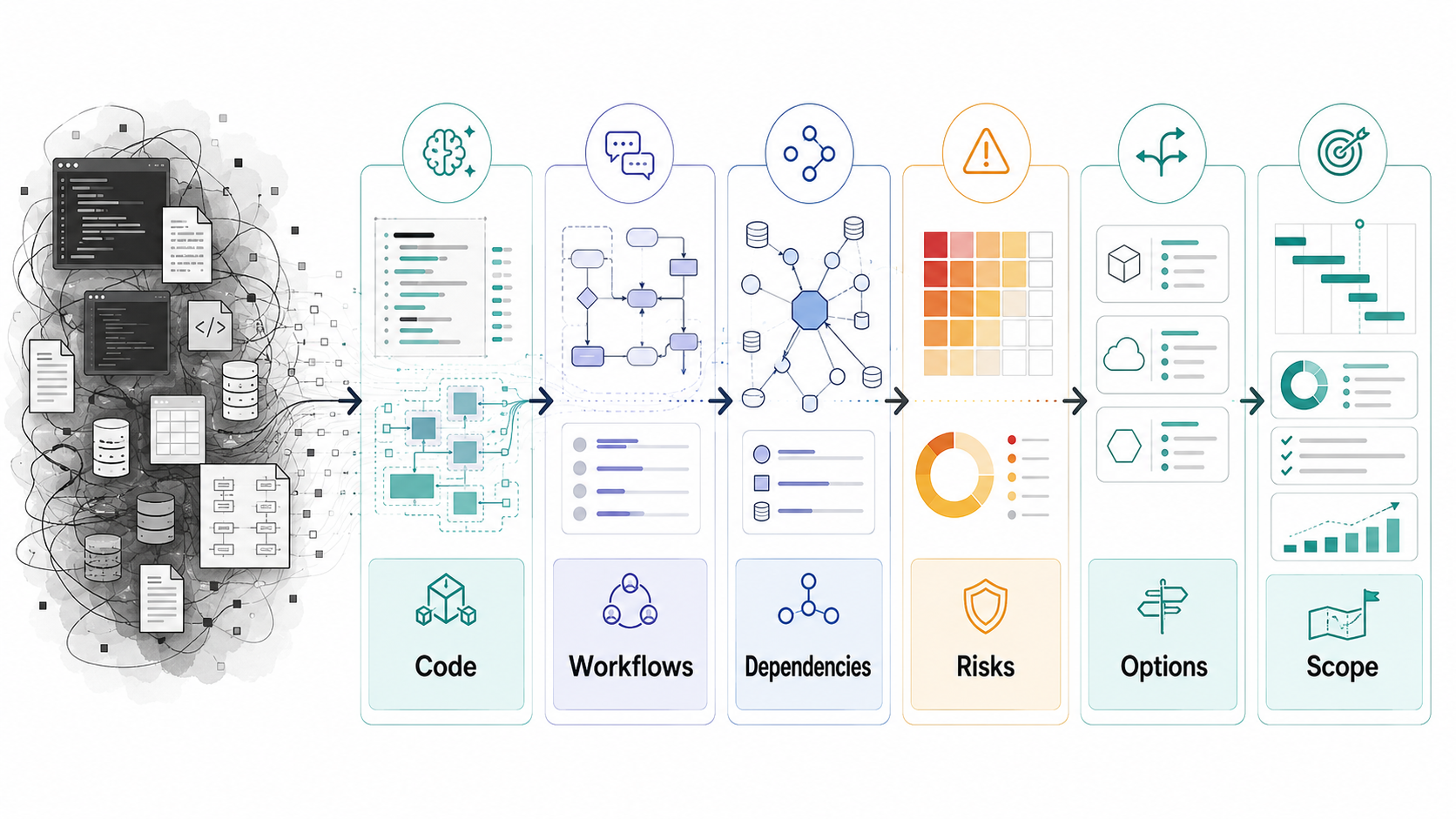
Quick Answer: What An AI Legacy System Discovery Sprint Should Produce
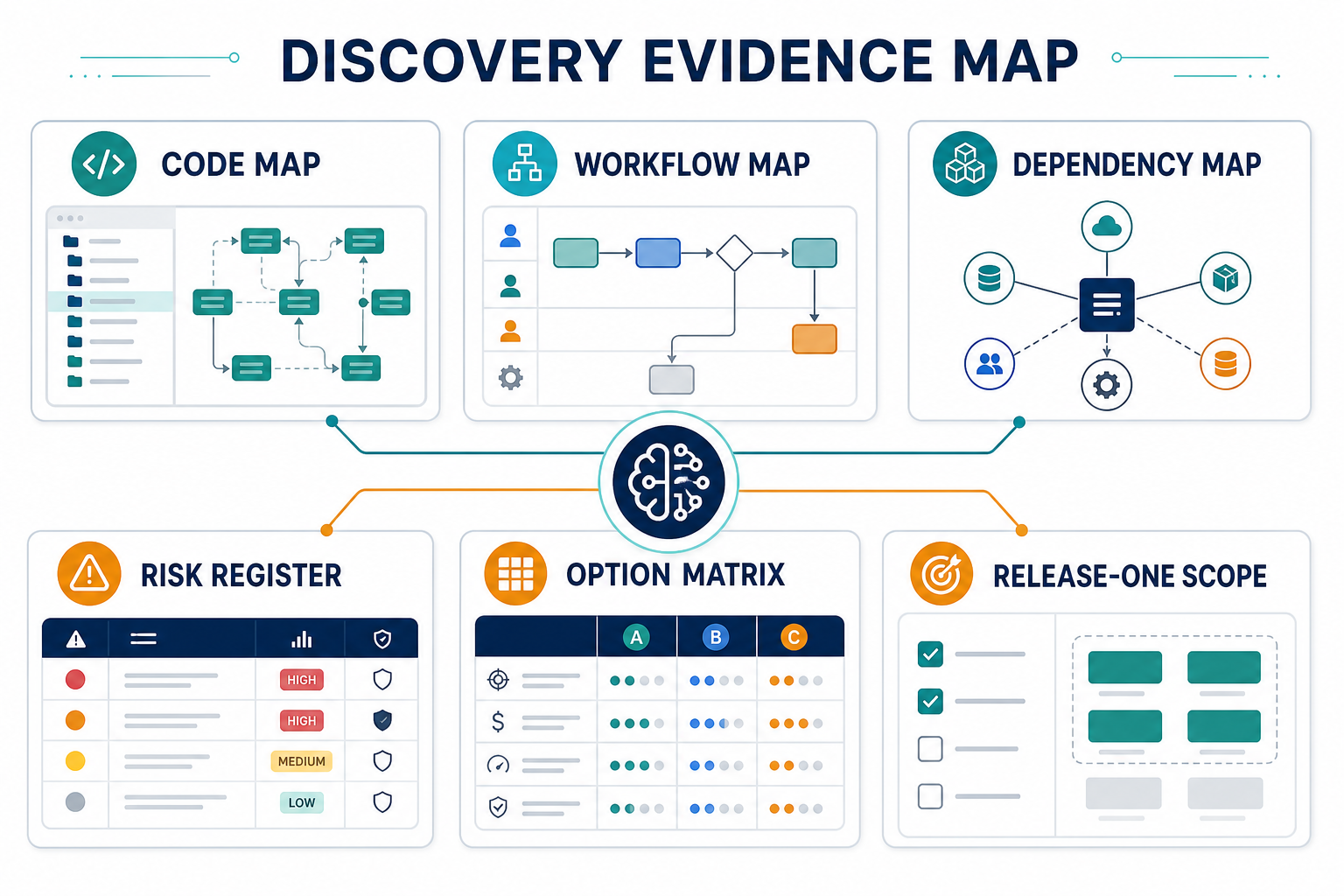
A useful sprint should produce six outputs: a code and architecture map, a workflow inventory, a dependency and integration map, a risk register, modernization options, and a scoped roadmap for the first safe release. The sprint should combine AI-assisted analysis with human validation because legacy systems usually encode business rules in code, database tables, batch jobs, spreadsheets, user habits, and support workarounds.
The sprint is not a generic audit. It should end with decisions: which module to stabilize first, which workflow to wrap with an API, which screens or batch jobs to retire, which data must be cleaned, which tests are missing, and which modernization route has the best risk-adjusted return.
| Sprint Output | What It Answers | Why It Matters |
|---|---|---|
| System map | What code, databases, jobs, services, and environments exist? | Stops estimates from relying on old diagrams or tribal memory. |
| Workflow inventory | Which business processes depend on the system today? | Prevents technical cleanup from breaking revenue, compliance, or operations. |
| Dependency map | Which integrations, files, APIs, reports, and manual handoffs are coupled before choosing an application migration services path? | Exposes hidden risk before teams move or rewrite a module. |
| Risk scorecard | Where are the highest failure, security, data, support, and change risks? | Creates a defensible priority order. |
| Modernization options | Should the team wrap, refactor, replatform, rebuild, replace, automate, or retire? | Turns discovery into executive choices rather than analysis paralysis. |
| Release-one scope | What should be done first, by whom, with what evidence and rollback path? | Makes the next budget ask specific enough to approve. |
Why AI Code Understanding Is Not Enough
Recent modernization coverage and tool launches show the same useful pattern: AI can scan large codebases, summarize modules, trace dependencies, draft documentation, and identify technical debt faster than manual review alone. That is valuable because many legacy systems have stale architecture diagrams, missing tests, unsupported frameworks, and business rules nobody has documented for years.
But code understanding is only one input. A legacy system is usually part software, part operating process. It may depend on month-end finance routines, customer-support exceptions, batch exports, shared inboxes, admin screens, undocumented approval paths, vendor file formats, or senior employees who know why a strange rule exists. AI can surface clues, but modernization scope still needs business context and engineering judgment.
This is where NextPage's broader enterprise application modernization roadmap becomes useful. Discovery should connect system evidence to business sequencing, cloud readiness, data quality, risk, and operational rollout instead of treating modernization as a code transformation exercise.
When To Run A Discovery Sprint
Run a discovery sprint when the team knows the system matters but cannot yet answer basic scope questions with confidence. Common triggers include delayed releases, fragile deployments, support tickets that only one person can resolve, unsupported frameworks, audit concerns, duplicate data entry, brittle integrations, or a planned cloud migration that keeps expanding in estimate meetings.
A sprint is especially useful before hiring a full modernization team. Without discovery, vendors may quote a rewrite based on screen count, code volume, or optimistic assumptions. With discovery, the conversation changes to workflow value, dependency risk, data ownership, test coverage, and release sequencing.
- Use discovery before a rewrite when leaders do not know which business rules must be preserved.
- Use discovery before migration when the system has unknown integrations, batch jobs, or environment assumptions.
- Use discovery before automation when a workflow may be too brittle to automate safely; the AI Agent Readiness Assessment is a useful companion when the proposed path includes copilots, agents, or supervised workflow automation.
- Use discovery before API wrapping when backend access could bypass approval, audit, or validation rules.
- Use discovery before retirement when no one can prove which reports, users, or downstream systems still depend on the application.
Sprint Inputs: What To Collect Before Analysis Starts
The first week should gather enough evidence for both AI-assisted analysis and human validation. Do not wait for perfect access. Start with the best available repository, database schema, deployment notes, logs, support tickets, user roles, workflow descriptions, and production constraints. The sprint should record gaps explicitly rather than pretending the system is fully understood.
| Input | Examples | Discovery Use |
|---|---|---|
| Code and repositories | Application code, scripts, stored procedures, build files, dependency manifests. | AI-assisted code summaries, module map, dependency and risk hints. |
| Data structures | Database schemas, key tables, exports, reports, duplicate datasets. | Data ownership, migration risk, reporting dependencies. |
| Runtime evidence | Logs, jobs, queues, cron schedules, deployment notes, incident reports. | Operational flows and hidden coupling. |
| User workflows | Screen recordings, interviews, SOPs, support notes, approval paths. | Business rules and exception handling. |
| Integration evidence | APIs, file drops, vendor connectors, spreadsheets, emails, manual imports. | Downstream blast radius and replacement sequence. |
| Constraints | Compliance, uptime windows, data residency, vendor contracts, budget limits. | Modernization option scoring. |
How AI Helps The Sprint
AI is useful when it reduces the manual effort of reading unfamiliar systems. It can cluster modules, summarize code paths, identify recurring patterns, explain database relationships, draft questions for subject-matter experts, compare code behavior to stale documentation, and generate first-pass test ideas. It can also help create onboarding notes for engineers who will work on the system later, especially when the team is comparing AI-assisted discovery with the controlled patterns in AI agents for legacy systems.
The sprint should still treat AI output as evidence to verify, not truth to publish. Legacy systems often contain dead code, feature flags, special-case client logic, confusing names, and historical workarounds. A model may explain what a function appears to do without knowing whether anyone still uses it, whether a downstream report depends on it, or whether the behavior exists because of an old compliance promise.
A good pattern is to let AI produce hypotheses, then validate them through runtime evidence and interviews. For example, if AI identifies a pricing-rule module, verify it against recent orders, support tickets, finance workflows, and user interviews before deciding whether to preserve, simplify, or replace it.
Workflow Mapping: The Human Layer AI Cannot Skip
Workflow mapping turns code evidence into business meaning. It asks what users are trying to accomplish, what decisions the system supports, what data must be correct, what approvals cannot be bypassed, and what happens when the system fails. This is where many modernization projects discover that the most important logic is not in the codebase at all.
Interview people who operate the workflow, support it, approve exceptions, consume reports, and pay for the outcomes. Ask them to walk through real examples rather than ideal process diagrams. Capture where they leave the application for spreadsheets, email, phone calls, shared folders, or another system. Those detours often reveal the highest-value modernization opportunities.
The output should be a workflow map with owners, data touched, systems touched, decision points, manual steps, exceptions, controls, and pain points. This gives modernization leaders a better question than "how much code do we have?" The better question is "which workflows create the most value or risk, and what system changes would improve them without disrupting the business?"
Dependency And Risk Scoring
Legacy modernization gets dangerous when teams underestimate dependencies. A small change may affect reports, nightly jobs, vendor exports, tax calculations, audit trails, customer communication, or operations dashboards. The sprint should score each major area by change risk, business value, technical health, data quality, integration complexity, and test coverage.
| Risk Dimension | Low-Risk Signal | High-Risk Signal |
|---|---|---|
| Business criticality | Internal convenience workflow. | Revenue, compliance, customer commitments, or operations uptime. |
| Code clarity | Readable modules, current dependencies, active maintainers. | Unsupported stack, dead code uncertainty, unclear ownership. |
| Data quality | Clear source of truth and validation rules. | Duplicate fields, manual corrections, inconsistent reports. |
| Integration coupling | Documented APIs and limited consumers. | File drops, shared databases, emails, hidden downstream jobs. |
| Test coverage | Automated tests and known acceptance checks. | Manual QA only or no reproducible regression path. |
| Operational resilience | Clear logs, rollback path, monitored jobs. | Silent failures, shared credentials, support-only knowledge. |
Use the score to prioritize modernization slices. High-value, high-risk areas may need characterization tests, legacy software QA audit evidence, and careful strangler-style migration. Low-risk, high-value workflows may be good candidates for early API wrapping or UI replacement. Low-value, high-cost modules may be candidates for retirement or replacement.
Modernization Options After Discovery
A discovery sprint should avoid one-size-fits-all recommendations. Different parts of the same legacy system may need different treatments. One module may be stable enough to wrap with an API. Another may need a phased rebuild. A report may be retired. A workflow may be automated temporarily while the data layer is cleaned. A backend service may be migrated only after test coverage improves.
NextPage's legacy application modernization roadmap covers the broader migration paths. The sprint should translate those paths into a decision matrix for this specific system.
| Option | Best Fit | Discovery Evidence Needed |
|---|---|---|
| Stabilize | Critical system with immediate reliability or security issues. | Incident patterns, unsupported dependencies, fragile deployments. |
| Wrap With API | Stable business logic that needs safer integration access. | Clear data ownership, permission model, audit requirements. |
| Refactor | Valuable code with poor structure but manageable risk. | Module map, tests, dependency boundaries, release plan. |
| Replatform | Useful app blocked by old hosting, runtime, or deployment constraints. | Infrastructure assumptions, environment parity, operational constraints. |
| Rebuild Slice | High-value workflow with poor user experience or data model problems. | Workflow map, acceptance criteria, migration and rollback approach. |
| Replace | Commodity workflow better served by a proven product. | Feature fit, data migration needs, integration gaps, change-management plan. |
| Retire | Low-value module or report with little active usage. | Usage evidence, downstream dependency check, stakeholder signoff. |
What The Final Scope Should Include
The final deliverable should be practical enough to fund. A generic slide deck that says "modernize in phases" is not enough. The scope should name the first release, affected users, workflow boundaries, systems touched, data migration needs, integration approach, test plan, risk controls, timeline range, team shape, and expected business outcome.
For example, a strong release-one scope might say: rebuild the quote approval workflow as a modern web module, preserve the legacy pricing rules through a read-only service wrapper, add characterization tests for the pricing path, migrate only active customer records, keep the legacy admin report read-only for two months, and use support-ticket reduction plus approval-cycle time as success metrics.
That level of specificity helps leaders compare options. It also prevents modernization from becoming an unbounded rewrite disguised as a technical cleanup project. After release-one boundaries are clear, the Custom Software Cost Estimator can turn scope assumptions into a directional build range for budget conversations.
How NextPage Runs The Sprint
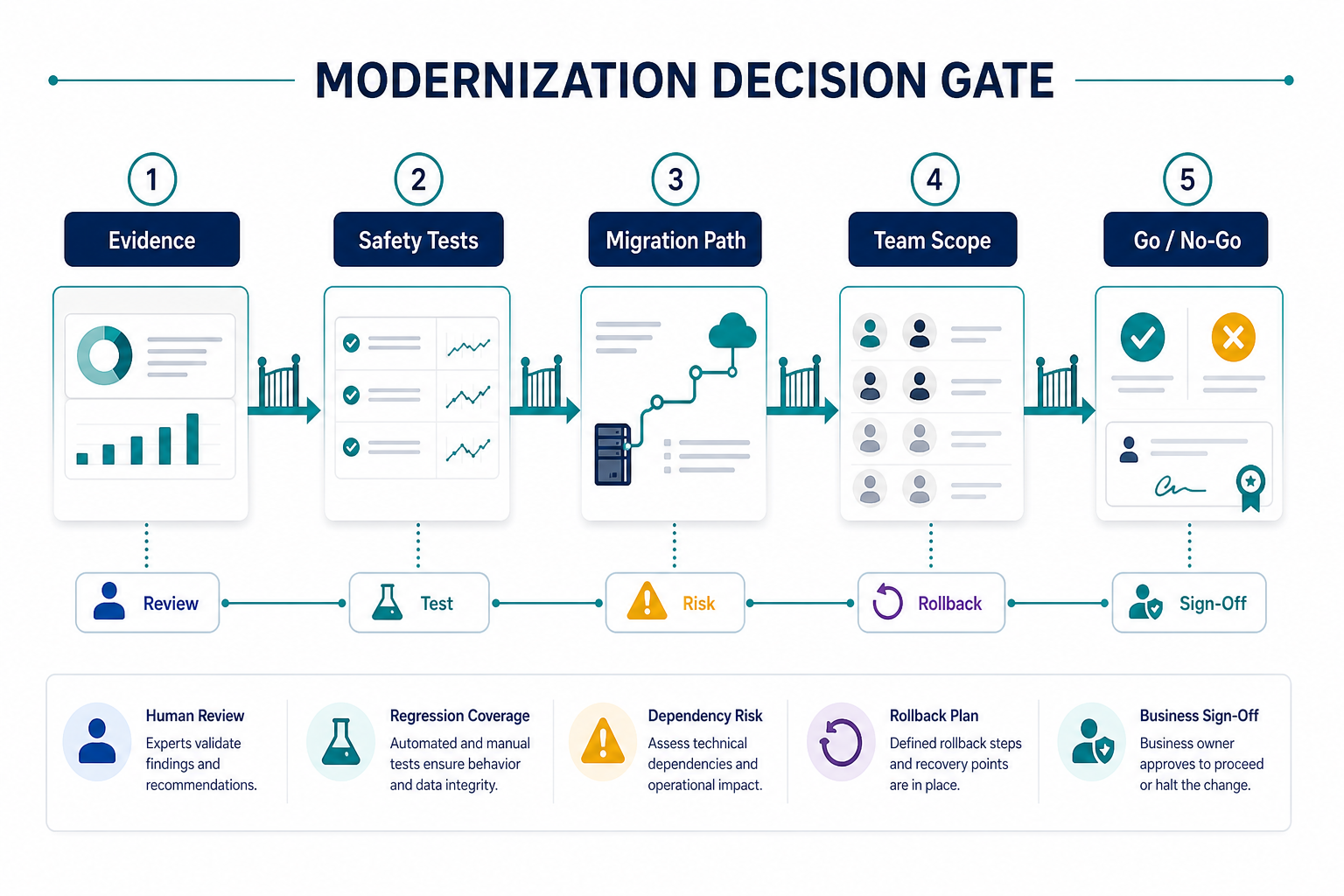
NextPage runs discovery as a business and engineering exercise, not just a code audit. The sprint starts with goals, constraints, and access. It then combines AI-assisted repository review, architecture and database inspection, workflow interviews, integration mapping, risk scoring, and modernization option design.
The output is a decision-ready modernization plan: where to start, what to avoid, what to test, what to wrap, what to rebuild, what to retire, and how to sequence the work without surprising operations. When the right path includes AI or automation, NextPage's AI Development Services can help design controlled copilots or code-analysis workflows. When the work becomes a broader replacement, rebuild, or growth-platform effort, Custom Software Development and Scalable Software Development Services cover product engineering, QA, deployment, and support.
If the legacy system is blocked by hosting, infrastructure, or environment constraints, the sprint can also feed into Cloud Migration Services. The key is sequencing: prove the workflow, risk, and data model before moving expensive parts of the system.
Checklist Before You Approve Modernization
- Do we know which workflows the system supports today?
- Have we validated AI code summaries with runtime evidence and user interviews?
- Do we know which integrations and reports depend on each module?
- Have we scored business value, technical risk, data quality, and test coverage?
- Can we name what to stabilize, wrap, refactor, rebuild, replace, or retire?
- Is release one small enough to ship without a big-bang cutover?
- Do we have rollback, monitoring, and support handoff plans?
- Can executives approve the scope based on evidence rather than optimism?
Next Step
If your team is unsure whether a legacy platform should be rebuilt, migrated, wrapped with APIs, automated around, or retired, start with a discovery sprint instead of a full modernization quote. Use the Legacy Software Modernization Scorecard to frame the first conversation, then talk to NextPage about a focused modernization discovery sprint that turns code, workflows, dependencies, and risks into an approved release-one plan.