
Quick Answer: What Is AI-Native Engineering?
AI-native engineering is a software delivery model where product teams use AI across requirements, architecture, implementation, testing, review, documentation, release, and monitoring while keeping humans accountable for product judgment and system quality. It is not simply giving every developer a coding assistant. The real shift is from manual implementation as the bottleneck to stronger specification, architecture, validation, and governance around AI-assisted execution.
A useful AI-native team can turn product intent into clearer requirements, generate implementation options, produce tests, draft code, explain tradeoffs, update documentation, and surface delivery risks faster. But the team still needs architecture decisions, review gates, security controls, evaluation sets, observability, and rollback paths. Without those controls, AI only accelerates technical debt.
If you are deciding whether a workflow or team is ready, start with the AI Agent Readiness Assessment. Even when the first use case is engineering productivity, the same readiness questions apply: workflow clarity, data and context access, tool integration, human review, and governance.
AI-Native Engineering Is Not Ungoverned Vibe Coding
AI-native engineering has become easy to confuse with unstructured AI coding. A product manager describes a feature, an AI tool generates files, a developer runs the app, and the team keeps prompting until something looks usable. That can be helpful for prototypes, but it is not a reliable operating model for production products.
Production engineering needs traceability. The team should know which requirement led to a change, which architecture decision constrained the implementation, which tests prove behavior, which security checks ran, which reviewer approved the merge, which feature flag controls release, and which metric will show whether the change worked. AI can help with all of that, but only if the system is designed around clear artifacts and review loops.
NextPage's Shadow AI Governance Checklist is relevant here. If engineers are using personal AI tools, unapproved browser extensions, or unmanaged agents without shared standards, the organization may see speed in the short term and lose control of IP, security, consistency, and maintainability later.
The AI-Native Engineering Operating Model
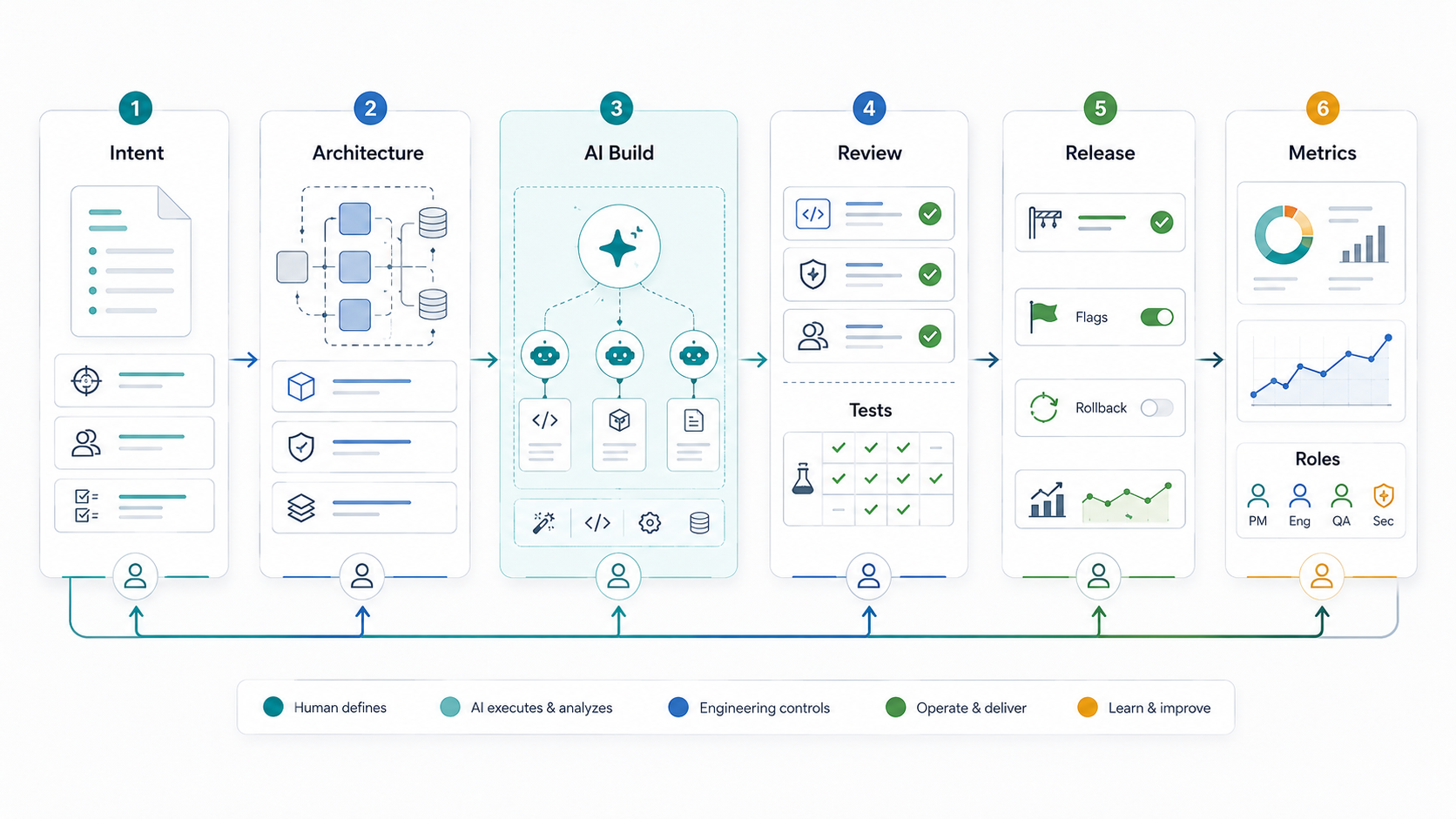
A practical AI-native operating model has six connected layers. First, product intent must be written clearly enough for humans and machines: user goals, constraints, acceptance criteria, edge cases, compliance needs, and success metrics. Second, architecture decisions need to be explicit: system boundaries, data ownership, integration contracts, performance expectations, and security assumptions. Third, AI-assisted implementation can draft code, tests, migrations, docs, and refactors inside those boundaries. Teams that need production AI connected to product workflows should pair this operating model with AI development services that cover data, UX, backend systems, evaluation, and ongoing operations.
Fourth, review and validation become more important, not less. Pull requests need human review, automated tests, static analysis, security scanning, accessibility checks, and sometimes AI-generated test critiques. Fifth, release controls must absorb faster code output: feature flags, canary rollout, rollback, observability, error budgets, and support handoff. Sixth, the learning loop should measure what improved and what got worse.
| Layer | AI Contribution | Human Responsibility |
|---|---|---|
| Product intent | Draft requirements, user stories, edge cases, and test ideas | Decide the real customer problem and tradeoffs |
| Architecture | Compare options, identify dependencies, draft ADRs | Own system boundaries, quality attributes, and risk |
| Implementation | Generate code, refactors, tests, migrations, and docs | Review correctness, maintainability, and fit |
| Validation | Suggest test cases, review diffs, find gaps | Approve release quality and security posture |
| Release | Draft release notes, checks, rollback steps, monitoring queries | Control deployment, rollout, and incident response |
The AI Development Lifecycle guide is a useful companion because AI-native engineering needs governed release gates, evaluation, monitoring, and production ownership rather than isolated tool adoption.
Guardrails Product Teams Need Before Scaling AI Coding
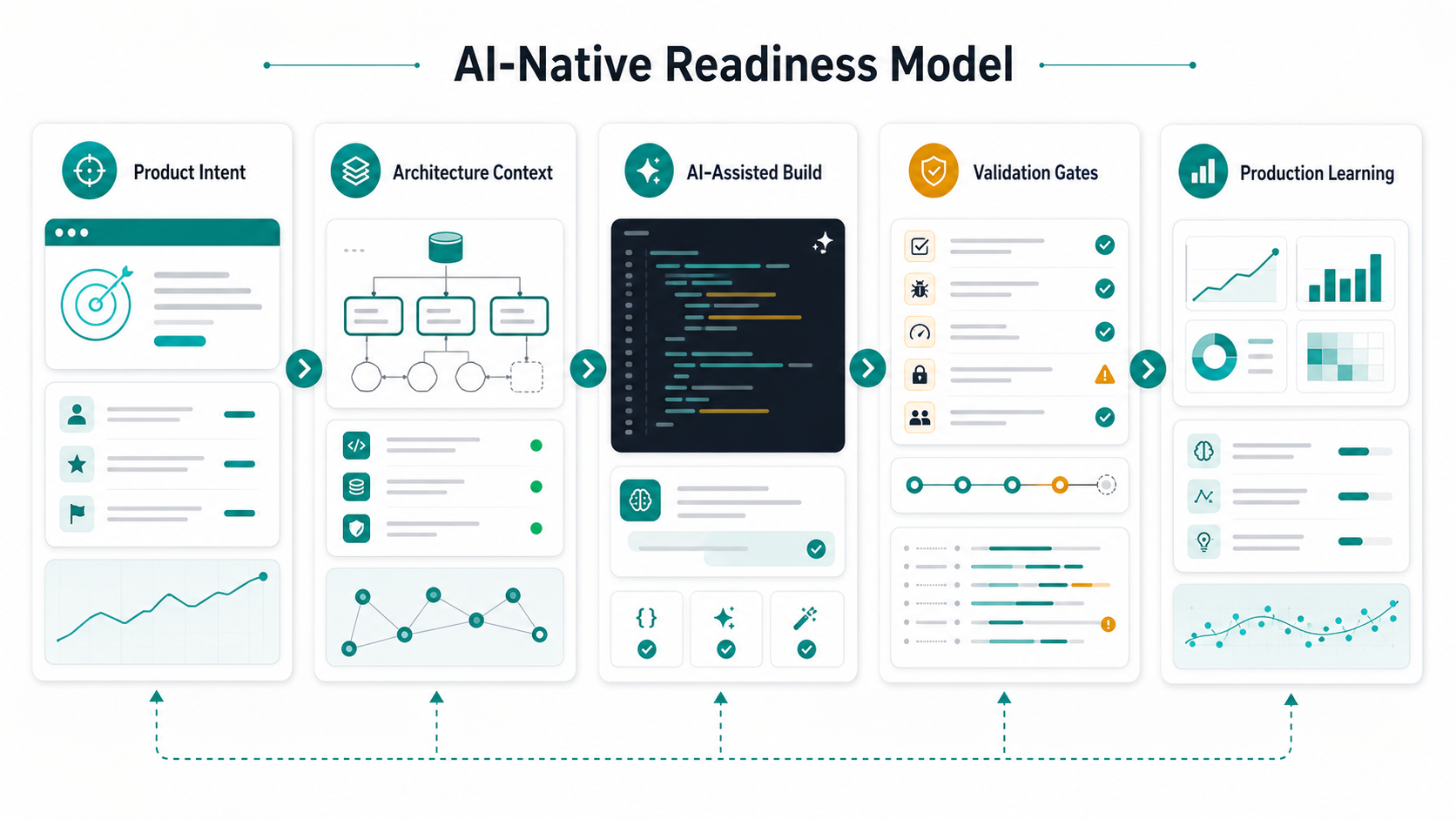
Product teams should add guardrails before they mandate AI usage. The first guardrail is executable requirements: acceptance criteria, examples, and behavior-driven tests that make expected behavior unambiguous. The second is architecture context: system diagrams, API contracts, data models, decision records, and coding conventions that give AI tools the right constraints. The third is review automation: linting, type checks, unit tests, integration tests, dependency scans, secret scans, and security checks.
The fourth guardrail is repository context. AI tools should understand the local codebase, not hallucinate patterns from unrelated projects. The fifth is role-based access: not every AI tool needs production secrets, customer data, or broad repository access. The sixth is change traceability: prompts, generated changes, review comments, test results, and release decisions should be tied to tickets or pull requests. For teams extending AI from coding assistants into tool-using workflows, the enterprise AI agent governance model is a useful reference for permission envelopes, audit evidence, monitoring, and rollback planning.
AI can reduce cycle time when it removes bottlenecks across discovery, implementation, QA, deployment, and support. The AI Engineering Cycle Time article explains why the largest gains come from clearer specs, faster review, better test coverage, and smoother handoffs instead of code generation alone. Security teams should also treat AI-generated code, tool outputs, retrieved context, and agent memory as untrusted inputs; the secure AI agent development checklist maps those risks to allowlists, approval gates, and audit logs.
Team Roles In An AI-Native Delivery Model
AI-native engineering changes roles, but it does not remove ownership. Product managers need to write sharper intent, define success metrics, and decide what should not be automated. Tech leads need to maintain architecture context, reusable patterns, and review standards. Developers need to become stronger reviewers, test designers, and system thinkers. QA engineers need to expand from manual validation into test strategy, automation coverage, regression risk, and AI-generated test review. DevOps and platform teams need to make delivery safer through templates, environments, observability, flags, and rollback.
For distributed teams, this operating model is especially important. If you use IT outsourcing services or remote engineering capacity, AI-native delivery should come with shared repositories, coding standards, test expectations, review rules, IP controls, and documentation. Speed without shared governance makes distributed delivery harder to manage.
When the product needs to scale across users, data, integrations, and regions, connect the operating model to scalable software development services. AI can accelerate implementation, but scalability still depends on architecture, database design, queues, caching, observability, reliability, and maintainable code.
Metrics That Prove AI-Native Engineering Is Working
Do not measure AI-native engineering only by prompt count or lines of AI-generated code. Those metrics are easy to inflate and can hide downstream cost. Better metrics include cycle time by stage, pull request size, review turnaround, test coverage, escaped defects, change failure rate, rollback frequency, incident recovery time, documentation freshness, onboarding time, and developer satisfaction.
Track AI-specific signals too: percentage of changes with AI assistance, reviewer edit rate, generated test usefulness, prompt reuse, policy violations, security findings, hallucinated APIs, duplicate code, and architecture drift. If coding gets faster but QA, review, and incidents get slower, the team has not become AI-native. It has shifted the bottleneck downstream.
Use A Release Evidence Gate Before Expanding AI-Native Delivery
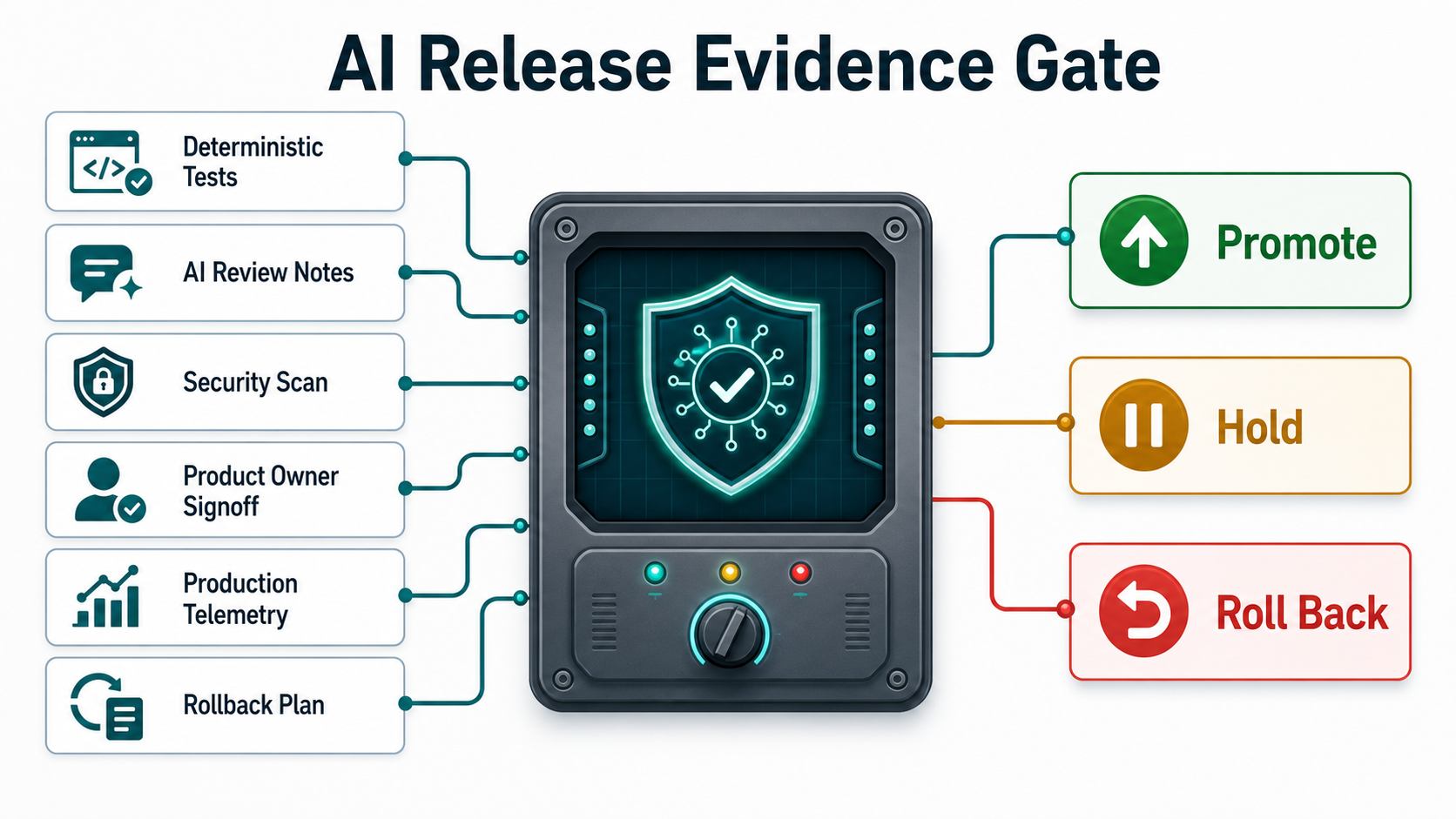
A faster AI-assisted team needs a stricter release evidence gate, not a lighter one. Before expanding AI-native delivery across more repositories or product areas, define the evidence required to promote, hold, or roll back a change. The gate should combine deterministic tests, AI review notes, security scans, product-owner signoff, production telemetry, and a rollback plan. This keeps AI output as decision support instead of quiet release authority.
The same principle applies to QA. An AI-powered QA automation roadmap should separate repeatable checks, AI-assisted triage, and human judgment so teams improve release confidence instead of creating a noisy automation layer.
AI-Native Engineering Maturity Checklist
- Do product tickets include acceptance criteria, edge cases, and success metrics?
- Do AI tools receive current architecture, API, data, and coding-standard context?
- Are architecture decisions recorded and used as constraints for implementation?
- Do pull requests include tests, security scans, and human review before merge?
- Are AI-generated changes traceable to tickets, prompts, and reviewers?
- Are sensitive data, secrets, customer records, and production access restricted?
- Do feature flags, canary releases, monitoring, and rollback paths exist?
- Are teams measuring defect rate and incident recovery, not only coding speed?
- Is there a policy for approved AI tools, models, extensions, and agents?
- Can the team explain where AI should not be used yet?
If many answers are no, start with a focused pilot. Pick one workflow such as test generation, documentation updates, API implementation, regression analysis, or internal tool development. Use the Custom Software Cost Estimator when the AI-native shift is part of a broader product build or modernization budget.
How NextPage Helps Product Teams Adopt AI-Native Engineering
NextPage helps product teams adopt AI-native engineering without losing delivery discipline. We can assess readiness, map engineering workflows, define approved AI use cases, create architecture and review guardrails, set up test and release gates, build internal tools, and measure whether AI is improving the whole delivery system. For teams that want custom AI assistance inside a product, admin workflow, or engineering process, we can connect the readiness review to practical AI development services and a phased production roadmap.
For teams building new products, modernizing old systems, or adding AI to existing workflows, the goal is not to look AI-native. The goal is to ship better software with clearer specs, faster feedback, stronger review, and lower operational risk.
Start with the AI Agent Readiness Assessment, or use it as the first step in an AI engineering readiness review.