
Quick Answer: What Does AI Personalization Mean For News Apps?
AI personalization for news apps means using reader signals, editorial rules, and recommendation models to decide which stories, topics, alerts, newsletters, and paid-content prompts should appear for each reader. The strongest systems pair product relevance with visible editorial control, privacy choices, measurable trust signals, and a visible fallback plan for breaking news or sensitive topics. For publishers, the goal is not to let an algorithm replace editorial judgment. The goal is to make the product more relevant while preserving trust, transparency, privacy, and newsroom control.
For 2026 planning, the ranking question is no longer only which model recommends the next article. Product teams need to prove how personalization handles public-interest stories, AI-answer summaries, paywall pressure, anonymous readers, opt-outs, editorial overrides, and model rollback. Reuters Institute 2026 findings show why that matters: trust is weaker in AI chatbot news answers than in owned publisher products, so personalization has to make source, control, and accountability visible instead of hiding the ranking logic behind a black box.
A good personalization system starts with modest inputs: followed topics, saved stories, reading history, location or edition preferences, newsletter clicks, subscription status, and explicit feedback such as “show less like this.” It then adds ranking logic, segmentation, and controlled recommendations. Mature teams can move toward machine-learning models, but only after the data foundation, consent model, evaluation process, and editorial override workflow are ready.
The most important design decision is where personalization is allowed to act. A publisher may personalize the home feed, related stories, push notifications, newsletter modules, paywall prompts, and topic recommendations, while keeping breaking-news placement, public-interest coverage, elections, health, and sensitive topics under stronger editorial guardrails.
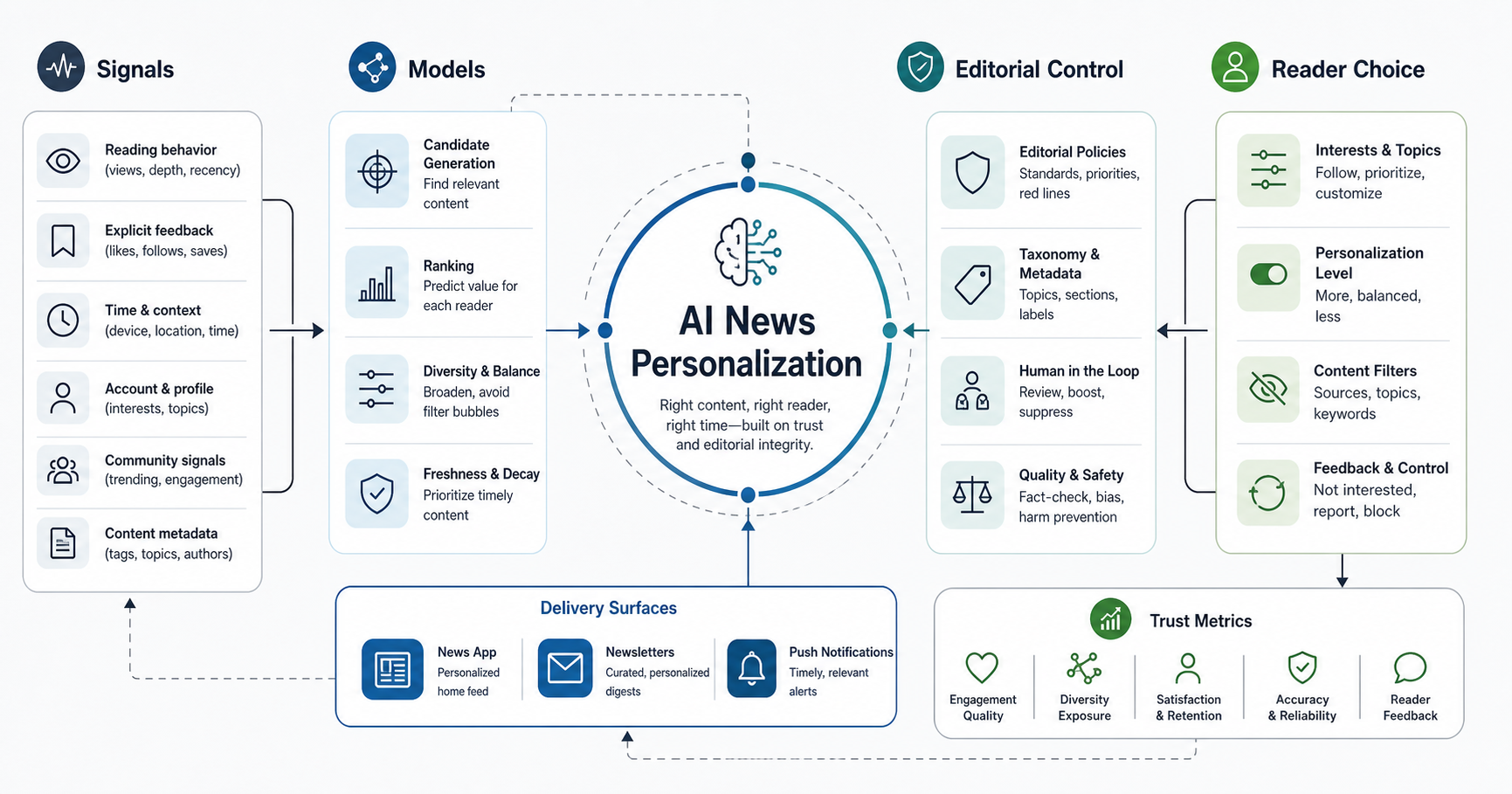
Why Publishers Are Prioritizing Personalization Now
News and media apps compete with social feeds, aggregators, creator platforms, and AI assistants for daily attention. Readers expect relevance, but publishers cannot simply copy social-media ranking patterns because news products carry higher trust, source, and civic-responsibility expectations. That tension is why personalization has become a product and governance problem, not just an AI feature.
Google News documentation is a useful signal: some Google News surfaces use reader interests, while Full Coverage is designed to show broader context around a story from multiple sources. Google also states that personalized news surfaces should not rank content by political or ideological viewpoint. The lesson for publisher-owned apps is clear: personalization needs source diversity, context controls, and explainable reader settings, not only click prediction.
The 2026 Digital News Report makes this sharper: audiences are encountering more news through platforms, creators, and AI interfaces, while trust in news from AI chatbots remains low. Publisher-owned personalization should therefore compete on usefulness and accountability, not only relevance. A personalized feed should explain why a story appeared, keep editorially important stories visible, and give readers a reliable way to adjust interests, notifications, and data use.
Signals That Power Reader Personalization
The safest personalization systems combine explicit reader choices with observed behavior. Explicit signals include selected topics, followed authors, chosen regions, saved stories, muted topics, newsletter preferences, and notification settings. Observed signals include article views, scroll depth, dwell time, recency, search behavior, sharing, app sessions, subscription events, and churn risk.
Do not treat every signal equally. A completed long read means more than an accidental tap. A topic follow means more than one article view. A breaking-news push open may reflect urgency, not long-term preference. A paywall bounce may mean the reader is not ready to subscribe, or that the offer appeared too early. Weighting matters because poor signal design creates repetitive feeds and bad notification timing.
Before advanced models, publishers should define a data contract: what is collected, why it is collected, how long it is retained, which teams can access it, and how readers can change their preferences. Use NextPage's mobile app integrations checklist when that data must move between the CMS, analytics stack, subscription platform, notification provider, and recommendation API. NextPage's enterprise AI readiness checklist is a useful companion when teams need to connect personalization to data governance, security, and operating controls.
Recommendation Types For News And Media Apps
News personalization is rarely one model. Most products need a layered recommendation system.
| Recommendation type | How it works | Best use | Control risk |
|---|---|---|---|
| Editorial curation | Editors manually choose priority stories, sections, and packages | Breaking news, public-interest stories, investigations, homepage anchors | Low algorithmic risk, higher staff effort |
| Rules-based personalization | Logic uses followed topics, region, subscription state, and recency | MVP feeds, topic pages, newsletters, paywall prompts | Easy to explain, can feel rigid |
| Collaborative filtering | Finds stories liked by readers with similar behavior | Related stories, evergreen content, entertainment and lifestyle sections | Can over-amplify popular or narrow content |
| Content-based recommendations | Matches article entities, tags, topics, authors, and semantic similarity | Topic discovery, explainers, background reading, archives | Needs clean taxonomy and metadata |
| Hybrid ML ranking | Combines editorial rules, reader signals, article metadata, and model scores | Mature personalized feeds, notifications, retention programs | Needs monitoring, testing, and editorial override |
For most publishers, the first serious step is a hybrid system that still exposes editorial controls. NextPage's AI recommendation engine development services can support model and ranking design, while machine learning development work can cover feature pipelines, evaluation, monitoring, and deployment. The implementation should still start with product rules, taxonomy quality, and evaluation criteria.
Personalization Architecture For News Apps
A production personalization system needs more than a model endpoint. It usually needs a CMS and taxonomy layer, reader event stream, consent and preference store, feature store, recommendation API, editorial rules layer, app delivery surfaces, analytics, and fallback behavior. If any one layer is weak, the reader experience becomes repetitive, slow, opaque, or difficult for editors to govern.
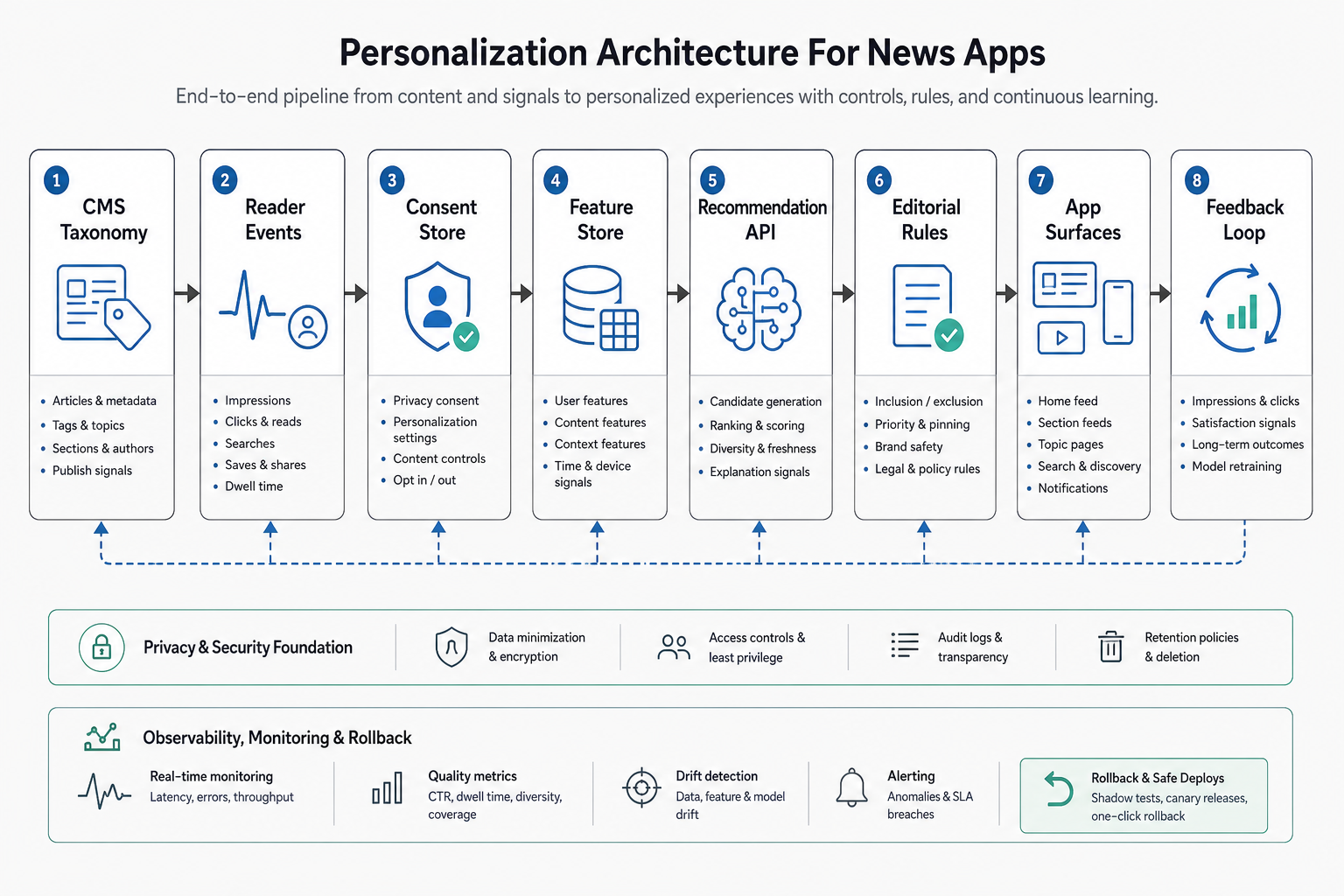
The practical architecture decision is whether the first release should be rules-based, hybrid, or model-led. Teams should also decide which surfaces are allowed to personalize first: home feed, section feed, search, newsletters, push notifications, or paywall prompts. A rules-based release can use followed topics, location, recency, and subscription state. A hybrid release can add similarity scores and reader segments. A model-led release should wait until data quality, experimentation, editorial override, and rollback paths are ready.
This is also where publisher AI overlaps with broader app delivery. NextPage's news and media app development services can connect reader UX, CMS APIs, paywall rules, analytics events, and mobile release workflows, while the news app development cost guide helps teams budget the adjacent CMS, subscription, and analytics work.
Editorial Controls That Keep Personalization Trustworthy
Personalization should never become a black box that the newsroom cannot correct. Editorial teams need controls over story priority, exclusion rules, sensitive topic treatment, diversity of sources, local editions, recency thresholds, paywall placement, and push notification eligibility. They also need audit trails that explain why a story was promoted or suppressed in a personalized surface.
Useful editorial controls include pinned packages, must-show stories, do-not-personalize categories, topic caps, freshness rules, source diversity limits, duplicate story suppression, manual override for major events, and safe defaults for new readers. Governance should follow the same evidence discipline as the MLOps implementation checklist: owners, tests, monitoring, approval logs, rollback rules, and incident review. Sensitive topics should have stronger rules around authority, recency, context, and human review.
The control model should be written down before machine learning is introduced. If the editorial team cannot describe what the feed should never do, the model cannot be safely evaluated. That is the difference between personalization as product strategy and personalization as uncontrolled ranking automation.
Privacy, Consent, And Reader Controls
Personalization requires reader trust. Apps should explain what signals are used, provide preference controls, support topic muting, respect notification settings, and avoid collecting data that the product does not need. Paid-content status, location, reading history, and sensitive topic interactions should be handled with extra care.
A practical privacy checklist includes consent language, event taxonomy, retention rules, role-based access, opt-out behavior, preference reset, data deletion process, age-sensitive handling when relevant, and analytics-vendor review. Product teams should also test how the app behaves when personalization is disabled. A reader who opts out should still receive a high-quality editorial experience.
If your team is unsure whether the workflow, data, integrations, and governance are ready for AI-enabled personalization, start with an AI readiness assessment before building a model. For teams that need an executive business case, the AI Automation ROI Calculator can estimate whether retention, conversion, and content operations gains justify moving beyond a rules-based MVP. For teams with EU readers or high-risk content surfaces, pair that review with the EU AI Act readiness checklist and a privacy review. Readiness work is cheaper than rebuilding trust after the feed behaves badly.
Rollout Scorecard: From Rules To Supervised AI
Do not start with a fully automated feed. Start with a staged roadmap that proves the data, editorial controls, reader controls, experimentation loop, risk monitoring, and success metrics first.
- Foundation: clean taxonomy, structured article metadata, reader accounts, analytics events, consent, and notification preferences.
- Rules-based personalization: topic follows, regional editions, saved interests, recency rules, and simple recommendation modules.
- Hybrid recommendations: combine editorial rules with similarity scoring, reader segments, and controlled ranking experiments.
- Supervised AI: introduce model evaluation, editorial review queues, automatic quality checks, drift monitoring, and rollback rules.
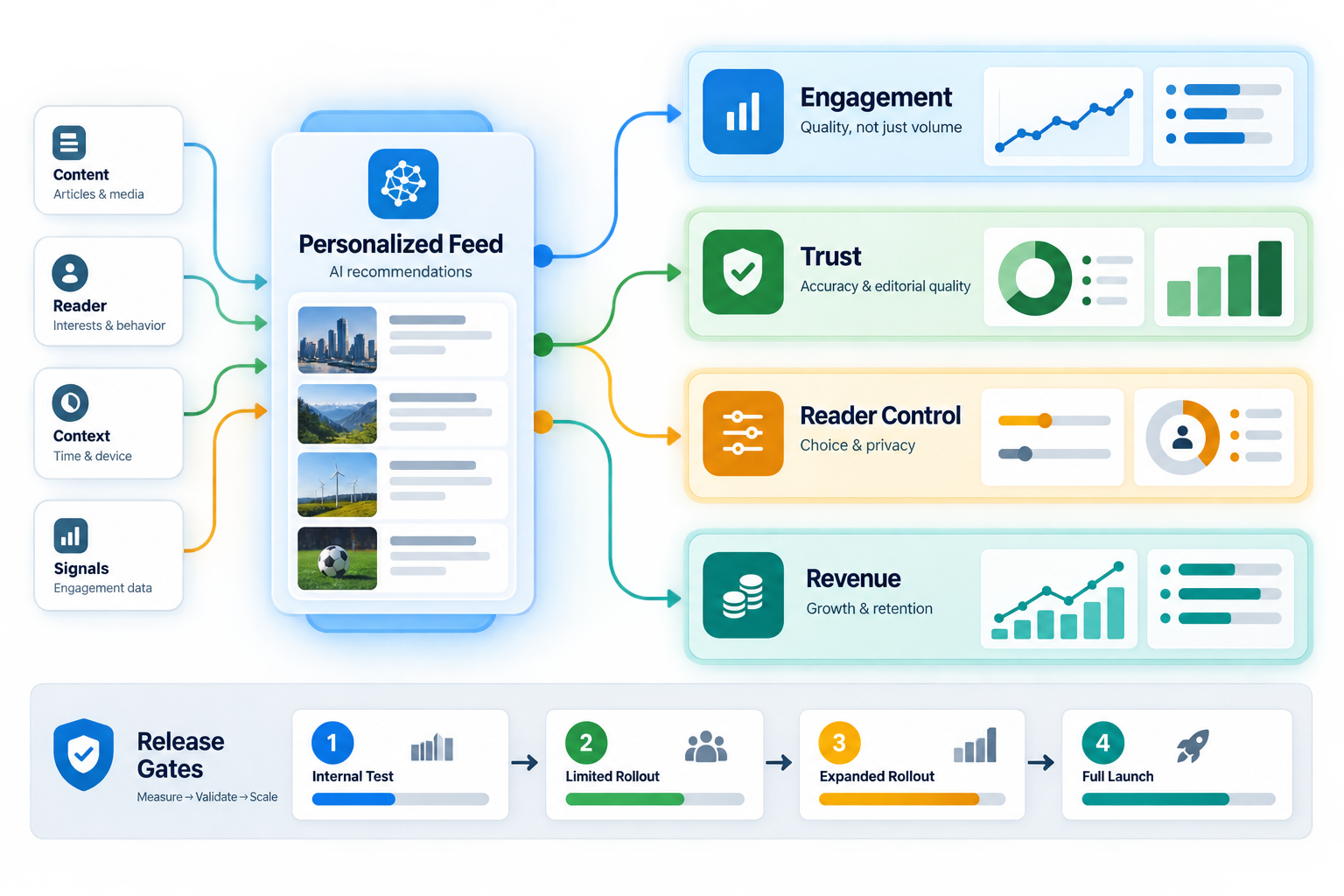
Each stage should have a release gate. For example, do not launch personalized push notifications until the team can measure opt-outs, complaint rate, open quality, unsubscribe behavior, and downstream retention. The mobile app QA launch checklist is a useful companion for proving analytics, permissions, offline states, notifications, and release evidence before rollout. Do not launch machine-learning ranking until the editorial team can override and audit the surface.
Metrics That Matter
Personalization should be measured across engagement, trust, revenue, and editorial quality. If the only metric is clicks, the system will optimize for clicks. Better measures include return frequency, article completion, topic follow rate, notification opt-out rate, subscription conversion, trial activation, churn reduction, complaint rate, source diversity, repeated-topic saturation, feed latency, cold-start quality, and editor override frequency. Better 2026 scorecards should also separate owned-app personalization from AI assistant or chatbot exposure, because readers judge source accountability, citation visibility, and control differently across those surfaces.
A/B testing is useful, but news products need more than generic conversion tests. A feed that increases short-term opens by overusing sensational stories may reduce long-term trust. A notification model that improves click-through may still damage retention if it interrupts readers too often. Measurement needs product and newsroom review together.
For publishers already planning the broader product, connect retention and subscription lift to the implementation scope before funding model work beyond a rules-based MVP.
Technical Architecture For AI Personalization
A practical architecture usually includes a CMS or content API, event tracking layer, reader profile service, consent and preference store, recommendation API, ranking rules, model/evaluation pipeline, analytics dashboard, notification service, and admin controls for editorial teams. The app should not call a model directly for every screen without caching, fallback logic, and editorial constraints.
Key engineering decisions include real-time versus batch recommendations, anonymous versus logged-in personalization, device-level privacy, CDN caching, app performance, API latency, content freshness, monitoring, rollback, and how the system behaves when recommendation services fail. For a production plan, connect the build to AI development services, mobile engineering, analytics, and operations rather than treating recommendation logic as a detached model experiment. Readers should never see a broken home feed because a model endpoint is unavailable.
This is where AI work intersects with app delivery. A news and media app development services team should review CMS workflow, app UX, recommendation APIs, analytics, subscriptions, and release operations together. Personalization cannot be bolted on cleanly if the product architecture is already fragmented.
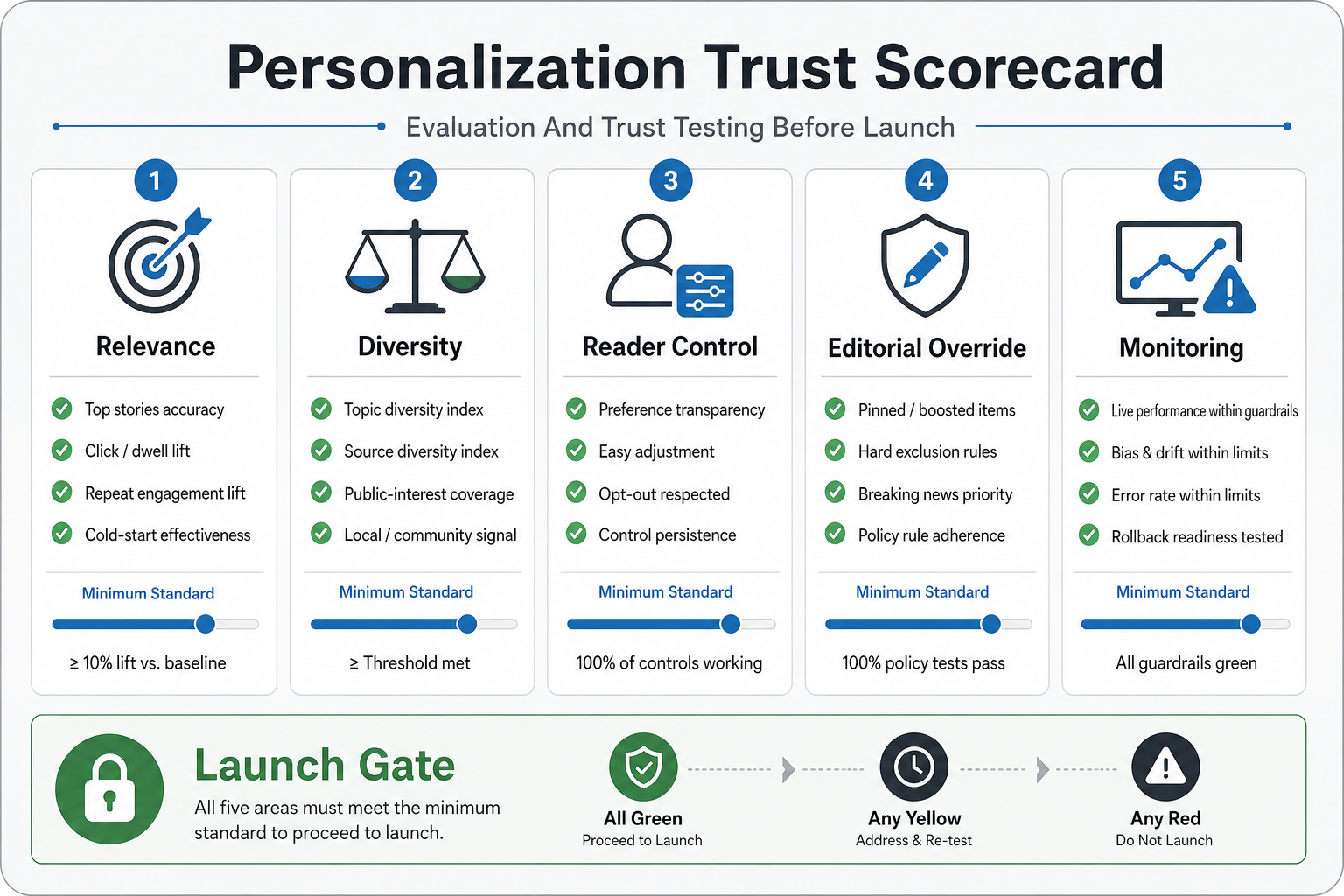
Evaluation And Trust Testing Before Launch
AI personalization should pass product, editorial, and technical tests before it reaches readers. Product teams should test whether recommended stories are useful, fresh, diverse, and aligned with stated reader interests. Editorial teams should review whether public-interest stories remain visible, whether sensitive topics are handled with context, and whether the feed avoids repetitive or sensational patterns. Engineering teams should test latency, fallback, event quality, logging, model drift, and rollback.
Create a small evaluation set before launch. Include new readers, loyal subscribers, anonymous users, readers with narrow topic follows, readers who mute topics, readers in different regions, and readers who turn personalization off. Review the same feed through multiple lenses: relevance, source diversity, recency, authority, topic repetition, fairness, conversion pressure, and complaint risk. NIST AI RMF guidance is useful here because it frames trustworthiness through reliability, safety, security, transparency, explainability, privacy, and harmful-bias management. For publisher products, translate those principles into release checks: recommendation quality, public-interest coverage, source diversity, reader controls, editorial override, incident logging, and rollback readiness.
For 2026 launches, add an AI disclosure check to the same gate. Readers do not need model jargon, but they should understand when ranking, summaries, alerts, newsletter modules, or paywall prompts are algorithmically personalized; where they can change preferences; and which stories remain protected by editorial priority. Current Reuters Institute audience research shows that interest in AI-driven news personalization is uneven, especially among people least interested in news, while 2026 Nieman Lab coverage of disclosure research shows that readers want AI labeling for accountability, fraud avoidance, trust, and verification cues. Treat disclosure as product UX and newsroom governance, not only legal copy.
Do not let short-term engagement be the only release gate. A recommendation system that increases clicks can still damage trust if it narrows the reader's view, buries major public-interest coverage, overuses alerts, or makes subscription prompts feel manipulative. Pair A/B tests with newsroom review, reader-control telemetry, support-ticket review, unsubscribe analysis, and manual spot checks. If the team cannot explain why a story was recommended, who can override it, and how to roll back a bad model version, the feature is not ready for broad release.
Common Pitfalls To Avoid
- Starting with AI before taxonomy: weak article metadata makes recommendations harder to explain and evaluate.
- Over-personalizing the homepage: readers still need shared editorial priorities and major story context.
- Ignoring new users: cold-start readers need onboarding, popular stories, editor picks, and explicit preferences.
- Sending too many alerts: personalized push can improve retention or accelerate opt-outs depending on rules.
- Hiding controls: readers should be able to adjust topics, mute categories, manage data-driven experiences, and see a plain-language explanation for why a story or alert appeared.
- Forgetting newsroom operations: editors need preview, override, audit, and rollback controls.
Implementation Checklist
- Define which surfaces will be personalized: feed, related stories, newsletters, push, paywall prompts, or all of them.
- Map reader signals and decide which are explicit, behavioral, subscription-related, or sensitive.
- Clean article taxonomy, author data, entities, sections, tags, and content freshness rules.
- Create editorial guardrails for breaking news, sensitive topics, public-interest stories, and source diversity.
- Design reader controls for topics, muted content, notifications, privacy, personalization reset, and visible explanations for algorithmic recommendations.
- Build analytics events before launch so tests can measure trust and retention, not just clicks.
- Start with rules-based personalization, then graduate to hybrid and supervised AI only after release gates pass.
- Document fallback behavior when the recommendation service, CMS, AI-summary workflow, or notification provider fails.
How NextPage Helps Publishers Build AI Personalization
NextPage scopes AI personalization as a product system: reader experience, data readiness, editorial governance, recommendation logic, mobile implementation, analytics, and launch operations. That keeps the project grounded in publisher outcomes instead of generic AI demos.
For early-stage products, we can start with preference design, rules-based recommendations, analytics, and CMS/app architecture through mobile app development. For proof that NextPage understands publishing-scale product systems, review the Maxabout portfolio case study. For procurement teams, the mobile app development RFP checklist helps turn personalization goals into vendor-ready requirements. Teams modernizing an existing publisher stack can also use the mobile app integrations checklist to scope CMS, analytics, paywall, notification, and recommendation API dependencies. For mature publishers with enough reader data, we can plan recommendation APIs, evaluation workflows, governance gates, and ML-backed ranking through recommendation-engine and machine-learning delivery.
If you are planning personalization for a publisher app, start with a readiness review. The right first release may be a clean topic-follow system, not an AI model. The right second release may be hybrid recommendations with visible reader controls. The right mature release is supervised AI with editorial controls, measurable trust signals, disclosure UX, and rollback paths.