
Quick Answer: How To Move An AI Pilot To Production
An AI pilot is ready for production only when the business owner, data owner, security owner, and delivery team can prove four things: the use case has a measurable operational outcome, the data pipeline is reliable enough for live decisions, governance controls are documented, and the production architecture can be monitored, supported, and rolled back. If any gate is missing, the next step is not a bigger model. It is a focused hardening sprint.
For mid-market companies, the practical roadmap is: choose one valuable workflow, define the production decision it will support, baseline the KPI, map all source systems, test data quality and permissions, add human review and audit trails, deploy behind feature flags, monitor cost and quality, and expand only after the first workflow survives real users. A structured enterprise AI readiness checklist helps teams avoid treating a controlled demo as a production system.
The goal is not to scale AI in the abstract. The goal is to move one proven workflow from experiment to owned software: a system with data contracts, evaluation evidence, support ownership, security controls, and a rollback plan.
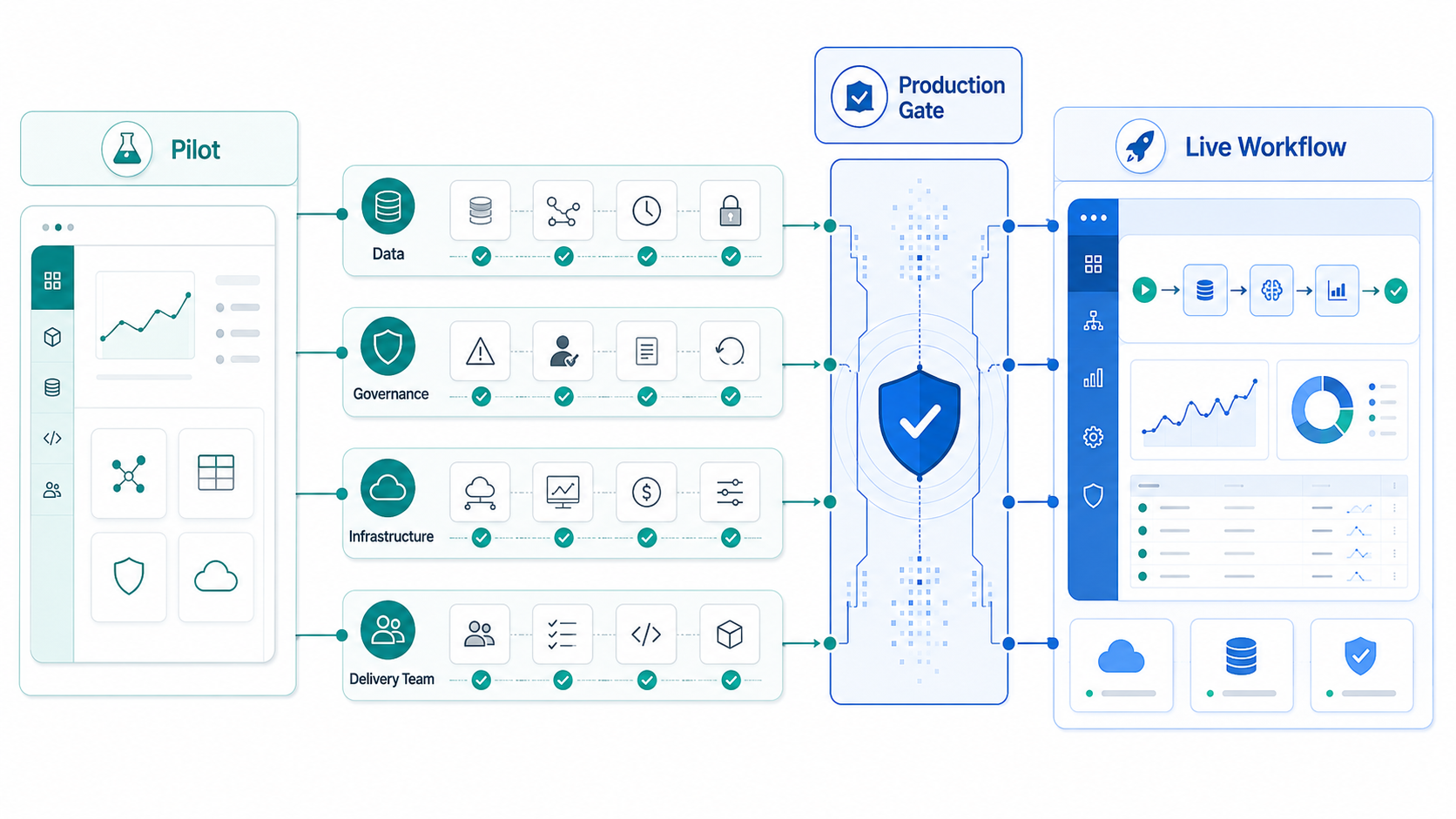
Why Mid-Market AI Pilots Stall
The current market pattern is familiar: leaders fund AI pilots, teams build promising prototypes, and then the work slows when the pilot has to touch production systems. Recent reporting on Accenture and Google Cloud's mid-market AI push described the same gap: many companies have AI experiments running, but most remain stuck in pilot because expertise, governance, infrastructure, and operating capacity are not ready for production.
That is not a failure of interest. It is a failure of transition design. A pilot can work with a narrow dataset, a friendly user group, manual data cleanup, and a small amount of traffic. Production has different requirements: identity and permissions, data freshness, integration reliability, monitoring, exception handling, human approval, cost control, support, and business accountability.
Mid-market firms feel this gap sharply because they often have enough complexity to need enterprise-grade controls but not enough internal bandwidth to dedicate separate AI platform, data engineering, security, and product teams. The roadmap must connect workflow scope to delivery capacity from the start.
The Production Gate: What Must Be True Before Scale
A production gate is a decision checkpoint. It prevents a team from expanding an AI pilot before the operational evidence is ready. The gate should be reviewed by the business owner, engineering lead, data owner, security or compliance owner, and support owner.
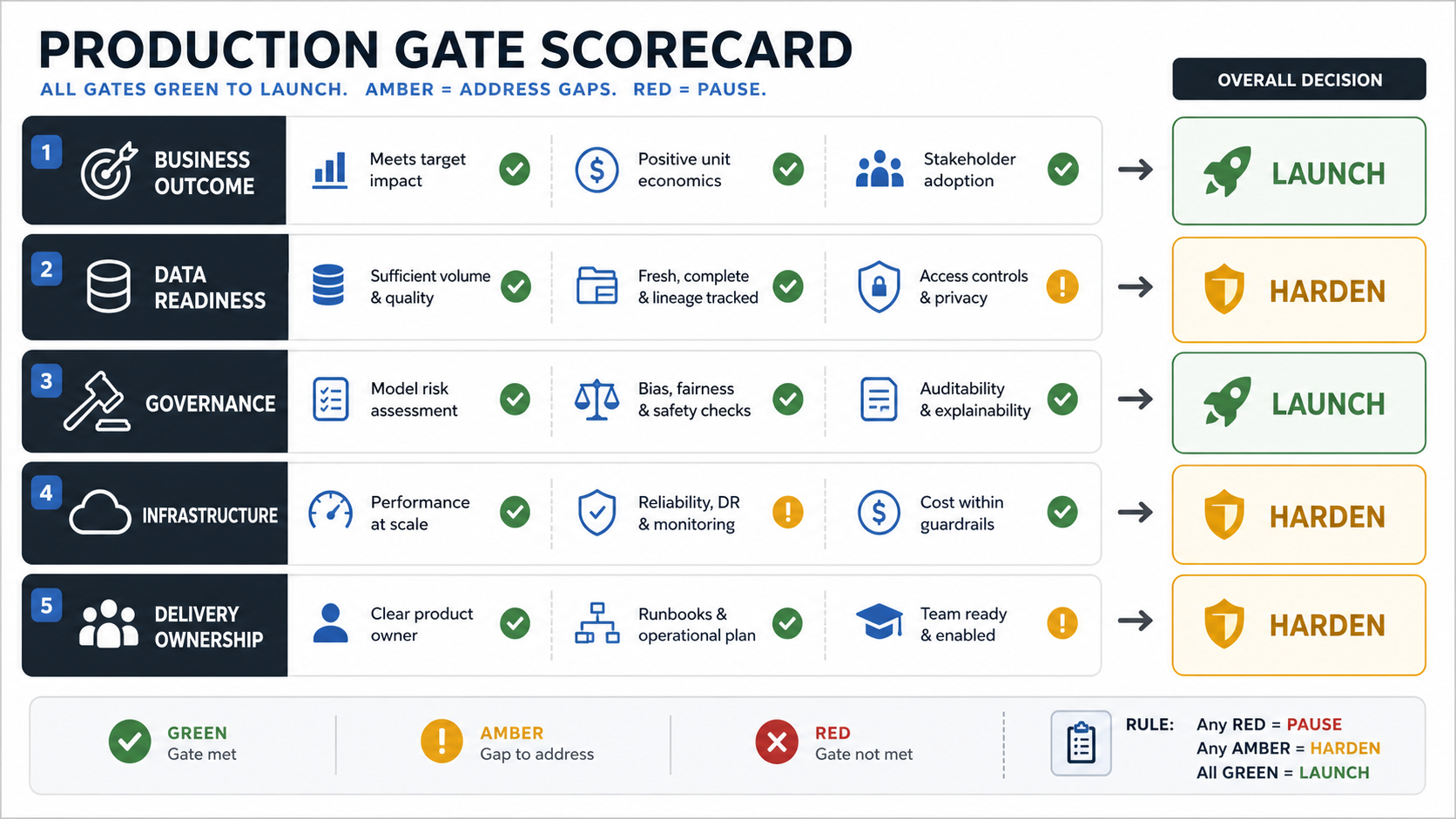
| Gate | Evidence Required | Stop Signal |
|---|---|---|
| Business outcome | Named workflow, KPI baseline, owner, value estimate, adoption plan | The pilot is interesting but not tied to a measurable decision |
| Data readiness | Source systems, freshness, lineage, permissions, quality checks, fallback path | Answers depend on manual exports or untrusted fields |
| Governance | Risk assessment, human review, audit trail, policy boundary, rollback owner | No one can explain who approves or reverses AI-assisted actions |
| Infrastructure | Deployment target, monitoring, latency budget, cost model, security controls | The pilot runs only in a notebook, personal account, or unmanaged tool |
| Delivery ownership | Product owner, technical lead, data engineer, QA path, support playbook | The team has no named owner after launch |
This gate is intentionally practical. It is not a legal document or a research review board. It is a delivery control that tells the team whether to harden, pause, narrow, or launch.
AI Pilot To Production Roadmap
Use this roadmap when a pilot already shows promise but has not entered a reliable production workflow.
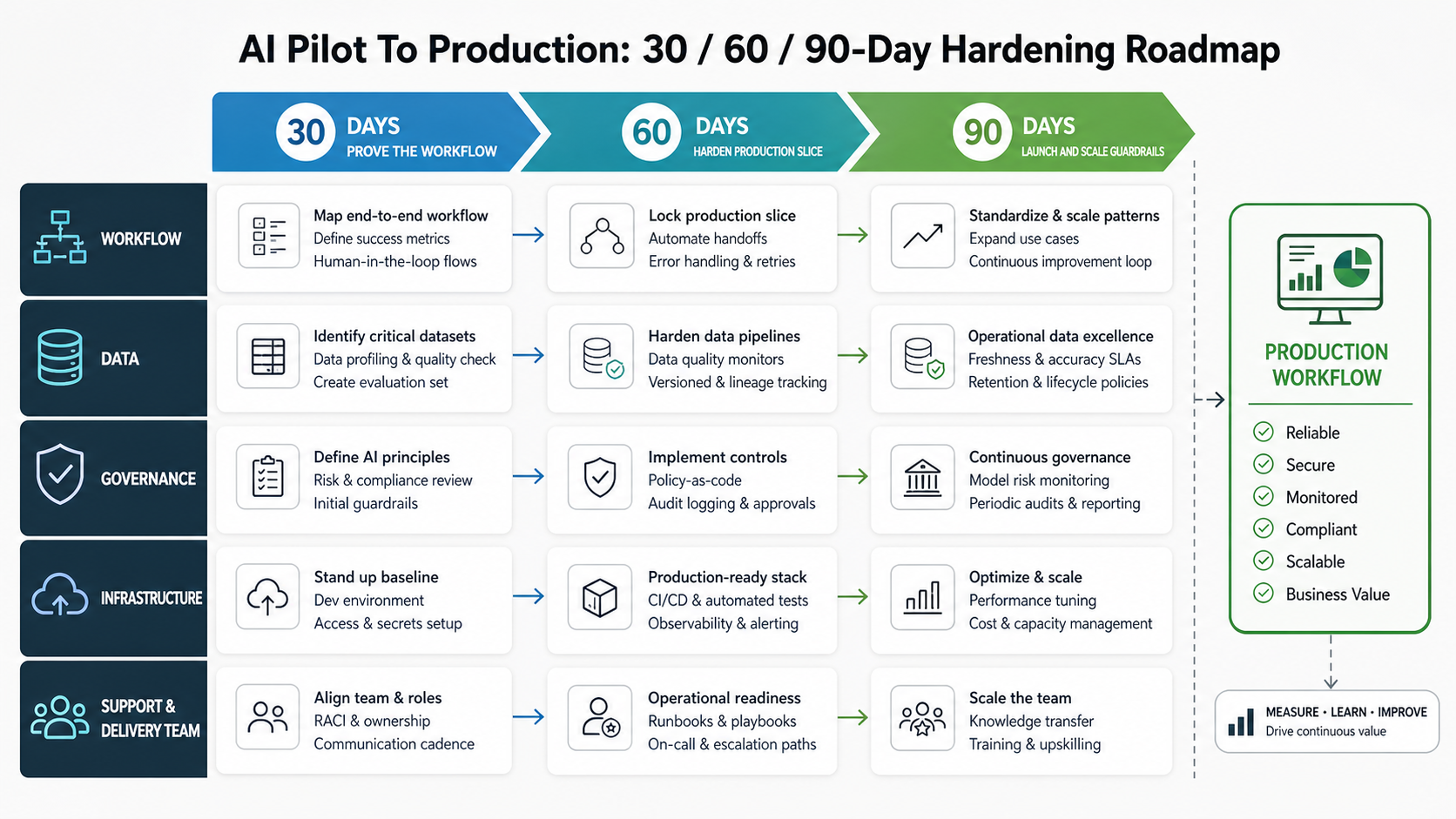
- Reframe the pilot as a workflow. Define the exact user, trigger, decision, output, approval path, and system of record. "AI assistant for operations" is too vague. "Summarize high-priority support escalations and draft CRM follow-up tasks for manager approval" is concrete enough to build.
- Set a production KPI. Pick one primary metric such as cycle time, manual review hours, first-response time, forecast error, exception backlog, or analyst throughput. Add guardrail metrics for quality, cost, and user override rate.
- Map data contracts. List source systems, fields, owners, refresh frequency, permissions, retention rules, and known gaps. If the pilot relies on copied files, make the data pipeline part of the next sprint.
- Design human control. Decide what AI can suggest, what it can draft, what it can write, and what must always require approval. Start with recommendations before autonomy.
- Build the production slice. Deploy one thin workflow with logging, monitoring, feature flags, and rollback. Do not rebuild the whole business process before proving the first production path.
- Run a shadow period. Compare AI recommendations against human decisions without letting the system act automatically. Use the misses to improve prompts, retrieval, rules, and data quality.
- Launch with support ownership. Assign who watches failures, who handles user feedback, who approves prompt/model changes, and who decides when to expand.
For teams still deciding whether a use case is ready, NextPage's AI Agent Readiness Assessment can help separate strong candidates from workflows that need process or data cleanup first.
Data And Infrastructure Decisions That Decide Cost
Many AI pilots look inexpensive because the prototype uses limited data, few users, and manual context preparation. Production cost changes when the system needs live data access, concurrent users, retrieval, storage, observability, model calls, background jobs, and integration retries. The expensive part is often not a single model request; it is the data and workflow layer around it.
Start by tracing one production request from user action to final output. Which systems does it read? Does it need a vector index? Does it need structured search? Does it call CRM, ERP, ticketing, billing, or warehouse systems? What data must be cached? What must never be cached? What latency is acceptable? What happens when one system is down?
Use an AI data readiness checklist before building the production slice. It should prove source ownership, freshness, permissions, lineage, quality checks, update cadence, and fallback behavior. This is where machine learning development services need to work with cloud, data, and product engineering instead of operating as a separate model effort. A production AI system is software with model behavior inside it.
| Decision | Pilot Shortcut | Production Requirement |
|---|---|---|
| Data access | CSV export or sample dataset | Owned pipeline with permissions and freshness checks |
| Retrieval | Small document upload | Indexed knowledge base with source tracking and update process |
| Identity | Shared testing account | User-level permissions and role-based access |
| Cost | Low traffic estimate | Per-workflow cost model with monitoring and limits |
| Deployment | Notebook or prototype app | Managed service with logs, alerts, rollback, and SLA expectations |
Governance Controls For Production AI
NIST's AI Risk Management Framework and Generative AI Profile are useful because they frame AI risk as a lifecycle responsibility, not a one-time policy review. For a mid-market production roadmap, governance should become a delivery checklist: govern ownership, map workflow and data risk, measure behavior, and manage changes after launch.
At minimum, production AI should have a documented risk assessment, approved data sources, model and prompt change history, human review policy, access control, output logging, incident path, and rollback plan. Agentic workflows need extra care because they may call tools, retrieve sensitive context, or trigger actions in other systems.
For regulated or high-impact workflows, use an explicit evidence gate before launch. NextPage's guide to AI governance for critical infrastructure software goes deeper on review evidence, accountability, and controls that are useful even outside critical infrastructure.
| Governance Evidence | Owner | Review Cadence |
|---|---|---|
| Risk assessment and policy boundary | Security or compliance owner | Before launch and after major workflow changes |
| Prompt, model, retrieval, and tool-change log | AI or platform lead | Every release |
| Human review and override policy | Business owner | Monthly during first production quarter |
| Incident and rollback playbook | Support owner plus engineering lead | Test before launch, review after incidents |
Delivery Team Model For Mid-Market Companies
The team model should match the production risk. A simple content-assist workflow may need a product owner, full-stack engineer, prompt/RAG specialist, and QA reviewer. A workflow that touches customer data, pricing, operations, or financial decisions needs stronger data engineering, security, DevOps, and business-process ownership.
A practical mid-market team includes:
- Business owner: owns the workflow outcome, KPI, adoption, and launch decision.
- Product or delivery lead: translates the workflow into requirements, backlog, acceptance criteria, and rollout plan.
- AI engineer: designs prompts, retrieval, model selection, evaluation, and tool-use boundaries.
- Data engineer: builds source access, transformations, lineage, and quality checks.
- Full-stack engineer: builds the user experience, APIs, integrations, and approval screens.
- Security or governance owner: reviews access, audit, retention, and risk controls.
- QA and support owner: tests scenarios, monitors launch, and manages incidents.
If internal capacity is limited, use an outside delivery team for the production slice while keeping workflow ownership inside the business. NextPage's AI development services are structured around this handoff: discovery, data readiness, prototype hardening, production software, and rollout support. For teams that need a broader product delivery lane, custom software development support can connect AI work to the surrounding portal, dashboard, integration, and workflow backlog.
Production KPIs, Monitoring, And Rollback
Production monitoring must cover business performance and system behavior. Track whether the AI workflow improves the target KPI, but also track user overrides, low-confidence cases, hallucination reports, latency, retrieval failures, tool-call failures, per-workflow cost, and incident volume. A system that saves time but creates unreviewed risk is not production-ready.
Every production workflow should have a rollback path. That may mean disabling the AI feature, switching to human-only review, reverting a prompt version, removing a data source, or turning off automated write-back. Rollback should be tested before launch, not improvised during an incident. The agentic AI infrastructure readiness checklist is useful when the pilot depends on tools, APIs, observability, and cost controls that have to survive live operations.
The operating cadence matters after launch. Review metrics weekly during the first month, decide whether the use case should expand, and keep a backlog of production lessons. The first launch should create reusable patterns for the next AI workflow: data access, logging, evaluation, approval, monitoring, and support.
How NextPage Helps
NextPage helps teams move from AI pilot to production by treating the project as software delivery, not only model experimentation. We start with the workflow, data sources, business KPI, and risk controls. Then we build the smallest production slice that can operate with real users, real permissions, and real monitoring.
A typical engagement can include AI readiness review, production roadmap, data and integration discovery, RAG or agent architecture, workflow UI, approval system, monitoring dashboard, cost controls, and rollout support. For operational workflows, our AI automation services connect model behavior to CRM, ERP, support, finance, logistics, or internal-tool processes.
If your pilot is promising but stuck, the next useful step is a production-readiness review. Bring the current demo, the workflow owner, the target KPI, and the systems it must touch. We can help identify whether to harden, narrow, rebuild, or launch.