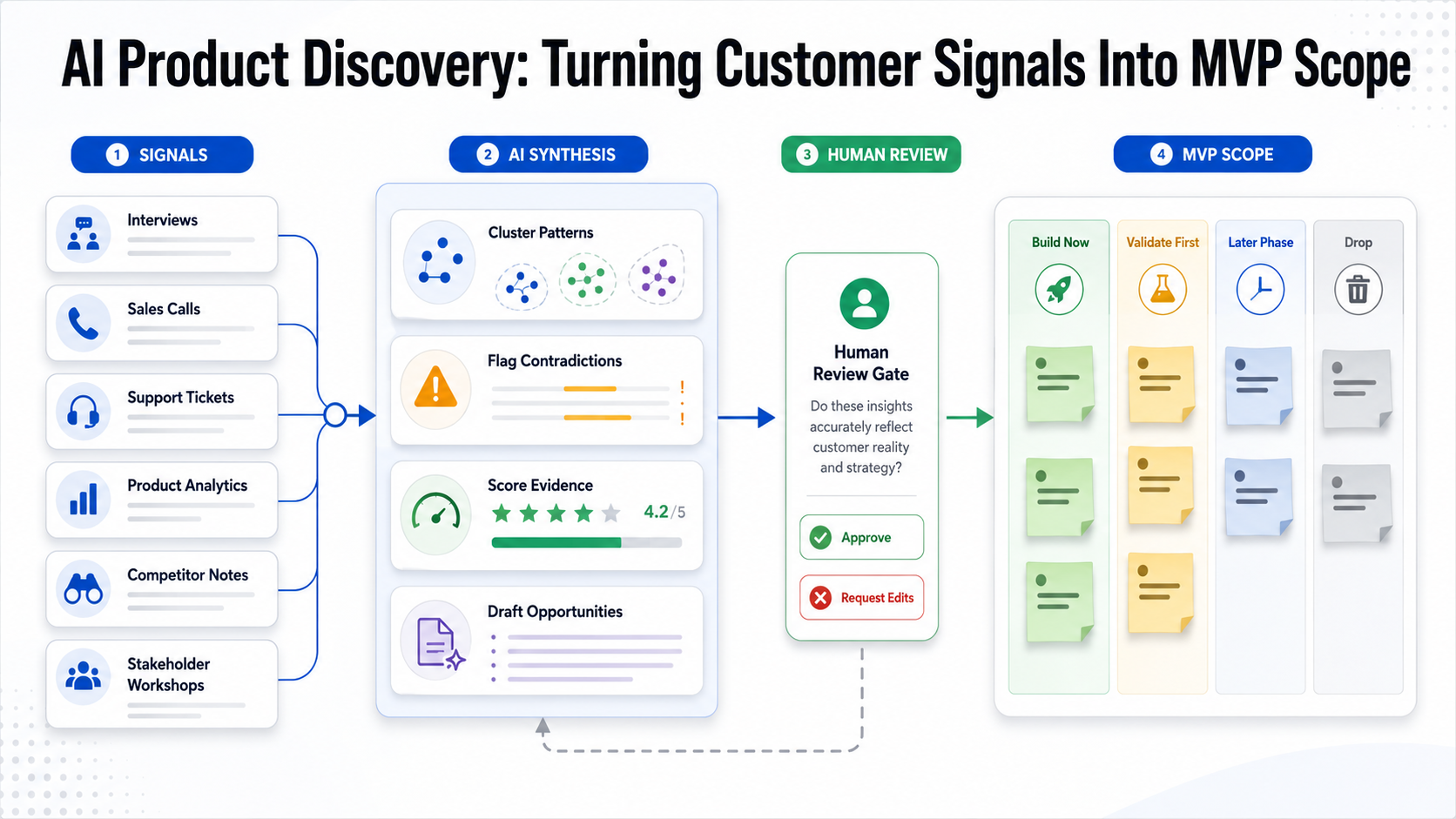

Quick Answer: AI Product Discovery
AI product discovery uses language models, retrieval, analytics, and workflow automation to help product teams turn messy customer and market signals into clearer problem statements, opportunity areas, prototype directions, and MVP scope. It is useful for synthesis, pattern detection, research organization, backlog drafting, and scenario exploration. It is not a replacement for customer interviews, founder judgment, technical feasibility review, pricing validation, or compliance checks.
The practical way to use AI is simple: collect real signals, ask AI to structure and challenge them, score the evidence, then make a human decision about what belongs in the first release and what should move into a later MVP development phase. Teams that already have a product idea can use NextPage's MVP Scope Builder to convert that decision into a build-now and later-phase scope before asking engineering for estimates or a custom software development delivery plan.
This guide is for founders, product managers, and SaaS teams that want faster discovery without outsourcing the most important decision: what problem is worth solving first.
Where AI Helps In Product Discovery
Product discovery is slow because the work is fragmented. Interview notes live in docs, sales objections sit in call recordings, support tickets describe symptoms, analytics show behavior without context, and stakeholders often bring conflicting assumptions. AI can reduce the mechanical weight of that work by helping the team organize inputs before a decision meeting.
The strongest use cases are:
- Interview synthesis: cluster transcripts into pain themes, jobs-to-be-done, objections, desired outcomes, and quotes that still need human review.
- Support and sales mining: summarize recurring complaints, requested integrations, onboarding confusion, feature gaps, and churn risks.
- Competitive scanning: compare public positioning, pricing pages, review complaints, and workflow gaps without treating the output as verified market truth.
- Problem framing: convert vague ideas into problem statements, assumptions, success metrics, constraints, and invalidation tests.
- Prototype exploration: draft alternative flows, edge cases, onboarding variants, and risk questions before design time is spent on polished screens.
- MVP scoping: sort opportunities into build now, validate first, later phase, or drop based on evidence strength, user value, feasibility, and business urgency.
For AI-enabled products, this discovery stage should connect directly to implementation planning. NextPage's AI development services team uses the same pattern: clarify the workflow, inspect data readiness, define human review, and only then choose the model, agent, or automation layer.
The Signal Map Before You Prompt AI
The quality of AI discovery depends on the quality of the input set. A model can summarize weak evidence quickly, but speed does not make the evidence strong. Before using AI, create a signal map that separates what customers said, what customers did, what the business needs, and what the team can actually build.
| Signal source | What AI can extract | Human check |
|---|---|---|
| Customer interviews | Pain themes, desired outcomes, quote clusters, contradictions | Was the sample biased? Did users describe real behavior or polite opinions? |
| Sales calls | Objections, buying triggers, integration needs, budget signals | Are these qualified buyers or edge-case prospects? |
| Support tickets | Repeated friction, missing workflows, severity, workaround patterns | Does the volume represent a strategic problem or a noisy corner case? |
| Product analytics | Drop-off points, feature adoption, cohort differences, funnel leakage | Does the data explain why the behavior happened? |
| Competitor reviews | Positioning gaps, recurring complaints, common expectations | Is the competitor serving the same ICP and workflow? |
| Stakeholder workshops | Assumptions, constraints, dependencies, success metrics | Which ideas are backed by evidence, and which are internal preference? |
This map prevents the most common AI discovery failure: treating a polished summary as a validated product direction.
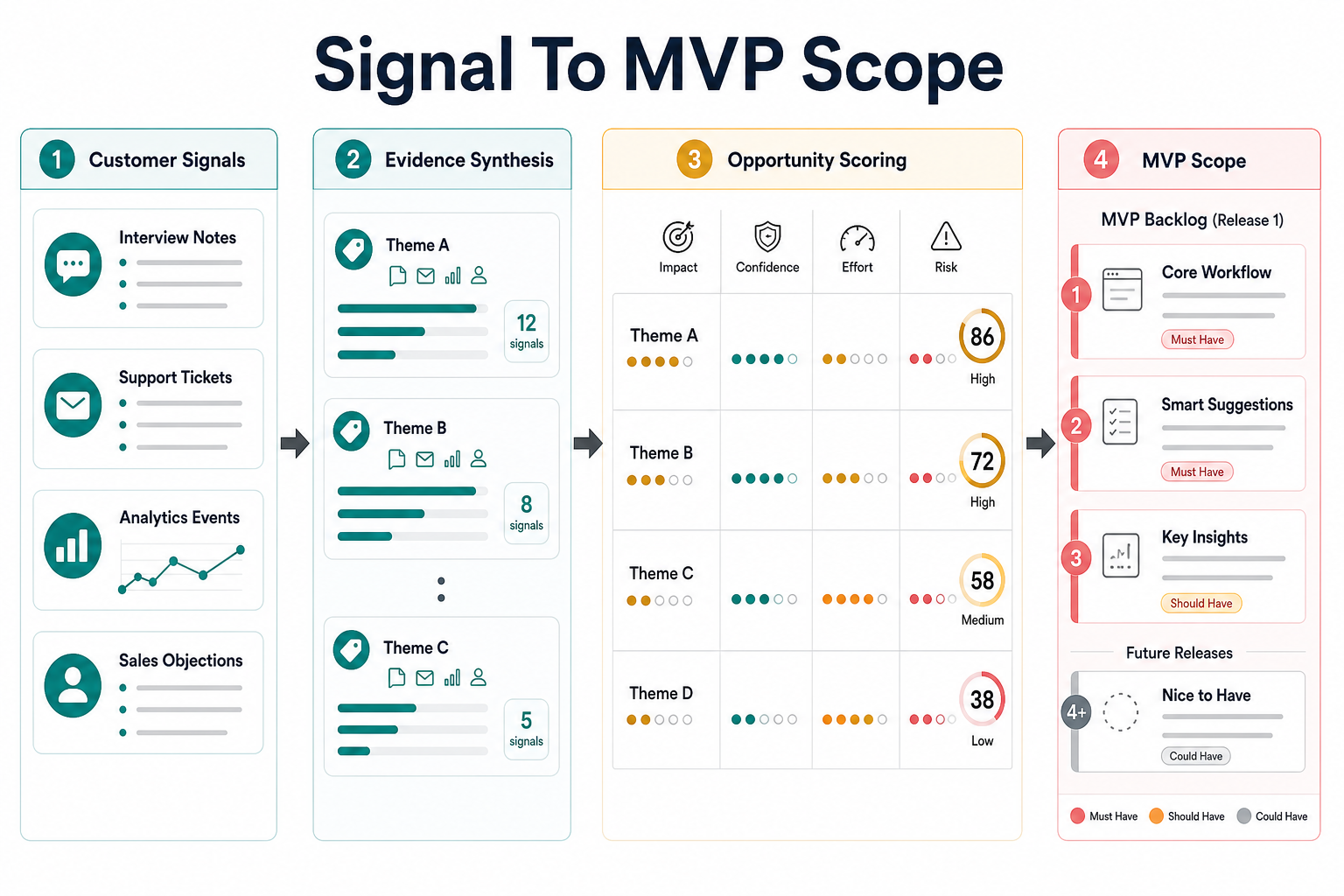
A Practical AI Product Discovery Workflow
Use AI as a structured discovery assistant, not as the decision owner. A useful workflow has six stages.
1. Define The Decision
Start with the decision you need to make. Examples: "Which workflow belongs in our MVP?", "Which customer segment should we validate first?", "Which integration is a blocker for paid pilots?", or "Which problem statement should engineering estimate?" A narrow decision produces better AI output than a broad prompt like "analyze our product idea."
2. Prepare Evidence Packs
Group the inputs by source and date. Remove private data that the model should not see. Add context about the ideal customer profile, current product stage, constraints, pricing model, and business goal. If you are working with sensitive customer data, use approved tools and access controls rather than pasting raw transcripts into an unmanaged chat.
3. Ask AI To Structure, Not Decide
Good prompts ask for structure: themes, assumptions, opportunity statements, risks, missing evidence, and possible experiments. Avoid asking the model to "choose the best feature" unless you also provide a scoring model and require it to show evidence for every recommendation.
4. Score Evidence Strength
Each opportunity should carry an evidence grade. A support-ticket cluster from 200 customers is not the same as one enthusiastic interview. A founder hypothesis is not the same as a conversion drop-off shown in analytics.
5. Run Human Review
Bring product, design, engineering, sales, and customer-facing teams into the review. Ask where the AI output overgeneralized, missed context, ignored constraints, or created attractive but unrealistic scope.
6. Convert To MVP Scope
The final output should be a scoped release plan: build now, validate first, later phase, and drop. If the scope still feels large, use the Custom Software Cost Estimator to pressure-test feature complexity, role count, integrations, AI requirements, timeline, and likely team shape.
MVP Prioritization Matrix
AI can draft a prioritization matrix, but the team should own the weights. For MVP scope, use criteria that reveal whether a feature proves the business case or simply makes the product feel complete.
| Criterion | High score means | Low score means |
|---|---|---|
| Customer pain | Repeated, urgent, expensive problem | Nice-to-have preference or isolated request |
| Evidence quality | Multiple sources agree: interviews, usage, sales, support | Only internal opinion or weak anecdote |
| Business value | Directly supports conversion, retention, revenue, or strategic learning | Hard to connect to a measurable outcome |
| Feasibility | Can be built with known data, APIs, team skills, and compliance controls | Depends on unresolved data, integration, or model risk |
| Learning value | Validates a core assumption quickly | Does not change the product decision even if shipped |
| Scope discipline | Can ship as a thin, usable workflow | Requires a platform rebuild before users get value |
A feature with high pain, strong evidence, high learning value, and manageable feasibility belongs in the first release. A feature with high excitement but weak evidence belongs in "validate first." A feature with strategic value but heavy dependencies belongs in a later phase.
Prompt Boundaries And Human Review
The safest prompts make the model show its work. Use boundaries like these:
- "Only use the evidence provided. Mark anything else as an assumption."
- "Separate direct customer quotes from your interpretation."
- "List contradictions and missing evidence before recommendations."
- "Score each opportunity from 1-5 for evidence strength, user pain, feasibility, and business value."
- "Suggest validation experiments that can be run before building."
- "Flag privacy, security, compliance, integration, or operational risks."
Current research on interview-informed generative agents supports this caution. Simulated or AI-generated customer responses may approximate population patterns, but they are not reliable stand-ins for individual users. Treat synthetic feedback as early screening, not proof. If the product depends on AI agents, tool use, or cross-system automation, run a separate readiness check with the AI Agent Readiness Assessment.
Examples: Turning Signals Into Scope
B2B SaaS Onboarding
Signals show that new admins abandon setup when they have to map roles, import users, and connect a CRM in the same session. AI clusters interview notes and support tickets into one problem statement: "Admins need a guided first-success path before advanced configuration." The MVP scope becomes guided onboarding, one CRM integration, role templates, and setup progress. Advanced permission automation moves to phase two.
Marketplace Search
Analytics show search exits, sales calls mention poor discovery, and competitor reviews complain about irrelevant results. AI helps group query types and identify missing filters. The first release becomes improved taxonomy, synonym handling, saved searches, and analytics events. Personalized recommendations wait until there is enough behavioral data.
Internal Operations Tool
Support teams report manual reconciliation across spreadsheets and a ticketing system. AI summarizes tickets and finds repeated exception categories. The MVP becomes an intake form, exception queue, dashboard, and two core integrations. Full automation is delayed until the team has clean exception rules and audit requirements. For similar workflows, NextPage's guide to AI workflow automation can help separate decision support from autonomous action.
Validation Metrics That Matter
AI can make discovery feel productive because it creates artifacts quickly: personas, opportunity trees, journey maps, wireframes, user stories, and backlog items. Those artifacts are useful only when they reduce uncertainty. Before the team agrees on MVP scope, define the validation metric for each core assumption.
| Assumption | Useful validation metric | Weak proxy to avoid |
|---|---|---|
| The problem is painful | Users describe the workaround, cost, frequency, and owner without being prompted | Users say the idea sounds interesting |
| The workflow is valuable | Pilot users complete the target job faster or with fewer errors | Stakeholders like the prototype screens |
| The buyer will pay | Qualified prospects agree to a paid pilot, LOI, or budgeted next step | Survey respondents choose a high willingness-to-pay range |
| The AI output is usable | Human reviewers accept, edit, or reject outputs with tracked reasons | The demo answer looks impressive once |
| The product can scale | Data, integration, permission, and support assumptions survive technical review | The no-code prototype works with sample data |
Good discovery does not need every assumption to be fully proven before development starts. It does need the team to know which assumptions are proven, which are risky, and which are deliberately being tested in the first release.
This is especially important for AI features. If the user experience depends on generated recommendations, summaries, classifications, or agent actions, the MVP should include evaluation data, rejection reasons, fallback paths, and monitoring from the start. Otherwise, the team may validate the interface while ignoring the model behavior that will determine trust.
How To Implement This In Two Weeks
A two-week AI-assisted discovery sprint should be intense but bounded.
| Day | Activity | Output |
|---|---|---|
| 1 | Define decision, ICP, constraints, and success metric | Discovery charter |
| 2-3 | Collect interviews, tickets, analytics, sales notes, and competitor inputs | Evidence pack |
| 4 | Run AI synthesis with source-separated prompts | Themes, contradictions, assumptions |
| 5 | Review with product, design, engineering, and customer-facing teams | Validated opportunity list |
| 6-7 | Draft workflows, user stories, risks, and validation experiments | Scope candidates |
| 8 | Score opportunities and split build now vs validate first | MVP matrix |
| 9 | Estimate feasibility, integrations, data readiness, and AI risk | Delivery assumptions |
| 10 | Finalize MVP scope, phase-two list, and decision log | Build-ready discovery brief |
If your output cannot be estimated by engineering, it is not finished discovery. It is just a better brainstorm.
Team Operating Model
AI product discovery works best when ownership is explicit. The model can support the workflow, but it cannot own the product risk. A lean operating model usually needs five roles:
- Product owner: defines the decision, success metric, priority tradeoffs, and final MVP scope.
- Research or customer lead: protects evidence quality, interview integrity, source labeling, and quote context.
- Design lead: turns opportunity statements into flows, prototypes, and usability questions without over-polishing uncertain ideas.
- Engineering lead: reviews feasibility, data, integrations, security, performance, and technical debt before scope is committed.
- Commercial lead: checks buyer urgency, pricing, sales objections, onboarding implications, and launch messaging.
The team should keep a decision log with four columns: decision, evidence used, assumptions accepted, and follow-up validation. This makes AI-assisted discovery auditable. It also prevents the team from forgetting why a feature was cut, delayed, or included in the MVP.
For founders, this operating model can be lightweight. One person may cover multiple roles. The important part is to separate the conversations. Do not let a model-generated product brief become the source of truth until customer evidence, design risk, engineering feasibility, and commercial urgency have each been reviewed.
For agencies and internal innovation teams, the same operating model helps align stakeholders before estimation. A scoped discovery brief should tell engineering what to build, what not to build, which integrations are required, which AI outputs need evaluation, and what evidence would make the team change direction after launch.
Common Mistakes To Avoid
- Using AI before defining the decision: broad prompts create broad summaries, not scope clarity.
- Mixing evidence sources: customer quotes, sales opinions, analytics, and stakeholder assumptions need separate labels.
- Skipping real validation: AI can propose hypotheses, but users still need to react to prototypes, pricing, workflows, and tradeoffs.
- Letting polished prototypes inflate scope: AI-generated screens can make immature ideas look finished.
- Ignoring technical feasibility: AI discovery should include data, integration, security, and operational constraints early.
- Shipping AI features without controls: if the MVP includes AI outputs or agents, define evaluation, monitoring, fallback, and human review before release.
Next Steps
AI can make product discovery faster, but speed only matters when it helps the team make a better first-release decision. The best use of AI is to make evidence easier to inspect, make assumptions explicit, and help teams compare scope options before development starts.
If you have a product idea and need to turn it into a first-release plan, start with the MVP Scope Builder. If the concept includes AI features, model workflows, RAG, agents, or automation, NextPage can help you validate the use case, design the architecture, and build the product through its AI development services.