
Quick Answer: Which AI Real Estate App Features Matter Most?
The best AI real estate app features are the ones that improve search quality, lead response, property understanding, and operational follow-through without pretending that AI can replace local market judgment. For most proptech founders, brokerages, property portals, and property-management teams, the strongest first release combines semantic property search, personalized recommendations, lead scoring, CRM follow-up, listing enrichment, and analytics. Valuation support, fraud detection, tour assistants, and maintenance triage can follow when the data and governance model are mature enough.
The practical rule is simple: build AI around the property data core first. If listings, user behavior, CRM activity, market comps, tour media, and maintenance records are fragmented, AI features will produce inconsistent answers. If the data is clean and the workflow is clear, AI can help buyers find better matches, agents prioritize better leads, managers triage issues faster, and operators learn which inventory is actually converting.
This guide is for teams planning a custom real estate product, not a generic feature list. If you need a production roadmap, NextPage's real estate software development company team can help map the app, data model, integrations, and AI rollout before build costs harden.
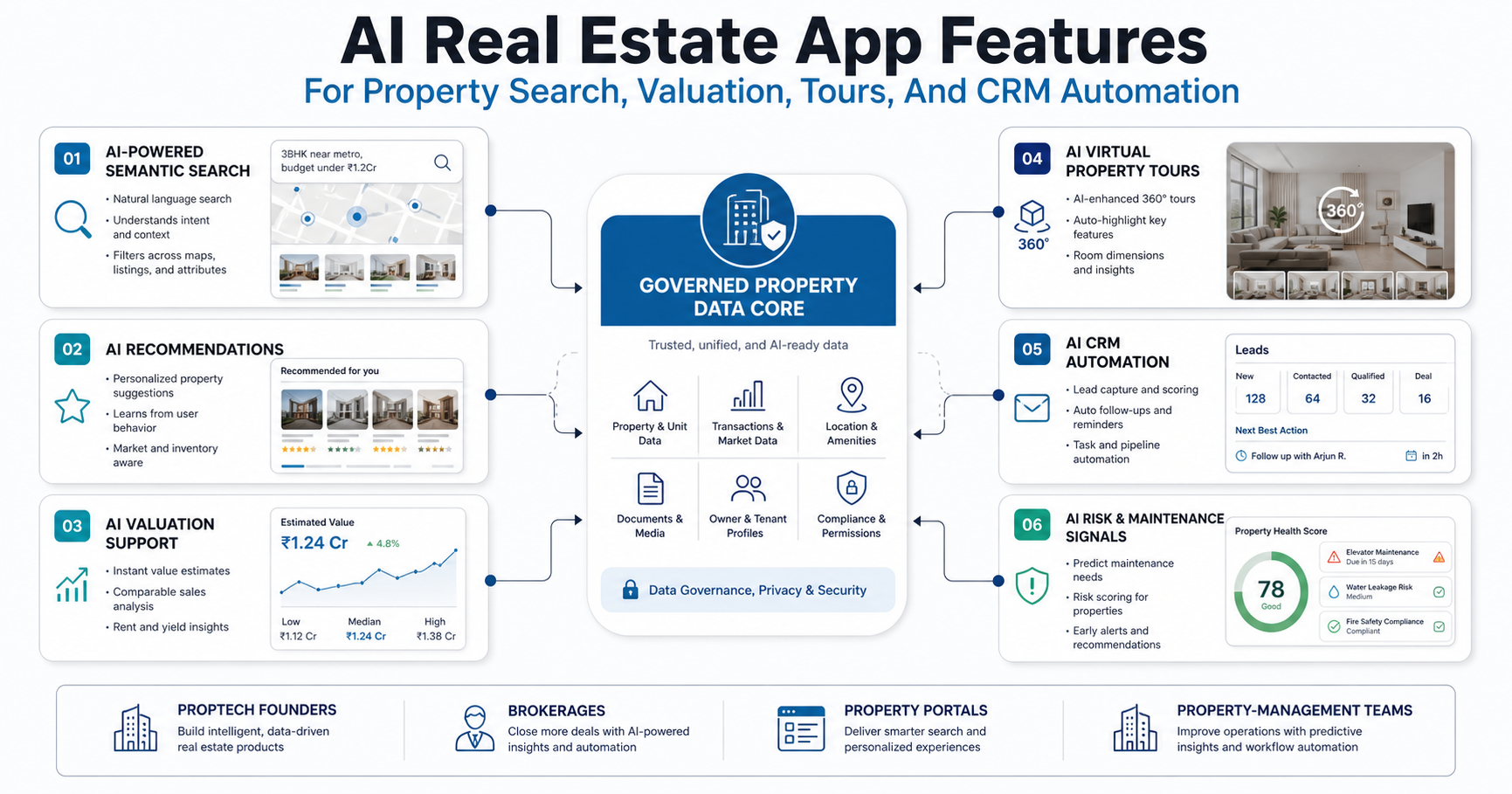
Why AI Real Estate Apps Are Changing Now
Real estate search has moved beyond static filters. Buyers describe lifestyle needs, commute constraints, school preferences, renovation tolerance, and budget tradeoffs in natural language. Agents need faster lead qualification. Property managers need cleaner tenant and maintenance workflows. Developers and portals need better listing quality, recommendations, and conversion analytics.
Recent market examples show the direction: conversational property search, AI-assisted valuation insights, virtual staging, 3D tour intelligence, CRM lead prioritization, and automated listing copy are moving from novelty to expected product capability. In 2025, the National Association of REALTORS noted growing AI usage alongside familiar tools such as CRM, e-signature, social media, drone photography, and video. Zillow has also moved AI deeper into the search journey, which is a useful signal for product teams: buyers now expect apps to interpret intent, affordability, tradeoffs, and tour context instead of only filtering bedrooms and price.
The risk is that many teams add AI as a thin chatbot or decorative recommendation widget. That rarely creates defensible product value. A stronger product treats AI as a decision-support layer connected to listings, CRM, media, analytics, permissions, and human review.
The stronger path is to decide which user decision the AI feature improves. A buyer wants to shortlist homes faster. A seller wants a credible price range. An agent wants to know which lead deserves attention now. A property manager wants to route a maintenance issue without reading long tenant messages. Each workflow needs different data, controls, and user experience.
AI Feature Priority Matrix
Use business value, data complexity, and risk to decide what belongs in version one. The easiest features are not always the most valuable, and the most impressive features are often not safe to launch without enough data quality, human review, or compliance thinking. If the first release is still broad, shape it with a MVP Scope Builder before asking engineers to estimate every AI feature at once.
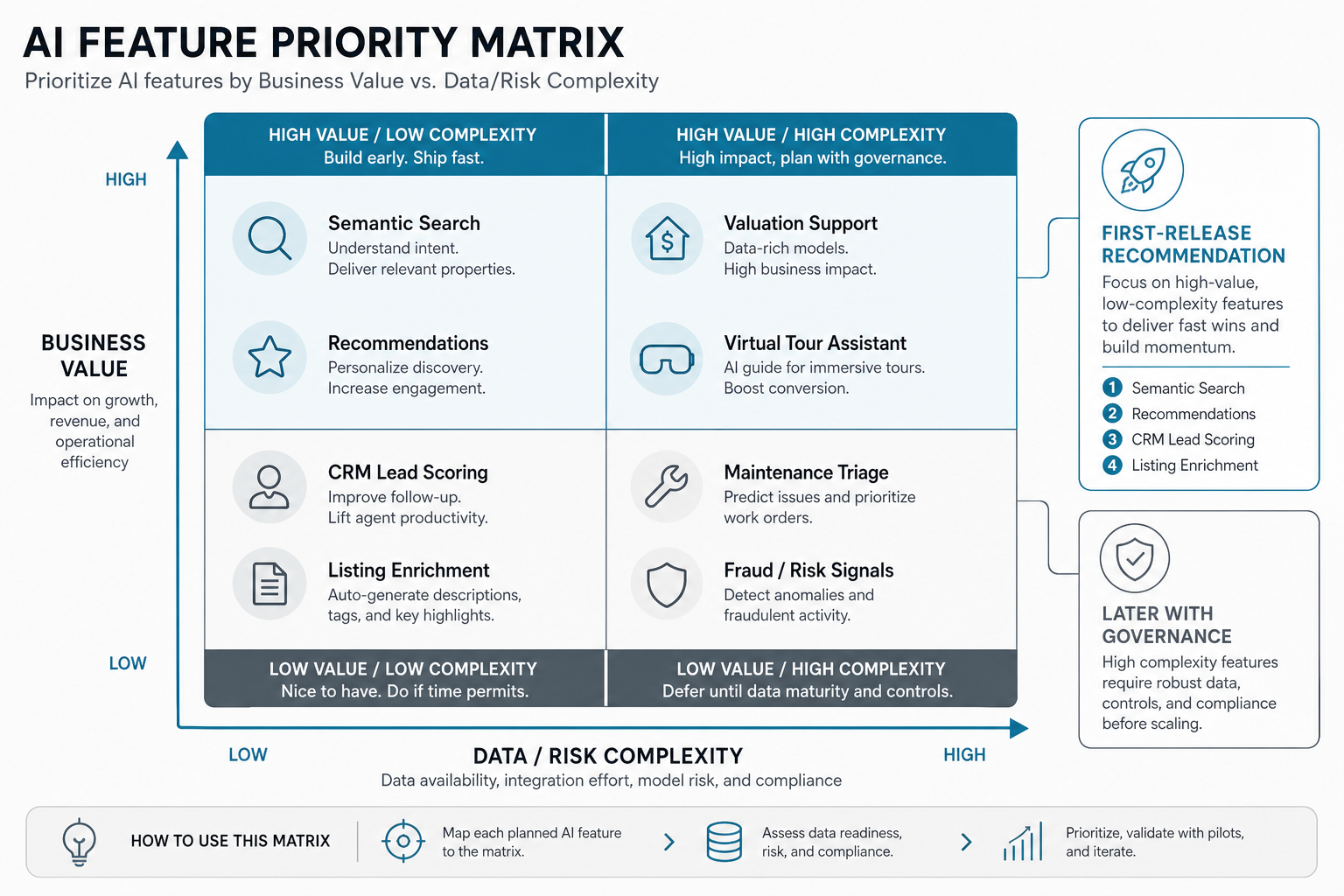
| Feature | Best First Use | Data Needed | MVP Priority |
|---|---|---|---|
| Semantic property search | Let users search by lifestyle, constraints, and natural-language preferences | Listings, amenities, locations, embeddings, filters | High |
| Personalized recommendations | Suggest better matches from behavior and saved searches | User events, favorites, inquiries, listing attributes | High |
| Lead scoring and routing | Prioritize buyer, renter, seller, and investor inquiries | CRM activity, forms, source, budget, urgency, response history | High |
| CRM follow-up automation | Draft reminders, next-best actions, and personalized outreach | CRM records, conversation history, listing interest | High |
| Virtual tour assistant | Answer questions from tour media, floor plans, and listing facts | Images, 3D tours, floor plans, listing metadata | Medium |
| Valuation support | Explain price bands and comparable-property signals | Comps, transaction history, market data, property condition | Medium to high |
| Fraud and risk signals | Flag duplicate listings, suspicious inquiries, and data inconsistencies | Identity, listing history, message patterns, moderation outcomes | Later unless risk is core |
1. Semantic Property Search
Semantic search is often the best AI feature to build first because it improves the core property-discovery journey. Traditional filters work when the user knows exact bedrooms, budget, and area. They fail when the user says, "I need a quiet three-bedroom near a metro station with a small office and good rental yield." An AI-enabled search layer can translate that intent into structured filters, vector search, neighborhood signals, and ranked listings.
The MVP should not be an unconstrained chatbot. Start with a search assistant that understands user intent, asks clarifying questions, applies hard constraints, and shows explainable results. The system should separate facts from inference: number of bedrooms, price, and location come from listing data; "quiet," "family-friendly," or "good investment fit" should be explained with the evidence available.
For implementation, combine keyword search, structured filters, geospatial constraints, and embeddings. Add guardrails so the system never invents availability, pricing, legal terms, or neighborhood claims. If the app is mobile-first, design this as part of broader mobile app development, because search, saved lists, push alerts, maps, and agent contact flows must work together.
2. Personalized Property Recommendations
Recommendations help users discover properties they would not have found through filters alone. Good recommendation logic can use saved searches, viewed listings, ignored listings, inquiry patterns, budget changes, location preferences, and similar-user behavior. The product value is not just "more listings." It is fewer irrelevant listings and clearer reasons for each recommendation.
Start with transparent recommendations such as "similar homes near your saved search," "lower-maintenance apartments in the same budget," or "properties with stronger rental-yield signals." Avoid opaque ranking that feels manipulative. Real estate decisions are high-stakes, so users need controls to tune recommendations and understand why a listing appears.
Teams should also protect against feedback loops. If the app only recommends inventory that already gets clicks, new listings, niche locations, and under-marketed properties can disappear. Track recommendation diversity, lead quality, lead-to-tour conversion, saved-search usefulness, and user satisfaction instead of only click-through rate.
3. Valuation Support Without Overclaiming
Automated valuation models can help users understand price bands, comparable properties, renovation effects, rental yield, and market movement. They can also damage trust if the app presents a number as a final truth. Property value depends on condition, location nuance, legal status, upgrades, neighborhood changes, buyer demand, and local professional judgment.
The safest AI valuation feature is an explanation layer, not an oracle. Show a range, confidence level, comparable-property set, data freshness, and the factors that moved the estimate. Make it clear when human appraisal or agent review is needed. For brokerages and portals, use valuation support to improve conversations, not to bypass professional accountability.
If valuation is central to the product, plan for model monitoring, bias checks, outlier handling, and audit logs. This is where AI development services matter: the work is not only model integration, but data governance, evaluation, monitoring, and responsible UX.
4. Virtual Tour And Listing Media Assistance
Virtual tours, floor plans, and listing images are rich data sources. AI can summarize room flow, answer questions about layout, identify missing photo coverage, generate accessibility notes, help users compare properties, and assist agents with listing descriptions. For property managers, image analysis can also support inspection notes and maintenance triage.
A useful tour assistant should stay grounded in the available media. It can say that the tour appears to show an open kitchen, balcony, or dedicated workspace, but it should avoid unverified claims about structural quality, legal compliance, exact dimensions, or neighborhood safety. When precision matters, route users to floor-plan data, agent confirmation, or professional inspection.
For the MVP, start with listing enrichment: detect missing fields, suggest better photo order, summarize highlights, and generate structured captions for agent review. Add interactive tour Q&A only after the media pipeline, permissions, and quality checks are stable.
5. CRM Lead Scoring And Follow-Up Automation
AI can create immediate commercial value inside real estate CRM workflows. It can score inquiries by urgency, budget fit, location interest, repeat activity, financing signals, and response likelihood. It can draft follow-up messages, summarize buyer preferences, recommend next-best actions, and alert agents when a lead goes cold.
This is often easier to monetize than a flashy buyer-facing feature because the ROI is direct: faster response, cleaner handoffs, better lead conversion, and less manual CRM hygiene. The implementation still needs discipline. The system should explain why a lead is high priority, avoid discriminatory attributes, respect consent rules, and keep humans in control of outbound messages.
A practical first release can include lead summaries, intent tags, duplicate-lead detection, follow-up reminders, and suggested message drafts. Later releases can add calendar booking, WhatsApp or SMS routing, nurture campaigns, and broker dashboard analytics. For teams deciding whether CRM should be custom, configured, or integrated, the custom CRM development cost guide explains where bespoke workflows start to justify engineering investment.
6. Property Management And Maintenance Triage
For rental operators and property managers, AI features can reduce operational friction. Tenants submit maintenance issues in messy language and photos. AI can classify urgency, extract appliance details, ask for missing information, route the issue to the right vendor, estimate SLA priority, and summarize the history for staff.
Start with triage and summarization rather than autonomous dispatch. A leaking pipe, electrical issue, security concern, or HVAC failure can carry safety and cost implications. The system should identify likely category and urgency, but the product should preserve human approval for vendor assignment, tenant communication, and expense authorization.
The same pattern applies to lease questions, document lookup, inspection notes, and owner reporting. AI is useful when it reduces reading and routing time while preserving accountability.
7. Fraud, Risk, And Trust Signals
Real estate apps deal with high-value assets, personal data, and time-sensitive decisions. AI can help flag duplicate listings, suspicious price changes, fake reviews, inconsistent photos, abnormal inquiry patterns, copied descriptions, and possible listing scams. These features are especially important for marketplaces and portals with user-generated listings.
Risk features should produce signals, not automatic punishment. Give moderators evidence, confidence levels, and review workflows. Track false positives, appeal outcomes, and bias. If the app touches identity verification, payments, deposits, or contracts, involve legal and compliance review before launch.
Trust also means being transparent with users. If content is AI-assisted, if a valuation is a model estimate, if a photo has been virtually staged, or if a recommendation is sponsored, the UI should make that clear. Disclosure, audit trails, and review workflows are product features, not legal footnotes.
Data Architecture For AI Real Estate Apps
AI features depend on the data model underneath the app. A real estate product usually needs property entities, listing versions, media assets, location data, user events, saved searches, inquiries, agent records, CRM activity, transaction or rental comps, and admin moderation data. If these live in disconnected tools, AI outputs will be shallow.
Plan the architecture around governed data flows. This is where many AI real estate apps succeed or fail: the visible feature may be search or CRM automation, but the reliability comes from source ownership, consent, lineage, monitoring, and clean integration paths.
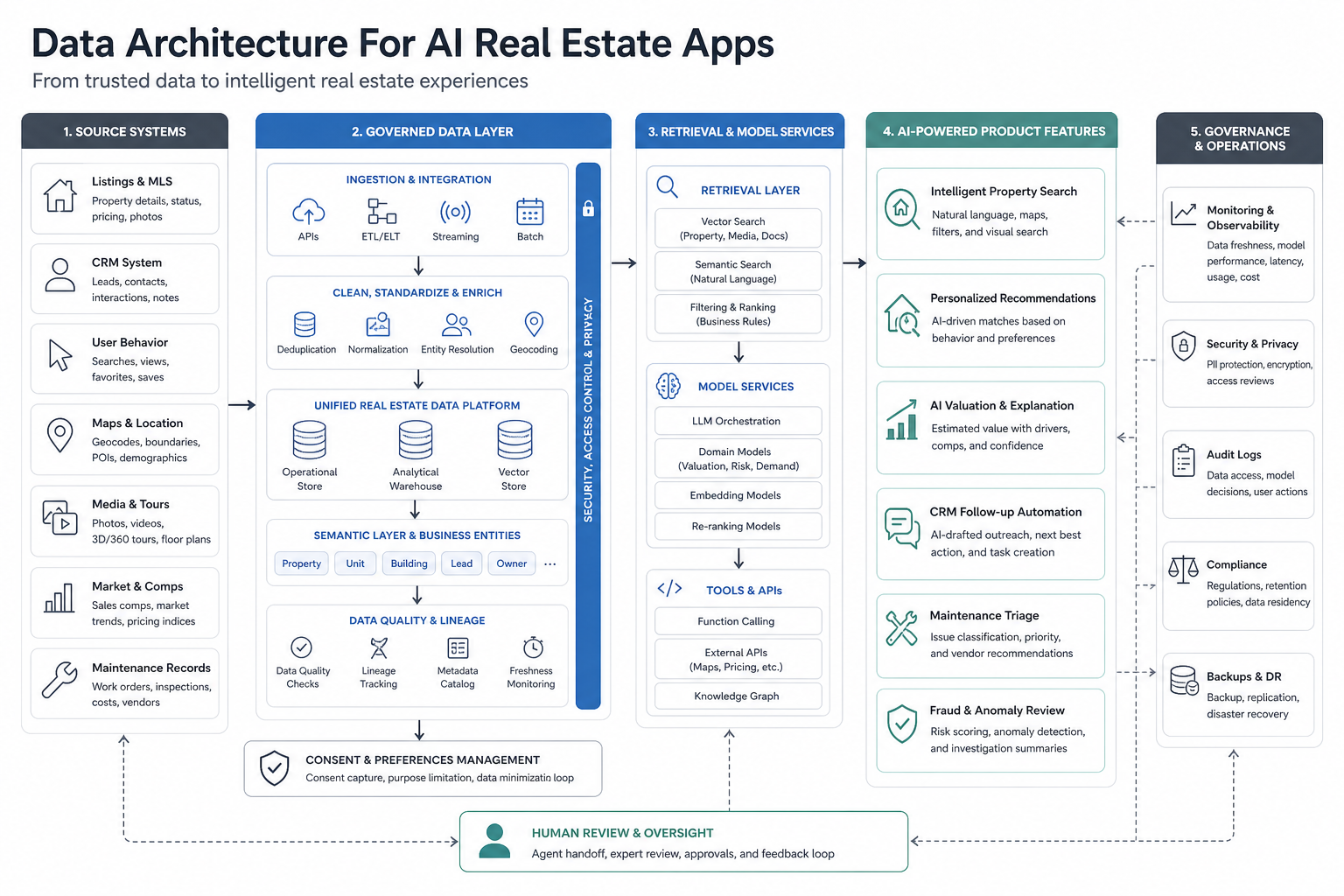
Plan the architecture around governed data flows:
- Listing data: property facts, amenities, availability, pricing, ownership status, and listing source.
- Search and behavior events: views, saves, hides, inquiries, map interactions, tour requests, and alerts.
- CRM data: lead source, agent assignment, conversation history, stage, follow-up outcome, conversion, and cleanup rules. Before connecting AI to sales workflows, review CRM data cleanup for duplicates, consent, lifecycle definitions, and reporting gaps.
- Media data: images, floor plans, virtual tours, inspection photos, captions, and rights metadata.
- Market data: comparable listings, recent transactions, rental signals, neighborhood data, and price history.
- Governance data: model version, prompt version, human overrides, moderation actions, and audit logs.
Use the AI Agent Readiness Assessment if the roadmap includes autonomous workflows or tool-using assistants. Many teams discover that the first milestone should be data cleanup, event tracking, and CRM integration before any advanced agent feature.
A Practical MVP Roadmap
A strong MVP should improve one or two core journeys, not launch every AI idea at once. For a buyer or renter marketplace, start with semantic search, recommendations, saved-search alerts, and lead capture. For a brokerage, start with lead scoring, CRM summaries, follow-up drafts, and listing enrichment. For property management, start with maintenance triage, tenant message summaries, and owner reporting. The same risk-first planning logic appears in the mobile app MVP roadmap: prove the useful workflow, test the risky flow, then expand.
- Phase 1: Data and UX foundation. Clean listing schema, event tracking, CRM integration, search analytics, and admin review tools.
- Phase 2: High-value AI assistance. Semantic search, recommendations, lead summaries, listing quality checks, and follow-up drafts. If sales follow-up is the first workflow, compare it with the patterns in AI agents for sales before giving an assistant write access.
- Phase 3: Higher-risk intelligence. Valuation support, tour Q&A, maintenance triage, and risk signals with human review.
- Phase 4: Workflow automation. Agent routing, nurture campaigns, vendor workflows, portfolio dashboards, and controlled AI actions.
Use NextPage's custom software cost estimator to frame the first-release scope, then refine it with data integrations, app platform, user roles, and AI governance requirements. For repeated operational workflows such as lead routing, maintenance triage, or follow-up drafts, the AI Automation ROI Calculator can help estimate whether the workflow is worth automating now.
Build, Buy, Or Integrate?
Do not build every AI component from scratch. Many teams should integrate managed search, maps, CRM, messaging, analytics, document processing, or model APIs while building the differentiated product layer themselves. Build custom when the workflow, data, ranking logic, CRM process, compliance requirements, or user experience creates strategic advantage.
| Route | Use It When | Main Risk |
|---|---|---|
| Buy SaaS | You need standard CRM, listing syndication, email automation, or analytics quickly | Limited differentiation and data ownership |
| Integrate AI APIs | You need language, embeddings, vision, summarization, or classification without model operations | Provider changes, cost, privacy, and evaluation gaps |
| Custom build | Your search, recommendation, valuation, CRM, or property-management workflow is unique | More discovery, QA, governance, and maintenance responsibility |
| Hybrid | You want speed now with a path to proprietary ranking, data, and automation | Architecture complexity if ownership boundaries are unclear |
Most serious real estate platforms end up hybrid. The important decision is what you own: the data model, workflow design, ranking strategy, user experience, and evaluation process. If the shortlist includes multiple automations, use the Workflow Automation Opportunity Finder to rank them by repeatability, data readiness, risk, and operational value.
Questions To Answer Before Building
- Which user journey should AI improve first: search, lead conversion, listing quality, valuation, tours, maintenance, or risk?
- Which data is reliable enough to ground the AI feature today, and who owns quality, consent, retention, and audit rules?
- Which outputs require human review before users see them or before actions happen?
- Which integrations are required: MLS/listing feeds, CRM, maps, calendar, messaging, payments, property-management systems, or analytics?
- How will the app measure quality: search satisfaction, inquiry rate, lead response time, valuation error, maintenance resolution time, or fraud review accuracy?
- What user disclosures, consent, retention, and audit logs are needed?
Final Recommendation
AI real estate app features are worth building when they make a real workflow faster, clearer, or more trustworthy. Start with the property-data core, semantic search, recommendations, lead scoring, and CRM follow-up because they improve the main commercial loop. Add valuation, virtual-tour intelligence, maintenance triage, and fraud signals when the data, review process, and risk controls can support them.
The winning product will not be the one with the longest AI feature list. It will be the one that helps buyers, sellers, agents, and property managers make better decisions with evidence. If you are planning that roadmap, NextPage can help scope the MVP, connect the data, and build the production system around the AI feature set.