
Quick Answer: The Practical AI Restaurant Roadmap
An AI restaurant implementation roadmap should not start with a chatbot demo or a list of tools. It should start with the operating workflow you want to improve, the POS and order data available to support it, the integrations needed to act on predictions, and the metric that will prove whether the pilot is worth scaling.
For most restaurants, the safest first AI pilots are narrow and measurable: voice ordering for high-volume phone or drive-thru demand, demand forecasting for labor and inventory planning, review and guest-message automation with human review, loyalty personalization using order history, or kitchen and delivery exception alerts. The wrong first pilot is usually the one with poor data, unclear ownership, no baseline, and no path from prediction to action.
A good roadmap moves in four phases: assess data readiness, choose one high-value workflow, build the integration and human-review controls, then measure ROI before expanding. If you need to pressure-test whether your workflow is ready for agentic automation, start with NextPage's AI Agent Readiness Assessment before committing to a platform or custom build. If the pilot still feels too broad, use the MVP Scope Builder to separate the first operating workflow from later automation.
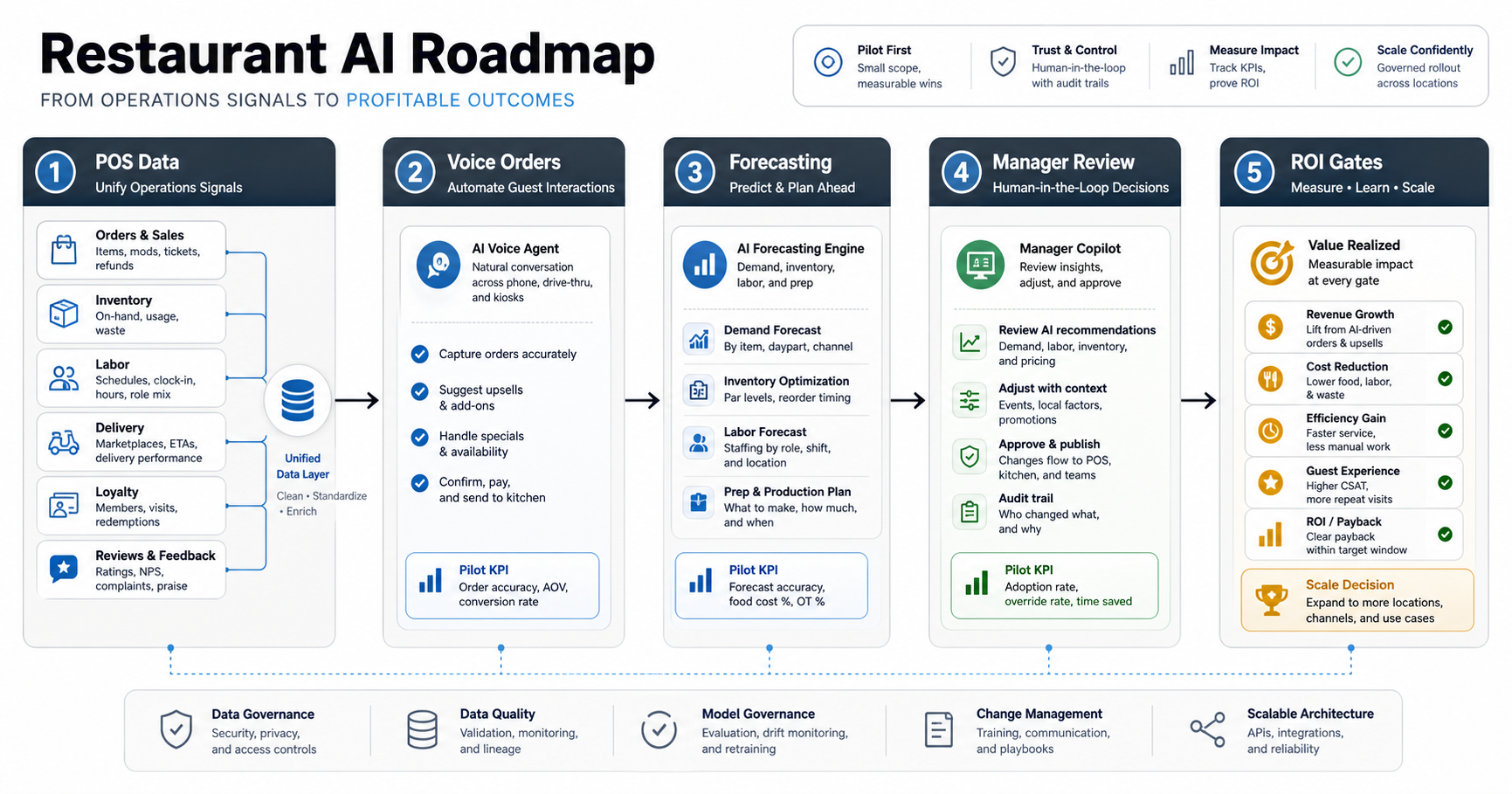
Why Restaurant AI Projects Fail Before The Model
Restaurant AI projects often fail before model quality becomes the real issue. The data is fragmented across POS, delivery marketplaces, reservations, loyalty, kitchen display systems, inventory tools, scheduling software, review platforms, and spreadsheets. The team may have daily sales numbers, but not clean order-item history, modifier patterns, refund reasons, cancellation codes, local events, weather, channel mix, preparation times, or labor variance.
That data discipline matters more in 2026 because operators are under margin pressure while also being pushed to prove technology ROI, improve efficiency, and strengthen guest connections. The National Restaurant Association projects $1.55 trillion in 2026 U.S. restaurant sales, but also calls out persistent cost pressure, tighter consumer budgets, and the need for digital ordering, automation, and data analytics to improve productivity. Treat that as the roadmap filter: choose AI pilots that create measurable operating leverage, not pilots that merely sound advanced.
That matters because restaurant AI is operational. A forecast only helps if someone trusts it enough to change ordering, prep, staffing, or promotions. A voice-ordering agent only helps if it can understand menu logic, apply modifiers, route exceptions, and hand off uncertain cases without annoying guests. A loyalty recommendation only helps if it respects channel permissions and feels useful rather than intrusive.
Before buying an AI tool, document the system of record, the decision owner, and the operational action. NextPage's restaurant management software development cost guide is a useful companion because it maps the POS, inventory, kitchen, and analytics scope that many AI pilots depend on.
Phase 1: Audit POS Data, Channels, And Workflow Ownership
Start by auditing the data and ownership behind each candidate workflow. The goal is not to build a perfect data warehouse on day one. The goal is to know whether enough reliable data exists to support a pilot, whether the data can be accessed legally and technically, and whether a manager can act on the output.
| Readiness area | What to check | Why it matters |
|---|---|---|
| Order history | Item-level sales, modifiers, refunds, voids, coupons, channels, timestamps, and locations | Forecasting and personalization need more than daily totals. |
| Menu logic | Combos, substitutions, add-ons, allergens, kitchen constraints, and unavailable items | Voice ordering and AI recommendations must not create impossible orders. |
| Operations signals | Labor schedules, prep times, stockouts, waste, ticket times, delivery delays, and complaints | ROI depends on tying predictions to operational outcomes. |
| Integration access | POS APIs, webhook support, data export cadence, sandbox access, and vendor limits | The model cannot help if outputs cannot reach the workflow. |
| Human review | Who approves forecasts, agent escalations, inventory changes, and guest responses | Restaurants need clear override and accountability paths. |
If your data is not ready, do not treat that as failure. It simply changes the first milestone. You may need a lighter analytics layer, API cleanup, or custom integration work before a production AI pilot. For multi-location operators, this is often where AI development services, custom software development, and integration planning overlap.
Phase 2: Pick One AI Pilot With A Short ROI Path
The first AI pilot should be narrow enough to measure but meaningful enough to matter. Avoid choosing the flashiest idea. Choose the workflow where data access, operational pain, measurable baseline, integration feasibility, and manager ownership are strongest.
| Pilot | Best fit | Baseline metric | Primary risk |
|---|---|---|---|
| Voice ordering | High phone volume, drive-thru pressure, missed calls, or repetitive ordering flows | Call containment, order accuracy, average handle time, missed-call recovery | Menu complexity and poor escalation design |
| Demand forecasting | Locations with waste, stockouts, labor swings, or event-driven demand | Forecast accuracy, waste, out-of-stock rate, labor variance | Dirty data and forecasts that do not change decisions |
| Inventory planning | Multi-location groups with recurring waste, spoilage, or emergency purchasing | Waste cost, spoilage rate, substitution frequency, purchasing variance | Supplier and recipe data gaps |
| Loyalty personalization | Brands with direct ordering, repeat guests, and usable consented history | Repeat order rate, offer redemption, average order value, churn | Over-targeting and weak preference logic |
| Review automation | Brands receiving enough reviews or messages to justify triage support | Response time, escalation accuracy, sentiment recovery, review volume handled | Unreviewed responses that sound generic or unsafe |
Use a simple scoring rule: if the workflow has weak data, weak integration access, and no owner, do not start there. If it has a clear baseline, a strong manager owner, and a weekly decision it can improve, it is a better first pilot.
Voice Ordering Roadmap: Start With Guardrails, Not Autonomy
Voice ordering is attractive because the pain is visible: missed calls, drive-thru queues, labor pressure, inconsistent upsells, and repetitive menu questions. But it is also easy to overbuild. A restaurant voice AI pilot should begin with constrained workflows, clean handoffs, and clear limits.
Start with call intents such as store hours, order status, reservations, simple reorders, basic menu questions, and limited order capture. Add complex modifiers, refunds, catering, loyalty redemption, and complaint handling only after the team proves accuracy. The system should know when to transfer to a person, when to confirm an item, and when to stop rather than guess. In 2026, the practical benchmark is not whether the voice bot can demo a full order; it is whether the restaurant can measure containment, transfer quality, menu accuracy, upsell lift, refund risk, latency, and guest complaints by location and daypart.
If the voice workflow includes customer support, call-center routing, or drive-thru style interactions, review NextPage's voice AI agent development services approach for production voice workflows. When the pilot must connect an LLM, speech layer, POS data, CRM notes, and reporting into an existing product, the implementation also starts to resemble generative AI integration services rather than a standalone bot. The important point is not the speech interface itself; it is the menu data, integration path, escalation policy, and post-call analytics behind it.
Forecasting Roadmap: Connect Predictions To Prep, Labor, And Inventory
Demand forecasting is usually the most practical restaurant AI use case because the output can improve decisions that already happen every day. Managers already plan prep, inventory, labor, promotions, and delivery capacity. AI can help when it predicts demand by item, daypart, location, channel, and event context with enough confidence to change the plan.
Start with one or two locations and one high-value decision: how much to prep, how many people to schedule, or what inventory to order. Feed the model historical sales, daypart, menu category, promotions, holidays, weather, local events, delivery-channel mix, and recent stockout signals when available. Do not measure only prediction accuracy. Measure whether the forecast reduced waste, stockouts, overtime, long waits, or last-minute manager intervention.
For forecasting-heavy projects, the work is often closer to machine learning development services than a generic chatbot implementation. The model, data pipeline, evaluation method, and operational dashboard all matter. Forecasting leaders should also review the operating patterns in NextPage's demand forecasting software guide, especially if the pilot needs location, channel, promotion, or weather-aware planning.
Integration Architecture: What The AI System Must Connect To
A restaurant AI pilot should have a clear integration map before engineering begins. The map should show which system provides data, which system receives recommendations, and where humans approve or override decisions. Current restaurant technology research points to the same constraint: online ordering, inventory management, and data analysis are among the highest-priority systems to integrate with core restaurant hardware such as the POS and KDS.
| System | AI use cases it supports | Implementation questions |
|---|---|---|
| POS | Forecasting, loyalty, voice ordering, menu analysis, upsell prompts | Can you access item-level history, modifiers, voids, refunds, and channel data? |
| Inventory | Purchasing recommendations, spoilage reduction, prep planning | Are recipes, stock units, supplier lead times, and substitutions clean? |
| Scheduling | Labor forecasting, shift recommendations, overtime alerts | Can forecasts influence schedules without violating labor rules? |
| Delivery and dispatch | Order timing, delivery exceptions, driver capacity, customer updates | Are direct orders and third-party orders visible in one workflow? |
| Reviews and CRM | Sentiment triage, loyalty offers, guest recovery, personalization | Do permissions and review policies allow automated suggestions? |
For restaurants building direct ordering or delivery operations, AI planning should sit alongside the broader delivery workflow. NextPage's restaurant delivery management software page covers the order, dispatch, driver, and delivery-zone operations that AI alerts may eventually support. If the roadmap also includes guest-facing apps, table booking, loyalty, payments, menus, and multi-location admin workflows, use restaurant app development services planning to keep the AI pilot connected to the broader product experience.
POS-To-AI Operating Architecture
The most important architecture decision is not which model to use. It is whether the restaurant has a trusted path from operating data to an action a manager can review. POS tickets, online orders, delivery marketplace data, menu availability, inventory, labor schedules, loyalty profiles, reviews, and kitchen events often use different IDs and different update cadences. The implementation roadmap needs a data contract before it needs a model benchmark.
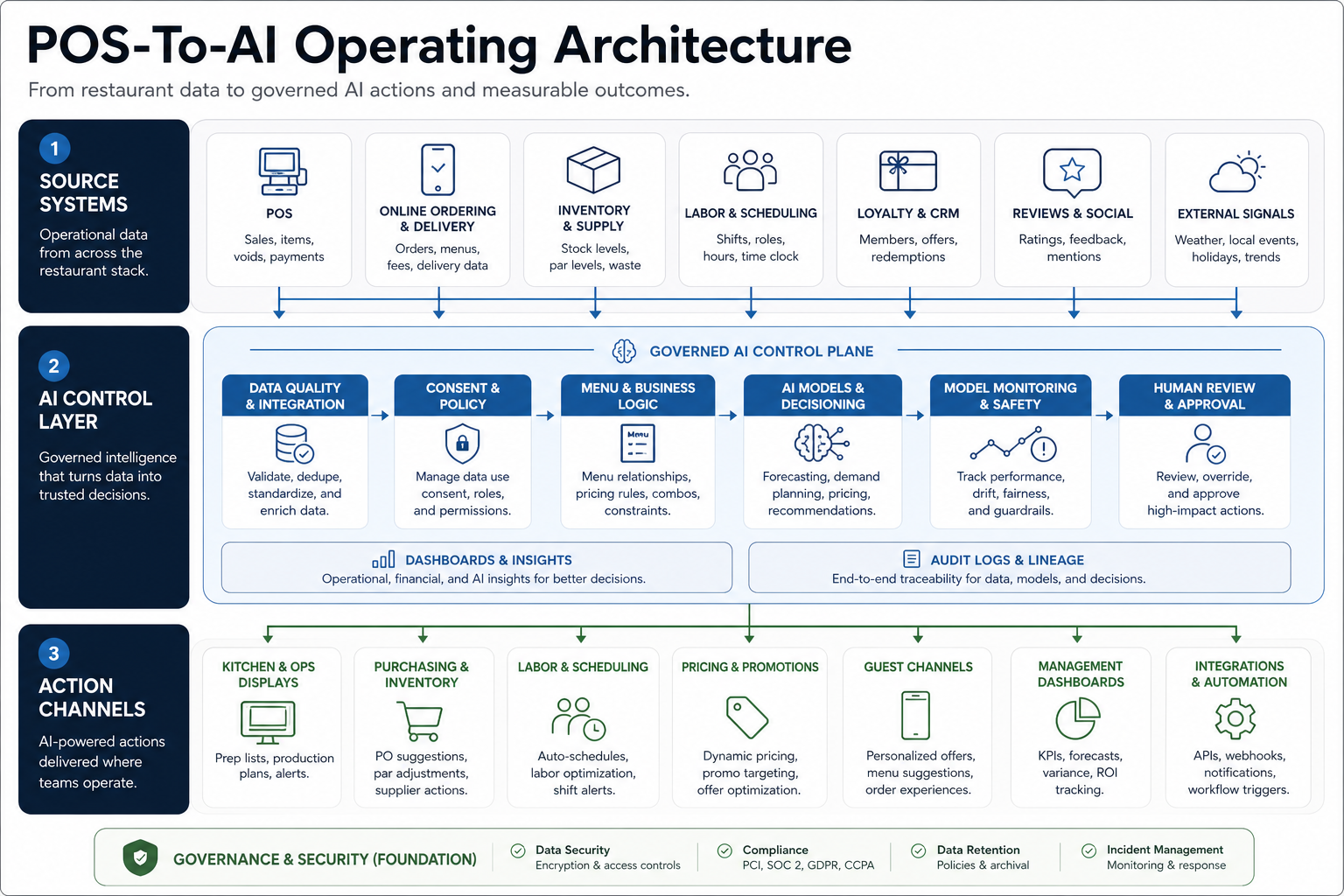
Use a simple layered model: source systems, ingestion and identity matching, menu and recipe logic, consent and retention rules, data-quality checks, AI services, manager dashboards, and action channels. This is where custom dashboard development services can matter: managers need explainable weekly decisions, not isolated model output. For operators comparing vendor dashboards against a purpose-built control room, the Power BI vs custom dashboard app guide is a useful decision companion. If the roadmap includes vendor menus, checkout, order tracking, coupons, and operator dashboards, the VenueCart portfolio case study shows how mobile ordering and admin operations can live in one managed platform.
Document every handoff. If voice AI captures an order, where does uncertainty go? If forecasting suggests more prep, who approves it? If loyalty AI recommends an offer, which consent rule applies? If review automation drafts a response, who can edit or block it? These contracts keep restaurant AI useful under real operational pressure.
Also price security and uptime as first-class requirements. As restaurants add more connected ordering, kiosk, drive-thru, loyalty, camera, and analytics systems, the AI roadmap inherits a larger attack surface and more operational dependencies. For a multi-unit rollout, the architecture should define API access, role-based permissions, audit logs, fallback workflows, vendor limits, incident response, and a recovery owner for every guest-facing AI workflow before the pilot expands beyond one location or channel.
Pilot Scorecard And ROI Gates
Before the pilot starts, agree on the gates that decide whether the project scales, gets fixed, or pauses. This protects the team from both hype and premature cancellation. A pilot can be valuable even if it reveals that the data, integration, or workflow is not mature enough yet.
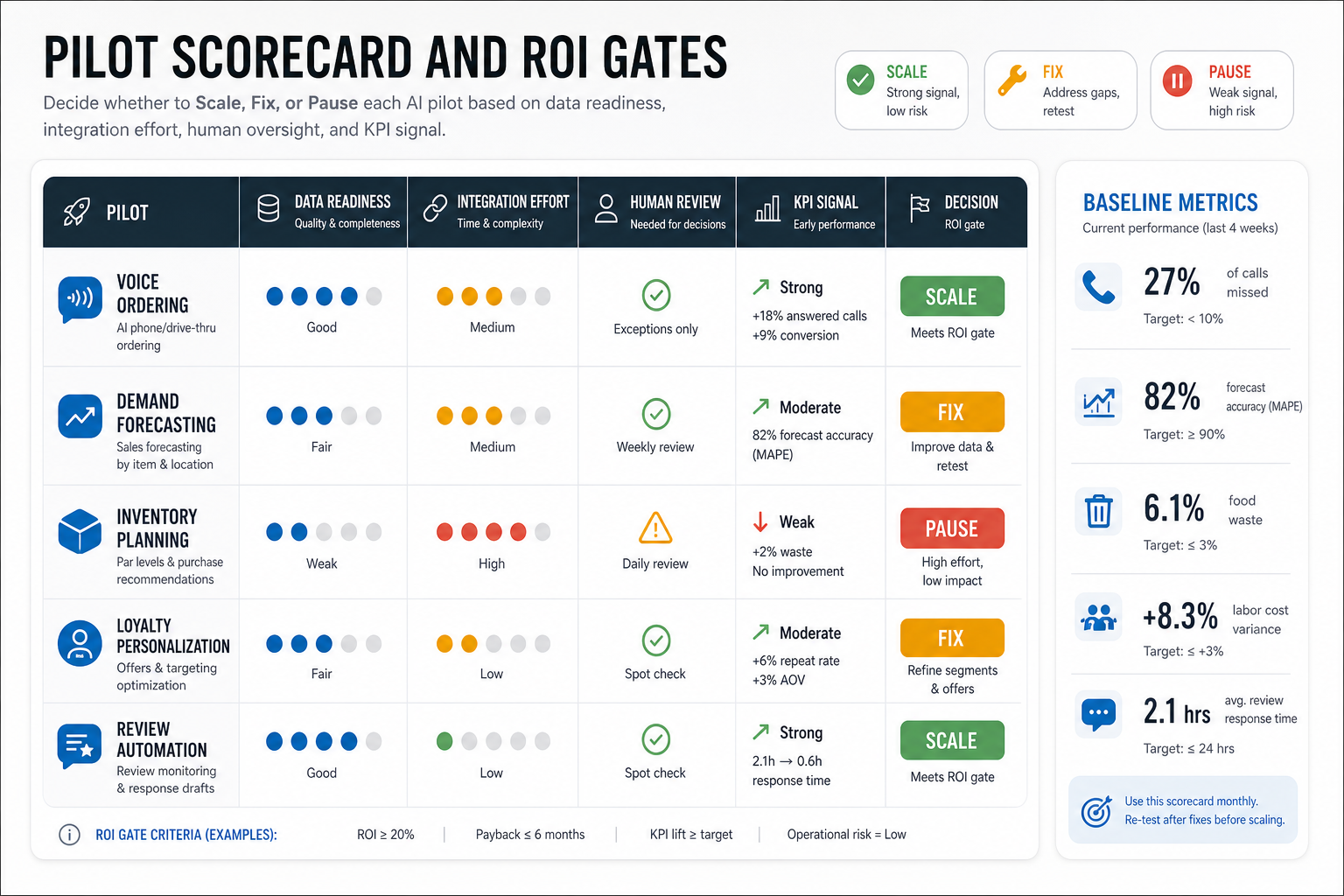
| Gate | Scale | Fix before scaling | Pause |
|---|---|---|---|
| Data quality | Stable exports, useful history, low manual correction | Some missing fields or inconsistent categories | No reliable source of truth |
| Operational adoption | Managers use outputs weekly and can explain why | Useful output but weak training or unclear ownership | Outputs are ignored or bypassed |
| Customer experience | Accuracy and escalation are acceptable | Some friction in edge cases | Guest trust or brand experience suffers |
| ROI signal | Measurable savings, sales lift, or capacity improvement | Positive signs but baseline needs better tracking | No credible metric movement |
Add one more gate before scaling: instrumentation readiness. Each pilot should have a pre-AI baseline, a target improvement range, an override reason list, a location-level adoption view, and a weekly owner who can explain whether the AI changed an operating decision. Without that baseline, a promising voice, forecasting, inventory, or loyalty pilot can look successful in a demo while failing to move restaurant economics.
2026 Adoption And Human Handoff Reality Check
The 2026 restaurant AI market is not a simple story of every operator replacing a workflow with automation. Restaurant Dive's read of the National Restaurant Association report found that 26% of operators use AI-related tools, but only 6% use AI for customer orders. Current voice-ordering coverage still points to the same rollout lesson: accuracy, accents, menu modifiers, refunds, and guest trust decide whether a pilot works outside the demo. That gap matters. It means restaurant AI roadmaps should still assume uneven staff familiarity, uneven guest comfort, and uneven data quality across locations.
Voice ordering is the clearest example. Current drive-thru reporting shows more chains expanding voice AI, but also shows why early tests failed: accents, modifiers, menu exceptions, refunds, prank orders, and customer trust can break a demo that looked clean in the lab. A production restaurant roadmap should therefore design handoff before autonomy. Define the confidence threshold, the transfer script, the employee override path, the menu-update process, the refund boundary, and the daily review report before increasing containment targets.
| AI workflow | Human handoff trigger | Evidence to review weekly |
|---|---|---|
| Voice ordering | Low confidence, complex modifiers, allergen questions, refunds, complaints | Containment, transfer quality, order accuracy, upsell acceptance, guest complaints |
| Forecasting | Unusual events, stockouts, weather shocks, new menu items, thin history | Forecast error by item/daypart, waste, stockouts, labor variance, manager overrides |
| Loyalty and offers | Sensitive targeting, discount exceptions, margin-risking promotions | Offer margin, redemption, unsubscribe rate, repeat visit lift, guest feedback |
| Review and support automation | Refund requests, safety issues, angry guests, legal/privacy complaints | Response time, escalation rate, sentiment shift, refund outcomes, blocked drafts |
This is also where agentic AI development services can be useful for governed workflows, but only after the restaurant has clear permissions, audit logs, source-system access, and an owner for every automated action. For most operators, the first win is not full autonomy. It is a narrower AI workflow that captures demand, flags exceptions, gives managers better daily decisions, and proves that humans can intervene cleanly when the system is uncertain.
How To Measure Restaurant AI ROI
Measure restaurant AI by operational outcomes, not model novelty. The ROI model should include labor hours saved, missed orders recovered, waste reduction, stockout reduction, average order value lift, faster response time, fewer manager interruptions, or better schedule accuracy. It should also include costs: licenses, integration work, maintenance, data cleanup, manager training, monitoring, and exception handling.
For a first estimate, use NextPage's AI Automation ROI Calculator to translate hours saved and automation potential into a payback range. Then compare that model with the broader build economics in the custom software development cost guide. Then refine the model with restaurant-specific metrics such as food cost variance, labor percentage, queue time, missed-call rate, review response time, waste, stockouts, refunds, and channel margin.
A credible ROI review should answer three questions: Did the pilot improve a real operating metric? Did managers trust and use it? Can the workflow be supported across more locations without heroic manual work? Add one simple evidence rule: every reported win should tie back to a source system, an owner, a human handoff policy, and a timestamped operating decision such as a prep change, staffing adjustment, menu action, recovery message, or delivery-capacity choice.
Build Vs Buy: When Custom AI Makes Sense
Many restaurants should buy before they build. If a POS vendor, reservation platform, scheduling tool, or delivery platform already solves the workflow well, it may be faster to configure that product and focus on training. Custom AI makes more sense when the workflow crosses systems, the brand experience is differentiated, the data model is unique, or the operator needs control over integrations, routing logic, dashboards, and governance. Restaurant delivery operators should also connect the roadmap to dispatch, driver, zone, and ETA workflows covered by NextPage's restaurant delivery management software work.
Use this rule of thumb: buy for standard features, integrate for cross-system workflows, and build when the workflow creates strategic advantage or cannot be handled safely by a generic tool. A cloud-kitchen group may need custom forecasting across delivery channels and menu variants. A QSR chain may need a voice workflow with brand-specific menu rules and escalation. A multi-brand operator may need analytics that combine POS, inventory, delivery, reviews, and labor in one decision cockpit.
For budget planning, use the Custom Software Cost Estimator after defining your first pilot. If the first version is still unclear, the MVP Scope Builder can help separate the pilot from later-phase automation.
A 90-Day Restaurant AI Implementation Plan
A practical first roadmap can fit into 90 days when scope is controlled. The exact timeline depends on data access, vendor APIs, integrations, and operational availability, but the sequence below keeps the team focused.
- Days 1-15: readiness audit. Pick candidate workflows, review POS and channel data, confirm API access, define baselines, and name business owners.
- Days 16-30: pilot design. Choose one workflow, define success metrics, map integrations, design human review, and create the test plan.
- Days 31-60: build and connect. Configure or build the AI workflow, connect data sources, create dashboards, train users, and test edge cases. For voice-heavy pilots, include transfer paths, menu constraints, latency checks, and conversation analytics from the start.
- Days 61-75: controlled rollout. Run the pilot in one location, channel, or daypart. Track usage, exceptions, customer friction, and metric movement.
- Days 76-90: ROI review. Decide whether to scale, fix, or pause. Document data gaps, integration lessons, and the next workflow candidate.
This timeline works only when the team resists the urge to automate everything at once. AI maturity in restaurants comes from repeated small wins, not one oversized platform project. If the team needs help turning the first workflow into a practical automation roadmap, connect the pilot plan to NextPage's AI automation services so integration work, model behavior, human review, and ROI measurement stay tied to daily operations.
Governance And Risk Controls
Restaurant AI governance should be practical. You need enough control to protect guests, staff, margin, and brand trust without slowing every decision to a crawl. Define what the AI can decide, what it can recommend, and what must always require human approval.
- Menu and allergy safety: Do not let AI invent ingredients, substitutes, or allergen claims. Use approved menu data.
- Pricing and promotions: Require approval for discounts, offer targeting, and dynamic pricing rules.
- Guest communications: Review complaint responses, refund suggestions, and sensitive service recovery messages.
- Labor decisions: Treat staffing recommendations as decision support, not autonomous scheduling, especially where labor rules apply.
- Data privacy: Limit guest data use to consented, necessary, and auditable purposes.
- Monitoring: Track accuracy, override rate, escalation rate, complaints, containment, latency, cost per resolved interaction, manager adoption, dashboard usage, data freshness, and ROI every week during the pilot.
The governance question is simple: if the AI output is wrong, who catches it, who fixes it, and how quickly can the workflow recover?
How NextPage Plans Restaurant AI
NextPage plans restaurant AI around operating outcomes first. We start with the workflow, data sources, integrations, human review, ROI baseline, and rollout risk. Then we decide whether the best path is vendor configuration, custom integration, AI agent development, forecasting models, analytics dashboards, or a staged software build. When the work includes production voice workflows, the roadmap should include the menu, escalation, and QA discipline described in NextPage's voice AI agent development services approach.
That approach is slower than promising a generic AI assistant, but it is safer for restaurants because the real value comes from changing daily decisions: ordering, prep, staffing, guest recovery, promotions, direct ordering, and delivery operations. The best AI roadmap makes managers more confident, not more dependent on a black box.
If you are planning a restaurant AI pilot, start with one measurable workflow. Score data readiness, integration effort, human review, and ROI signal. Then use the AI Agent Readiness Assessment or the AI Automation ROI Calculator to turn the idea into a practical first implementation plan.